L’Oréal Digital Marketing Strategy: How Gen AI and AR Personalize Beauty
L’Oréal digital marketing strategy is one of those interesting brands that marketers have been studying for years. Let’s step back for a minute: for generations, L’Oréal has stood out by making beauty feel both aspirational; it has been grounded...
 Tfoso
Tfoso

L’Oréal digital marketing strategy is one of those interesting brands that marketers have been studying for years.
Let’s step back for a minute: for generations, L’Oréal has stood out by making beauty feel both aspirational; it has been grounded in science but expressed through emotion.
It’s a brand customers remember because it speaks to confidence, self-worth, and everyday expertise, whether through a mass product on a drugstore shelf or a premium experience in luxury beauty. That consistency is what makes L’Oréal memorable: consumers buy into a promise that beauty is personal and achievable.
Today, that promise extends into digital, especially unique beauty marketing campaigns. As expectations change, L’Oréal hasn’t tried to reinvent who it is. It has translated what already works into new spaces, using Gen AI and AR to make beauty advice more intuitive, more human, and more relevant at scale.
What’s Inside
L’Oréal Marketing Mix (4Ps) L’Oréal Market Share & Target Audience L’Oréal SWOT Analysis (Including 2026 Beauty Challenges) L’Oréal Digital Marketing Strategy (+ Social Media Strategy) How L’Oréal Uses AI and AR FAQ about L’Oréal Digital Marketing StrategyL’Oréal Marketing Mix (4Ps)
L’Oréal marketing strategy is often referenced as a benchmark in global brand management, but what makes it “valuable” for us as marketers is how clearly it translates strategy into execution through the classic 4Ps framework.
As we look at L’Oréal’s product architecture, pricing logic, distribution choices, and promotional discipline, we start to see how the brand balances global scale with local relevance, without losing coherence.
Not specific enough? Here is L’Oréal marketing mix.
Product
Before starting, we can say that L’Oréal’s product strategy is not about having “more SKUs” but structured diversity.
According to the Managing Marketing Report on L’Oréal Group, the company operates through clearly defined divisions: Consumer Products, L’Oréal Luxe, Professional Products, and Active Cosmetics. And each is designed to serve different consumer expectations, usage contexts, and levels of expertise.
That product diversity allows L’Oréal to innovate aggressively.
What’s especially relevant for us is how product innovation is positioned as a growth engine. As global cosmetics growth slows, L’Oréal continues to outperform competitors by prioritizing R&D and continuous product renewal.
Price
L’Oréal does not compete on a “one price strategy,” and that’s intentional.
As you already know, pricing directly reflects brand positioning and consumer value perception. Mass brands like L’Oréal are priced to drive accessibility and volume, while luxury and dermocosmetic brands use premium pricing.
Let’s be more specific:
Consumer products are priced for mass accessibility, competing in highly price-sensitive categories. Professional products command higher prices, justified by salon expertise, professional endorsement. L’Oréal Luxe brands rely on premium pricing to reinforce exclusivity. Dermocosmetics use pricing to signal scientific credibility, often sitting between mass and luxury.Place
One of L’Oréal’s most underappreciated strengths is its distribution intelligence.
L’Oréal adapts distribution by division: mass products via supermarkets and drugstores, professional products via salons, active cosmetics through pharmacies, and luxury via selective retail and prestige environments.
This means contextual relevance.
L’Oréal’s “universalization” strategy, globalization that respects local differences, extends into the place strategy. Distribution choices are tailored to how trust is built in each category and region.
Promotion
L’Oréal’s marketing is designed to “trigger real emotion” while making consumers the heroes of the brand story. This emotional core is consistent globally, but execution is highly localized.

source: https://careers.loreal.com/portal/196/docs/professionals/Marketing.pdf
Celebrity endorsements, scientific authority, digital storytelling, and influencer partnerships all coexist. However, they’re deployed selectively based on brand division and market maturity. Importantly, promotional strategy is deeply connected to digital experience design.
If you search L’Oréal on Google shortly, you can encounter multiple sources that position the brand as the world’s largest cosmetics group by market share, driven by brand breadth and category depth.
According to the brand’s finance report, in the first nine months of 2025, L’Oréal recorded €32.8 billion in sales, with like-for-like growth of around +3.4%, reflecting steady expansion across divisions and regions despite macroeconomic headwinds.
Half-year results also confirmed continued revenue growth (+3.0%) and operating strength across core segments.
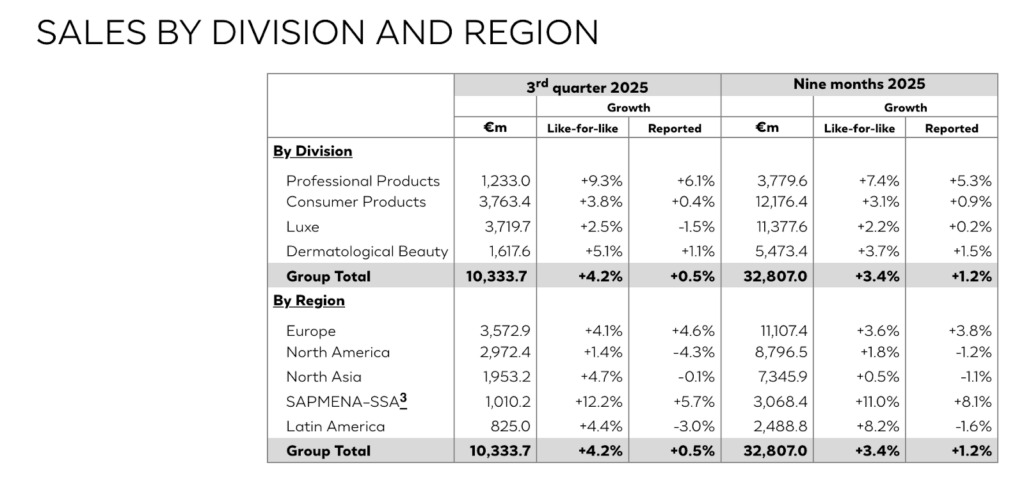
source: loreal-finance.com/eng/press-release/sales-30-september-2025
What matters for us as marketers is why this share is defensible. As you may know, L’Oréal operates 39+ beauty brands, and it allows the brand to occupy shelf space, digital space, and mindshare across consumer needs simultaneously. Same time, this limits whitespace for competitors and reduces reliance on any single growth engine.
Another multi-layered thing about L’Oréal is the target audience.
The beauty brand targets:
Mass consumers seeking accessibility and everyday beauty solutions Affluent consumers looking for luxury, prestige, and aspiration Professionals who value performance, expertise, and technical credibility Health-conscious consumers prioritising dermatological safety and efficacyThe best part is that L’Oréal assigns each audience segment a dedicated brand role, supported by tailored marketing and distribution strategies like localization and pricing.
As we mentioned earlier, this segmentation approach is reinforced by heavy investment in consumer research and R&D (including AI and AR), with over 4,000 researchers globally. It ensures products align with the expectations of each audience group.
<h2 id=”loreal-swot”>L’Oréal SWOT Analysis (Including 2026 Beauty Challenges)</h2>
When we step back and assess L’Oréal’s strategic position, the SWOT framework remains one of the most useful tools. Since it’s simplistic, it forces us to confront trade-offs.
Strengths
L’Oréal’s strongest advantage remains its unmatched portfolio scale, underpinned by science.
As we stated before, L’Oréal operates 39+ beauty brands across mass, luxury, professional, and active health categories. So, it gives the brand one of the broadest competitive footprints in the industry. It also allows the group to serve multiple consumer needs.
Another major strength is R&D leadership on AI and AR. The study titled L’Oréal Group Strategic Analysis and Recommendations notes over 4,000 researchers, 21 global research centres, and 497 registered patents. That kind of investment positions innovation as a long-term structural advantage rather than a marketing claim.
And for marketers, this matters because it sustains credibility.
Weaknesses
Scale, however, creates friction.
Managing dozens of brands (including Maybelline) across regions makes it harder to roll out AI- and AR-driven tools consistently. While some brands move quickly with virtual try-ons or AI skin diagnostics, others lag, creating uneven consumer experiences across the portfolio.
Another clear weakness is growth saturation in core beauty categories, particularly skincare in mature markets. While L’Oréal dominates shelf space, competition from indie and celebrity-backed brands is intensifying, making it harder to generate standout growth from traditional product lines.
Finally, high investment costs extend beyond R&D into AI infrastructure, AR platforms, and tech partnerships. These technologies strengthen long-term positioning but raise short-term operational costs and complexity.
Opportunities
AI and AR are where L’Oréal’s future advantage becomes very tangible.
One of the clearest opportunities is AI-powered personalization. As you already know, private customization and active health cosmetics are high-growth areas. AI enhances this by enabling skin diagnostics, ingredient matching, and product recommendations at scale.
Augmented reality (AR) try-on experiences also represent a major opportunity, especially as e-commerce and social commerce continue to grow. AR reduces purchase hesitation and bridges the gap between online discovery and in-store confidence. It particularly works for younger, digital-first audiences (Gen Z).
AI and AR also increase data-driven marketing efficiency. These tools allow L’Oréal to better understand consumer behavior, refine segmentation, and deliver more relevant messaging without relying solely on mass advertising.
Threats
Threats are where the 2026 conversation becomes unavoidable.
There are actually three major risk areas:
Intensifying competition from Dove, Estée Lauder, Fenty, Rare Beauty, and fast-growing celebrity brands that benefit from social reach and speed over scale.Market volatility and external shocks, including economic uncertainty and supply-chain sensitivity.
Product safety and regulatory scrutiny, with growing attention on ingredients, transparency, and consumer trust.
For marketers, this changes the game: credibility must be continuously earned.
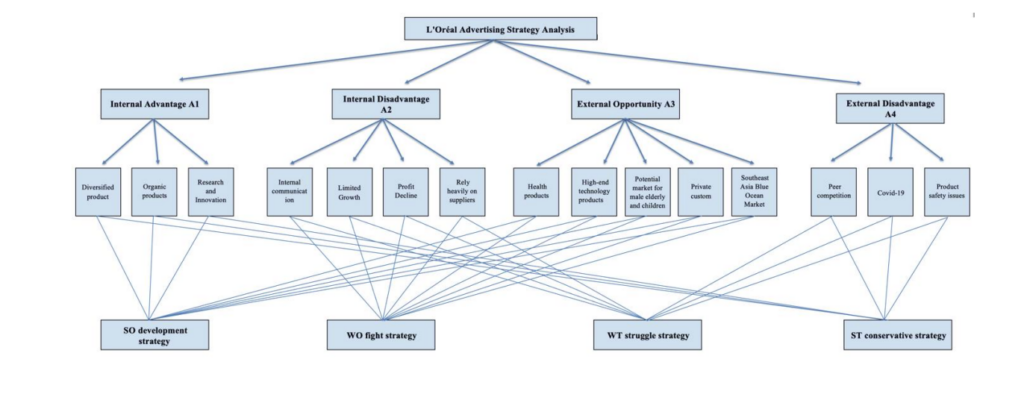
In addition to that SWOT analysis, the same study ( L’Oréal Group Strategic Analysis and Recommendations) explains L’Oréal’s advertising strategy, advantages & disadvantages, in a diagram as follows:
L’Oréal Digital Marketing Strategy (+ Social Media Strategy)
L’Oréal digital marketing strategy is best understood as a long-term shift.
Over the last five years, the group has steadily moved from using digital as a media channel to using it as a core brand-building and commerce engine. For those of us working in marketing, what’s impressive is how human the strategy feels at scale, despite the data, the AI, and the technology underneath it.
Unlike other brands, L’Oréal explains its marketing story throughout the years via a page that is solely dedicated to its advertising campaigns:
From our earliest days, we have consistently demonstrated a forward-thinking approach to reaching our consumers. Our founder, Eugène Schueller, recognized the power of promotion, using newspaper ads and even launching a women’s magazine, Votre Beauté, in 1933. We were also early in embracing emerging mass-market strategies, like events to promote our first mass-market shampoo, Dop.
Do you remember the iconic L’Oréal Paris tagline, “Because I’m worth it?” Launched back in 1971, that tagline redefined the beauty brand’s connection with its customers.
Fast forward to today, where we operate in a world of augmented marketing, where technology seamlessly integrates with our consumer interactions. This profound shift means our marketing is no longer just about broadcasting messages; it’s about creating interactive, personalized, and data-driven experiences.
The brand even has another page about how they create online & offline experiences within their marketing efforts:
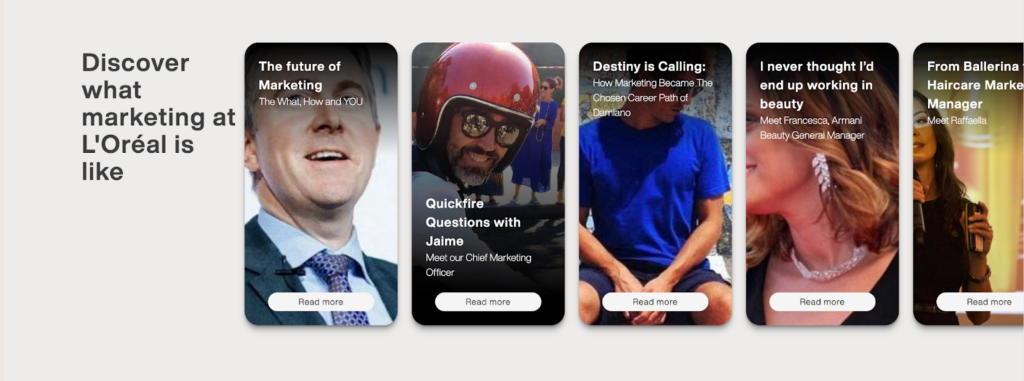
As you can see, at its core, L’Oréal’s digital strategy is based on a simple truth: beauty decisions are emotional, personal, and often uncertain. Digital is used to reduce that uncertainty, so across brands, L’Oréal invests heavily in:
Brand-owned platforms (websites, apps, CRM), AI-powered diagnostics and recommendations, AR tools that allow consumers to see products on themselves, E-commerce journeys that feel guided.This is where digital stops feeling like “performance marketing” and starts behaving like a beauty advisor at scale.
Especially during and after COVID, L’Oréal accelerated its use of AR try-on technology across brands like L’Oréal Paris, Maybelline, and Lancôme.
Instead of treating AR as a novelty, the group integrated it directly into brand websites, e-commerce partners, and social platforms. In that period, L’Oréal proved that tech needs to be useful.
So far, we’ve discovered that L’Oréal digital marketing strategy is powered by a “digital first, but consumer-led” approach.
What about the L’Oréal social media strategy?
This is not a brand that treats social as a content calendar or a media add-on. Social is where beauty discovery, education, and cultural relevance now happen.
Across 2020–2025, L’Oréal’s social content shifted noticeably away from overt selling and toward helping people make better decisions.
A large share of posts now focus on:
How to use products correctly, Why certain ingredients matter, What routine fits which skin or hair concern? How professionals or creators use the product in real life.This is especially visible in skincare and dermocosmetics, where social content often feels closer to a consultation than an ad.
The result is content that earns attention instead of interrupting it.
The L’Oréal Paris “Stand Up” campaign is a strong example of how the brand uses social media beyond product marketing.
On social platforms, the campaign relied on influencers and public figures sharing personal perspectives and educational posts designed for sharing, not just liking.
Street harassment limits women’s freedom and self-worth. @simoneashley shares with us her feelings.
This International Day for the Elimination of Violence Against Women, learn how to react when facing street harassment with the Stand Up program by @lorealparis and @righttobeorg.
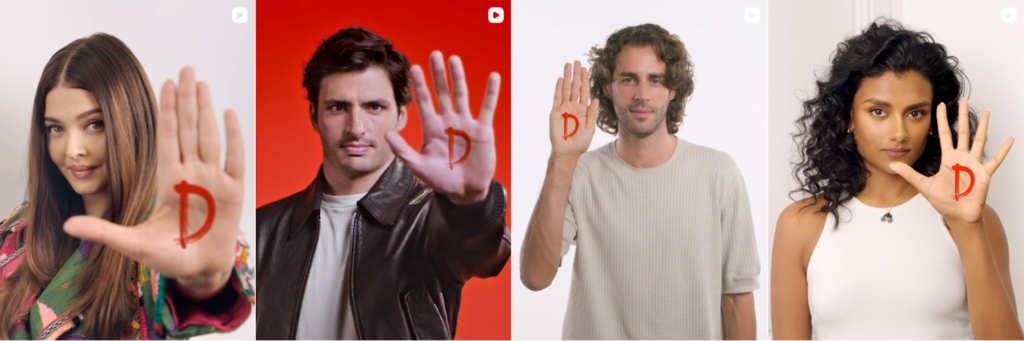
Importantly, this is not a one-week burst. The campaign supports L’Oréal Paris’ long-standing empowerment narrative.
So, yes, purpose-led content only works when it’s sustained and platform-native.
Speaking of L’Oréal social media, what about collaborations and influencer marketing?
We are all familiar with seeing trendy faces in beauty brands’ advertisements, like Hailey Bieber, Rihanna, Selena Gomez, Kylie Jenner, and more. In addition to being part of that approach (by working with Kendall Jenner), the brand teams up with different names across ages and industries.
In the same year, the brand worked with Gillian Anderson, Helen Mirren, Kendall Jenner, Eva Longoria, Heidi Klum, Ariana Greenblatt, and more.
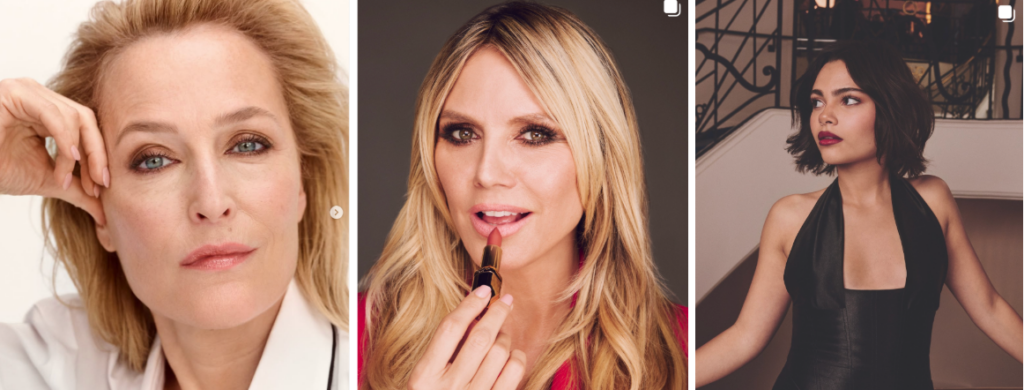
A strong illustration of how L’Oréal manages multiple brand identities at the same time is Le Défilé 2025.
Rather than promoting a single hero brand, Le Défilé was designed as a shared cultural moment. It is about bringing together different L’Oréal brands, ambassadors, and creative voices under one umbrella event.
From a social perspective, this created multiple entry points into the same story. Consumers experienced Le Défilé as many parallel narratives unfolding at once, depending on which brand or creator they followed.
How L’Oréal Uses AI and AR
As a part of its digital marketing strategy, L’Oréal builds real digital experiences that help consumers make better beauty decisions.
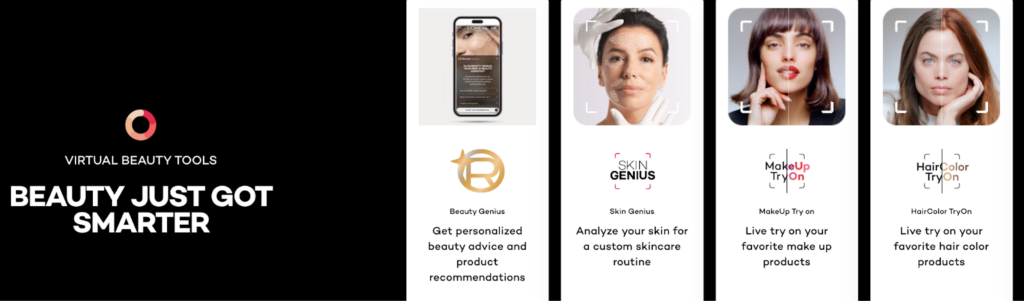
As we mentioned above, over the last several years, the group has woven artificial intelligence (AI) and augmented reality (AR) into core parts of the beauty journey: diagnosing needs, trying products virtually, and personalising recommendations.
The focus is, no doubt, making beauty more personal and confident.
One of the most impactful uses of AI from L’Oréal is Skin Genius, a virtual beauty assistant accessible on the L’Oréal Paris USA site.
As you can see in the video, Beauty Genius uses generative AI to deliver personalised product recommendations and routines for skincare, makeup, hair care, and hair color.
Similarly, L’Oréal’s Skin Genius utilizes AI to analyze skin conditions, offering tailored skincare routines. It assesses factors such as fine lines, wrinkles, and skin tone, guiding users to suitable products for their specific needs.
The skin scanner generates results that are up to 95% accurate compared with live dermatologist consultations.
What about L’Oréal’s AR tools?
The brand’s AR tools let users see themselves in makeup and hair color before buying, directly from their phone or browser, and it seems that that tech will be a big part of the L’Oréal advertisement in the foreseeable future.
Virtual Makeup Try-On: Users can try on lipstick, eyeshadow, foundation, mascara, and more in real time.
Virtual Hair Colour Try-On: Users can explore 200+ hair colors and see how they look in different shades. Even though it does not seem like a promotion at all at first sight, it’s a great L’Oréal hair advertisement.
Shade and Product Quizzes: AI-powered quizzes help find the right foundation shade, lip colour, or skincare match based on selfie and responses.
Much of L’Oréal’s AR and AI capability comes from ModiFace, a tech company L’Oréal acquired that specializes in beauty tech. ModiFace powers many of the virtual try-on and diagnostic features and has been central to making AR a core part of digital beauty experiences worldwide.
In many markets, this technology is integrated directly into social platforms and retail partners. This means users can try makeup virtually on Instagram or in e-commerce environments.
FAQ about L’Oréal Digital Marketing Strategy
What is L’Oréal’s digital marketing strategy, and how does it drive global brand growth?
L’Oréal’s digital marketing strategy is designed to scale relevance globally while maintaining strong brand differentiation, using social platforms, AI-driven tools, and localized storytelling. These are to fuel discovery, confidence, and conversion, which directly support sustained L’Oréal market share growth across regions and categories.
How does L’Oréal use digital marketing to maintain and expand its market share?
As we explained in detail above, L’Oréal uses digital marketing to maintain and expand its position by reducing consumer uncertainty. In recent years, the brand does it through AR try-ons, AI-powered recommendations, and creator-led education. While doing that, they reinforce the marketing mix of L’Oréal through personalized product experiences, tiered messaging, and seamless online-to-offline journeys.
What is the marketing mix of L’Oréal, and how is it reflected in its digital campaigns?
L’Oréal’s marketing mix is reflected digitally by turning product innovation into diagnostic tools, price positioning into differentiated content strategies, and selective distribution into omnichannel experiences. And promotion into platform-native storytelling, with L’Oréal advertisements adapting tone, format, and messaging based on brand role and audience expectations.
How do L’Oréal advertisements differ across product categories such as skincare and hair care?
A L’Oréal hair advertisement differs from skincare campaigns by focusing more heavily on visible transformation, speed of results, and emotional impact. As you already know, “usual” skincare advertising leans into education, routines, ingredient transparency, and scientific credibility to build long-term trust and perceived efficacy.