TikTok US Explains Privacy Policy Update
TikTok's new U.S. ownership recently sparked concerns with a privacy policy update.
 Troov
Troov
This audio is auto-generated. Please let us know if you have feedback.
It’s taken a little while, but the team on the new TikTok USDS joint venture has come through with an explanation of recent privacy policy changes, the ones that have sparked a wave of conspiracy theories and concerns over the past couple of weeks.
As a quick recap, on Jan. 22, TikTok’s parent company ByteDance announced that it had come to terms with a U.S. ownership consortium on a new deal that would split TikTok’s U.S. business into its own separate unit, in order to meet the requirements of U.S. law. That means that TikTok in America now operates under different management to the regular TikTok app, which sparked concern among many users as to how this new group, which has been handpicked by the Trump administration, may look to change things with the algorithm, data gathering, etc.
Those concerns were immediately piqued by an in-app notification sent out to users the day after the deal was enacted, informing them of a change to TikTok’s privacy policy under the new group.
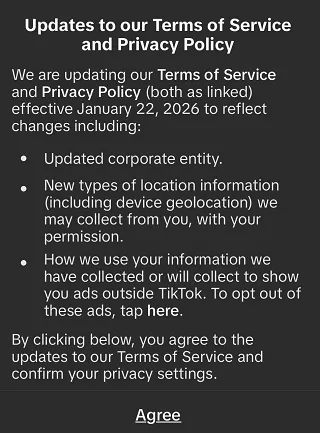
What does this mean? What are they actually changing? Does this give them the right to gather more information on users?
As I noted at the time, the changes are actually pretty mundane, and/or in line with industry standards. And now, TikTok U.S. has provided its own explanation of its updated terms.
As per TikTok: “Our U.S. Privacy Policy aligns with data privacy laws, mirroring language used in state laws like the California Consumer Privacy Act (CCPA). These laws require companies to describe broad categories of personal information that could be processed, including when that information is shared voluntarily by you - for example, in the content you post to platforms.”
So, again, the updated privacy policy did include new notes about data gathering and the usage of your info for off-platform advertising. But as TikTok U.S. notes, this is all fairly standard, and there’s nothing obviously untoward here.
“When you voluntarily post to TikTok, we process the information you share, and we're required by law to tell you this. TikTok has included this type of language in its privacy policy since 2024, and similar language appears in the privacy policies of other platforms subject to the CCPA.”
So the documentation and legal wording has changed, in order to be more in line with U.S. standard policy. But there’s no actual update to how TikTok U.S. will gather user data.
The TikTok U.S. team has also sought to explain how some of the more concerning terms in the updated document relate to actual usage:
“Under U.S. privacy laws, such as CCPA, ‘sensitive personal information’ is a legal term that includes certain categories of information. These categories are defined by state privacy laws and are not determined by our platform. State privacy laws require companies to describe collection of sensitive personal information in their privacy policies, including information that people choose to share.”
So the updated documentation is more precise about the kinds of data that TikTok U.S. takes in, and how it may be used, but there’s no major shift in approach, or increase in the amount of personal data gathered.
And on one of the more speculated elements, TikTok U.S. says that it won’t suddenly begin tracking your location at all times.
“In the coming weeks, we’ll be introducing the option for you to choose whether or not you want to share your precise location with TikTok to help power discovery of local content, creators, and businesses. When we roll out the feature, you will see a system pop-up that asks whether you want to share your precise location, just like any other app that uses similar location features.”
So you’ll have the option to share location info, in order to drive more accurate recommendations, based on geography. But it won’t be required, and TikTok U.S. won’t be keeping tabs on you.
Of course, social media apps are always profiling you to some degree, and TikTok, in particular, has some history of tracking users, and even using that for nefarious purpose. But in terms of contract terminology, and what’s actually changing under TikTok’s new U.S. ownership, the new group wants to reassure users that it’s all good, and there are no major changes to how it gathers info on users.
Even if the wording may seem different, and even if some people are anticipating impacts, the documentation, specifically, doesn’t indicate anything untoward.
You can read TikTok’s U.S. privacy policy here.









![Which LLM Should You Use for Your Business? [Pros and Cons]](https://www.hubspot.com/hubfs/which%20llm%20to%20use.png)