Top B2B Advertising Campaigns: Marketing That Hijacked Attention
B2B advertising campaigns have evolved far beyond cold calls and trade show booths, no doubt. Today’s B2B marketing blends behavioral science, multi-channel orchestration, and deep audience intelligence to reach decision-makers in increasingly sophisticated ways. Yet despite this evolution, many...
 KickT
KickT

B2B advertising campaigns have evolved far beyond cold calls and trade show booths, no doubt.
Today’s B2B marketing blends behavioral science, multi-channel orchestration, and deep audience intelligence to reach decision-makers in increasingly sophisticated ways.
Yet despite this evolution, many B2B marketers still struggle with a fundamental challenge: remember the 95/5 rule. According to the theory, only about 5% of their target market is actively buying at any given time.
In that blog, I invite you to explore the foundations, psychology, and proven B2B content marketing strategies behind successful business-to-business marketing campaigns. Together, we’ll discover how leading brands like SAP, IBM, and Salesforce create memorable campaigns that drive long-term growth.
What’s Inside
Foundations of B2B Marketing Campaigns What Is a B2B Marketing Campaign? What Is B2B Advertising? Key Differences Between B2B and B2C Campaign Strategy Market Reality & Behavioral Science Types of High-Impact B2B Marketing Campaigns Core B2B Advertising Campaign Models Real-World B2B Marketing Campaign Examples (With Strategic Analysis) What Makes a B2B Campaign Successful? Best Practices for High-Performing B2B Marketing Campaigns FAQ about B2B Marketing CampaignsFoundations of B2B Marketing Campaigns
Before jumping into B2B advertising tactics and examples, let’s clarify what we mean by “B2B advertising” and how it differs from its B2C counterparts.
What Is a B2B Marketing Campaign?
In the simplest terms, a B2B marketing campaign is a coordinated series of marketing activities designed to achieve “business objectives” when selling to other businesses.
Unlike one-off marketing efforts, campaigns involve multiple touchpoints across various channels, all working together toward a common goal. Like building brand awareness, generating qualified leads, launching a new product, or expanding relationships with existing accounts.
These campaigns are designed for an environment where it’s hard to sell. So much so that B2B projects & processes typically unfold over weeks or months rather than days, reflecting the longer decision-making cycles inherent in business purchasing. Similarly, according to Forbes:
Typically, the B2B buying group consists of six to 10 decision-makers, each armed with four to five pieces of information they’ve gathered independently, and all must communicate with one another to figure out whether they should buy the solution.
So, a good B2B marketing campaign considers the entire buying committee, even different stakeholders’ concerns throughout the buyer’s journey.
What Is B2B Advertising?
B2B advertising refers to the (paid) promotional activities within your broader marketing campaign. It can include display ads, sponsored content, search engine marketing, social media advertising, video ads, and programmatic advertising. And all targeted toward business audiences.
While B2B advertising campaigns form a subset of your marketing efforts, they play a crucial role in reaching prospects who might not discover you organically, no doubt. In other words, effective B2B advertising educates, entertains, or provides value that resonates with business decision-makers.
On the other hand, the landscape of B2B advertising has transformed dramatically in recent years. Platforms like LinkedIn, YouTube, and even TikTok have joined traditional channels like trade publications and industry websites.
However, in 2026, we can still accept LinkedIn as the number 1 platform for B2B marketing activities. According to Lindsey Brummer, a solutions marketing professional at LinkedIn:
LinkedIn hosts a community of more than 1 billion professionals worldwide, and ranks as the #1 platform for influencing B2B decision-makers. It’s the perfect place to start differentiating your people-led thought leadership strategy.
On that platform, as you already know, programmatic advertising allows for sophisticated targeting based on company size, industry, job title, and even specific accounts.
Key Differences Between B2B and B2C Campaign Strategy
Trying to create campaigns that actually work in business contexts? Then you should understand the distinctions between B2B and B2C marketing!
First, the decision-making process differs fundamentally. B2C purchases are often individual, emotional, and relatively quick. On the other hand, as I mentioned above, B2B purchases involve multiple stakeholders, extensive evaluation periods, and rational justification. A consumer might buy a pair of shoes on impulse; a company doesn’t buy enterprise software the same way. Second, the sales cycles are dramatically different. While a B2C transaction might complete in minutes or days, B2B sales cycles commonly span months or even years. So much so that enterprise-level B2B deals typically take 9–18 months to close, and some complex, high-value purchases can extend beyond two years.This means your B2B marketing campaigns must maintain engagement and build trust over extended periods, not just drive immediate action.
Third, the audiences are smaller but more valuable. B2C brands might target millions of consumers; B2B campaigns often focus on hundreds or thousands of potential accounts. Fourth, the messaging complexity varies significantly. B2C advertising can be simple and emotion-driven. B2B messaging must address technical requirements, ROI calculations, implementation concerns, and multiple stakeholder priorities. You’re not just selling a product; you’re selling a business solution that multiple people must agree provides value. Finally, the metrics of success differ. B2C campaigns often optimize for immediate conversions and customer acquisition costs. B2B campaigns must balance short-term lead generation with long-term brand building. Remember: most of your audience isn’t ready to buy today but might be in six months or a year.Market Reality & Behavioral Science
As you may know, the most successful B2B advertising campaigns are built on a foundation of understanding how business buyers actually behave. Several key principles from behavioral science and market research should inform every campaign strategy.
The B2B buying process is far more complex and psychologically nuanced than traditional marketing models suggest. However, these decision-makers are not the opposite of B2C buyers at all. According to a study from Google:
While the business buying decision is indeed well-researched and deliberate, it is far from void of emotion. B2B customers are significantly more emotionally connected to their vendors and service providers than consumers.
In fact, because B2B purchases often involve risk to one’s career and reputation, emotional factors like fear, trust, and confidence may be even more influential than in consumer decisions.
Obviously, buying committees consist of individual human beings, each with their own concerns, biases, and emotional responses. The IT director worries about implementation risk. The CFO fears cost overruns. The end users resist change. The executive sponsor wants to look good to the board. Your B2B marketing campaigns must address these emotional undercurrents, not just the functional specifications.
That’s why the most effective campaigns tell stories that resonate emotionally while providing the rational justification that stakeholders need to defend their decision internally. They reduce perceived risk through social proof, demonstrate understanding of customer challenges, and create emotional connections through authentic brand personality. This is also why many of the best B2B advertising uses humor, compelling narratives, and human-centered storytelling rather than just feature lists and technical specifications.
Understanding these psychological realities transforms how we approach campaign design and measurement.
What about other rules of business-to-business advertising?
Have you ever heard the “Rule of 7?”
The classic marketing “Rule of 7” suggests that prospects need to encounter your brand at least seven times before they take action. In B2B contexts with longer sales cycles and higher stakes, this number is likely much higher.
Each interaction with your brand (it can be a thought leadership article, a retargeted ad, a conference presentation, or a sales email) contributes to accumulated mental availability and trust. No single touchpoint closes the deal; rather, the cumulative effect of consistent, valuable encounters builds the confidence necessary for a major business decision.

This is why successful B2B advertising campaigns maintain presence across multiple channels over extended periods. A prospect might first see your LinkedIn ad, then encounter your content on an industry website, hear your podcast interview, receive your email newsletter, and see your CEO speak at a conference. And all before they ever raise their hand as a qualified lead.
Each of these touchpoints should reinforce a consistent brand narrative while providing genuine value. You’re not just increasing frequency; you’re building a relationship based on demonstrated expertise and trustworthiness.
And here is the “trust vs. attention” rule. It’s actually the real constraint in modern B2B growth. Let’s start with an interesting fact: only about 40% of B2B buyers trust that salespeople fully understand their needs.
Decision-makers are bombarded with vendor messages daily. Getting attention is actually relatively easy with enough budget. The challenge is converting that attention into trust, especially when you’re asking buyers to bet their career on your solution.
Trust is built through consistency, transparency, demonstrated expertise, and social proof over time. It comes from seeing your brand solve problems similar to yours for companies similar to yours. It develops when your content actually helps them do their job better, not just when it tries to sell them something.
This means your B2B advertising campaigns should prioritize credibility signals, like customer testimonials, case studies, industry recognition, thought leadership, and proof of concept, over clever slogans or aggressive calls-to-action. The brands that win are those that invest in becoming genuinely trustworthy, not just those that demand trust.
Types of High-Impact B2B Marketing Campaigns
Different business objectives require different campaign approaches, obviously.
Here are the most effective types of B2B marketing campaign types:
Brand awareness campaigns
⭐️Focus on establishing and maintaining mental availability with your target market.
⭐️Prioritize reach and frequency over immediate conversions (recognizing that most of your audience isn’t ready to buy today.)
⭐️Use compelling creative, broad targeting, and consistent messaging across multiple channels to ensure your brand comes to mind when prospects eventually enter the buying cycle.
⭐️Metrics focus on brand recall, aided and unaided awareness, search volume, and share of voice rather than immediate leads.
Lead Generation Campaigns
⭐️Identify and capture prospects who are actively researching solutions.
⭐️They typically offer valuable content (like whitepapers, webinars, e-guides, tools, or assessments) in exchange for contact information.
⭐️Segment audiences based on buying stage, personalize offers to specific pain points, and integrate tightly with sales processes to ensure timely follow-up.
⭐️Balance volume with quality; generating thousands of unqualified leads creates more problems than it solves.
Product Launch Campaigns
⭐️Introduce new solutions to the market and drive early adoption.
⭐️Combine education about the product’s value with proof points from early customers and limited-time incentives for fast movers.
⭐️Create momentum through coordinated PR, content marketing, advertising, events, and sales enablement.
⭐️Address the “why now” question by highlighting the problem’s urgency and the solution’s differentiation.
⭐️Work best when they tell a compelling story about market changes and customer needs, not just feature announcements.
Customer Retention & Expansion Campaigns
⭐️Recognize that your existing customers represent your highest-value audience.
⭐️Nurture relationships, drive product adoption, prevent churn, and create expansion opportunities through upsells and cross-sells.
⭐️Use customer success content, exclusive community access, product education, and personalized recommendations based on usage data.
⭐️Because retention and expansion are typically far more cost-effective than new acquisition, these campaigns deserve significant investment despite often receiving less attention than new customer campaigns.
Account-Based Marketing (ABM) Campaigns

⭐️Flip traditional demand generation by targeting specific, named accounts rather than broad audience segments.
⭐️Create personalized experiences for each target account, often involving customized content, one-to-one outreach, and coordinated sales-marketing plays.
⭐️Particularly effective for enterprise deals with complex buying committees and high contract values.
⭐️ Treat each account like its own market, with tailored messaging, dedicated resources, and customized measurement frameworks.
Event & Community-Led Campaigns
⭐️Use in-person and virtual gatherings to build relationships, demonstrate expertise, and create memorable brand experiences.
⭐️Center on conferences, roadshows, webinars, user groups, or online communities.
⭐️Excel at building trust and emotional connections that are difficult to achieve through purely digital channels.
⭐️Extend before and after the event itself, using pre-event nurturing to drive attendance and post-event follow-up to convert conversations into opportunities.
<h2 id=”b2b-campaign-models”>Core B2B Advertising Campaign Models</h2>
Within your broader marketing campaigns, specific advertising approaches serve different strategic purposes. Here are the core B2B ad models:
Air-Cover Brand Advertising
👉🏻Runs continuously in the background to maintain mental availability with your entire addressable market.
👉🏻Prioritizes reach and frequency with memorable creative that builds brand equity over time.
👉🏻Includes display advertising, video ads, sponsored content, and social media campaigns designed for awareness rather than clicks.
👉🏻Keeps your brand top-of-mind with the 95% who aren’t currently buying, ensuring you’re considered when they eventually enter the market.
👉🏻Measurement focuses on share of voice, brand lift, and future pipeline influence rather than immediate attribution.
Retargeting Advertising Campaigns

👉🏻Re-engage prospects who have previously interacted with your brand. CTAs & phrases are: “Clock is ticking,” “Ends soon,” “Planning a…,” “Awaiting…” “Still want it?,” “Ready to check out?”
👉🏻Highly efficient because you’re reaching people who’ve already demonstrated some level of interest.
👉🏻Sequence prospects based on their behavior—someone who visited your pricing page sees different ads than someone who only read a blog post.
👉🏻Excel at nurturing prospects through the consideration phase and preventing competitive displacement.
Content Distribution Ads
👉🏻 Promote your valuable content to extended audiences beyond your owned channels.
👉🏻Offer educational resources, research reports, tools, or insights that help your audience solve problems.
👉🏻Particularly effective for building thought leadership, capturing early-stage prospects, and supporting your SEO strategy through increased content engagement.
👉🏻Work best when the content itself is genuinely useful, not just thinly veiled sales material, and when you have a nurture strategy to move content consumers toward commercial engagement over time.
Testimonial & Proof-Driven Advertising

👉🏻Uses social proof to build trust and reduce perceived risk.
👉🏻Features customer success stories, case studies, industry awards, analyst recognition, or user reviews.
👉🏻Especially powerful for prospects in the consideration and decision phases who need validation that your solution actually delivers results.
👉🏻Works particularly well for retargeting campaigns and ABM programs where you can match proof points to the viewer’s specific industry or use case.
👉🏻The most effective proof-driven ads are specific and credible—mentioning real companies, quantifying results, and addressing objections head-on.
Real-World B2B Marketing Campaign Examples (With Strategic Analysis)
Studying successful campaigns reveals patterns and principles you can apply to your own b2b advertising campaigns.
Here are 7 exceptional examples with an analysis of what makes them work:
SAP – Business AI: “Office Cat” IBM & Ogilvy France – Smart Ideas for Smart Cities – IBM & Ogilvy France UPS – Tools for Unstoppable Small Businesses Caterpillar – The Next 100 Years Amazon – You Grow, We Deliver | Amazon Shipping Salesforce – “Data Forest” | Ask More of AI with Matthew McConaughey Cisco Security – The Hacker#1 SAP – Business AI: “Office Cat”
I’m starting that section with a campaign that is a masterclass in making complex enterprise technology emotionally engaging!
SAP’s “Office Cat” ad features a cat wandering through an office, accompanied by voiceover explaining how SAP’s AI handles mundane business tasks.
What makes this campaign brilliant is its ability to communicate abstract AI capabilities through simple storytelling. Forget about listing technical features; it shows the emotional benefit: freedom from tedious work. And the cat serves as a charming metaphor that cuts through enterprise software’s typical jargon and creates genuine delight.
This campaign proves that B2B decision-makers respond to creativity and emotion. It also acknowledges that many buying committee members aren’t deeply technical. They need to understand the value proposition quickly and memorably. This ad accomplishes that while remaining share-worthy and discussion-worthy.
#2 IBM & Ogilvy France – Smart Ideas for Smart Cities
IBM’s “Smart Cities” partnered with Ogilvy France is actually a guerrilla-style B2B campaign, since it turns outdoor advertising into functional urban furniture; shelters, ramps, and benches.
In other words, the campaign brings abstract technology concepts into physical reality. IBM demonstrates problem-solving in ways that resonated emotionally while showcasing technical capabilities.
So, instead of saying “IBM can help cities innovate,” it proves the point through actual innovation. This approach is particularly powerful in B2B contexts where skepticism runs high and proof matters more than promises.
The best part? The campaign created highly shareable content that reached audiences far beyond traditional IBM marketing channels.
#3 UPS – Tools for Unstoppable Small Businesses
B2B campaigns include ads that directly address small businesses—remember Shopify advertising style.
In that campaign, UPS directly focuses on empowering small businesses with the same logistics capabilities available to enterprise companies. The campaign highlights specific tools and services while telling authentic stories of small business owners overcoming challenges.
What makes this campaign effective is its clear understanding of the target audience’s emotional drivers. Small business owners see themselves as scrappy underdogs fighting for success. The “unstoppable” positioning taps into that identity and positions UPS as an enabler of their ambitions.
By supporting small companies with enterprise-grade tools, they’re positioning themselves as the natural choice as these businesses scale. So, the campaign invests in future value.
#4 Caterpillar – The Next 100 Years
Let me say: the best B2B advertising campaigns are those positioning a company as an innovation leader rather than a legacy industrial brand.
And Caterpillar’s centennial campaign does it well. This campaign, actually, tackles a common B2B challenge, maintaining relevance while respecting tradition. By explicitly framing the narrative around the next century, Caterpillar signals ongoing evolution.
Tomorrow takes courage. Tomorrow takes commitment. Tomorrow takes Caterpillar.
For over 100 years, Caterpillar has powered the world’s progress – and with our renewed focus on customer-driven solutions, digital technology, and empowering our people, we’re ready to lead and build the future.
Strategically, this campaign maintains mental availability with existing customers while attracting new audiences who might not associate Caterpillar with cutting-edge technology. It’s brand building designed to influence long-term positioning.
Amazon – You Grow, We Deliver | Amazon Shipping
Here is a brand that can be both B2B and B2C. In that section, I’ll focus on its business-to-business side.
Amazon‘s B2B shipping campaign directly challenged established logistics providers by emphasizing reliability and scale. The “You Grow, We Deliver” positioning promises that Amazon’s logistics infrastructure can support business growth without the complexity and limitations of traditional shipping.
What’s more, that creative B2B campaign uses Amazon’s consumer brand equity in the B2B space. Actually, businesses already know Amazon delivers reliably to consumers; this campaign extends that trust to commercial shipping.
So, it makes it a strategic use of brand architecture to ease entry into a new market segment.
The messaging is simple and benefit-focused; it speaks to a core business concern and positions Amazon as the solution. This clarity is particularly effective in crowded markets where competitors often sound similar.
Salesforce – “Data Forest” | Ask More of AI with Matthew McConaughey
Is there anything better than seeing Matthew McConaughey in an ad, surprisingly?
Indeed, using a celebrity spokesperson in B2B advertising is risky but can work when the person adds credibility or relatability to the message.
The well-known Salesforce partnered with McConaughey for a campaign exploring AI capabilities through the metaphor of a “Data Forest.” The campaign uses cinematic storytelling to make AI concepts accessible and engaging rather than technical and intimidating.
McConaughey’s everyman appeal and storytelling ability make complex AI concepts feel approachable rather than overwhelming.
The best part? Strategically, this campaign positions Salesforce as an AI leader during a period of rapid technological change.
Cisco Security – The Hacker
When it comes to successful B2B marketing campaigns, there is no way not to mention Cisco.
Cisco’s security campaign takes the unusual approach of featuring a sympathetic hacker character who ultimately can’t penetrate Cisco’s security solutions. The campaign humanizes the threat while demonstrating product efficacy through storytelling rather than technical specifications.
The campaign also demonstrates Cisco’s confidence in its solutions. Featuring the adversary prominently requires certainty that your product can actually withstand the threat.
And, strategically, the campaign differentiates Cisco in a crowded security market. By being more entertaining and story-driven, Cisco creates distinctive brand memory that influences future consideration.
What Makes a B2B Campaign Successful?
Analyzing these examples reveals common success factors to inform your B2B marketing campaigns.
Deep audience intelligence: You must understand not just demographics but psychographics, what your audience cares about, worries about, and aspires to achieve. This requires ongoing research, customer interviews, win-loss analysis, and collaboration with the sales team. You can’t create resonant messaging without genuinely understanding your audience. And successful B2B marketing agencies “obey that rule” all the time. Message-market narrative fit: You’re not creating awareness of a need that doesn’t exist; you’re tapping into existing concerns and positioning your solution within the customer’s existing mental framework. The most successful campaigns identify an emerging market narrative (like AI transformation or sustainability) and position their offering within that story. That also means you need to have a bold narrative and solid branding; that’s the point of B2B startup branding gaining importance. Multi-channel consistency architecture: This doesn’t mean identical content across channels, but rather consistent themes, visual identity, and narrative adapted appropriately for each platform. A prospect might see your LinkedIn ad, visit your website, receive your email, and attend your webinar. All of which should reinforce the same core positioning and value proposition while being optimized for each medium. Social proof & credibility signals: It’s a great way to reduce risk and build trust throughout the buyer’s journey. This includes customer testimonials, case studies, industry analyst recognition, certifications, awards, and user reviews.The Impact of Reviews on B2B Buyers and Sellers benchmark report highlights that 92.4% of B2B buyers are more likely to purchase a product or service after reading a trusted review.

Best Practices for High-Performing B2B Marketing Campaigns
Scaling a B2B brand is tough, and honestly, you shouldn’t have to do it in a vacuum.
Most successful leaders realize pretty quickly that teaming up with online advertising companies is a way to get some serious weight behind their marketing without having to reinvent the wheel themselves. It’s about leaning on people who live and breathe these platforms every day so you can focus on the big picture.
Other ways? Here are proven practices to strengthen your B2B advertising campaigns and drive better results.
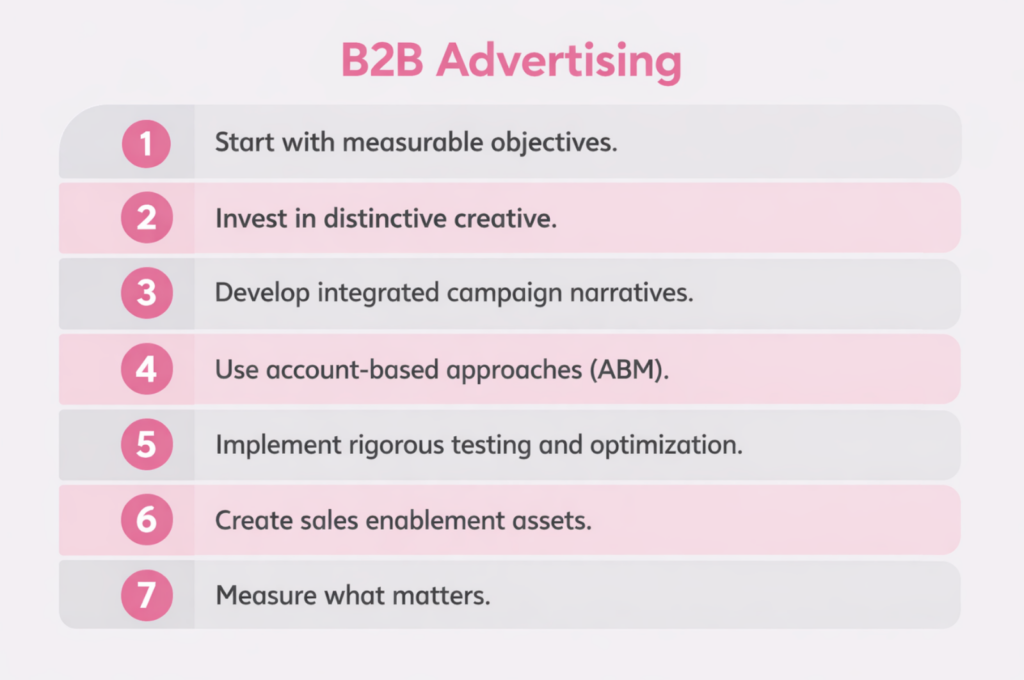
Start with measurable objectives. Vague aims like “increase awareness” aren’t sufficient. Define specific targets like “increase aided brand awareness by 15% among enterprise IT directors” or “generate 500 marketing-qualified leads from target accounts.” Invest in distinctive creative. Too many B2B campaigns look and sound identical, relying on stock photography, corporate jargon, and generic messaging. This doesn’t mean being weird for its own sake, but rather finding creative approaches that make your brand memorable. Develop integrated campaign narratives. Your campaign should tell a coherent story that deepens with each interaction. A prospect might see a brand awareness ad, then encounter detailed content, then receive personalized outreach. Use account-based approaches (ABM). Not every prospect deserves the same level of personalization, but your target accounts should receive customized experiences that acknowledge their specific context, challenges, and needs. This might include personalized landing pages, customized content, direct mail, or account-specific events. Implement rigorous testing and optimization. Continuously test messaging, creative, offers, channels, and targeting. Use multivariate testing where possible, but recognize that many B2B audiences are too small for statistically significant tests, requiring judgment alongside data. Create sales enablement assets. Marketing campaigns often generate interest that sales teams fail to capitalize on because they lack the right tools and content. Develop battle cards, objection handlers, demo scripts, and follow-up sequences that align with campaign messaging and help sales teams maintain momentum. Measure what matters. Last-touch attribution favors bottom-of-funnel tactics while ignoring the awareness and consideration-building that make conversion possible.Use multi-touch attribution models, incrementality testing, brand lift studies, and long-term cohort analysis to understand your campaigns’ full impact. Accept that some campaign benefits (like mental availability with future buyers) are difficult to measure precisely, but essential.
In summary:
FAQ about B2B Marketing Campaigns
What is the difference between B2B marketing campaigns and B2B advertising campaigns?
In the simplest terms, B2B marketing campaigns are comprehensive, multi-channel initiatives that may include content marketing, email nurturing, events, social media, SEO, sales enablement, and other tactics working together toward common objectives. B2B advertising campaigns are the paid promotional component within your broader marketing campaign, including display ads, sponsored content, search advertising, social media ads, and other paid placements.
Which types of B2B marketing campaigns generate the most revenue impact?
The answer depends on your business model, sales cycle, and market position, but several studies show that integrated approaches combining brand building and demand generation deliver the best long-term results. However, I can say that account-based marketing campaigns typically show the highest ROI for companies with defined target accounts and high-value deals. On the other hand, customer retention and expansion campaigns often deliver exceptional returns because they target an audience that already trusts you.
How do you measure ROI in long B2B sales cycles?
Long sales cycles complicate attribution because months or years may pass between initial awareness and closed revenue. Use multi-touch attribution models that credit all touchpoints in the buyer’s journey, not just the last one before conversion. Implement pipeline velocity metrics that measure how campaigns influence deal progression through stages. Track long-term customer lifetime value by acquisition cohort to understand which campaigns attract the most valuable customers.
And…Accept that precise measurement is often impossible in complex B2B contexts, and use a combination of quantitative data and qualitative feedback to inform decisions.
Why is trust more important than attention in B2B campaign performance?
While attention is necessary, it’s insufficient for B2B conversion because business purchases involve risk to budgets, operations, careers, and company performance. As I stated above, decision-makers can give attention but withhold their business if they don’t trust the ability to deliver results. Trust is the actual constraint on growth in most B2B categories.
How can personalization and intent data improve B2B campaign results?
Personalization allows you to address specific stakeholder concerns, industry challenges, and company contexts that generic messaging cannot. When prospects see content that speaks directly to their situation, engagement and conversion rates improve dramatically.
On the other hand, intent data allows you to prioritize resources on accounts showing buying signals and adjust messaging based on where they are in their research process.
Combining personalization with intent data enables “right message, right account, right time” precision that mass marketing cannot achieve.