What Is ChatGPT Shopping?
You can now purchase products directly within ChatGPT. That’s right, OpenAI recently announced a new feature that turns ChatGPT into a personal shopping assistant. You ask for something, and it doesn’t just recommend it. It finds it, prices it,...
 JaneWalter
You can now purchase products directly within ChatGPT.
That’s right, OpenAI recently announced a new feature that turns ChatGPT into a personal shopping assistant. You ask for something, and it doesn’t just recommend it. It finds it, prices it, and even helps you check out all in one chat.
They’re calling it Instant Checkout, and it’s already rolling out with help from e-commerce giants like Stripe and Walmart. The feature enables OpenAI to pull in real-time product listings and personalized suggestions.
It’s still early days, but this is a big deal for e-commerce brands. It opens up an entirely new kind of shopping experience; one where everything from product discovery and research to checkout all happens in a single interface. And with new ChatGPT ads already hitting the ecosystem, it’s clear this is a major market shift.
Key Takeaways
ChatGPT now supports in-chat shopping with real-time product listings and checkout through partners like Walmart. Users interact with the feature using natural language prompts, making product discovery more conversational than keyword-based. Product visibility depends on clean data: use schema markup, clear product names, and natural descriptions. E-commerce brands must adapt fast. AI-driven recommendations are transforming the way customers browse and make purchases. Optimizing for ChatGPT shopping requires mobile speed, fresh reviews, and structured product content.What Do We Know About ChatGPT Shopping and How It Works?
Here’s what we know so far: ChatGPT can now help users discover and buy products directly in the chat interface.
The feature is called Instant Checkout, and it’s powered by OpenAI’s integration with tools like Stripe and Shopify, with Walmart also recently partnering for early rollout. The service is available to all U.S. users of ChatGPT, regardless of their tier.
What It Looks Like in Action
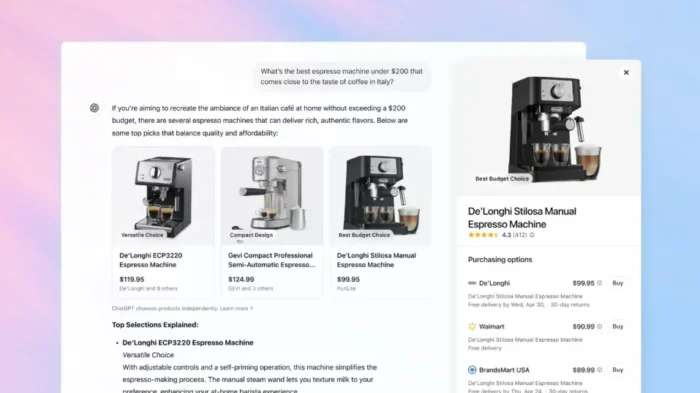
Let’s say you ask ChatGPT for “espresso machines under $200.” ChatGPT doesn’t just return a list of brands; it provides:
Curated product suggestions from across major retailers Real-time pricing and availability Affiliate-style product cards (think: images, links, reviews) And for specific vendors, direct checkout options without leaving the chat
Source: RetailTouchPoints
All of this happens through integrations with online retailers and APIs that deliver live product data behind the scenes. The interesting thing is that brands don’t pay for this visibility in ChatGPT’s shopping function.
Where Google Shopping results are based on brands’ paid ad campaigns or Google’s search algorithm, ChatGPT shopping is more conversational and organic. It focuses on the people (what people are saying bout this product online, what the reviews are, etc.).
Built on Conversational Search
What makes this different is the user experience (UX). You’re not clicking through filters and category pages; you’re chatting. You refine your request like a conversation, asking questions like, “What about ones with arch support?” or “Can you find those in women’s sizes?” That’s a huge shift in how product discovery happens.
So, how does it choose what to show you? The platform analyzes structured metadata and previous model responses. It will look back on how it handled similar queries before it ever touches new search results.
The personalization potential is what makes this even more powerful. ChatGPT will be able to tailor your shopping experience by elevating or demoting various factors of your results based on your needs. For example, if you have a shopping budget of $50, ChatGPT can elevate price as a “signal” and only show you appropriate results. OpenAI is doubling down on the modern customer’s need for personalization.
Is ChatGPT Just Another Shopping Assistant?
Not exactly. Yes, it gives you product recommendations like other AI shopping assistants.
However, ChatGPT takes it a step further by allowing you to shop in a way that feels like texting with a smart, well-informed friend.
Here’s what sets it apart:
Conversational search: You don’t have to use exact filters or keywords. You can talk to it naturally and refine your search. Live product data: ChatGPT pulls real-time pricing and availability from partner retailers. Built-in checkout: With select partners, you can complete a purchase directly in the chat.This changes the experience from “browse and compare” to “ask and buy.”
That kind of frictionless experience makes it especially appealing for time-strapped users, mobile shoppers, and anyone who already uses ChatGPT regularly. It takes online shopping from endless options to making an informed and personalized decision quickly.
How ChatGPT Shopping Will Impact E-Commerce
ChatGPT isn’t just adding shopping features. This will rewrite how people discover and buy products.
Instead of browsing categories or scrolling search results, users now get personalized recommendations just by asking a question. That creates a new funnel, one that starts with natural language. This could be new territory for many e-commerce brands.
Discovery Is Getting More Personal
In traditional search, people type product-focused keywords. With ChatGPT, they might say:
“I need a thoughtful gift under $50 for a coworker.” Or “What are some comfy sneakers for walking in Europe this winter?”
These are context-rich prompts that AI can interpret and respond to with curated product suggestions. Brands with clear, structured product data and natural-language copy will excel in this type of environment.
Product Pages Matter More Than Ever
AI pulls data from your listings, descriptions, and reviews. If your content is outdated or poorly structured, you might not even show up to ChatGPT shoppers.
And with impulse buys likely to spike in this kind of frictionless experience, your clarity and trust signals can make or break a sale.
This is the next frontier of AI in e-commerce. The game is constantly evolving, and now it’s about showing up where customers are asking questions and ensuring your brand is one of the first answers shown.
How To Optimize Your E-Commerce Product Pages for ChatGPT Shopping
If you want your products to show up in ChatGPT’s recommendations, your product pages need more than nice images and a sale price. You need structure, clarity, and language that AI understands.
Here’s how to get there:
1. Use Product Schema Markup
Structured data helps AI understand what’s on your page. Add product schema so ChatGPT (and other tools) can pull in your:
Price Availability Reviews Product name and imageThis is the foundation. Without it, you’re invisible to most recommendation engines.
2. Write Natural, Benefit-Focused Descriptions
ChatGPT’s main focus here is pulling product info and providing an output that sounds conversational. Rewrite your descriptions to sound like how people talk:
Don’t: “Ergonomic, breathable mesh back with tilt-lock feature” Do: “Keeps you cool and comfortable during long workdays”3. Keep Product Names Clear
Avoid overly clever names. “The Cloudstep LX” might sound cool, but no one’s searching for that. Try: “Men’s Waterproof Running Shoes – Cloudstep LX”.
4. Feature Fresh Reviews and Ratings
Recent social proof helps both users and AI understand what’s worth recommending. Keep reviews visible and up-to-date.
5. Speed Up Your Mobile Site
A slow page kills conversions, especially if someone’s trying to buy right in the moment. Optimize images, reduce scripts, and test your load time on mobile to ensure the best user experience.
FAQs
How do you use ChatGPT for shopping?
To use ChatGPT for shopping, start a conversation with a shopping-related prompt like “Find me wireless earbuds under $100.” If you’re using ChatGPT Plus, you’ll get product recommendations that also include links. Some users may also have access to built-in checkout through select partners.
Conclusion
ChatGPT shopping is a new channel, not just a new feature. One where conversation replaces search bars and product discovery happens through real-time, AI-driven recommendations.
If you’re in e-commerce, now’s the time to adapt. That means optimizing your product pages with proper schema markup and making sure your content speaks the way real people do.
Your potential customers are already chatting. The question is: is your brand ready to be part of that conversation?











![What It Takes To Stay On Top Of Local Search In 2025 [Webinar] via @sejournal, @lorenbaker](https://www.searchenginejournal.com/wp-content/uploads/2025/06/3-559.png)








.jpg&h=630&w=1200&q=100&v=1a56ad72fe&c=1)