What Is Hatha Yoga? A Beginner’s Guide to Its Practice and Origins
Hatha Yoga is a traditional form of yoga that uses physical postures (asanas), breathing techniques (pranayama), and meditation to balance the body and mind. It is the foundation of most modern yoga styles and is known for its slow,...
 Tekef
Tekef
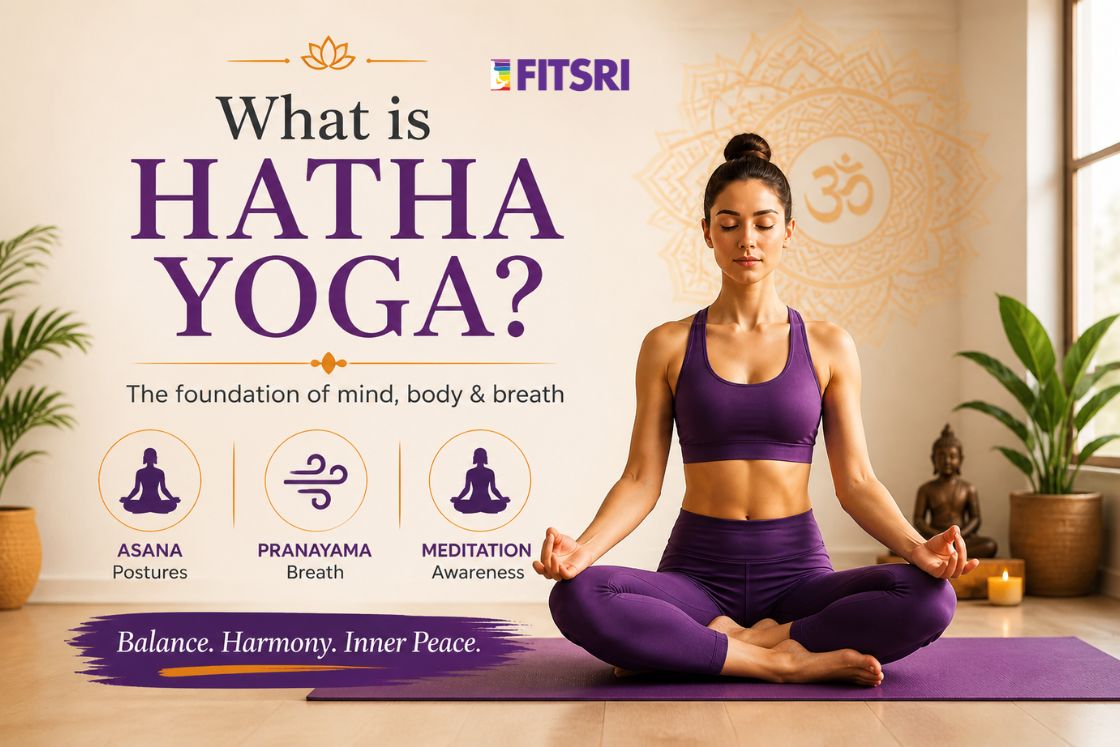
 Source: FITSRI
Hatha Yoga is a traditional form of yoga that uses physical postures (asanas), breathing techniques (pranayama), and meditation to balance the body and mind. It is the foundation of most modern yoga styles and is known for its slow, steady, and mindful approach.
If you have ever searched for yoga classes and felt confused by the options, you are not alone. Vinyasa, Yin, Ashtanga, Kundalini, Restorative… it can feel overwhelming at first.
Here is something most people do not realise: almost every modern style of yoga comes from one traditional system. That system is Hatha Yoga.
Hatha Yoga is a traditional form of yoga that uses physical postures (asanas), breathing techniques (pranayama), and meditation to balance the body and mind. It is the foundation of most modern yoga styles and is known for its slow, steady, and mindful approach.
In the West, Hatha Yoga is often described as a gentle or beginner-friendly practice. That is partly true, but it only shows a small part of the full picture. In the classical Indian tradition, Hatha Yoga is a complete system for working with the body, breath, and energy to prepare for deeper awareness.
This guide gives you both perspectives. You will learn what Hatha Yoga really means, where it comes from, how it is practised, and what benefits you can expect. Whether you are completely new to yoga or want to understand its roots more deeply, this article will give you a clear and practical starting point.
What Is Hatha Yoga?
Hatha Yoga is one of the six classical branches of yoga and the foundation of nearly all modern yoga practice. The word comes from Sanskrit. Ha represents the sun and the vital energy of the body. Tha represents the moon and the energy of the mind. Hatha Yoga is the practice of bringing these two forces into balance.
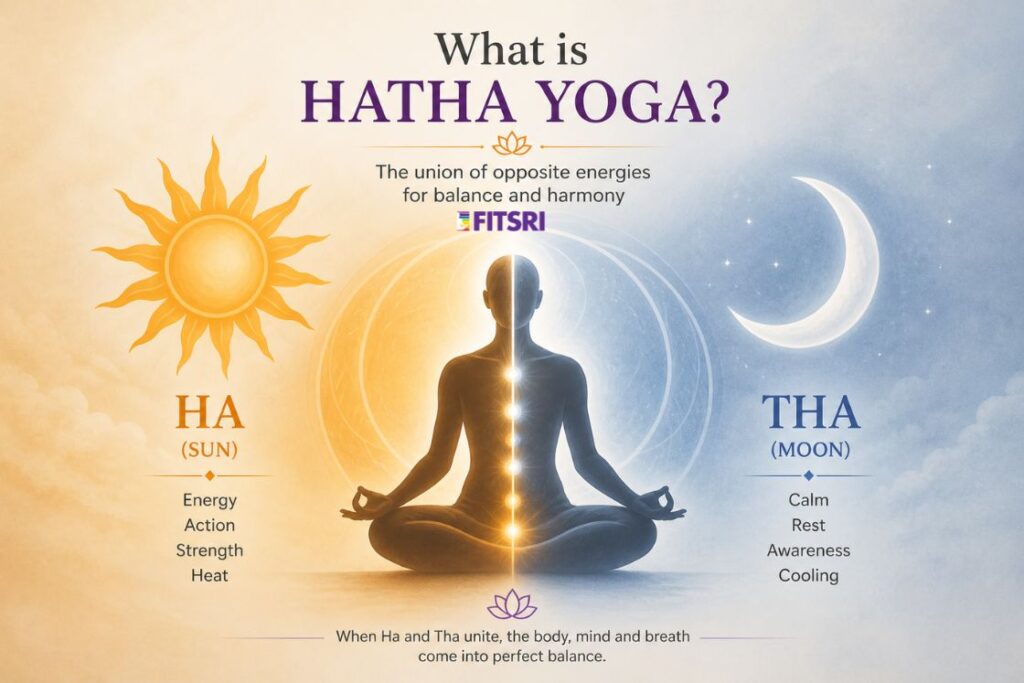
The word Hatha also means forceful, though not in an aggressive sense. It points to the kind of steady, unhurried effort required to actually work on yourself. Not pushing, not forcing, but showing up and doing the work with commitment.
As a system, Hatha Yoga works through body purification, physical postures, breath control, energetic gestures, concentration, and meditation. None of these are separate activities. Each one feeds the next, and together they move a practitioner toward something the tradition calls Samadhi, a state of deep inner stillness and expanded awareness.
Fitness and flexibility are side effects. The real work is preparing the body and nervous system so thoroughly that the mind becomes genuinely quiet, not because you forced it to, but because it finally has no reason not to be.
Also Read: Meaning of Hatha yoga ‘Ha’ & ‘Tha’ in Details
How Hatha Yoga Became Popular in the West
When a yoga studio in London or New York or Sydney lists a Hatha class on its timetable, it usually means a slower-paced class with held postures and conscious breathing. That description is not wrong. But it is a little like describing the ocean as wet. Technically true, mostly missing the point.
The full Hatha tradition includes a complete philosophy of the human body, a detailed understanding of energy and consciousness, and a systematic path that practitioners have followed for well over a thousand years. What gets taught in most modern studios is a simplified version, which is a perfectly good place to start, but it helps to know there is much more available when you are ready.
The History of Hatha Yoga
The Ancient Foundations
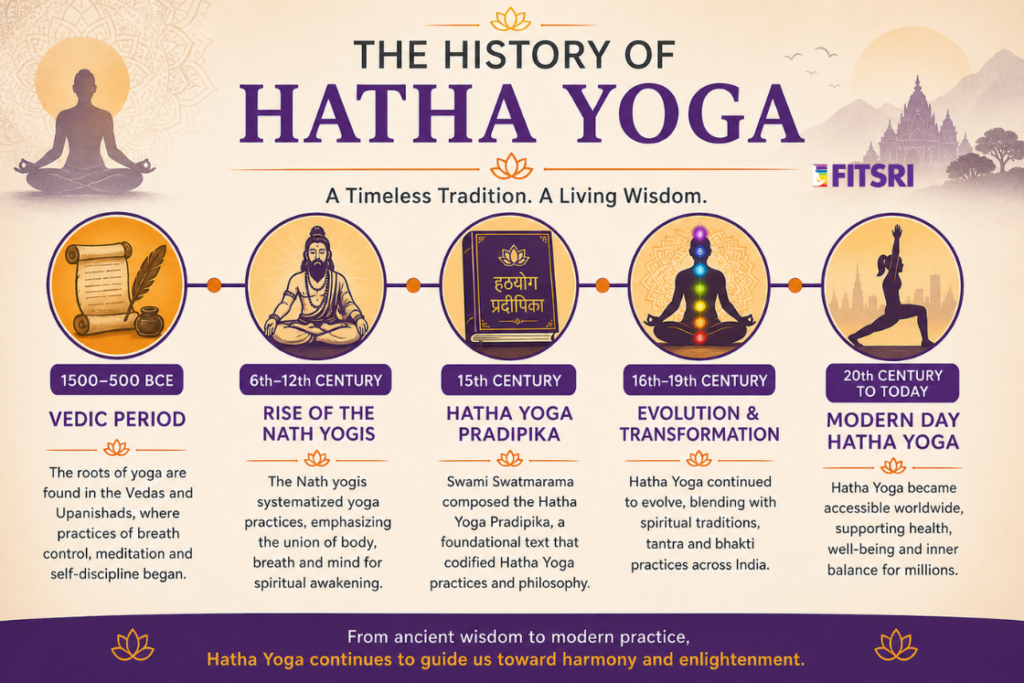
Yoga is at least five thousand years old. The earliest references appear in the Rig Veda, one of the oldest texts ever written. In those early centuries, yoga had nothing to do with postures. It was a contemplative tradition, concerned entirely with the nature of consciousness and the possibility of liberation.
Around the 6th century BCE, the Buddha’s teachings brought a more structured attention to the relationship between body and mind. Over the centuries that followed, these ideas merged with the tantric traditions spreading across India, and the seeds of what would become Hatha Yoga were planted.
The Nath Yogis
Hatha Yoga as a recognisable system belongs to the Nath tradition, a lineage of Indian yogis who lived roughly between the 4th and 11th centuries CE. The tradition traces its origin to Maharshi Matsyendranath, who according to the teachings received the knowledge of yoga directly from Lord Shiva, the Adiyogi, the first teacher of yoga in the Hindu tradition.
His disciple Gorakhnath took those teachings and shaped them into the structured practice we now call Hatha Yoga. The insight that defined everything the Nath yogis did was simple but radical: you cannot reach spiritual realisation by escaping the body. You have to go through it. Purify it, strengthen it, balance it, and then it becomes the very vehicle for awakening rather than the obstacle to it.
This idea, that the body is the beginning of the spiritual path rather than something to transcend, is still what makes Hatha Yoga different from most other contemplative traditions.
The Hatha Yoga Pradipika
In the 15th century, a yogi named Swami Swatmarama wrote down what had until then been passed from teacher to student through direct transmission. The text is called the Hatha Yoga Pradipika, which roughly translates as a lamp that illuminates Hatha Yoga. It covers asanas, pranayama, mudras, bandhas, and samadhi, and it remains the primary classical reference for Hatha Yoga today.
Two other texts, the Gheranda Samhita and the Shiva Samhita, cover similar ground with some differences in emphasis. Any serious practitioner or teacher will eventually spend time with all three.
The Journey West
Yoga first reached Western audiences in 1893, when Swami Vivekananda spoke at the Parliament of World Religions in Chicago. His focus was philosophy and meditation rather than physical practice, but he opened a door.
The person who walked the physical practice through that door most decisively was Sri T. Krishnamacharya, born in 1888 in Karnataka, South India. Teaching out of the Mysore Palace gymnasium, he trained students who would eventually carry Hatha Yoga to every corner of the world. B.K.S. Iyengar, K. Pattabhi Jois, and Indra Devi all studied under him. The yoga world as the West knows it today is almost entirely Krishnamacharya’s legacy yoga can help you build a strong foundation before exploring faster or more intense styles.
The Philosophy Behind Hatha Yoga
Begin with the Body
In most classical spiritual traditions, including Patanjali’s Yoga Sutras, the instruction is to discipline the mind first. Establish ethical conduct, restrain your impulses, cultivate inner resolve, and then move to the body.
Hatha Yoga takes a different position. Swami Swatmarama argued in the Pradipika that trying to control an unprepared mind simply creates more inner conflict. You sit down to meditate and spend the whole session fighting your own thoughts. You resolve to be patient, then snap at someone before lunch.
The Hatha approach says: work with the body first. Clean it, strengthen it, and balance it. When the physical foundation is solid, the mind begins to settle on its own. You do not force it. You simply remove the conditions that were agitating it.
This is not a rejection of mental discipline. It is a recognition that body and mind are not two separate things that happen to share a house. Every unprocessed emotion leaves a physical trace. Every physical state shapes the quality of your thinking. Work honestly with the body, and the mind changes with it.
Prana: The Life Force
Running through all of Hatha Yoga philosophy is the concept of prana, the vital life-force energy that flows through every living being. In the yogic understanding of the body, prana moves through channels called nadis, of which the tradition counts 72,000, though three are primary.
Ida is the lunar channel, cooling and mental in quality. Pingala is the solar channel, warming and energising. Sushumna runs along the centre of the spine. When Ida and Pingala are balanced and unobstructed, prana can move freely through Sushumna, activating the chakras, the energy centres along the spine, and eventually moving toward the crown of the head in what the tradition calls Kundalini awakening.
Every practice in Hatha Yoga, every asana, every breathing technique, every mudra, is designed to serve this process in some way.
That may sound abstract when you are just trying to figure out how to do Downward Dog. But most practitioners begin to feel the effects long before they understand the theory. The particular clarity that comes after a good pranayama session, the quality of quiet that settles after Savasana, these are prana moving more freely through the system.
Hatha Yoga and Raja Yoga
Hatha Yoga and Raja Yoga, the yoga of meditation and the mind as described by Patanjali, are often presented as separate paths. They are not really separate. The Pradipika is clear that Raja Yoga cannot reach its fullness without Hatha Yoga as its foundation. Hatha prepares the ground. Raja Yoga deepens the work that becomes possible on that ground.
Think of it like this: you cannot play music well on an instrument that is out of tune. Hatha Yoga tunes the instrument. Raja Yoga is the music.
The Core Practices of Hatha Yoga
Hatha Yoga is not a single technique. It is a complete system with several interlocking practices, each addressing a different layer of the body and mind.
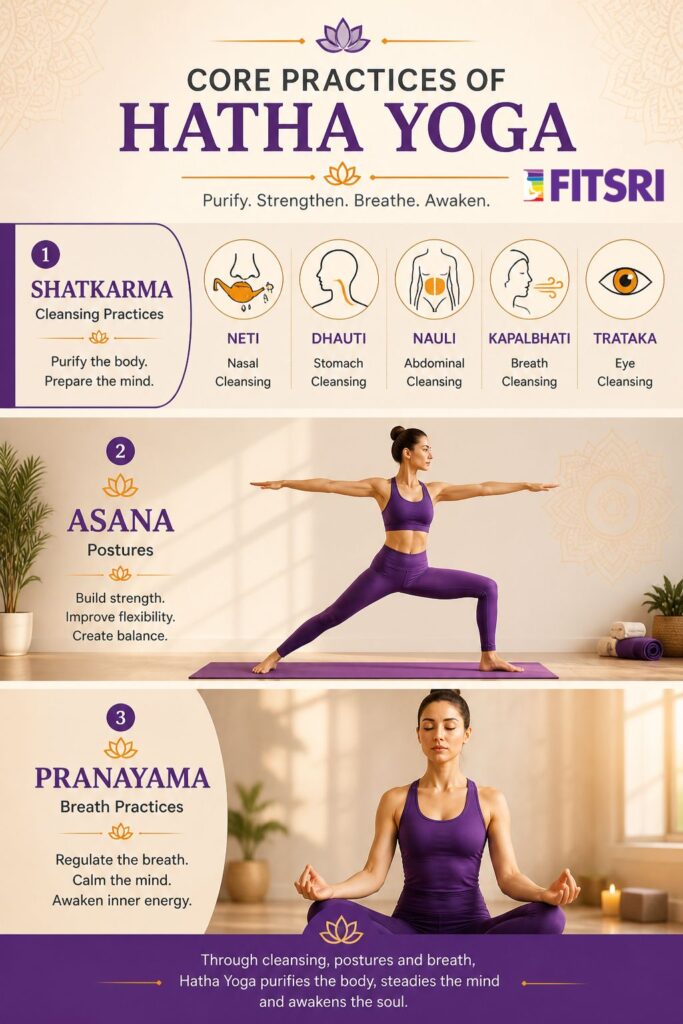
Here is how the sequence traditionally unfolds.
Shatkarma: Start by Cleaning House
Hatha Yoga does not begin on a yoga mat. It begins with purification. Before you build anything, the body needs to be clean.
The Shatkarmas are six techniques for doing this, each addressing a different part of the body.
Neti cleans the nasal passages using water or a thin thread. If you have never done a neti pot cleanse, it sounds strange until you try it, and then you wonder how you breathed before.
Dhauti addresses the digestive tract.
Nauli is a rolling abdominal movement that massages the digestive organs from the inside.
Basti is a yogic colon cleanse.
Kapalbhati is a vigorous rhythmic breath that clears the respiratory system, though most modern classes teach it as a pranayama rather than a purification technique.
Trataka is steady gazing at a candle flame, used to develop concentration and sharpen the nervous system.
Not all of these are beginner practices. Neti and Kapalbhati are the most accessible and widely taught.
The others are best learned in person with a qualified teacher.
Why Hatha Yoga Is the Foundation of Kundalini Yoga
Asana: More Than Shapes
Asanas are the physical postures of yoga. They are what most people think of when they hear the word yoga, and in the West they are often treated as the whole of the practice.
In the Hatha system, they are one part of six.
The classical texts describe 84 key asanas, with 15 seated postures considered the most important for meditation preparation. Over the centuries, the repertoire has expanded considerably.
A modern Hatha class might include standing poses, backbends, forward folds, twists, inversions, and restorative shapes.
What makes Hatha asana practice different from faster styles is the quality of attention it asks for. You stay in a pose long enough to actually feel what it is doing.
The body softens. The breath deepens. The mind, with nowhere to rush to, begins to settle.
That settling is not a side effect of the asana. It is the point.
Pranayama: The Breath Does More Than You Think
Of all the practices in Hatha Yoga, pranayama is perhaps the most underestimated in modern Western classes.
The classical texts regard it as more powerful than asana, because the breath connects the body and mind more directly than anything else.
You cannot manipulate your heart rate through willpower, but you can influence it through the breath in minutes.
The main Hatha pranayama practices include:
Nadi Shodhana — alternate nostril breathing that balances the two energy channels and calms the nervous system Ujjayi — the soft, slightly audible breath used throughout asana practice Bhastrika — an energising and clearing breath Sitali — a cooling breath drawn across the tongue Kumbhaka — breath retention, an advanced practice that builds inner heat and concentrationFor beginners, five minutes of slow, deliberate nasal breathing is enough to notice a real shift in mental state.
Start there.
Mudra and Bandha: The Subtler Work
Mudras are gestures, made with the hands, the face, or the whole body, that direct and seal the flow of prana.
The hand position of touching the index finger and thumb together, which you have probably seen in meditation images, is Jnana Mudra. Simple as it looks, it is functional, not decorative.
Bandhas are internal muscular contractions that lock prana within a region of the body and redirect its flow.
Mula Bandha is a gentle lift at the pelvic floor. Uddiyana Bandha draws the lower abdomen in and up. Jalandhara Bandha brings the chin toward the chest, closing the throat.
These are introduced gradually, after a practitioner has some stability in asana and pranayama.
Dharana, Dhyana, and Samadhi
Everything in the Hatha system is preparation for this.
Dharana is focused concentration, training the mind to rest on a single point without slipping away.
Dhyana is sustained, unbroken meditation, where the effort of concentration relaxes into something more natural.
Samadhi is the state beyond both, where ordinary thinking dissolves and awareness simply rests in itself.
Hatha Yoga does not bolt meditation onto the end of a workout. It understands meditation as the natural result of preparing the body and breath properly.
When the body is comfortable and the breath is steady, the mind has no particular reason to be anywhere other than here.
Hatha Yoga vs Other Yoga Styles
| Hatha Yoga | Slow | Alignment, breathing, held poses | Beginners, mindful practice |
| Vinyasa Yoga | Fast | Flowing movement with breath | Fitness, variety, dynamic practice |
| Ashtanga Yoga | Fast, structured | Fixed sequence, strength, discipline | Experienced and disciplined practitioners |
| Yin Yoga | Very slow | Passive holds, deep tissue stretch | Flexibility, relaxation, stress relief |
| Kundalini Yoga | Variable | Breathwork, chanting, energy work | Energy awareness, spiritual practice |
If you are not sure where to begin, Hatha gives you the clearest foundation and the most transferable understanding. Whatever style you move into later will make more sense because of it.
Also Read: Kundalini vs Vinayasa yoga
What Hatha Yoga Actually Does for You
For the Body
People who practise Hatha Yoga regularly become more flexible, yes, but also stronger, and in a functional way, not just in a gym sense. The core muscles that hold the spine, the hips, the shoulders, all develop steadily. Weight-bearing poses like the Warrior series and Tree Pose build bone density, which matters more as you get older. Chronic lower back pain, which plagues a significant portion of Western adults, responds well to consistent Hatha practice. Blood pressure, heart rate, sleep quality, all improve over time. These are not claims. They are what the research consistently shows and what practitioners consistently report.
For the Mind
Stress is the most common reason Westerners take up yoga, and Hatha Yoga is genuinely good at addressing it. Slow, conscious breathing activates the parasympathetic nervous system, which is the body’s built-in counterweight to the stress response. Do it regularly, and you begin to shift your default setting. People who practise find they react less impulsively, sleep more deeply, and feel more mentally clear, not because something magic happened, but because their nervous system is getting regular practice at being calm.
Over time, the quality of attention that Hatha Yoga develops, close, honest, non-reactive, starts showing up outside of practice. You notice your habits more clearly. You recognise emotional patterns earlier. You become a little harder to knock off balance.
For Something Harder to Name
Many people come to Hatha Yoga for the physical benefits and stay because they found something they were not expecting. A quality of inner stillness. A sense of being more at home in themselves. The tradition has been pointing at this for centuries. It does not insist you call it spiritual. It just asks you to keep practising and see what you find.
How to Start Hatha Yoga (Beginner)
Hatha Yoga works for an unusually wide range of people because it does not ask you to perform. It asks you to pay attention. That makes it suitable for:
Complete beginners who want to understand what they are doing before moving to faster styles People managing stress, anxiety, or burnout Anyone recovering from injury who needs a careful, adaptable approach Older adults maintaining mobility and balance Athletes and active people working on flexibility and recovery Anyone who has tried faster classes and found them too rushed to feel anythingIf you have health concerns, particularly spinal problems, heart conditions, or high blood pressure, speak to your doctor first. A good Hatha teacher will also know how to adapt the practice for most situations.
How to Start
Find a teacher first if you can. Videos and apps are useful supplements, but they cannot see you. A teacher who can watch your alignment and listen to your breath in the first few weeks will save you months of developing habits you will later have to undo.
Keep the early practice simple. Mountain Pose, Child’s Pose, Cat-Cow, Downward Dog, Warrior I and II, and Savasana are enough to build a real foundation. Learn those well before adding more.
Practise short and often rather than long and rarely. Twenty minutes every day does more for you than two hours on a Saturday. The nervous system changes through repetition, not duration.
Learn to actually breathe. From your very first session, treat the breath as the practice, not as a background activity. If you lose the breath, you have left Hatha Yoga and started doing something else. Keep it slow, nasal, and steady.
Drop the timeline. Some things shift quickly, better sleep, less back pain, a noticeable improvement in mood. Others take months. The tradition says practise without attachment to results, not because results do not come, but because the grasping for them gets in the way. That lesson, of showing up without needing a particular outcome, is arguably the most useful thing Hatha Yoga teaches.
Conclusion
Hatha Yoga has been around for over a thousand years. It has survived the fall of empires, the rise of modernity, and the global wellness industry’s habit of flattening everything profound into a product. It survived because it works.
It works because it is honest. It starts with the body you actually have, not the one you wish you had. It asks you to breathe, to pay attention, and to keep coming back. The Indian yogic tradition has been refining this practice across generations, and the accumulated understanding in it is extraordinary.
Whether you come for stress relief, a bad back, or a genuine curiosity about what is possible in a human life, Hatha Yoga has something real to offer. The door is open. The practice is waiting.
FAQs
1. Is Hatha Yoga the same as regular yoga?
Hatha Yoga is often used as a general term for yoga, but it is actually a specific traditional style. Most modern yoga classes are based on Hatha principles, but Hatha Yoga itself focuses on slower movements, held poses, and conscious breathing.
2. How long does it take to see results from Hatha Yoga?
Many people notice small changes, like feeling calmer or less stiff, within a few sessions. Physical improvements such as flexibility and strength usually develop over a few weeks of regular practice.
3. How is Hatha Yoga different from Vinyasa Yoga?
Hatha Yoga is slower and focuses on holding poses with steady breathing. Vinyasa Yoga is more dynamic, where movements flow continuously from one pose to another with the breath.
4. Is Hatha Yoga enough exercise on its own?
Hatha Yoga can be enough for general fitness, especially if your goal is flexibility, strength, and stress reduction. However, if you are looking for high-intensity cardio, you may want to combine it with other forms of exercise.
5. Is Hatha Yoga good for older adults?
Yes, Hatha Yoga is often recommended for older adults because it is gentle, low-impact, and can be adapted to different fitness levels. It helps maintain flexibility, balance, and joint health.
6. Can beginners practise Hatha Yoga at home?
Yes, beginners can start Hatha Yoga at home with simple poses and guided sessions. However, learning from a teacher initially can help avoid mistakes and build a proper foundation.









.jpeg?quality=75&width=1200&auto=webp)