6 generative engine optimization benefits every marketer should know
You’ve seen it with your own eyes, reader. The way buyers discover brands is changing faster than most marketing teams realize.
 Kass
Kass
You’ve seen it with your own eyes, reader. The way buyers discover brands is changing faster than most marketing teams realize. But the audience isn’t quite disappearing. It is, however, moving to a channel where your brand is either cited in the answer or is entirely invisible. That channel is generative engine optimization (GEO). It’s the practice of structuring your content and brand presence so AI platforms like ChatGPT, Google AI Overviews, Perplexity, and Gemini can accurately understand, cite, and recommend you in their responses. GEO differs from traditional SEO by prioritizing structured data and machine-friendly content over link-based rankings alone, but it doesn’t replace your SEO investment. It amplifies it. Still, many marketing teams hesitate — unsure how to measure AI visibility, uncertain about implementation, or wary of risks like AI hallucination. Heck, you might be one of them. Lucky for you, this post breaks down six generative engine optimization benefits that make a concrete, measurable difference for marketers right now, along with the data behind each one and the practical steps to start capturing them. Let’s dive in. Generative engine optimization (GEO) is the practice of structuring your digital content and brand presence so GEO platforms (i.e., ChatGPT, Google AI Overviews, Perplexity, Gemini) can accurately understand, cite, and recommend your brand in their responses. For marketers seeking to future-proof their organic visibility, GEO differs from traditional SEO by prioritizing structured data and machine-friendly content over link-based rankings alone. But here’s what matters most for marketing strategists evaluating where to invest: GEO does not replace SEO. It amplifies it. Data from HubSpot’s 2026 State of Marketing Report explains that nearly half of marketers (49%) agree that web traffic from search has decreased because of AI answers. However, 58% note that AI referral traffic has much higher intent than traditional search. Marketers benefit from increased AI search visibility, improved lead quality, and stronger brand inclusion when they treat GEO and SEO as complementary rather than competing strategies. For your reference, I’ve created a comparison below that breaks down the key dimensions: The generative engine optimization benefits are clear: But the challenges of generative engine optimization are real, too. According to recent data from SEO Sandwitch, 67% of digital marketers say GEO tracking is more complex. New measurement frameworks are required; traditional metrics like rankings and CTR don’t capture what matters for GEO, which are: Without structured data and schema markup, AI engines can’t reliably understand or cite your content, increasing the risk of brand misrepresentation or total invisibility. Pro Tip: HubSpot’s AEO Grader measures brand visibility in AI search engines by evaluating your brand across five scored dimensions. It’s free, requires no account, and delivers a scored baseline you can use to benchmark against competitors and track improvement over time. Structured data and schema markup help AI engines understand and cite your content; yet, implementation remains one of the top barriers for marketing teams adopting GEO. Here’s what high-performing GEO practitioners are doing now: However, the tradeoffs of adopting GEO are real barriers. They’re as follows: But they’re also solvable with the right frameworks. I’ll walk through how to __ in-depth, in the next section. Generative engine optimization (GEO) enables brands to appear in search results and conversational answers — a visibility layer that traditional SEO alone can no longer guarantee. But, reader, I assure you: there is light on the other end of the tunnel. Here are the most impactful advantages marketers gain from a deliberate GEO strategy: The most immediate benefit of GEO is presence where it matters most: inside the AI-generated response itself. When a prospect asks ChatGPT or Perplexity, “What’s the best CRM for remote teams?” and your brand appears in that answer, you’ve reached that buyer at the moment of highest intent (without competing for a click in a list of ten blue links). This matters because, as HubSpot’s 2026 State of Marketing Report notes, nearly 24% are exploring updating their SEO strategy for generative AI in search (e.g., ChatGPT, Gemini, Claude). Thus, as Semrush shared in this article about the impact of AI search on SEO traffic, the marketers already investing in GEO are capturing higher-intent traffic that converts at 4.4x the rate of traditional organic search, proving that GEO isn’t a speculative bet on the future — it’s a measurable revenue advantage available right now. AI-referred traffic doesn’t just drive volume, it drives better outcomes. Visitors arriving through answer engines have already absorbed context about your product, compared alternatives, and formed an initial opinion before they ever click through to your site. Plus, recent data affirms this: For marketing strategists managing pipeline targets, this conversion advantage means GEO doesn’t just expand the top of the funnel; it compresses the journey from discovery to decision. Generative engines don’t rank websites in a list. Conversely, they synthesize information from multiple sources and present a curated answer. When your brand is included in that synthesis (cited alongside or ahead of competitors, it signals authority and trust to the buyer reading that response. But, unfortunately, inclusion isn’t automatic (not yet, at least). The top 50 brands account for a disproportionate share of AI citations, and the brands earning those mentions are the ones proactively supplying: One of the most underappreciated GEO benefits is how citation authority compounds over time, similar to how domain authority works in traditional SEO, but across multiple AI platforms simultaneously. When your content earns citations in ChatGPT, those same authority signals strengthen your presence in Perplexity, Gemini, and Google AI Overviews. AI models draw from overlapping training data and real-time retrieval sources, so if a brand wants to create a citation flywheel that reinforces itself across every platform, it must build entity authority through: A common concern among marketing teams evaluating GEO is measurement uncertainty (also known as one of the most frequently cited challenges in generative engine optimization). You see, reader, traditional metrics like rankings, impressions, and CTR don’t capture how AI engines represent your brand in generated responses. But, alas, there is good news: dedicated measurement frameworks now exist. That said, the KPIs that matter in GEO include: Ready for some more GEO-related good news? Here it is: GEO doesn’t require starting from scratch. The content that performs best in AI citations is already ranking well in traditional search. That means your highest-ROI GEO move is to optimize the content you already have. Restructure any existing blog posts, guides, and product pages with: Next, let’s talk about what makes GEO difficult — and how to fix it. GEO benefits are well-documented, but they’re often oversimplified in an effort to understand how GEO actually works. In plain English, GEO simply garners: But realizing those benefits requires navigating a set of challenges that are fundamentally different from traditional SEO. You see, reader, many of the challenges marketers face with generative engine optimization aren’t about content quality. Oppositely, they’re about: To help you navigate this shift, I’ve compiled a list of the most common GEO obstacles and the practical fixes for each. Take a look: GEO requires your brand information to be consistent and machine-readable across every surface AI models pull from: Most marketing teams manage these surfaces in separate tools with no single source of truth, creating fragmented entity signals that confuse AI engines. When your LinkedIn company page says one thing, your Google Business Profile says another, and your website schema doesn’t match either, AI models receive conflicting inputs. The result? Lower “entity confidence” — the model’s internal certainty about who you are and what you do — which reduces your likelihood of being cited or, worse, leads to inaccurate representation. The fix: AI engines don’t just match keywords; they resolve entities. If your brand name is generic (think “Summit,” “Atlas,” or “Relay”), shares a name with another company, or lacks distinct entity signals, generative models may: This is one of the downsides of generative engine optimization that traditional SEO teams rarely encounter. In conventional search, disambiguation happens through domain authority and link signals. In generative search, it happens through entity resolution; if your entity is ambiguous, you lose. The fix: Large language models don’t retrieve facts, they predict statistically likely word sequences. When they encounter gaps in training data or ambiguous signals, they generate confident-sounding responses that may be entirely fabricated. For brands, this means AI can: The fix: Structured data is the translation layer between your content and AI systems. Yet most marketing teams find schema implementation technically intimidating, and many who do implement it get it wrong (mismatched schema types, stale data that contradicts visible page content, or missing entity connections that leave AI models guessing). The fix: Traditional SEO has decades of established metrics: GEO introduces a visibility layer that none of these metrics capture. You can rank #1 in Google for a target keyword and still be completely absent from the AI-generated answer that appears above your listing. The fix: Lastly, GEO introduces privacy and compliance considerations that traditional SEO largely avoided. AI models train on publicly available data, which means brand information, employee details, product specifications, and customer testimonials published on your site may be ingested, recombined, and surfaced in AI responses in ways you didn’t anticipate. For businesses in regulated industries (healthcare, finance, legal), this creates questions about data accuracy obligations, liability for AI-generated claims, and compliance with evolving AI transparency regulations. The fix: Every one of these generative engine optimization challenges is solvable with the right framework, the right tooling, and a systematic approach. The teams that treat these obstacles as implementation problems, not reasons to wait, are the ones building AI visibility while their competitors are still debating whether GEO matters. Luckily, you don’t need a six-month roadmap or a new tech stack to start capturing generative engine optimization benefits. The most effective GEO implementations build on the SEO foundation you already have: Generative engine optimization enables brands to appear in GEO results and conversational answers, and the fastest path to that visibility starts with the content and infrastructure your team has already invested in. Here’s a practical, quick-start framework you can begin executing this week: Step 1: Establish your AI visibility baseline Before optimizing anything, you need to know where you stand. Most marketing teams have no idea how (or whether) AI engines are representing their brand in generated responses. To start, run your brand through HubSpot’s AEO Grader. As I previously mentioned several times throughout this post, it measures brand visibility in AI search engines by scoring your presence across five dimensions (i.e., sentiment, presence quality, brand recognition, share of voice, and market position). Then, supplement with manual testing: query ChatGPT, Perplexity, and Gemini with 10–15 prompts your ideal buyers would actually ask (“What’s the best [your category] for [use case]?”). Document whether your brand appears, how it’s characterized, and which competitors are cited instead. This exercise alone often reveals the most urgent content gaps. Pro Tip: For a fuller picture of the monitoring landscape, explore the HubSpot Blog’s guide to answer engine optimization tools that help marketing teams track AI visibility systematically. Here’s the (frustrating but true) bottom line about GEO: AI engines don’t read your content the way humans do. Instead of reading linearly or interpreting nuance, they scan for direct, extractable answers — typically within the first 40 to 60 words of a section — and prioritize content structured with question-based headings, factual claims, and cited statistics. To start seeing measurable impact quickly, pick your five highest-traffic blog posts or landing pages and apply these changes: Pro Tip: For a comprehensive breakdown of which content formats perform best in AI-generated answers, see this guide on the best content types for AI search. Structured data and schema markup help AI engines understand and cite your content, yet most sites either lack schema entirely or have implemented it incorrectly. Now, read this next sentence slowly: You don’t need to mark up your entire site on day one. I recommend starting with the three schema types that drive the most GEO value: Then, use JSON-LD in the document head for all implementations. It’s Google’s recommended format and the cleanest for AI parsing. Then, validate every page using Google’s Rich Results Test before publishing. One of the most persistent challenges in generative engine optimization is measurement. Teams can’t justify continued investment in what they can’t report on. However, what these teams don’t know is that the fix takes about 10 minutes. Create custom channel groups in GA4 to segment traffic from AI referral sources: This lets you isolate AI-referred sessions, measure conversion rates separately from traditional organic, and build a reporting infrastructure that connects GEO effort to pipeline outcomes. Track two parallel metric streams going forward: Both matter. (HubSpot’s 2026 State of Marketing Report even confirmed that the top channel by ROI and personalization success is still SEO (at 27%, right before paid social media content at 26%).) As a marketer, you’ve just got to measure and optimize for both simultaneously. Pro Tip: For a deeper look at how AI is reshaping the SEO landscape and which metrics to prioritize, this resource on AI and SEO covers the convergence in detail. AI platforms trust third-party sources more than brand-owned content when assembling responses. That means your website alone (no matter how well-optimized) won’t earn citations if AI engines can’t find independent validation of your brand’s claims. Prioritize these external authority signals: For an overview of how AI agents discover and process brand information across these sources, this explainer on AI agent types provides helpful context on the retrieval mechanisms at work. Believe me or don’t, the biggest barrier to GEO adoption isn’t complexity… It’s the perception that it requires a parallel workstream. And want to know something super mind-blowing? It doesn’t. You see, reader, GEO integrates directly into the content production process your team already runs. Here’s how to embed it without adding overhead: Pro Tip: HubSpot’s Marketing Hub and Content Hub support GEO implementation through its AEO Product, which unifies data and content automation, allowing teams to manage content creation, SEO optimization, and performance tracking from a single CRM-connected system. GEO is not a one-time project. AI models update their knowledge regularly, competitors are optimizing too, and the answer engine optimization trends shaping this space are evolving fast. Build a monthly review cadence: One known downside of GEO is that results require sustained attention rather than a set-and-forget approach. But the compounding nature of citation authority means each month of consistent effort builds on the last. That said, early movers create structural advantages that late adopters will struggle to close. You don’t need an enterprise budget to operationalize GEO. Understanding AI costs helps you plan realistically, and many foundational GEO actions (i.e., content restructuring, schema implementation, FAQ creation, and manual prompt testing) cost nothing beyond your team’s time. Where budget helps most is in monitoring and automation. Dedicated generative engine optimization tools can automate citation tracking, competitive benchmarking, and content audit recommendations at a scale that manual testing can’t match. Evaluate tools based on which generative engine optimization challenges your team faces most acutely, whether that’s: Marketers benefit from increased AI search visibility, improved lead quality, and stronger brand inclusion when they treat GEO as a complement to their SEO foundation rather than a separate initiative. Start with your baseline, restructure your top content, implement core schema, track the results, and iterate. The framework above is designed to get you from “thinking about GEO” to “measuring GEO impact” sooner rather than later. Initial generative engine optimization benefits can appear within 2 to 4 weeks, which is significantly faster than traditional SEO’s typical 3 to 6 month timeline. AI models update their knowledge bases more frequently than search engines recrawl the web, so structured improvements to existing content get picked up quickly. That said, the timeline depends on what you’re optimizing: Yes. GEO’s highest-ROI actions require time investment, not budget. Truth be told, reader, a team of one can start seeing results by restructuring existing content and implementing basic schema, neither of which costs anything beyond the hours to execute. Here’s a realistic week-one plan for a small team: You don’t need enterprise tooling to start. You need consistent execution on the fundamentals. AI hallucinations (instances in which models generate confident but fabricated information about your brand) are among the most frequently cited downsides of generative engine optimization. Now, you can’t eliminate hallucinations entirely (they’re inherent to how LLMs predict text), but you can reduce their frequency and impact substantially by doing the following: Start with existing content. It’s both faster and higher ROI. Your pages that already rank in the organic top 10 are the strongest candidates for GEO optimization because AI engines disproportionately cite content that performs well in traditional search. Restructuring a top-ranking page for AI extraction (i.e., adding a direct-answer opening, FAQ schema, specific statistics, and temporal markers) unlocks AI visibility from an asset your team has already invested in. Create net-new content when you identify citation gaps (i.e., queries where your buyers are asking AI platforms questions and your brand has no relevant content at all). Then, prioritize these formats for new GEO content: The most effective approach is a 70/30 split: 70% of your GEO effort on optimizing existing high-performers, 30% on creating new content for uncovered citation opportunities. One of the persistent generative engine optimization challenges is the temptation to treat GEO as an entirely new content program when, in practice, most of the work is restructuring what you already have. GEO creates the most business value when it’s connected to your CRM and revenue operations, not siloed within the content team. Here’s how to align GEO across marketing, sales, and service: The benefits of generative engine optimization multiply when every customer-facing team understands how buyers discover and evaluate your brand through AI. In the GEO era, this is how a modern revenue engine should be functioning: Simply put, generative engine optimization enables brands to appear in search results and conversational answers. It’s not the future of search, it’s where we are now. At this point in time, the generative engine optimization benefits are, thankfully, measurable: higher-intent leads, stronger brand inclusion in the answers shaping buyer decisions, and a compounding visibility advantage that rewards teams who move early. However, the challenges of generative engine optimization are just as real. Measurement frameworks are newer, schema markup takes deliberate effort, and the downsides of generative engine optimization (including hallucination risk and entity ambiguity) require proactive monitoring rather than passive hope. Nevertheless, every one of these obstacles is solvable with the right tooling and a systematic approach. The brands pulling ahead aren’t the ones with the biggest budgets. More specifically, they’re the ones that: Ready to see how AI search engines are representing your brand today? Get started with HubSpot’s AEO Grader. It’s free, takes minutes, and gives you a scored baseline across ChatGPT, Perplexity, and Gemini so you know exactly where to focus first.![See Your Brand's Visibility in Answer Engines [Free Tool]](https://no-cache.hubspot.com/cta/default/53/d4233c10-60b6-46d7-9852-c71dde8507b6.png)
Why generative engine optimization’s ROI is higher than ever
Top benefits of generative engine optimization for marketers
Common challenges in generative engine optimization
How to get started with GEO now
Frequently asked questions (FAQ) about the benefits of generative engine optimization
GEO is the future of content marketing
Why generative engine optimization’s ROI is higher than ever
![[alt text] a hubspot-branded graphic explaining, in plain english, what generative optimization is](https://53.fs1.hubspotusercontent-na1.net/hubfs/53/benefits-of-generative-engine-optimization-2-20260427-8394899.webp)
Where GEO and SEO differ (and where they converge)
How to practically implement GEO (without the guesswork)
Top benefits of generative engine optimization for marketers
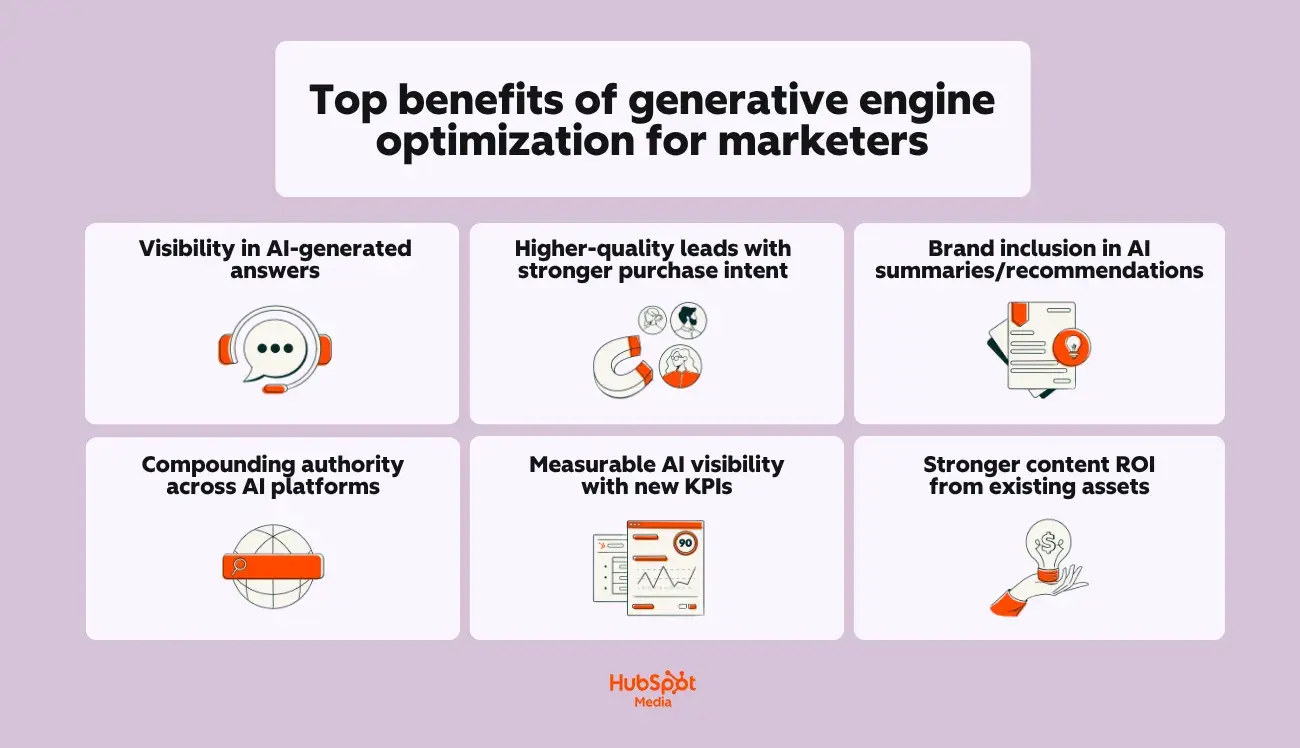
1. Visibility in AI-generated answers
2. Higher-quality leads with stronger purchase intent
3. Brand inclusion in AI summaries and recommendations
4. Compounding authority across AI platforms
5. Measurable AI visibility with new KPIs
6. Stronger content ROI from existing assets
Common challenges in generative engine optimization
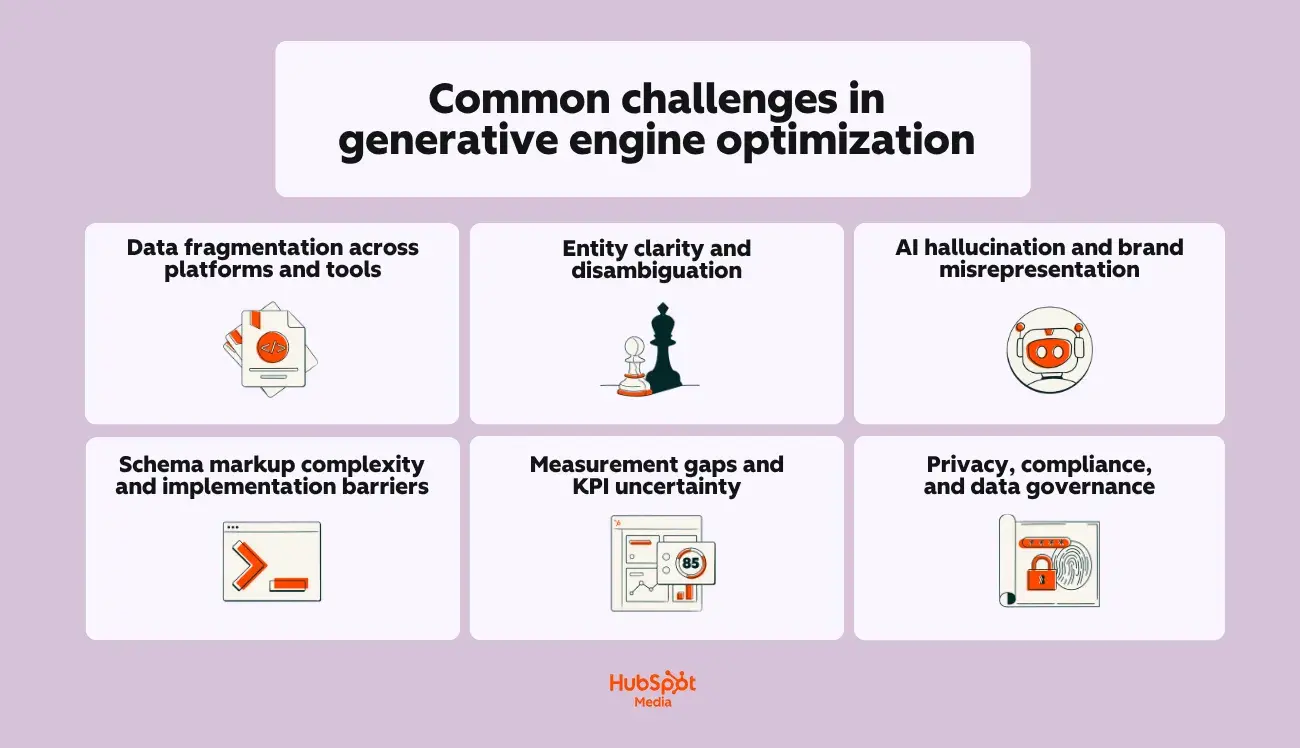
1. Data fragmentation across platforms and tools
2. Entity clarity and disambiguation
3. AI hallucination and brand misrepresentation
4. Schema markup complexity and implementation barriers
5. Measurement gaps and KPI uncertainty
6. Privacy, compliance, and data governance
How to get started with GEO now
Step 2: Restructure your highest-value content for AI extraction
Step 3: Implement core schema markup on priority pages
Step 4: Set up AI referral traffic tracking in Google Analytics 4 (GA4)
Step 5: Build entity authority beyond our own domain
Step 6: Integrate GEO into your existing content workflow
Step 7: Monitor, iterate, and scale
Choosing the right tools for your GEO stack
Frequently asked questions (FAQ) about the benefits of generative engine optimization
How long does it take to see benefits from GEO?
Can small teams get value from GEO quickly?
How do I reduce the risk of AI hallucinations about my brand?
Should I update my existing content or create new content for GEO?
What’s the best way to align GEO with sales and service?
GEO is the future of content marketing






















.jpg&h=630&w=1200&q=100&v=c0f97a310e&c=1)