A Drunken Bee
The life and times of Sunthorn Phu, Thailand’s national poet The post A Drunken Bee appeared first on Tricycle: The Buddhist Review.
 AbJimroe
Until the end of the sky and the seas,
There will be no end to this love, ever-enduring.
Even if you lie beneath the earth and rivers
I ask to meet again this harmonious love.
Even if your cold flesh were a vast ocean
I ask for the felicity of being a fish.
Even if you’re a lotus, then I’ll be a bee
Caressing your petals and blossoms.
—Sunthorn Phu, Phra Aphaimani (c. 1830s)
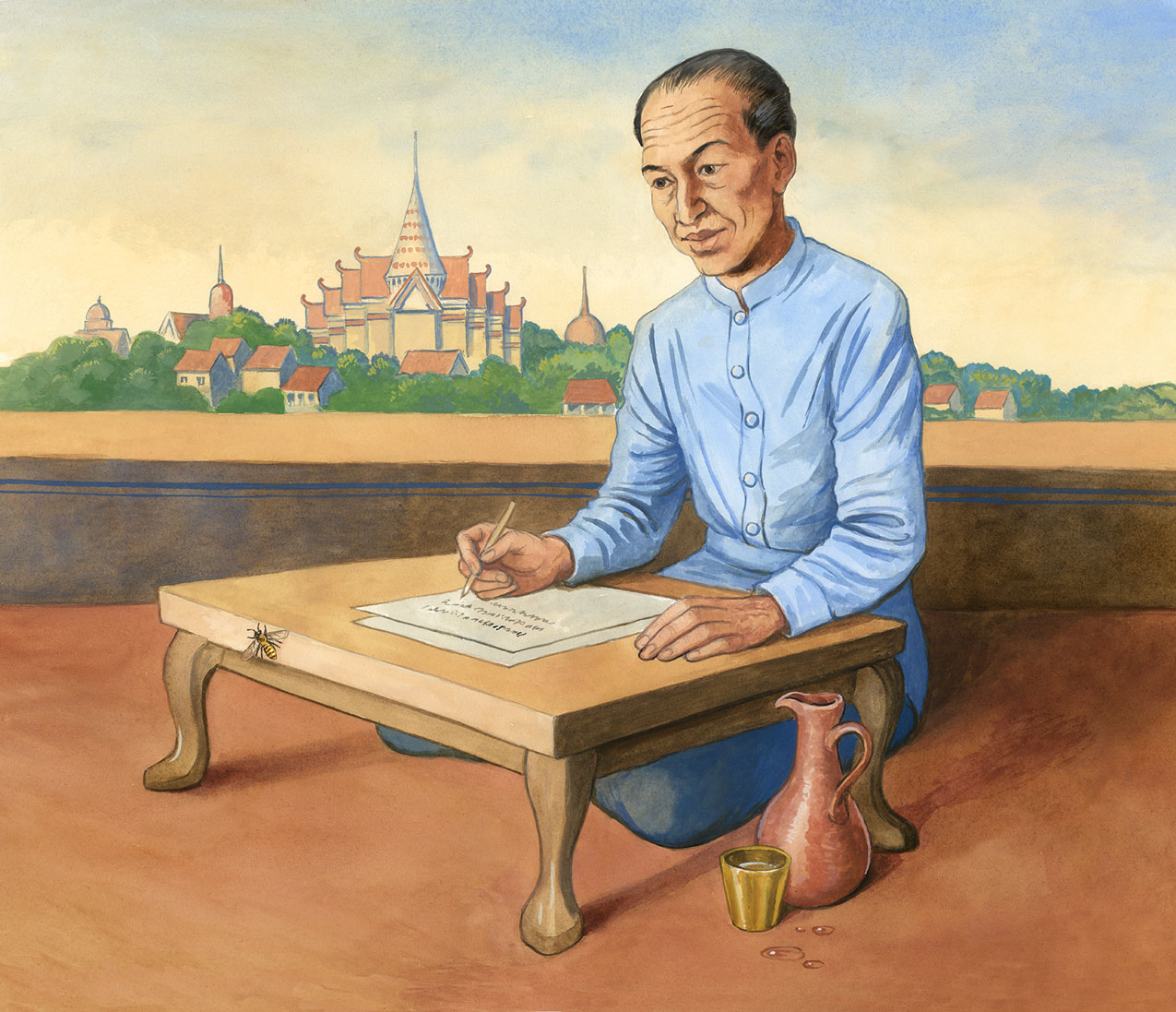
Sunthorn Phu (1786–1855) was a monk for much of his life, but not a very good one. From his monk’s hut at Thepthidaram temple in Bangkok, he once lamented how it was “better to die on a wooded hill” than live without the same earthly pleasures of his fellow men. He is remembered as a great lover of women and of drink. Phu is the national poet of Thailand, and his verse is saturated in the Buddhism of his time, albeit a version that was far more varied and colorful than elites would have liked to advertise. The verse above showcases his most doggedly explored obsession: desire. Desire in all its facets, in its cravenness, its unrelenting grip on our psyches, its destructiveness, its tarnished beauty. His name is homophonic with the Thai word for “bee” and he frequently described himself as a “lusty bee,” one who could not help but long for the impossible, for those flowers that lie “at the foot of the spheres of our nearest heaven.”
Across Thailand, every June 26 is celebrated as Sunthorn Phu Day, and schools often commemorate this by holding a competition to dress up like one of the poet’s many memorable characters, like the pipe-playing Phra Aphaimani and his half-mermaid son Sudsakorn, scaling the seas on his flying horse or the glamorous Princess Suwannamali. Statues and museums are devoted to him, such as at his former monk’s kuti at Wat Thepthidaram. And all those who have undergone a Thai public high school education will have at some point memorized some of his verses. Primarily, he is lauded in such contexts for the beauty of his language and honored as the “Shakespeare of Thailand.” Yet, as with so many national poets, he is perhaps celebrated more than read and, by focusing on his “genius” as a wordsmith, one can easily overlook how mischievous and innovative his work really was.
Phu was born in Bangkok in 1786 to a working-class family, a fact that would stay with him throughout his life as he made his way into a deeply feudal society. When his father left the family when he was still very young to ordain as a monk, his mother found work as a wet nurse at Thailand’s royal court. From then on, as Thai scholar Sujit Wongthet writes, Sunthorn Phu would live his life “between court and temple.” The era in which Phu became connected with the court was a time of great structural change. Just two decades before Phu’s birth, in 1767, the neighboring Burmese empire destroyed Thailand’s capital, which was then situated in Ayutthaya. When Phu was growing up, the Kingdom of Thailand was in the process of building a new capital in Bangkok. As well as constructing and refurbishing temples, canals, and glittering buildings in the Ayutthaya style, Thai kings were expected to ensure that proper monastic discipline was maintained. More than any other Theravada country, Thailand emphasized the study of the vinaya, the monk’s disciplinary code. Gilded temples, strict monks with a semidivine monarch at the top—that was the desired model.
He frequently described himself as a “lusty bee,” one who could not help but long for the impossible.
While the new capital was under way, it was also necessary to feverishly recopy the old literature. This included the Ramakien, the Thai version of the Indian epic the Ramayana, in which the mischievous and womanizing monkey Hanuman plays an outsized role; epics from Java like the (again) womanizing prince Inao; local versions of the Persian One Thousand and One Nights, and Chinese epics. Phu would have grown up hearing these stories and songs. And once he finished his education as a novice monk at a nearby temple, he became a court scribe himself.
At some point or another, the young writer came to the attention of King Rama II (r. 1809–1824). Poets found great favor during his reign, and Sunthorn Phu became the most favored poet of all. He tutored the king’s children and sang songs on royal barge processions. Despite his rambunctious personality, his quarreling, and his drinking, the prized wordsmith was forgiven all his trespasses, so invaluable were his gifts to the king.
But Phu’s love of women eventually caught up with him. He fell in love with a high-born lady named Moon (Chan). In the old Ayutthaya codes, there were laws that condemned, to execution, any man who “brings books of poetry into the palace to seduce palace maids and inner palace servants.” It was precisely for men like Phu that such laws were made. Thanks to a general relaxation in disciplinary standards at court, Phu was not executed, and was instead sent to the palace jail, then released. Once free, he journeyed to his father’s temple in Rayong, perhaps “ordaining to escape,” which would be a recurring theme in his life of taking up robes for a brief period of time to escape political heat. His first nirat, a poem of journeying and separation, begins:
At Dawn Temple, rays of the moon (Chan) gleam, glimmer
Looking back, turning back—holding back not the tears.
During the journey to Rayong, Phu found himself thirsty at Pattaya Bay. Looking at the salty water, he wrote of a “lover-less man outside the palace walls for, if he starts a-wooing, whipped he’ll be to within an inch,” surely drawing on his own experiences. Shortly after, his guide disappeared. Enraged by his companion’s abandonment, Phu reached a nearby temple and made the following declaration:
By the powers of true revelation, I declare, I here accuse:
Let him be branded a Devadatta, foe of the Buddha, till his dying day.
As if his name on the back of the vihara were written in smoldering charcoal,
Like his heart, that black ash of a soot-smeared pot, the crook.
Phu returned to Bangkok soon after his temporary ordination, though it is not clear whether he was able to return to his beloved Chan, but even if he did, she was certainly not his final lover. Phu would then resume his womanizing, drinking, and rule-breaking ways until a sudden change in royal leadership came about, and what had been his meteoric rise to prominence at court was soon followed by an equally precipitous downfall. Rama II passed away suddenly in 1824 and was succeeded by his sober and pragmatic half-brother, who was less than keen to suffer the excesses of unruly court poets. Once again, Phu ordained to escape, this time for a longer stint. It was as a reluctant monk that he set out on a journey to the ruined capital of Ayutthaya, composing one of his most celebrated journey poems, Nirat to Golden Mountain. Leaving from Ratchaburana temple, where he had ordained after the death of the king, he wrote:
And so, I bid farewell to the monastery, going a lonely traveler;
Coming a spirit, alone and outcast, upon the waters.
As the poem continues, Phu laments that he was no longer a celebrated court poet but a lowly monk. He remembers his king’s “nirvana,” or passing away, and compares himself to a Buddha image that has had its head cut off, like a ruin, a thing no longer worthy of being honored. In an innovative twist on the nirat journeying poem genre, he extends this theme of lost glory and decay to the kingdom as a whole. He writes of Bangkok as a land in decline, systematically describing the five Buddhist precepts (against killing, stealing, lying, drinking, and sexual misconduct) being broken across the land. In a verse still memorized by all Thai high schoolers, he laments the “demerit” of his own former love for drink. Now, in place of that “water of hell” he would pour “only holy water.” No longer would he drink rice liquor, “not too much, at least.” When he finally reached the object of his journey to Ayutthaya, the fabled Golden Mountain temple, he found it abandoned, and speaks not of the glories of the kingdom, as older nirat poems had often done, but of decline and impermanence.
In the years that followed, Phu, still a monk, became obsessed with the search for life-prolonging materials like mercury, detailing his bizarre quests to find these in two of his later nirat journeying poems. With several of his children by various mothers who were ordained as novices, he traveled deep into the jungle where they encountered tigers, bandits, and a python “as big as the pillar of a house or a ship’s hoist.” Phu had read about the life-extending mercury in arcane manuscripts. Upon drinking it, his grey hairs would “be hacked off right at their sprouts” and he would become “beautiful, dazzling.” Mercury in the old Thai imagination was not merely a metal but a miraculous substance that comes only to those with sufficient enough karmic merit to “invite” it, functioning somewhat like modern-day Thai Buddhist amulets, which are not merely acquired objects but evidence of the holder’s superior merits.
At the mythic Temple of the Prince, Sunthorn Phu and his sons performed a ceremony to invite the mercury with great arcane performances, “paper flags pitched proud, fluttering in the wind,” and “candles, all one-hundred-and-eight, circled about us dispelling protections, withdrawing Vedic spells which obscure.” Yet the spirits of the temple refused to grant Phu his mercury. Similarly, in the poem Nirat to Suphanburi, Phu and his children are led by forest-dwelling tribesmen to a cave where they find an ancient stupa covered in sparkling “diamond mortar.” He was again denied the life-prolonging drug, this time by the ghost of an ancient king. The reader is left to wonder: Did the aging poet really go on these fantastical adventures? Or is the mercury simply a stand-in for the unobtainable, just as the ruin of Golden Mountain temple was a symbol for lost glory?
In one of his final poems, Lamentations, Sunthorn Phu reflects on his life’s journey with its many disappointments. Looking back, he says, “I felt afloat on open seas / With naught to see but open sky.” He tells of a strange occurrence at his monk’s hut while he had been praying. Ominous portents began to occur, such as spiders thumping their chests beneath his bed and the bees that had nested outside his door floating “forth abroad in a chilling hum.” He had a dream-vision of a court full of heavenly ladies. There was a leader amongst them, her skin “like the orb of the moon,” her body “nubile and perfect, ready to be courted.” He awoke, lamenting that he had not obtained the angelic lady. Pining, he wrote that obtaining her would have given him joy equal “to the attainment of buddha-mind,” and that:
She’d make my face all cheery, gay with her words,
Like nirvana, beyond suffering—in total bliss.
Phu goes on to invite the angelic princess on a voyage across the world. They shall marvel at the (likely invented) “Island of Wangkanlaphangha,” ruled over by an angel where fragrant grapes, opium, and coffee grow naturally. Then, on to the trading town of Malacca, “which before was of Muslims but to the white men fell.” Finally, he promises to take her to the summit of Adam’s Peak in Sri Lanka to pay their respects to the Buddha’s shoulder-bone relics. Such fantastical journeys of flight can be found in much old Thai literature, including jataka stories of the Buddha’s former lives. But what is different is that Sunthorn Phu is not a bodhisattva prince possessed of superior karmic merit and miraculous abilities. Instead, he will take his princess with him in “a boat of dreams,” employing only his own “industry,” his knowledge, and his wits. Even though the poem was written as a parody of the unassailable appetites of this aging poet, it does make imaginatively available the idea that commoners might be able to rely on their own talents to achieve the incredible. No longer need poetic heroes be ultra-merited princes. Great deeds could be performed by old common-born monks, too, at least in their dreams.
In Lamentations, Phu’s ironic depiction of craven desires allows him to put forward new ways of thinking. This is also the case in his epic poem Phra Aphaimani. Like Siddhartha Gotama, the protagonist is a prince exiled because he does not wish to rule with force but rather, in Phra Aphaimani’s case, with music. Instead of a characteristic martial weapon, he carries a magical flute with the power to seduce or send to sleep whoever hears it. Phra Aphaimani is not, like prior heroes, possessed of martial excellence but is in fact quite selfish and cowardly. He is a parody of both old-school literary heroes and a parody of insatiable appetites. Yet, it is with his skillful manipulation of desire, by seducing clever princesses and corralling the services of foreigners, that Phra Aphaimani wins back Sri Lanka, the center of the Theravada Buddhist world, which had been taken over by the Christian British.
Phu had throughout his oeuvre shown the comic extremes and hypocrisy that desire can lead us to. Yet, over time, it is through these parodies of unbidden impulses that Phu began to illustrate not only the comic but the creative potential of desire. When Phra Aphaimani first sets out on his journey, a Brahmin teaches him that he must learn “worldly stratagems of the five senses” in order to make humans “spellbound and distracted in samsara.” Seducing a mermaid who is afraid of their union, Phra Aphaimani counters with:
Be we nagas, humans, garudas, or demons
In the end, it is only the heart’s harmonies that should guide us.
Passions of the heart can be powerful tools to convince, coerce, and even bring those that are usually kept separate together. In a culture saturated with Buddhist ethical thinking, it makes sense that Phu would mock the ridiculous extremes that craving leads us to. Yet he found himself in a time when his kingdom was faced with the looming threat of covetous foreigners from the West and their immense will to master the physical world. Understanding and even embracing desire, Phu seems to hint, could help Thailand navigate a more dangerous and complicated world.
Toward the end of his life, a new king ascended and granted Phu back his courtly status as well as bequeathing on him the honorific name “Sunthorn,” meaning “the well-spoken,” by which he is still known today. He died in 1855 at the age of 69. August statues of Phu, now known as the “Shakespeare of Thailand,” stand around the kingdom. Yet reading his work reveals the Buddhism of his time, not as the uniform bastion of conservatism elite monks and princes might have liked to portray it as but as a very messy world of amorous bodhisattvas, misbehaving monks, and magic formulas. It was a Buddhism deeply entrenched in a feudal economy that was starting to break at the seams, and in which Sunthorn Phu, among others, was beginning to imagine individualism as a counter to the ethics of inherited “karmic” merit.
Perhaps because of the centrality of the desire problem in Buddhism, Phu was keen to dissect it. He did not preach against desire but explored its multiple manifestations and even its potential for inspiring us. Such a message is hard to square with orthodox Theravada Buddhism. And most Thais certainly do not remember him as a Buddhist thinker. The court astrologer, summing up the life of this man whose gifts led him from being a commoner, to court poet, to exiled monk, to grandfather of Thai poetry, wrote simply: “Sunthorn Phu, drunken writer.”
◆
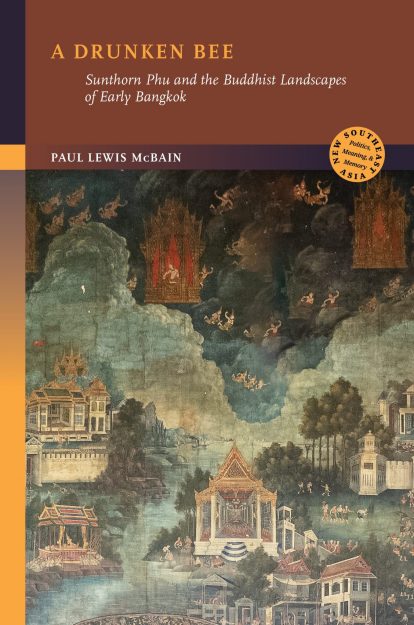
Adapted from research for A Drunken Bee: Sunthorn Phu and the Buddhist Landscapes of Early Bangkok by Paul Lewis McBain, copyright University of Hawaii Press, 2025.