Amazon to buy Globalstar to bolster Leo satellite business in deal worth about $11.5 billion
Amazon said it would acquire Globalstar, giving its nascent satellite internet business a boost as it vies to compete with Elon Musk's SpaceX.
 Tekef
Tekef

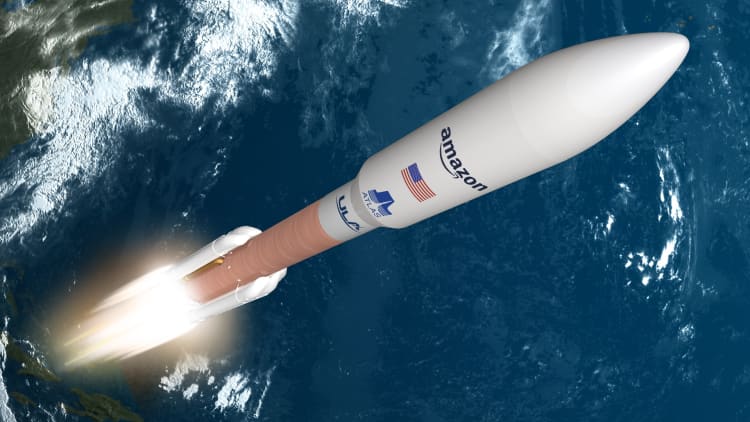
A United Launch Alliance Atlas V rocket is on the launch pad carrying Amazon's Project Kuiper internet network satellites, which are expected to eventually rival Elon Musk's Starlink system, at the Cape Canaveral Space Force Station in Cape Canaveral, Florida, on April 9, 2025.
Steve Nesius | Reuters
Amazon said Tuesday it would acquire Globalstar for $90 a share, in a deal worth $11.5 billion.
The deal will give Amazon's nascent Leo satellite internet business a boost as it vies to compete with Elon Musk's SpaceX.
Shares of Globalstar surged more than 9% in premarket trading. Amazon's stock rose about 1%.
Under the agreement, Amazon said it will acquire Globalstar's existing satellite operations, infrastructure and assets, including some spectrum licenses with global authorizations. Globalstar's new satellites and its existing fleet will operate alongside Amazon's network.
Amazon said the acquisition will enable it to build its own direct-to-device satellite system, which it expects to start deploying in 2028.
"By combining Globalstar's proven expertise and strong foundation with Amazon's customer-obsession and innovation, customers can expect faster, more reliable service in more places — keeping them connected to the people and things that matter most," Panos Panay, Amazon's senior vice president of devices and services, said in a statement.
Globalstar stockholders will choose to receive either $90 in cash or 0.3210 shares of Amazon common stock for each share of Globalstar stock that they own, the companies said.
Alongside the move, Amazon said it also agreed to a deal with Apple to provide satellite connectivity for current and future iPhone and Apple Watch features.
The transaction is expected to close in 2027.
Six years ago, Amazon unveiled its plans to build a constellation of thousands of low Earth satellites, designed to provide high-speed, low-latency internet to consumers, corporations and governments, offering connections through square-shaped terminals.
The company has sent up more than 240 satellites since last April through a series of rocket launches handled by partners, such as United Launch Alliance and SpaceX. It recently rebranded the service to Leo from Project Kuiper.
Amazon is trying to catch up to SpaceX's Starlink service, which currently dominates the internet-from-space market. Starlink has more than 10,000 satellites in orbit and over 9 million users. It recently received authorization from federal regulators to put another 7,500 satellites into orbit.
SpaceX also has a fledgling direct-to-device business, called Starlink Mobile. The company has acquired multiple spectrum licenses from EchoStar as it looks to build out that network.