An Incense Verse and Four Invocations
Come on in The post An Incense Verse and Four Invocations appeared first on Tricycle: The Buddhist Review.
 Tfoso
Tfoso
The following chapter is from Reading the Heart Sutra by Hiromi Ito, originally published in Japanese in 2010 and translated into English below for the first time by Jeffrey Angles. A renowned poet, Ito first came to national prominence in Japan in the 1980s for her groundbreaking writing about pregnancy, childbirth, and female sexuality. In Reading the Heart Sutra, she examines a number of Buddhist texts and reflects on them in the context of her own life as she navigates motherhood, loss, and caring for her aging parents. Over the course of the next year, Tricycle will be publishing the English translation of the book serially, with one chapter released each month. Read the first installment here.
***
My goodness.
Now I’ve gone and done it.
I’m no expert in the sutras, but I’ve gone and taken on this project simply because I couldn’t suppress my curiosity.
I’ve never regularly attended a temple, and I’ve hardly ever heard the sutras recited out loud. But here I am now, looking things up on my own, reading books, and searching the net. I’ve been finding that every little thing my hands, eyes, and ears encounter leads me to all sorts of fascinating passages, and through them, I am discovering what it means to be human.
Recently, I found some incredibly beautiful ones. Here they are.
香こう偈げ
願がん我が身み淨じょう如にょ香こう爐ろう
願がん我が心しん如にょ智ち慧え火か
念ねん念ねん焚ぼん燒じょう戒かい定じょう香こう
供く養よう十じっ方ぽう三さん世ぜ佛ぶ
Incense Verse
May my body be pure like an incense burner
May my heart burn like the fire of wisdom
With each thought, I burn the incense of discipline and meditation
And offer myself to the Buddhas of the ten directions
and three worlds, past, present, and future
四し奉ぶ請じょう
散さん華か樂らく散さん華か樂らく
奉ぼう請ぜい十し方ほう如じょ來らい入じ道どう場ちょう散さん華か樂らく
奉ぼう請ぜい釈せい迦か如じょ來らい入じ道どう場ちょう散さん華か樂らく
奉ぼう請ぜい弥び陀た如じょ來らい入じ道どう場ちょう散さん華か樂らく
奉ぼう請ぜい觀かん音にん勢せい至し諸しょ大だい菩ぼ薩さ入じ道どう場ちょう散さん華か樂らく
The Four Invocations
Music of the scattering of flowers—music of the scattering of flowers
We humbly invite the Tathāgatas of the ten directions
To enter this place of practice—music of the scattering of flowers
We humbly invite the Tathāgata Śākyamuni
To enter this place of practice—music of the scattering of flowers
We humbly invite the Śākyamuni Amitābha
To enter this place of practice—music of the scattering of flowers
We humbly invite Avalokiteśvara, Mahāsthāmaprāpta, and the other great bodhisattvas
To enter this place of practice—music of the scattering of flowers
Both the Incense Verse and the Four Invocations are recited at the beginning of a service. Maybe these aren’t sutra passages exactly as much as short poems. The text differs somewhat from sect to sect. There are parts that some sects read and some they don’t. I found the text of the Incense Verse in a book about Pure Land Buddhism, and I found the Four Invocations in a book about Tendai Buddhism. I understand there’s an alternative version of the Four Invocations that only contains three.
The pronunciation of the words 散華樂, meaning “music of the scattering of flowers,” as sankaraku struck me as really strange at first, but I understand this comes from the Han pronunciation, which reached Japan during the Tang dynasty. I understand many of the sutras use Wu pronunciations—the earliest readings that came to Japan from the area located near modern-day Nanjing, during the period of Northern and Southern dynasties—but I understand that occasionally in the sutras, we find the older pronunciations.
I understand. I understand. Just about everything I just wrote is prefaced with I understand. You’d think I’m the mayor of “I-Understand-Land” or something. Sorry. I’m just sharing what I’ve learned.
My family held funerals for my grandparents, but I really don’t remember them. I’ve got no recollection at all of the services. When I got married, we didn’t go to a temple. As a result, all my memories of hearing the sutras read out loud have faded into a blur: mumble-mumble then murmur-murmur-murmur-murmur then brrrrring—the ringing of a bell.
I don’t think I’ve ever heard these two verses recited live. I just happened across them in a book, and their beauty took my breath away. I felt so compelled to put them into my own words that before I knew it, I was working away on it. That’s my calling as a poet, I suppose.
The Incense Verse
With my body as pure
As an incense burner
With my heart as bright
As the flame of enlightened wisdom
I open my heart
I restrain the body
As I light this incense
I light it for the sake
Of all the enlightened ones
Who appear before us
The Four Invocations
I offer a scattering of flowers, I offer a performance of music
I offer a scattering of flowers, I offer a performance of music
Please come in, oh, you who have come from all directions
Traveling the path of truth, I offer a scattering of flowers
Please come in, oh, Lord Śākyamuni, who has come
Traveling the path of truth, I offer a scattering of flowers
Please come in, oh, Lord Amitābha, who has come
Traveling the path of truth, I offer a scattering of flowers
Please come in, oh, Lords Avalokiteśvara and Mahāsthāmaprāpta
Seeking the path of truth so you may guide humanity
Please come in, oh, all you bodhisattvas
Seeking all possible paths of truth so you may guide humanity,
Please come in, I offer a scattering of flowers.
When I first read these poems on the page, I imagined the author of the Incense Verse to be a strong-willed woman.
In my imagination, she’s wearing a robe of nearly transparent white. She’s seated alone in a gloomy temple hall, lighting a stick of incense. Her mouth is pursed and serious, and with an intense gaze, she reflects on her own body and mind as they undergo purification . . . How beautiful.
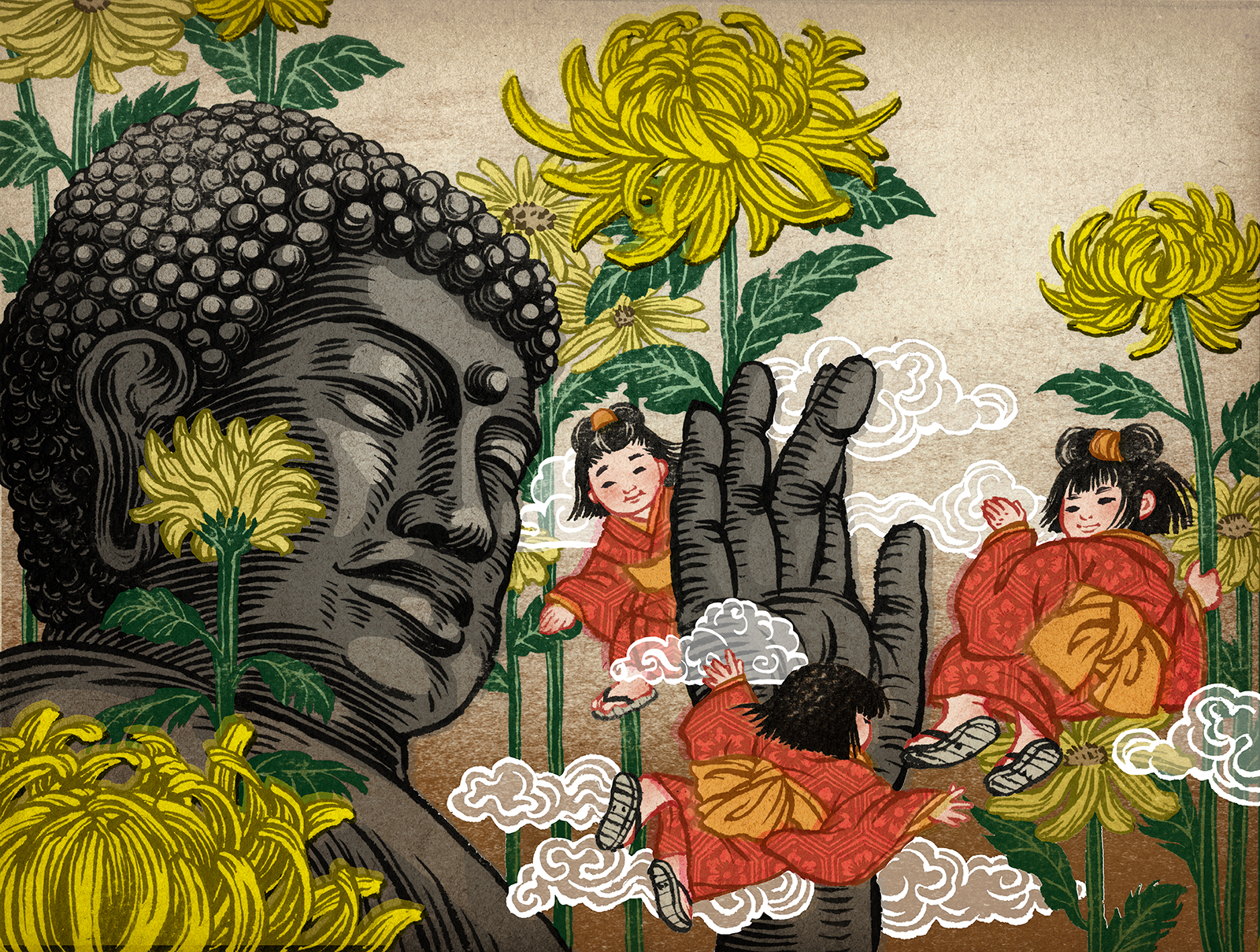
I imagine the author of the Four Invocations to be three or four young girls who are always smiling.
In my imagination, they’re out in a field filled with flowers. They’re picking offerings for the Buddha, but they’re so full of joy at being alive that they can hardly contain themselves . . . How beautiful.
When I finished my translations, I tried listening to the text on a bunch of different CDs. What I heard astonished me.
The priests doing the readings were all men. Maybe “readings” isn’t the right word. What they did was more like an incantation or song. Or, maybe even a growl or a groan. If I had been used to hearing that style of reading, I might have just nodded, satisfied and accepting, but quite frankly, I wasn’t used to hearing anything of the sort.
Their voices were thick and deep as if their noses were stopped up. There was something so unexpectedly masculine about their voices that I quickly tired of them.
That got me to thinking.
About a lot of things.
About my past. About our past. About the society we live in.
About the various relationships I’ve had with men. About the people I’ve abandoned, about the people I’ve dragged along in my adventures. About my life as a woman. About love and hate. About disappointment.
Sometimes I get fed up listening to men’s voices, but that doesn’t mean I dislike them. If anything, I like them. A lot. There’s one recording I heard of the Heart Sutra performed by some priests from the Chisan sect of Shingon. Several men were chanting as one man’s flat, low voice wound its way in, stretching and contracting as it twisted and turned around the others. Really beautiful. I’ve also really enjoyed some of the deep chords I’ve heard in shōmyō recitations, which remind me of the sound of the earth rumbling. Beautiful.
One Pure Land monk I talked to told me he’d been taught to read the sutras like a “clean breath of wind sliding over the watery surface of newly fallen drops of morning dew.” One Shingon monk told me he’d been taught to read the sutras like “rain falling on the eaves of the roof.” It seems that when men train their voices, they sometimes become deep and thick-sounding, transforming into wind and water droplets, resulting in the kinds of readings I’ve just described.
Still, given my druthers, I suppose I’d prefer to hear the Incense Verse recited by a woman. I’d like to hear women reciting the Four Incantations and the Heart Sutra too.
Just imagine a bunch of clear, soft, women’s voices stretching on and on. I’m not necessarily talking about what you might hear in Japan when people recite the sutras in the traditional ways. Instead, imagine a bunch of women reciting these ancient Buddhist verses using all the ancient sounds inherited from all the oral traditions that exist in every corner of the world. Just think how beautiful that would be!