Practice Like the Four Elements
A venerated teacher from the Thai forest tradition on using the elements to train our minds away from its habitual responses. The post Practice Like the Four Elements appeared first on Tricycle: The Buddhist Review.
 Kass
Kass
A city person may like to eat mushrooms. He asks, ‘‘Where do the mushrooms come from?’’ and someone tells him, ‘‘They grow in the earth.’’ So he picks up a basket and goes walking out into the countryside, expecting the mushrooms will be lined up along the side of the road for him to pick. But he walks and walks, climbing hills and trekking through fields, without seeing any mushrooms. A villager has gone picking mushrooms before, and she knows where to look for them; she knows which part of which forest to go to. But the city person only has the experience of seeing mushrooms on his plate. He heard they grow in the earth and got the idea that they would be easy to find, but it didn’t work out that way.
Training the mind in samadhi, meditative stability, is similar. We get the idea it will be easy. But when we sit, our legs hurt, our back hurts, we feel tired, we get hot and itchy. Then we start to feel discouraged, thinking that samadhi is as far away from us as the sky from the earth. We don’t know what to do and become overwhelmed by the difficulties. But if we can receive some training, it will get easier little by little.
When we are new to it, training in samadhi is difficult. Anything is difficult when we don’t know how to do it. But training at it, this can change. That which is useful can eventually overcome
and surpass that which is not. We tend to become fainthearted as we struggle—this is a normal reaction, and we all go through it. So it’s important to train for some time. It’s like making a path through the forest. At first it’s rough going, with a lot of obstructions, but returning to it again and again, we clear the way. After a while, we have removed the branches and stumps, and the ground becomes firm and smooth from being walked on repeatedly. Then we have a good path for walking through the forest. This is what it’s like when we train the mind. Keeping at it, the mind becomes illumined. The Buddha and his disciples were once ordinary beings, but they developed themselves to progress through the stages of enlightenment. They did this through training.
It’s important to train for some time. It’s like making a path through the forest. At first it’s rough going, with a lot of obstructions, but returning to it again and again, we clear the way.
What was the Buddha’s advice on how to practice meditation? He taught to practice like the earth, to practice like water, to practice like fire, to practice like wind. Practice like the ‘‘old things,’’ the things we are already made of: the solid element of earth, the liquid element of water, the warming element of fire, the moving element of wind.
If someone digs the earth, the earth is not bothered. It can be shoveled, tilled, or watered. Rotten things can be buried in it. But the earth will remain indifferent. Water can be boiled or frozen or used to wash something dirty; it is not affected. Fire can burn beautiful and fragrant things or ugly and foul things—it doesn’t matter to the fire. When wind blows, it blows on all sorts of things, fresh and rotten, without concern.
The Buddha used this analogy. The aggregation that is us is merely a coming together of the elements of earth, water, fire, and air. If you try to find an actual person there, you can’t. There are only these collections of elements. But for all our lives, we never thought to separate them like this to see what’s really there; we have only thought, ‘‘This is me. This is mine.’’ We’ve always seen everything in terms of a self, never seeing that there are merely earth, water, fire, and air. But the Buddha teaches in this way. He talks about the four elements and urges us to see that this is what we are. There are earth, water, fire, and air; there is no person here. Contemplate these elements to see that there is no being or individual, but only earth, water, fire, and air.
It’s deep, isn’t it? It’s hidden deep—people will look but they can’t see it. We’re used to thinking in terms of self and other all the time. So our meditation is still not very deep. It doesn’t reach the truth, and we don’t get beyond the way things appear to be. We remain stuck in the conventions of the world, and being stuck in the world means remaining in the cycle of transformation: getting things and losing them, dying and being born, being born and dying, suffering in the realm of confusion. Whatever we wish for and aspire to doesn’t really work out the way we want, because we are seeing things wrongly. With this kind of grasping attachment, we are still very far indeed from the real path of dharma.
Let’s get to work right now. Our practice of dharma should be getting us beyond suffering. If we can’t fully transcend suffering, then we should at least be able to transcend it a little, now, in the present. For example, when someone speaks harshly to us, if we don’t get angry, we have transcended suffering. If we get angry, we haven’t transcended dukkha.
When someone speaks harshly to us, if we don’t get angry, we have transcended suffering. If we get angry, we haven’t transcended dukkha.
When someone speaks harshly to us, if we reflect on dharma, we will see it is just heaps of earth involved. OK, he is criticizing me—he’s just criticizing a heap of earth. One heap of earth is criticizing another heap of earth. Water is criticizing water. Air is criticizing air. Fire is criticizing fire.
But if we really see things in this way, then others will probably call us mad. ‘‘He doesn’t care about anything. He has no feelings!’’ When someone dies we won’t get upset and cry, and they will call us crazy.
It really comes down to practicing and realizing for ourselves. Getting beyond suffering doesn’t depend on others’ opinions of us, but on our own individual state of mind. Never mind what they will say—if we experience the truth for ourselves, then we can dwell at ease.
When difficulties occur, recollect dharma. Think of what your spiritual guides have taught you. They teach you to let go, to have restraint and self-control, to put things down; they teach you to
strive in this way to solve your problems. The dharma that you study is just for solving your problems.
What kind of problems are we talking about? How about your families? Do you have any problems there? Any problems with your children, your spouses, your friends, or your work? All these things give you headaches sometimes, don’t they? These are the problems we are talking about; the teachings are telling you that you can resolve the problems of daily life with dharma.
We have been born as human beings. It should be possible to live with happy minds. We do our work according to our responsibilities. If things get difficult, we practice endurance. Earning a livelihood in the right way is one sort of dharma practice, the practice of ethical living. Living happily and harmoniously like this is already pretty good.
We are usually taking a loss, however. Don’t take a loss! If you go to a center or a monastery to meditate and then go home and fight, that’s a loss. Do you hear what I’m saying? It’s just a loss to do this. It means you don’t see the dharma even a tiny little bit—there’s no profit at all.
♦
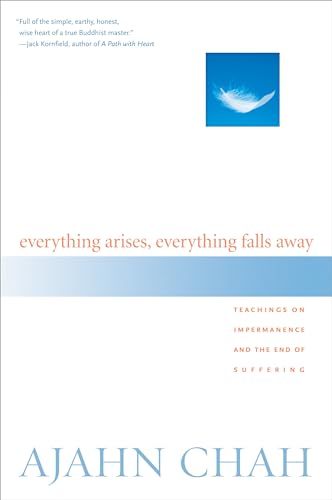
From Everything Arises, Everything Falls Away © 2005 by Ajahn Chah, translated by Paul Breiter. Reprinted in arrangement with Shambhala Publications, Inc. Boulder, CO. www.shambhala.com