Beyond the Glass Tunnel
Buddhist teachings find unexpected resonance in the work of British philosopher Derek Parfit. The post Beyond the Glass Tunnel appeared first on Tricycle: The Buddhist Review.
 KickT
KickT
“I enter the Teletransporter,” imagines the British philosopher Derek Parfit.
The machine scans each one of my cells, sends the information to Mars, and destroys my body. Another machine on Mars then reconstructs it atom by atom. I step out of the other machine, good as new, and go about my martian business.
By now I’ve completed the journey unscathed many times. This time, however, when I step into the Transporter, all I hear is a brief whirring sound; I’m not destroyed. I step out and tell the technician that there’s a problem. “Nothing to worry about,” she says reassuringly. “The machine’s just been updated. Now, it replicates travelers on Mars without destroying them here on Earth. If you’d like, you can watch live footage of yourself arriving on Mars.” I turn to a monitor, horrified and incredulous. But sure enough, there I am, on another planet.
The two people are physically and psychologically identical. Both retain the same memories and dispositions, and both have teletransported before without issue. So which of the two is the one who stepped into the Teletransporter a moment earlier? Which one is the real me?
Parfit says that questions like these are “empty”: We can’t answer them in any definitive or satisfying way. Indeed, not only are they empty, they also don’t matter. “Personal identity is not what matters,” writes Parfit in his landmark 1984 book Reasons and Persons, where this now famous Teletransportation scenario first appeared. Our identity is unimportant because we aren’t the stable, well-defined things we think we are—a conclusion that strikes some as depressing but is, for Parfit, a “liberating and consoling” insight that resonates strongly with Buddhist anatman (no-self) teachings.
Derek Parfit (1942–2017) was a highly original thinker whose work on personal identity and ethics had a profound impact on the philosophical world. His peculiar life and eccentric personality were chronicled in an excellent 2023 biography by David Edmonds, Parfit: A Philosopher and His Mission to Save Morality, and more recently in a book of personal essays by those who knew him best. Much of Parfit’s work relied on disorienting thought experiments like the Teletransporter case. He painstakingly described imaginary cases of brain fission, worlds in which nothing exists, and scenarios where readers acquire all of Napoleon’s memories in order to unearth our unspoken intuitions about the world, and to challenge those intuitions in cases where they proved false.
 Derek Parfit. Courtesy of Toby Ord.
One such false intuition is that people retain their identity through time, that there is some thing—a “self,” a “soul,” a “thinking substance,” or what Parfit simply described as a “further fact”—that bundles together the physical and psychological facts of our lives. The person is fully reducible to these “impersonal” elements, leading Parfit to the conclusion that “we could give a complete description of reality without claiming that persons exist.”
That the self is not unitary or stable is demonstrated not only by wacky teletransportation thought experiments but also by the more mundane facts of cell turnover and even psychological change. I am not a thing, but rather a process, a flux, a stream of ever-changing sensations and parts in constant and highly intricate causal interaction. Cells form and pass away; emotions come and go; thoughts crystallize and disintegrate. If I conceive of myself as a unitary, enduring entity, the transitoriness and fragility of life take on a tragic aspect. My death becomes a nightmare of nonexistence. Describing his emancipation from this false self-understanding, Parfit writes in Reasons and Persons:
When I believed that my existence was such a further fact, I seemed imprisoned in myself. My life seemed like a glass tunnel, through which I was moving faster every year, and at the end of which there was darkness. When I changed my view, the walls of my glass tunnel disappeared. I now live in the open air. There is still a difference between my life and the lives of other people. But the difference is less. Other people are closer. I am less concerned about the rest of my own life, and more concerned about the lives of others.
This often-quoted passage has been described as one of “the most moving, effective, and humane to be found in modern philosophy”—a remark that might tell you more about the aridity of analytic philosophical writing than about Parfit’s rather staccato style, but which nevertheless reflects the profound sense of relief from the torments of mortality anxiety that his philosophy affords.
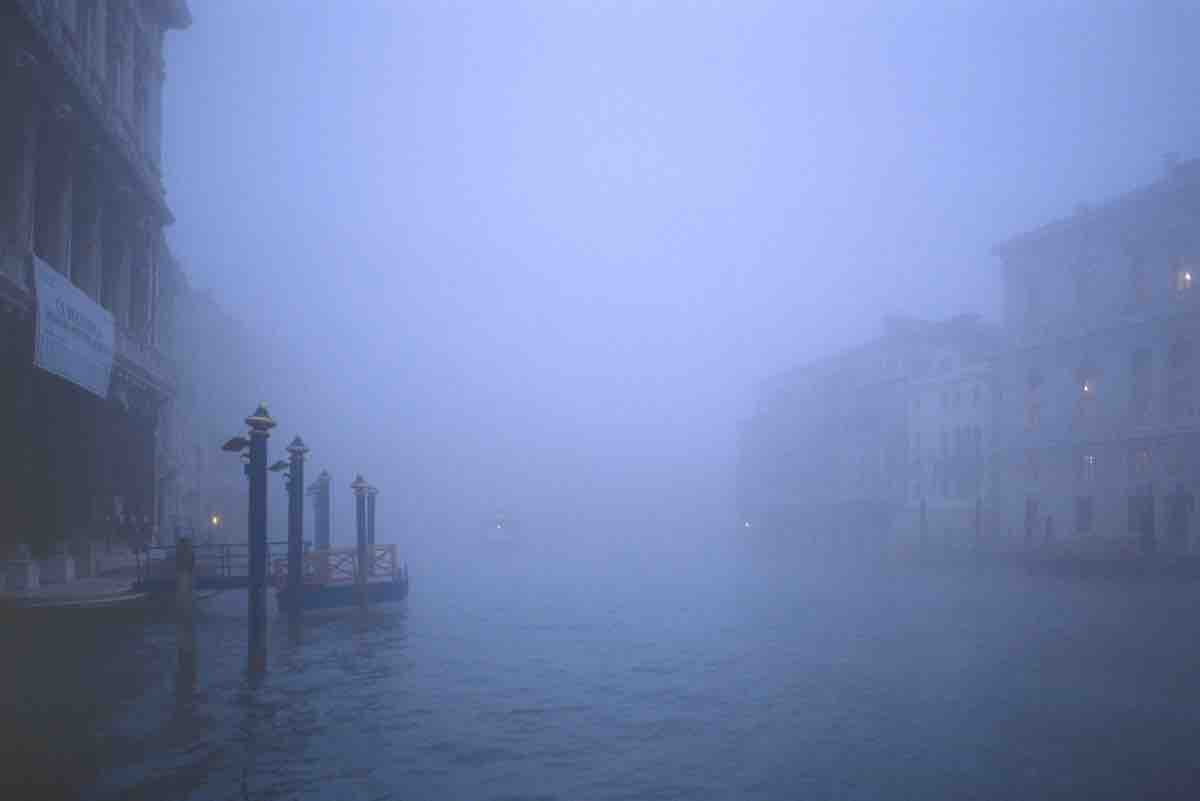
Parfit’s conclusions about the self’s unstable and dynamic nature are borne out by his own life. Until his mid-30s, Parfit was outgoing, literary, and multilingual; his interests were many and varied. From middle age onward, however, he became increasingly reclusive and work-obsessed. The 300-plus pages of Jeff McMahan’s Derek Parfit: His Life and Thought (2025) read as a catalog of bizarre personal quirks recounted by friends and family members, from daily rituals of nude stationary cycling and multihour toothbrushing to a monomaniacal, unfulfilled quest to achieve the perfect photograph of St. Petersburg in the snow and Venice in the mist (these were virtually his only two subjects).
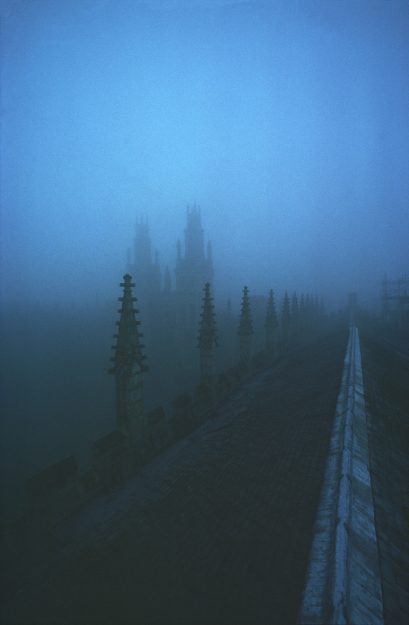 Derek Parfit, Misty blue spires (Oxford). | Courtesy of Janet Radcliffe Richards
Some of these changes might be explained by the fact that Parfit lived and worked for almost his entire career at All Souls College, a hermetic Oxford institution known for its idiosyncratic rituals and eccentric fellows, who have no administrative or teaching duties and who are free to exercise their genius as they see fit. The change might also be explained physiologically: Parfit struggled for years with insomnia and consumed vast quantities of vodka and sleeping pills to manage it. A large part of the personal transformation, however, remains a great mystery to those who knew him. His biographer remarks that the younger Parfit was so indistinguishable from his older self that he was to “become, some might say, a different person.” A former student, meanwhile, described Parfit as “not quite a person,” observations that Parfit himself might have endorsed given his views on personal identity.
Parfit’s “reductionist” understanding of the person—the view that persons are fully reducible to a stream of mental and physical events—practically begs for comparison to the Buddhist teaching of no-self. Parfit was himself highly cognizant of the connection, taking the Buddha’s anticipation of his thesis as evidence that it is “the true view about all people at all times.” He quotes from a variety of Buddhist texts, from The Questions of King Milinda to Vasubandhu’s Treasury of Abhidharma and Buddhagosha’s Path of Purification, to draw out the parallels. He also found in Buddhist teachings a reason to believe that the insight of no-self could be more than just intellectually understood. Rather, he insisted that it could be fully experienced:
[Others have] claimed that it is psychologically impossible to believe the Reductionist View. [The] Buddha claimed that, though this is very hard, it is possible. I find [the] Buddha’s claim to be true. … Since I can believe this view, I assume that others can do so too. We can believe the truth about ourselves.
When Parfit wrote these words in the early 1980s, it was rare to mention—let alone endorse—Buddhist ideas in mainstream academic philosophy, so it is perhaps unsurprising that Reasons and Persons drew the attention of many philosophically inclined Buddhists. More surprising, however, is the fact that the text drew the interest of a Tibetan monastic community who began to incorporate it into their curriculum, chant passages from it, and weigh its arguments in the formalized exchanges of tsopa, the dialectical debate system of Tibetan Buddhism.
Parfit’s work had a major impact on the study of Buddhist philosophy, as scholars took up the vocabulary of Reasons and Persons and debated whether or not the Buddhist no-self teaching is “reductionist” in the way that Parfit describes. Some have argued that the attempt to impose Parfit’s Western philosophical categories on Buddhist authors has obscured their original insights, while others see his ideas as useful in the effort to reconstruct Buddhist arguments so that they can better convince a skeptical audience. Parfit himself insisted in an interview that “I do not accept the Buddhist no-self view, since I believe that persons exist. We are persons. But I believe that persons are not entities of a kind that must be recognized in any adequate conceptual scheme.”
This remark may strike some as confusing, even contradictory, given the enormous effort Parfit expended in showing that the self was reducible to a set of “impersonal” elements. But he didn’t think that this reduction proved our nonexistence; it just showed that we are less mysterious than we think we are. Philosophers try to convince us that we are free-floating, invisible “souls” or “minds,” when really it’s less complicated than that. We don’t have bodies, feelings, or experiences; we are bodies, feelings, and experiences.
Parfit distinguished his “reductionist” view from “eliminativism,” or the view that the person is an entirely fictitious entity whose harmful presence in our language must be undone. Although Parfit seems to identify the Buddhist no-self view as eliminativist, scholars have debated whether this is really the case. Don’t Buddhists accept the self as conventionally, albeit not ultimately, real? How else could we go about our daily lives? Would it even be possible to act ethically if we didn’t have the concept of a person?
Yes and no. While the world would quickly become, as William James put it, “a blooming, buzzing confusion” if we weren’t able to distinguish between different people, the idea that I am an entity completely severed from others has unfortunate ethical consequences. It leads, for instance, to a vision of the self as an autonomous agent whose interests are set against everyone else’s—an image that dominated the period in which Parfit was writing Reasons and Persons and which was epitomized in a dictum by Margaret Thatcher: “There is no such thing as society. There are individual men and women and there are families.”
Parfit took issue with this outlook and devoted much of his career to fleshing out the implications of his reductionism for our ethical lives. He argued that, given the nature of persons, we have no reason to privilege our own well-being over any one else’s. Theories that supported self-interested behavior, he thought, directly undermined their own goals: If we all acted out of self-interest, everyone would be worse off, myself included. Thatcherite visions of the individual are not only false but also self-defeating.
Even more radically, Parfit believed that we have no reason to privilege our own current well-being over that of future people, not excluding the future person that shares my name and Social Security number. If I leave shards of broken glass in the forest, what difference does it make whether a child steps on them tomorrow or a thousand years from now? We are morally required to show equal concern for everyone, “self” and “other,” past, present, and future. Parfit’s insight that our moral concern shouldn’t be arbitrarily restricted to the present moment sparked a renaissance in population ethics, a field that has become increasingly important as we think through the generational effects of climate change and the obligations we hold toward those who will be affected by it in the decades and centuries to come.
Parfit believed that we have no reason to privilege our own current well-being over that of future people, not excluding the future person that shares my name and Social Security number.
Though Parfit’s “moral mathematics” and insistence on impartiality in ethics may strike many as somewhat cold, much of his philosophy was actually an attempt to make sense of and systematize his deep sense of moral pain at the suffering of others. Parfit was known to spontaneously burst into tears behind the lecture podium at the mere thought of comatose patients or World War I. Those who knew him expressed wonder at the fact that he never experienced any retributive emotions whatsoever, and in philosophical discussions he balked at the idea that there could ever be a justification for deserved punishment. As the child and grandchild of former Christian missionaries, Parfit had early aspirations to become a monk but lost his faith at the age of 7 because he concluded that a benevolent God would not allow suffering.
His tendency to become overwhelmed by the pain of others grew only more intense with age. In his later life, Parfit also became increasingly worried by the idea that, as his biographer puts it, “If morality was not objective, life was meaningless. His own life was meaningless, and every human and animal life was meaningless.” Haunted by this specter of nihilism, he began to devote his philosophical energies to refuting the claim that the world of value and meaning, of goodness and beauty, was just a projection of our minds. Whereas his earlier work sought primarily to draw out the moral implications of the insight that “personal identity is not what matters,” later in life Parfit turned to the question of what does matter, if not ourselves. Thus, his second and final book, the modestly titled On What Matters (2011), Parfit tried in a mere 2,000 pages to prove not only that morality was objective but also that disagreement between different moral theories was only apparent. Basically, the truth about morality exists, and we all secretly agree about what it is. Few find the book’s thesis plausible, but it’s hard not to admire the sheer architectural integrity of On What Matters, a book whose impressive construction invites comparison to the Venetian buildings Parfit spent decades photographing.
 Derek Parfit, Boat Straps (Venice). | Courtesy of Janet Radcliffe Richards
Parfit’s extraordinary capacity for compassion and his commitment to a universalistic, unconventional, and highly demanding moral vision may go some ways toward explaining why this intensely atheistic, proudly secular philosopher is so often described in religious terms. He has been called “saintly,” “egoless,” “omnibenevolent,” “a higher form of being,” “a Godlike figure,” “a modern secular missionary,” an “ascetic,” and even a pratyekabuddha, and the experience of being taught by him has been likened to a “religious experience” and a “conversion.” This extravagant praise shows that there is more than a hint of religiosity in Parfit’s philosophy, despite his insistence otherwise.
No-self, reductionism, impermanence, suffering, compassion, omnibenevolence. . . . That Parfit did not take more interest in the many Buddhist resonances of his work is somewhat surprising. Of course, Parfit would have had very little occasion to observe Buddhism as a lived practice, though he was certainly aware of its ideas. Moreover, as someone who viewed himself as standing at the dawn of an epoch of secular philosophizing, he was unlikely to be attracted to any religious concepts, no matter the tradition. Given Parfit’s terror at the prospect of meaninglessness and obsessive search for a moral foundation that could dispel the specter of nihilism, it is also possible that Parfit was simply put off by the idea of emptiness so synonymous with Buddhist philosophy. This distaste may also explain why he took pains to distinguish his position on the self from the “eliminativist” one purportedly upheld by the Buddha.
Why should a Buddhist care about Derek Parfit, then? Parfit found in Buddhism a confirmation of his own thought, proof for the validity of his ideas beyond his narrow historical and geographical context. Though some might harbor reasonable doubts about one person’s ability to come up with “the true view about all people at all times,” many Buddhists seem to be attracted to Parfit for a similar reason. His ideas stand as testimony that Buddhist teachings remain philosophically robust, relevant, and even emancipatory in a world far removed from that of the Buddha. Now, as then, “most of us have a false view about ourselves, and about our actual lives. If we come to see this view as false, this may make a difference” by enabling us to live, as Parfit writes, “in the open air.”























.jpg&h=630&w=1200&q=100&v=c0f97a310e&c=1)