Can't Stop Watching Sports This Summer? There's A Biological Reason Why
Get in the crowd!
 AbJimroe

Image by FG Trade / iStock July 31, 2026 If you were anywhere near Madison Square Garden when the Knicks clinched their first championship in 53 years, or spent an afternoon packed into a sports bar watching World Cup matches this summer, you already understand why everyone has been obsessed with watching sports. Your chest tightens with every near-miss. You cheer in unison. You hug people you've never met. You enter a room full of strangers, and by the end of the game the people suddenly feel like your family. Many people on social media have been describing this feeling as "collective effervescence," which describes the shared energy and connection people experience when they gather with others for a common purpose, like watching a live sporting event. The feeling is electric, and a new study1 is explaining the biological reason why.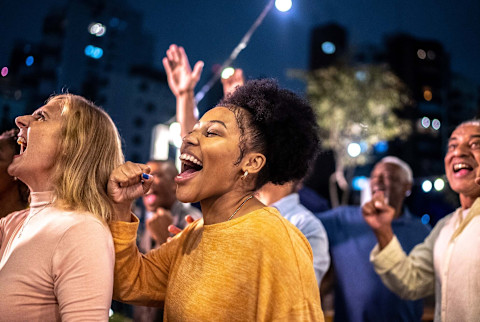
About the study
Researchers recruited spectators attending a college basketball game, not a championship game or a sold-out arena, but a regular college basketball match. The setting was intentionally modest, because the researchers wanted to know whether the effect of a live event was real even in a low-stakes environment, without the amplifying pressure of a major sporting event.
They used saliva samples to measure spectators' levels of oxytocin before and after the event, a hormone associated with bonding, trust, and emotional closeness. They also tracked participants' heart rates throughout the game using wearable monitors. After the event, participants filled out questionnaires rating how socially connected they felt to the people around them.
What they found
The researchers came away with two major findings.
The researchers saw that simply being in the crowd sent oxytocin levels soaring. People who started the game with lower oxytocin levels saw those levels rise over the course of the event, and people who began with higher levels of oxytocin held steady at that elevated level. By the final whistle, both groups had landed at similar oxytocin concentrations. Meanwhile, cortisol (the stress hormone) dropped across the board, and the ratio of oxytocin to cortisol climbed steadily.
Researchers were more surprised to see how participants' heart rates synchronized with one another during the game. Strangers sitting near each other showed aligned cardiovascular rhythms in real time, rising and falling together as the action on the court unfolded. The researchers measured this alignment and found it increased significantly during both halves of the game compared to before tip-off.
The degree of heart rate synchrony was also correlated with how connected spectators reported feeling to the people around them. The more their hearts beat in time, the more bonded they felt.
Why it matters
Oxytocin plays a key part in how we build trust, regulate stress, and feel a sense of belonging. Higher oxytocin is associated with reduced anxiety, greater generosity, and stronger social ties, all of which contribute meaningfully to long-term well-being.
The heart rate synchrony finding adds another layer. When your body physiologically aligns with the people around you, it's a sign of deep social engagement. This kind of physiological coordination has been observed between close friends and romantic partners, but finding it among strangers in a crowd is rare. It suggests that shared attention and shared emotion can create a real biological bond, even briefly with people you'll never see again.
Together, these findings suggest that live spectatorship isn't just entertainment. It's a form of social medicine.
You don't need to wait for a championship game
You don't need a playoff run or a World Cup bracket to access this effect. The study used a regular college basketball game, which is the kind of low-stakes sporting event you can find in your city just about every weekend.
The key ingredients appear to be physical presence, shared attention, and collective emotion, not the size of the stage. A local soccer match, a high school play, a live concert, or even a community event where people are genuinely invested in a shared outcome should all be able to produce a similar response.
The common thread is being there, in the room, with other people who care about the same thing at the same time. New research on face-to-face connection confirms that physical presence carries a biological weight that screens simply can't replicate.
If you've been feeling disconnected or socially depleted, this research offers a surprisingly simple prescription: get in the crowd! Watching a stream from your couch is not the same as being physically present, surrounded by people who are feeling what you're feeling.
The takeaway
Science confirms that there's something genuinely powerful about showing up together. The next time you feel that inexplicable rush of closeness with a room full of strangers at a game, a concert, or a community event, know that it's not just in your head. Your oxytocin is rising. Your heart is literally beating in time with theirs.
Remember this the next time you're debating whether it's worth checking out a concert with your friend, hesitating on going to a sports bar before a match. The hardest part is getting out the door, and once you're there, chances are you will be happy you went.