Cold Email vs LinkedIn Outreach: Which Performs Better in 2026?
Cold email works better for scale and cost-efficiency. LinkedIn outreach works better for trust and response rates. The highest-performing teams in 2026 use both together. That’s the honest short answer. But the longer one matters more. Because the way...
 JimMin

Cold email works better for scale and cost-efficiency. LinkedIn outreach works better for trust and response rates. The highest-performing teams in 2026 use both together.
That’s the honest short answer. But the longer one matters more. Because the way most people use these channels is exactly why they’re not getting results.
Cold email still works in 2026. So does LinkedIn outreach. What stopped working is the lazy version of both: blasting hundreds of templated messages and hoping someone bites. Inbox providers got smarter. LinkedIn got stricter, and prospects got tired…
The teams winning right now are following a better approach.
What Changed in Outreach in 2026?
Three things made outreach harder, and better at the same time.
Email deliverability became much stricter: Starting in 2024, Google, Yahoo, and Microsoft introduced tighter spam rules. Today, if your domain isn’t properly authenticated with SPF, DKIM, and DMARC records, your emails don’t reach inboxes. They’re just gone. Many teams discovered this after their open rates quietly cratered.
LinkedIn tightened its rules on automation: The platform now tracks connection acceptance rates. If you fall below roughly 30–40%, your ability to send new invitations gets limited. Automated tools that used to work freely are restricted or banned. This hurt many agencies running high-volume LinkedIn campaigns.
AI-generated outreach made people suspicious: When everyone uses similar tools to “personalize” messages, patterns become obvious. The hyper-polished, perfectly structured cold message is a red flag. Generic AI copy gets ignored faster than a plain, slightly imperfect human message.
Is cold outreach still effective in 2026?
Yes, but not the version most people are running.
Mass, untargeted, copy-paste outreach is dead. What still works is more deliberate. Outreach based on real research, sent to people who actually have a reason to care.
When done right, cold email typically sees open rates around 21–24%, with reply rates reaching 8–12% when personalization done properly. LinkedIn outreach, when targeted carefully, can reach reply rates of 30–50%. These aren’t theoretical numbers. They’re happening for teams willing to do the harder work upfront.
Cold Email Outreach in 2026: What Works Now
Cold email is just less forgiving than it used to be. The teams doing it right are seeing better results now, because most of the noise dropped out. But getting it right means understanding what works, what doesn’t, and where most people go wrong.
Here’s how it looks today.
Pros of cold email outreach
Cold email is the only outbound channel that allows a small team, even a single person, to reach thousands of qualified prospects without a huge time investment.
With cold email, you can:
automate sequences test subject lines track performance in detailThat level of control simply doesn’t exist on LinkedIn.
And when the numbers make sense, it’s hard to ignore. Some reports still show an average return of around $42 for every $1 spent.
Another advantage is direct access. Your message lands in the inbox. There’s no algorithm deciding who sees your message. No follower count required. If you have someone’s email and your domain is healthy, you can reach them.
Cons of cold email outreach
The barrier to entry is much higher now. Without proper setup, your emails won’t land. They’ll be filtered or blocked entirely. Purchased lists and scraped contacts will damage your domain reputation quickly. And even if your emails do land, poor targeting kills results. If your message isn’t relevant, it gets deleted in seconds.
There’s also a reputational risk. Done poorly, a cold email can hurt your brand and your domain for months.
What makes cold email work today
Three things, in order of importance:
Clean listsFocus on verified emails and real targeting. No shortcuts. Campaigns sent to fewer than 50 well-chosen prospects can reach reply rates around 5.8%. Large blasts to 1,000+ contacts often drop around 2.1%. Volume looks efficient, but it rarely performs better.
Domain setup and reputationUse a dedicated sending subdomain for cold outreach, separate from your main business email. Set up authentication properly. Then warm up the domain slowly over four to six weeks, starting with just 5–10 emails per day. Many teams underestimate email deliverability issues and how to fix them before starting outreach.
Controlling sending volumeKeep cold outreach under 100 emails per day per sending address. This isn’t only about avoiding spam filters. It’s about maintaining a natural sending pattern. Real people don’t send hundreds of identical emails in a short time.
What is the average success rate of cold emails?
Based on recent industry benchmarks across platforms like Mailchimp, HubSpot, and outbound tools such as Reply.io and Lemlist, cold email performance typically falls within these ranges:
Open rates: 21–24% on average, up to 32–38% with personalized subject lines Reply rates: 1–2% for generic emails 3–5% with basic personalization 8–12% with hyper-personalized copy 10–15% for warm follow-upsThe biggest driver of reply rates is personalization quality, not volume, not subject line tricks, not sending time.
A specific, relevant observation about the prospect’s business will outperform most other tactics.
How many emails can you send per day safely?
Keep it under 100 emails per day per sending address. If you’re warming up a new domain, start at 5–10 per day and build up gradually over a few weeks.
If you push beyond that too quickly, you risk triggering spam filters. And once your domain reputation drops, fixing it takes time.
For follow-ups, four to five emails spaced three to five business days apart work best. Nearly half of all replies come from follow-ups, not the first email.
Go beyond five touches, and you’ll likely see more complaints than results.
LinkedIn Outreach in 2026: Strengths and Limitations
LinkedIn outreach gets better results than cold email on paper, but it comes with real constraints most people don’t talk about. The trust factor is genuine, the reply rates are higher, and the conversations tend to be warmer. The tradeoff is scale, cost, and time. Here’s what it actually looks like in practice:
What is LinkedIn outreach, and how does it work?
LinkedIn outreach is the practice of reaching prospects directly on LinkedIn. Either through connection requests with personalized notes, direct LinkedIn outreach messages after connecting, or paid InMail credits that let you message people outside your network.
People are already in a professional mindset when they’re on LinkedIn. They expect conversations about work. That alone makes a difference.
Pros of LinkedIn outreach
Trust builds faster here than in any other outbound channel.
When someone receives your message, they can immediately check:
your profile your experience your connectionsYou’re not just another email. You’re a visible person. That changes how people respond.
InMail messages reportedly achieve open rates up to 85%. Even if the real number is lower than that, it’s still dramatically higher than anything cold email can reliably deliver.
And for certain industries, professional services, legal, finance, LinkedIn reply rates hit over 10%, with genuine interest rates (not just replies, but actual positive responses) between 25–35%
There’s also one tactic that stands out right now: voice notes.
A short 30-second voice note sent after someone accepts your connection request can generate up to eight times more replies than a text message. Voice messages feel more personal. If you don’t have some level of familiarity or a clear reason to send one, it can come across as unprofessional or simply annoy the person receiving it.
Used carefully, it’s one of the most effective tools in outbound. Used at the wrong moment, it can hurt your chances.
That’s why most people avoid it, and why it still works when done right.
Cons of LinkedIn outreach
LinkedIn limits how many connection requests you can send, in the range of 50–200 per month, depending on your account tier and behavior. InMail credits cost around $1.60 each. For broad market outreach, this is simply too expensive and too slow.
It’s also time-intensive by nature. You can’t responsibly automate LinkedIn outreach the way you can with email. Each message needs to be personal, each sequence needs to be monitored manually, and each account needs to maintain healthy acceptance rates or face throttling. Scaling LinkedIn properly takes real effort.
You can’t rely on automation the same way you can with email. Each message needs to feel personal. Each interaction needs attention. And your account needs to maintain healthy acceptance rates, or LinkedIn will limit your activity.
Scaling LinkedIn outreach properly takes effort. There’s no shortcut here.
What works on LinkedIn outreach today
Three patterns show up consistently.
1. Real personalization
Not just using someone’s name or job title. Referencing something specific they’ve said, posted, or worked on.
2. Content + outreach
People who post or engage on LinkedIn before reaching out get better results. When your name is already familiar, replies come easier.
3. Consistency over volume
10 great LinkedIn messages per day beats 100 mediocre ones every single time.
Is LinkedIn outreach free or paid?
You can do a lot on LinkedIn for free. Standard connection requests with personalized notes don’t cost anything. Direct messages to first-degree connections are free. The limitation is scale. Free accounts are more restricted in how many requests they can send.
Sales Navigator unlocks better search filters and higher outreach volume. InMail credits are paid and make most sense for high-value prospects.
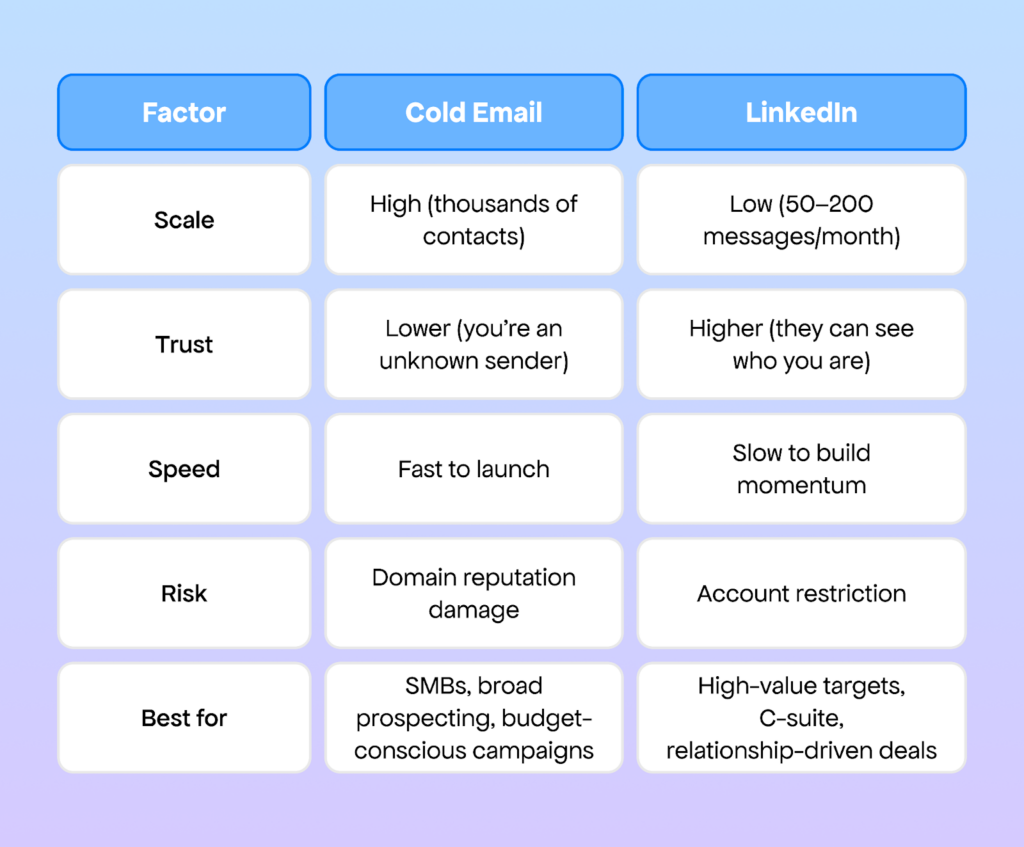
Cold Email vs LinkedIn Outreach: Side-by-Side Comparison
Which One Should You Use? (Use Case Breakdown)
It depends on your business type and deal size. SMBs, agencies, and high-ticket B2B teams each have a different starting point. Here’s the breakdown:
For SMBs:Start with a cold email.
It’s cost-efficient, scalable, and allows you to test messaging quickly across a larger audience. Focus on deliverability, keep your lists small and targeted, and run proper follow-up sequences.
For agencies:Go hybrid.
Use cold email to fill the top of the funnel and LinkedIn to warm up high-value prospects before outreach. Agencies targeting local businesses often see open rates in the 25–35% range. That’s a solid foundation to build on.
Start with LinkedIn, then follow up with email.
Senior decision-makers are more responsive when there’s already a LinkedIn connection. If they’ve seen your profile or content, your email doesn’t feel cold anymore.
That combination consistently outperforms using either channel alone.
The Best Strategy in 2026: Combine Both
Neither channel alone is enough anymore. LinkedIn builds the trust, email drives the volume, and together they consistently outperform either one used solo.
What is the most effective outreach method today?
It’s a hybrid outreach.
Use LinkedIn to build familiarity and trust. Use email to follow up at scale.
Campaigns that combine both tend to see around 25% higher reply rates compared to email alone. In some cases, engagement increases even more when multiple touchpoints are used.
The channels support each other. One builds context, the other drives action.
A sequence that works:
Step 1: Connect on LinkedIn.
Identify 50 well-researched prospects. Send a short, personal connection request. Don’t pitch. Give a specific, genuine reason you reached out to them. Mention something real.
Step 2: Engage with their content.
After connecting, spend a few days interacting with their posts. Like, comment, or react. This helps your name become familiar before you send a message.
Step 3: Follow up via email.
Send a cold email based on real research. Reference something specific, a post, a podcast, or a visible gap in their business. This changes how your message is received.
Step 4: Use multiple touchpoints.
Follow up with a LinkedIn message or a second email. Share something useful, a short insight, a relevant case, or a helpful resource.
Keep the sequence to four or five touches over two to three weeks. If there’s no response after that, move on.
Common Mistakes That Kill Outreach (Both Channels)
Most outreach fails because of how it’s executed. If you’re looking for cold outreach best practices, start here. Because the same mistakes happen repeatedly, across cold email and LinkedIn both. Knowing them up front saves you a lot of wasted time and effort.
What are the biggest mistakes in cold outreach?
Sending too fast – New domains that push to 100+ emails per day get immediately flagged. The same applies to LinkedIn. Sending too many connection requests with low acceptance rates can limit your account.Start slow, especially at the start.
Poor targeting – The gap between a well-targeted list of 50 and a blast to 1,000 isn’t small. It’s the difference between roughly 5.8% and 2.1% reply rates.More importantly, poor targeting affects more than performance. Over time, it damages your domain reputation and your standing on LinkedIn.
Over-automation – Automation can help with email sequencing. But using it for personalization is where things break.The market is now highly sensitive to AI-generated messages. People recognize the patterns. What feels “personalized” to a tool often reads as hollow to a real person.
Ignoring email infrastructure – SPF, DKIM, and DMARC are the foundation. Without them, your emails won’t reach the inbox.Copy-paste personalization – Using a first name and company name is no longer enough.
Real personalization means saying something that applies only to that person. A specific observation. A real reason for reaching out.
Final Thoughts
Cold email isn’t going away. LinkedIn isn’t a shortcut. Both work when used properly. Both fail when treated as volume games.
The teams getting consistent results today are more deliberate. Smaller lists, better research, stronger messaging, and enough patience to follow up.
Outreach in 2026 may feel slower than before. But slower and more targeted works better than fast and generic.
And honestly, it makes sense. No one wants to feel like just another name in a sequence. Treat outreach as a conversation, and the results follow.
FAQs
1.Is email or LinkedIn better for outreach?
Neither is universally better. Cold email is better for scale and cost. LinkedIn builds trust faster and often gets higher reply rates per message.
The right choice depends on your offer, audience, and budget. Most effective strategies use both LinkedIn to warm the relationship, then email to follow up.
2. What is the 30/30/50 rule for cold emails?
The 30/30/50 rule suggests spending 30% of your effort on list building, 30% on deliverability and technical setup, and 50% on the actual copy and personalization. It highlights a common mistake. Many people focus only on writing the email, while targeting and infrastructure actually determine whether the email gets seen.
3. What is the 3/2/1 rule on LinkedIn?
The 3/2/1 rule is a content and outreach framework: for every 3 posts that educate or add value, write 2 that engage with others’ content, and send 1 direct outreach message. The goal is to build familiarity first. When you reach out, your name already feels known, which makes your message more likely to get a response.
4. Does cold outreach work on LinkedIn?
Yes, when done correctly. Personalized connection requests see acceptance rates of 30–45%. Reply rates on LinkedIn messages range from 30–50% for well-targeted, personalized outreach. What doesn’t work is mass, generic outreach. LinkedIn monitors this closely and restricts accounts with low acceptance rates.
5. What is the most effective cold outreach strategy today?
A hybrid approach works best.Start with LinkedIn. Send a personalized connection request and engage briefly with their content. Then follow up with a research-based email that references something specific about their business.
Campaigns that combine both channels often see around 25% higher reply rates than email alone. In some cases, overall engagement can be up to three times higher.









![How to Do Market Research & Better Understand Your Target Customers [Template]](https://www.hubspot.com/hubfs/market-research-buyers-journey_5.webp)
![How to Create a Social Media Report in 7 Simple Steps [+ Free Templates]](https://www.hubspot.com/hubfs/social-media-report-1-20240724-2630720-1.webp)
![How the Next Generation Will Drive AI Adoption [Infographic]](https://imgproxy.divecdn.com/9clp8UVH6hTUL-mW4T_jHXgfanl3pKh_PKN2wY-uN8g/g:ce/rs:fit:770:435/Z3M6Ly9kaXZlc2l0ZS1zdG9yYWdlL2RpdmVpbWFnZS9taWxsZW5uaWFsc19BSTEucG5n.webp)