From the Academy: Diacritics and Translation
The small marks in Buddhist texts and the big questions they raise about translation The post From the Academy: Diacritics and Translation appeared first on Tricycle: The Buddhist Review.
 Konoly
The small marks in Buddhist texts and the big questions they raise about translation
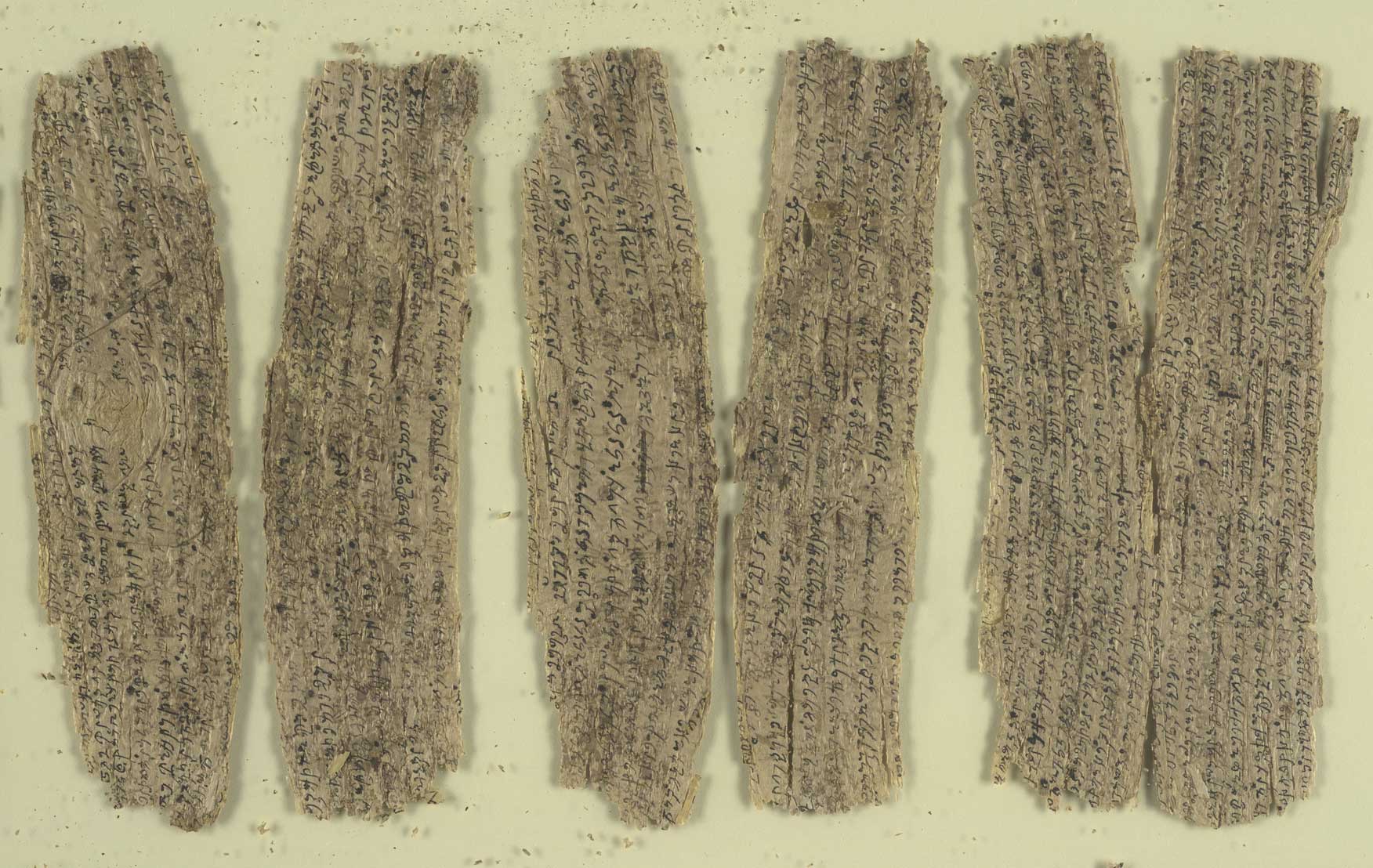
 Gandhara Buddhist birchbark scroll fragments, c. 1st century CE. | British Library / Wikimedia Commons
From the Academy is a monthly email newsletter for Premium subscribers, developed in collaboration with Tricycle’s resident Ho Family Foundation Buddhism Public Scholar. Each issue offers a scholarly take on a key topic in Buddhist thought and practice, with further readings and videos for exploration. Select issues are published here for the wider Tricycle community.
Anyone who reads about Buddhism will eventually encounter words bristling with a bunch of marks: diacritics, signs written above or below a letter indicating pronunciation. The diacritical dots, lines, and squiggles have many names—such as diaeresis ï, macron ā, and tilde ñ —but they may be unfamiliar to some Tricycle readers because English usually leaves them out when borrowing foreign words. We do not stay in hôtels, and even terms like naïve, passé, and résumé are often stripped of their marks.
To Use or Not To Use
When linguists convert languages such as Chinese, Sanskrit, and Pali into the Latin alphabet, they use diacritics to represent the sounds and spellings accurately. Thus, the diacritics of the Buddhist terms Ch’an, ḍākinī, or mettā indicate how to pronounce these words. Diacritics are especially useful when learning a foreign language and are used in academic writing for accuracy. Not using diacritics can create confusion with words that look similar without them.
Diacritics are less important when a commonly used foreign word appears in an English text. Sanskrit terms incorporated into the English dictionary—such as nirvāṇa, saṃsāra, śūnyatā—lose their diacritics, allowing them to become more easily integrated into general use. Tricycle typically does not employ diacritics for Buddhist terms, but we retain them in some proper names, in our long-running What’s In A Word series, or in the occasional article with a more academic slant, like this one. Tricycle addresses a popular audience, and for most readers, the primary consideration is recognizing and becoming familiar with key Buddhist terms. When we do use them, most readers are unlikely to know how a diacritic changes the pronunciation. Still, even among the editors, opinions on using them or not varies.
Diacritics and Translation
For translators and writers presenting Buddhist teachings in English, conversations about diacritics are part of a more extensive discussion about the movement of ideas across cultures. Translation and diacritics require a sensitivity to context: who is reading a text, where, and for what purpose. The translator Damion Searls suggests, for example, that using the Lakota name Tȟatȟáŋka Íyotak, or his Anglicized name, Sitting Bull, depends on the audience. Diacritics provide a visual reminder that words and names have meaning and history in another language and culture and alert us to pay particular attention so that nothing is lost in translation.
 This chart show tongue placement for Sanskrit vowel pronunication. The horizontal lines above letters indicate long vowels, held for two beats; unmarked vowels are short, sounded for one beat. For readers fluent in Sanskrit, diacritics are essential—the same string of letters can carry entirely different meanings depending on the marks. | Image from sanskritguide.com
Where the Rubber Meets the Road
Teachers and translators must decide whether to tailor Buddhist ideas to their time and place or challenge an audience to engage with the complexity of foreign concepts from the distant past. For example, mindfulness (coined in the late 19th century by the scholar William Rhys Davids) has long been used to translate the Pali sati and the Sanskrit smṛti; however, these terms have a significant range of meanings. The word mindfulness simplifies things for an English speaker and, for better or worse, allows for new meanings. The power of language to shape Buddhist teachings cannot be overestimated, and we take this seriously at Tricycle.
The Future of Translation
In a past Tricycle article, Donald S. Lopez Jr. discusses how the history of Buddhism is, in many ways, a history of translation. Both are on the cusp of significant change as artificial intelligence develops. AI might not be quite ready to perfectly translate Buddhist texts with nuance, but many scholars believe that as technology improves, so will its capacity to produce translations. How machines will handle the various choices surrounding diacritics remains to be seen.
Additional Resources
Jan Nattier, “The Proto-History of Buddhist Translation: From Gāndhārī and Pāli to Han-Dynasty Chinese,” video lecture, 2017. Nattier traces the earliest centuries of Buddhist translation and addresses the special challenges of translating Buddhist texts into English. Damion Searls, The Philosophy of Translation, Yale University Press, 2024. Searls offers a philosopher’s account of translation and examines what it means to carry meaning across languages. Bhikkhu Bodhi in conversation with Matthew Abrahams, “In Defense of ‘Enlightenment,’ ” Tricycle Summer 2021. The eminent translator and monk Bhikkhu Bodhi makes a case that “enlightenment,” not “awakening,” better captures the meaning of bodhi, and that the shift in usage has obscured something essential.
Thank you for subscribing to Tricycle! As a nonprofit, we depend on readers like you to keep Buddhist teachings and practices widely available.
This article is only for Subscribers!
Subscribe now to read this article and get immediate access to everything else.
Already a subscriber? Log in.