Google tests proactive AI guidance app
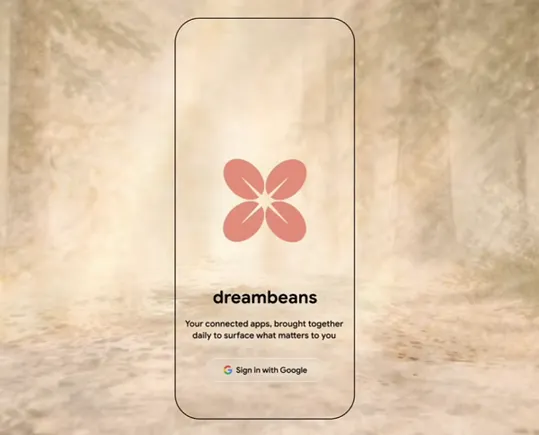
The company’s Dreambeans platform is designed to cull information collected from connected Google apps and make recommendations to “inspire and delight.”
 Kass
Kass
This audio is auto-generated. Please let us know if you have feedback.
Google is testing out a new artificial intelligence app that aims to provide proactive guidance and advice, based on what it knows about users’ history.
Which could be helpful when it comes to sharing personalized tips on topics of interest. But then again, it also feels a little intrusive, and maybe a little creepy as well.
Called Dreambeans, the app utilizes Google’s latest AI models to “proactively dream up personalized daily stories that cut through the clutter and connect you to what matters,” per the company.

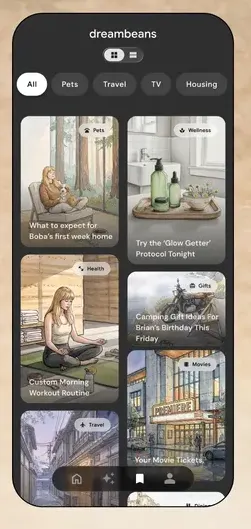
As explained by Google: “With your permission, Dreambeans uses Personal Intelligence to connect information from your Google apps, including Gmail, Calendar, Photos, YouTube and Search history, to curate stories that inspire and delight you. The goal is not to scroll forever, it’s a finite collection of stories designed to spark new ideas and allow you to focus on what matters to you.”
Essentially, the app extracts information from Google apps, and uses that to provide custom overviews of information that it thinks you may be interested in.
“For example, I got a Gmail confirmation that my puppy’s treats were delivered and Dreambeans surfaced training tips for using them,” Gozde Oznur, labs product manager at Google, said in a press release “It also referenced the Google Calendar reminder I have of my friend coming to town and provided recommendations of dog-friendly restaurants near me. Each story includes a unique illustration, reflecting the people and places you frequent the most.”
So it will feel like the Dreambeans app knows the user, and is able to help with proactive assistance.
Which is an interesting concept, for sure, but it may also feel a little pushy, and could even be counterintuitive as an engagement tool, because it will demonstrate the depth of knowledge Google has about each user.
While most people use online tools to plan and manage their daily lives, they are generally not confronted with the scope of their activity, and what that means in terms of corporate understanding of their interests.
A good example here is the long-standing rumor that Facebook listens in to people’s conversations through their device microphone, in order to serve its users targeted ads, often based on topics that they’ve never searched for online.
The gap here is that Facebook, and other online tools, don’t actually need to listen to conversations to gather such context. That's because these companies have such a massive trove of user data to use, based on what users have voluntarily entered into their systems, that they can already predict a lot of interest behaviors without needing to eavesdrop.
Indeed, back in 2015, researchers from the University of Cambridge and Stanford University found that insights gleaned from Facebook data alone may be able to predict a person’s personality and preferences better than their colleagues, their friends and even their partners.
This is not a major revelation. Everybody knows that the trade-off for using these free apps is that the companies extract info on each user’s preferences for future ad targeting. But being confronted with that knowledge in such a direct way could be a little creepy, and even a little concerning for some users.
It probably depends on the types of predictive stories the app chooses to show. However, it does feel like this could overstep the mark for some users, and make these updates more of a concern, as opposed to providing value.
Then again, maybe this is just the first step towards an AI-driven future, where everyone’s actions are predicted, and everyone feels less like individual, autonomous entities, and more like generic, predictable flesh units.










![20 Predictions for Social Media in 2025 [Infographic]](https://imgproxy.divecdn.com/HMVhRh2JvYwAse_QsxNWdYtb_Of31-oCF2OnUe4eZqA/g:ce/rs:fit:770:435/Z3M6Ly9kaXZlc2l0ZS1zdG9yYWdlL2RpdmVpbWFnZS9zb2NpYWxfbWVkaWFfdHJlbmRzXzIwMjVfMi5wbmc=.webp)

![The 9 Building Blocks of a Business’s Organizational Structure [With Diagrams]](https://www.hubspot.com/hubfs/business-building-blocks-1-20250109-2858404.webp)