The King Who Wasn’t There
Finding the dharma in the archetypes of Shakespeare The post The King Who Wasn’t There appeared first on Tricycle: The Buddhist Review.
 MikeTyes
Finding the dharma in the archetypes of Shakespeare
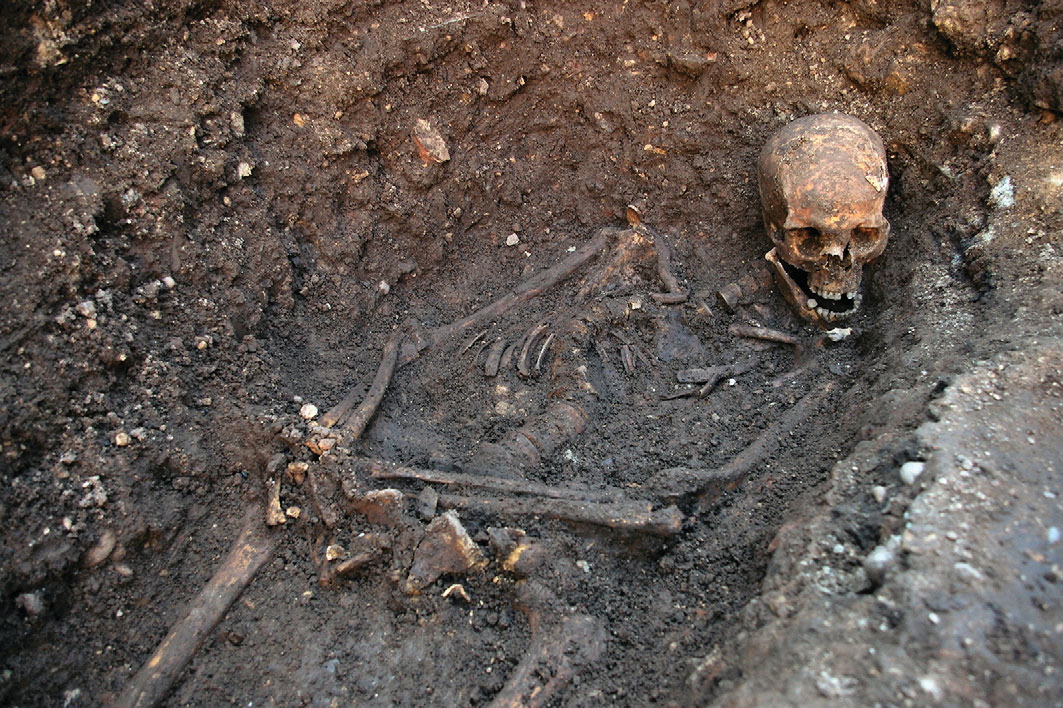
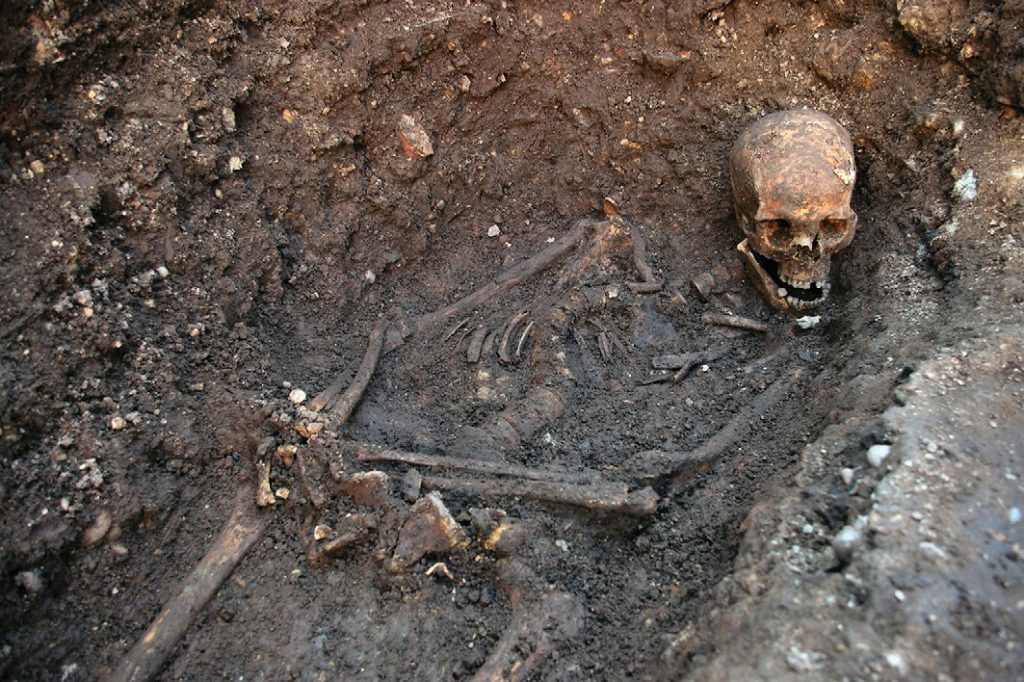 Remains of King Richard III as discovered in situ at the site of Grey Friars Priory, Leicester, 2012. | Image credit: Richard Buckley, Mathew Morris, Jo Appleby, Turi King, Deirdre O'Sullivan, Lin Foxhall / Wikimedia Commons
Shakespeare’s Richard II opens with a king who seems to possess everything—the throne, the divine right to it, and the absolute confidence of a man who has never been told no. By the play’s end he is alone in a cell, turning his own dethronement over like a koan he cannot solve. In between, the most powerful man in England discovers his power was never a possession. It was a story other people agreed to keep telling. And once they stopped, there was nothing underneath.
I find myself returning to this play whenever a leader who seems untouchable suddenly isn’t anymore. This just happened in the UK, where I live. The prime minister’s power drained away to an insurgent rival, and he was gone without a fight. While Shakespeare’s play isn’t about any one person, it could serve as a much-needed cautionary tale for many a political strongman as it maps the gap between a position and a person’s belief that the position is theirs.
The crucial scene comes when Richard, having left for Ireland, returns to find his Welsh army gone—dispersed on a rumor of his death. He conjures an army out of language instead, insisting the very stones of his kingdom will “prove armed soldiers,” summoning serpents to “lie in their way.” It is an incantation standing in for infantry—and it shows us something the dharma keeps saying in other terms: When the substantial thing is gone, the mind doesn’t accept absence—it manufactures presence.
This is, in miniature, how power always works, not just how it fails. The crown was never a metaphysical fact woven into the universe. It was an agreement—oaths, ritual, the consent of nobles—withdrawable the moment enough people stopped renewing it. Buddhism has a name for this: sunyata, or empty of inherent existence. This could be thought of as no-self, or anatta, as applied to an institution rather than a person. The throne has no throne-nature waiting inside it; it is conditions and attention, arising together and capable of dispersing together, just as the self is skandhas (Skt: aggregates) in temporary, dependent arrangement.
But Shakespeare is doing something more specific than illustrating impermanence in general. Richard’s kingship rests on a particular medieval belief—divine right, the conviction that “not all the water in the rough rude sea / Can wash the balm off from an anointed king.” That isn’t simply a fact later proven unstable; it’s a view so total it had hardened into reality. Buddhism calls this ditthi: belief mistaken for the nature of things, invisible because it has become the water we swim in. Richard has to be deposed before he can see his kingship as a position within a system of meaning, rather than the bedrock the system was built on.
Richard has to be deposed before he can see his kingship as a position within a system of meaning, rather than the bedrock the system was built on.
What makes the play devastating rather than merely clever is that Richard comes to know this about himself too. Deposed and alone, he calls for a looking glass, expecting the ruin of a fallen king. Instead, he finds his ordinary face unchanged. “Was this the face,” he asks, “that every day under his household roof / Did keep ten thousand men?” The kingship is gone, but the face looks exactly as it always did—it was never in the face, never anywhere that could be located and lost. It was always elsewhere: in others’ willingness to keep believing it real. Richard smashes the glass—read one way, a tantrum, read another, the right instinct badly aimed, a refusal to keep consulting a surface for an answer surfaces were never going to give.
Buddhism has long used a set of teachings called the eight worldly winds—gain and loss, pleasure and pain, praise and blame, fame and disgrace—to describe exactly this vulnerability. We build identity on conditions that are, by nature, unstable: a position, a reputation, a following. The winds blow, and what looked solid, moves, because it was never solid—only wind-built, like Richard’s stones and adders. His tragedy isn’t that he loses the crown. It’s that he had to lose it to discover he was never, in the way he imagined, a king at all—only a man, briefly and conditionally agreed upon as one.
Outside of Shakespearean tragedy, this pattern will soon repeat again, somewhere else—it isn’t really a story as much as an archetype. It’s the oldest story politics has: a figure who looked, for a time, like the solid thing itself, discovering they were only ever a place the agreement was currently pointing at. The view that made him seem inevitable was never inevitable; it was simply unexamined while it held.
Few of us will lose a throne. But most of us rest some quiet certainty on a ground just as conditional—a role, a reputation, the sense that what we’ve built will hold because it has so far. The practice the play points toward isn’t grim detachment; it’s simply noticing, before the winds arrive.

Thank you for subscribing to Tricycle! As a nonprofit, we depend on readers like you to keep Buddhist teachings and practices widely available.
This article is only for Subscribers!
Subscribe now to read this article and get immediate access to everything else.
Already a subscriber? Log in.