Huda Beauty Marketing: How a $6,000 Investment Built a $1 Billion Beauty Empire
Before starting, let’s accept that Huda Beauty marketing is one of the greatest stories in the cosmetics industry. And there is no chance you have not come across Huda Beauty & its products if you’ve been anywhere near the...
 Troov
Troov
Before starting, let’s accept that Huda Beauty marketing is one of the greatest stories in the cosmetics industry. And there is no chance you have not come across Huda Beauty & its products if you’ve been anywhere near the internet in the last decade.
A glittery eyeshadow palette flooding your Instagram feed, a YouTube tutorial featuring those iconic false lashes, or Huda herself going live at midnight to talk about self-love; the brand has an uncanny ability to show up everywhere in a genuinely authentic way.
And here’s the thing that makes it even more extraordinary: Huda Kattan started this entire empire with a $6,000 loan from her sister. Just one woman, a passion for makeup, a blog, and an obvious vision of what was missing in the beauty world.
Today, Huda Beauty is valued at over $1 billion (unicorn-level) and has been ranked the #1 most popular beauty brand globally, ahead of legacy giants.
So how did she do it? That’s exactly what I’m going to unpack in this deep dive into Huda Beauty’s marketing strategy; covering everything from her target market and brand positioning, to her SWOT analysis, 4P marketing mix, digital marketing management, social media strategy, and some jaw-dropping real-world campaigns.
Inside Huda Beauty Marketing Strategy
From Beauty Blogger to Beauty Billionaire Huda Beauty Target Market: Who Is She Actually Talking To? Huda Beauty Market Segmentation Huda Beauty Marketing Mix: Breaking Down the 4Ps SWOT Analysis: Huda Beauty’s Strengths, Weaknesses, Opportunities & Threats Huda Beauty Social Media Management: The Engine Huda Beauty Digital Marketing Management & Online Strategy Huda Beauty Marketing Campaigns FAQ about Huda Beauty Marketing StrategyFrom Beauty Blogger to Beauty Billionaire
Before we even talk about Huda Beauty’s marketing strategy, we need to understand how Huda’s career unfolded because her entire brand was built on the back of her personal journey, and it’s the main strategy.
Huda Kattan started her beauty career by writing blogs (you may know) and completing a prestigious makeup training course in Los Angeles. Through her work as a makeup artist, she noticed a frustrating gap; there were simply no high-quality products available that could meet her professional standards. So she decided to fill that gap herself.
Back in 2013, she launched her product line in Sephora Dubai, and within two years, expanded to Sephora USA. That product seeded an entire ecosystem.
The brand has since expanded into multiple sub-brands:
Huda Beauty Makeup (cosmetics), KAYALI (luxury fragrances — the name means “Imagination” in Arabic), Wishful (clean skincare)And, yes, from day one, Huda’s personal story, values, and voice have been the foundation of every single marketing decision. This isn’t a brand that happened to get an influencer, but the influencer is the brand.
Huda Beauty Target Market: Who Is She Actually Talking To?
When we talk about Huda Beauty’s target market, we’re talking about a very specific group of people who grew up with technology. It’s no secret that this generation loves unique, high-quality products and new-age beauty marketing campaigns that try new things.
And understanding them is what makes Huda’s marketing so extraordinarily effective.
Demographics
Huda Beauty’s Instagram audience exceeds 57 million followers, with a predominantly female base (estimated between 70–80%). The brand attracts a younger audience, primarily aged 20–29, while maintaining a global reach across the United States, India, and the Middle East.
Psychographics: Gen Z & Millennials
Her consumers are primarily Gen Z (born 1997–2012) and Millennials (born 1980–1996). As you already know, the two generations that drove the social media revolution and the growing cultural conversation around mental health and self-worth are important.
These are generations dealing with high self-doubt and low self-esteem at unprecedented rates.
They want a brand that sees them, respects them, and helps them feel good without setting unrealistic standards. They also hold brands accountable, calling out manipulation, photoshopping, and performative messaging.
According to Huda Beauty Business Case Study:
Consumers currently seek beauty products that are made of organic/clean formulas, are sustainable, and are not tested on animals… to increase their self-confidence.
So, Huda Beauty target audience:
Wants to feel empowered and express their individuality, Bases purchase decisions on real-time social media feedback, Seeks authenticity and reject photoshopped advertising, Is vocal, resilient, and hold brands to high ethical standards.Huda Beauty Market Segmentation
So far, we’ve explored how Huda strategically maps her brand to specific slices of a massive global market. Now, let’s be more specific about Huda Beauty market segmentation.
Geographic Segmentation
The abovementioned paper states that the market is largest in the US (~20% share), China (13%), and Japan (8%). Notably, Huda Beauty is not sold in China because the country requires imported beauty products to be tested on animals, conflicting with Huda Beauty’s cruelty-free values. This is a huge strategic/ethical decision that her target consumers deeply appreciate.
Psychographic & Values-Based Segmentation
Huda segments not just by age or location but by values. She speaks to consumers who prioritise authenticity, self-love, inclusivity, and sustainability.
This psychographic approach means her marketing resonates on an emotional, identity level, not just a product-features level.
@hudabeauty This is wild 😱 @Dani Herrera showing just how crazy filters can get… and exactly why we’re proud to be a #NoFilter beauty brand! #fyp #realskin ♬ original sound – Huda BeautyBehavioral Segmentation
Huda’s consumers make purchase decisions based on social proof and digital word-of-mouth.
They follow influencers, watch tutorials, read reviews, and consult their social communities before buying. This is reflected in how Huda Beauty structures its entire communication strategy.
Product Segmentation: Beyond Makeup
Within her portfolio, Huda segments customers by their beauty journey stage:
Full-glam lovers → Huda Beauty Makeup (bold colors, full coverage, statement looks) Natural/no-makeup makeup enthusiasts → GloWish (lightweight, skin-first makeup) Skincare-first consumers → Wishful (clean, cruelty-free skincare) Fragrance connoisseurs → KAYALI (layerable luxury Eau de Parfum collection)Huda Beauty Marketing Mix: Breaking Down the 4Ps
In Huda Beauty marketing mix, every element is aligned with the same core & sincere identity. Let’s take a close look:
Product: Personal Stories
Every Huda Beauty product has a backstory.
The foundation line? Inspired by Huda’s childhood wish to cover her skin imperfections.
The Wishful skincare line? Born from her personal self-love crisis, a period when she felt deeply uncomfortable in her own skin.
The GloWish line is particularly interesting; it’s an intersection product between skincare and makeup, entirely vegan, cruelty-free, and made from 90% naturally derived materials, with 100% recyclable packaging.
Price: Aspirational But Accessible
Huda Beauty operates in the affordable-luxury tier, similar to Sephora’s marketing approach.
Products typically range from around $20 for lashes to $65 for premium palettes. It’s premium enough to signal quality and desirability, but accessible enough for the 20-something Gen Z consumer who follows Huda. It positions the brand above drugstore alternatives while staying below ultra-luxury like La Mer or Charlotte Tilbury’s top-tier range.
Place: 2,000+ Retail Touchpoints
Products are sold online and in over 2,000 retailers worldwide, including powerhouse partnerships with Sephora (where it all began). Digital commerce through Huda Beauty’s website is a significant channel.
Promotion: The Influencer-First Playbook
The entire brand was built on social media, and every promotional lever pulls back to the same authentic, community-driven core, as I stated above. We’ll explore this in exhaustive detail in the sections below, but in short: it’s Instagram, TikTok, YouTube, live sessions, influencer reposts, daily blogs, pop-up events, and Huda’s own relentless personal presence.
Here is a summary:
| 🎁 PRODUCT | Multi-category portfolio: makeup (lips, eyes, face, body), KAYALI fragrances, Wishful skincare, and the GloWish hybrid line. Includes cruelty-free products and vegan options. |
| 💰 PRICE | Affordable-luxury positioning: typically around $20–$65 per product. False lashes began at approximately $25. Premium pricing signals quality without alienating Gen Z consumers. |
| 📍 PLACE | Sold in 2,000+ global retailers including Sephora and Harrods, as well as via hudabeauty.com. The brand is not sold in China due to animal testing laws. |
| 📣 PROMOTION | SMI-first strategy built around Instagram, TikTok, YouTube, and Twitter. Promotion includes influencer reposts, live sessions, petitions, pop-up events, and daily blog content. |
SWOT Analysis: Huda Beauty’s Strengths, Weaknesses, Opportunities & Threats
Alright, time to put on our strategy hats.
A thorough SWOT analysis of Huda Beauty tells a very nuanced story.
| 💪 STRENGTHS | Huda is the brand, with 50M+ Instagram followers Authentic influencer-led marketing from day one Inclusive shade ranges across all product lines Multi-brand portfolio: makeup, Wishful skincare, KAYALI fragrance Strong electronic word-of-mouth ecosystem Anti-photoshop, self-love values resonate with Gen Z & Millennials |
| ⚠️ WEAKNESSES | Brand continuity risk: heavily tied to Huda Kattan personally Sustainability messaging is weak or not clearly communicated No AI/AR virtual try-on feature compared to competitors Not available in China — missing ~13% of global cosmetics market GloWish eco-credentials are under-advertised |
| 🚀 OPPORTUNITIES | AI beauty personalization market projected to reach $16.4B by 2036 (CAGR 21.7%) TikTok expansion for Wishful sub-brand Sustainability positioning (54% of consumers prioritise sustainable cosmetics) Growth in EMEA & developing markets driven by influencer marketing Potential conglomerate expansion to rival Estée Lauder & L’Oréal |
| ⚡ THREATS | Fenty Beauty leading the inclusivity narrative Kylie Cosmetics backed by Kardashian-Jenner network power Rare Beauty dominating mental health & authenticity positioning Increasing regulation on influencer advertising disclosure Self-love paradox: beauty brands risk contradicting their message Dependence on Huda’s personal brand (The “Oprah Effect” risk) |
The Biggest Strategic Risk: “The Oprah Effect”
One of the biggest strategic risks facing Huda Beauty is what can be called the “Oprah Effect,” where a brand’s success is deeply tied to the personal influence of its founder.
From day one, Huda Kattan has been the face, voice, and growth engine of the brand, turning her massive social following into a powerful distribution channel that fueled global expansion.
But that same dependency creates vulnerability: any shift in her public image, opinions, or controversies can instantly ripple across the business, affecting perception, partnerships, and sales.
As Huda Beauty grows and aims to compete with legacy giants, this founder-centric model becomes harder to scale, limiting its ability to operate as a fully independent brand ecosystem. In other words, the very force that built Huda Beauty into a global powerhouse may now be the factor that defines how far it can go.
You cannot talk about Huda Beauty’s marketing strategy without going deep on social media.
As I mentioned above, the brand was born and raised on social media; its DNA is built on the same social media strategies for beauty brands that now drive its most important strategic decisions.
With more 57 million Instagram followers (compared to Fenty Beauty‘s 13M, Rare Beauty‘s 3M, and Kylie Cosmetics‘ 25.5M), Huda Beauty’s Instagram presence is unmatched in the celebrity-cosmetics space.
What makes the account uniquely powerful is what they actually post. While competitor accounts lean heavily on polished product shots and celebrity glamour, Huda Beauty’s Instagram is a genuinely mixed feed of:
Skincare tips and tricks (educational content that builds trust), DIY self-care tutorials (relatable, practical value), Makeup application tutorials using real people, not just models, Influencer reposts of UGC (user-generated content) featuring Huda Beauty products, Awareness posts about major world events (Afghanistan crisis, BLM movement, period poverty), Huda’s personal appearances.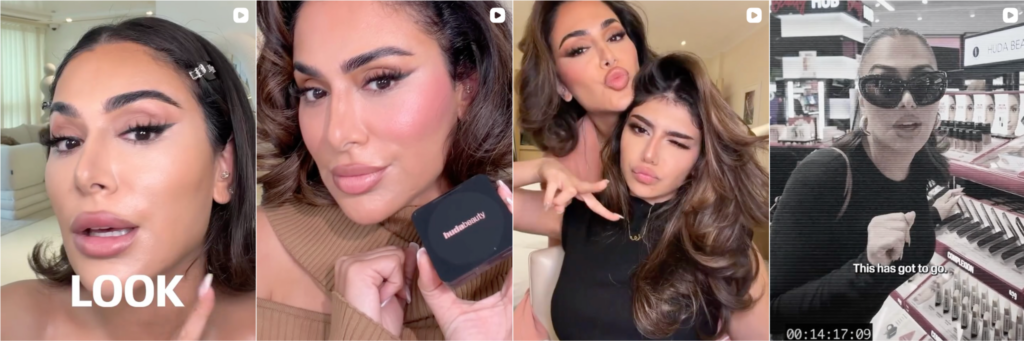
At that point, I want to remind you that Huda Kattan was not famous when she launched the brand. She built her audience authentically, from zero, through genuine expertise and personality. Her competitors launched with ready-made celebrity audiences. That means Huda’s community is arguably more deeply loyal and more engaged because they grew with her.
And building a loyal community is not a picnic.
According to “Unpacking Huda Beauty’s Strategic Innovation and Global Expansion in the Modern Cosmetics Arena,” Huda Beauty has been practicing electronic word-of-mouth, on social media. eWOM is the primary driver of consumers’ purchase intentions in the cosmetics space. Their study found a statistically significant association between influencer marketing and consumer buying behaviour (r = .808, p = .000).
What’s more, by reposting influencer content onto the brand’s own Instagram page, Huda Beauty turns every creator into a brand ambassador, and every tutorial into a soft advertisement. It’s organic, credible, and deeply effective.
In addition to Instagram, Huda Beauty has been active on YouTube and TikTok, building communities around video content, tutorials, behind-the-scenes footage, unboxings, and honest product reviews. The rise of short-form video on TikTok aligns perfectly with Gen Z’s content consumption habits.
Huda Beauty Digital Marketing Management & Online Strategy
Let’s zoom out from Huda Beauty social media and look at the broader digital marketing management picture.
From a digital perspective, content is king at Huda Beauty, and it spans formats:
Long-form blog posts on hudabeauty.com (daily publishing cadence), Short-form video content (Instagram Reels, TikTok), Long-form YouTube tutorials and behind-the-scenes videos, Instagram Stories and Highlights (used effectively by Wishful for dermatologist testimonials), Live social media sessions for real-time community engagement.And, of course, influencer marketing architecture means so much, and the brand’s influencer strategy is multi-tiered:
Tier 1: Huda Kattan herself (50M+ followers, ultimate brand authority), Tier 2: Macro-influencers with millions of followers who receive product collaborations, Tier 3: Micro-influencers whose content is actively reposted by the brand account, Tier 4: User-generated content from everyday consumers, celebrated and amplified.What about eCommerce?Huda Beauty has invested significantly in direct-to-consumer e-commerce through hudabeauty.com. This allows the brand to capture consumer data, control the brand experience, and maintain higher margins compared to third-party retail. The website also serves as a content hub (blog) and community space.
One notable gap here (identified in the case study critique) is the absence of an AI/AR virtual try-on feature. Both Fenty Beauty and Charlotte Tilbury already offer this (Fenty with a ‘Virtual Try-On’ for foundations and lipsticks, Charlotte Tilbury with her ‘Magic Mirror’ tool).
Huda Beauty Marketing Campaigns
Now we get to the fun stuff. Here are some specific Huda Beauty marketing campaigns and real-world initiatives that show just how well this brand executes its strategy.
#1: The Anti-Photoshop Petition
This is possibly the most bold and authentic Huda Beauty advertisement. Back in March 2021, Huda launched a petition on iPetitions calling for beauty brands to disclose when images have been edited on social media.
She used her platform to publicly call out the industry she operates in, the cosmetics sector’s long-standing habit of airbrushing and filtering product imagery.
Why was this such a brilliant marketing campaign? Several reasons:
It positioned Huda as an industry disruptor and ethical leader, not just a product seller, It perfectly aligned with her target market’s values, Gen Z and Millennials who despise corporate fakery, It generated massive earned media coverage and social discourse, It reinforced her personal brand as an honest, vulnerable, real person, It deepened the trust relationship with her community.Best part? This campaign cost essentially $0 in paid media, yet generated global press coverage and cemented Huda’s reputation as the beauty industry’s most authentic voice.
#2: The Mercury Retrograde Pop-Up, London
To launch the Mercury Retrograde eyeshadow palette, Huda Beauty hosted a spectacular pop-up event in Covent Garden, London, described as an “intergalactic experience.”
That experience gave consumers access to limited edition products, the chance to meet Huda Kattan in person, and a genuinely unforgettable experiential moment.
In terms of digital marketing management, this pop-up was a masterclass in “offline to online” amplification:
Attendees created massive amounts of social media content organically, The event generated TikTok and Instagram content that spread globally, Huda’s personal attendance made it feel intimate and special, Limited edition products created urgency and FOMO (Fear of Missing Out), Press and influencer coverage extended reach far beyond physical attendance.#3: Easy Bake Pressed Powder Relaunch
This is arguably Huda Beauty’s biggest recent campaign execution. Relaunched between Dec 2025 – Jan 2026 with a full 360° strategy.
Actually, it’s the first major campaign after Huda Kattan regained full ownership of the brand, and has been built around:
TikTok-first content, Fast-conversion “see → buy instantly” behavior (beauty shoppers convert within hours), Heavy creator seeding + tutorials.See it yourself:
@hudabeauty@huda hears everything… so what did she actually make in the Easy Bake labs this time? ❤️💙💚 Comment your guess below for a chance to receive the press kit 🤫
♬ original sound – Huda BeautyThis campaign shows Huda’s shift to hyper-optimized, conversion-driven launches instead of just hype.
#4: ‘My Struggle With Self-Love’ YouTube Video
One of the most watched pieces of content on Huda Beauty’s YouTube channel (468,766+ views) is Huda’s deeply personal video about her struggle with self-love.
In it, she discusses feeling uncomfortable in her own skin, her journey with body acceptance, and how she reconciles being in the beauty industry while advocating for natural confidence.
This type of beauty marketing campaign does something very few brands ever attempt: it humanizes the founder completely, makes her utterly relatable to an audience that deals with the same insecurities, and simultaneously reinforces that Huda’s products are tools for empowerment rather than instruments of unattainable perfection.
It’s vulnerability as marketing, and it works extraordinarily well.
#5 This Is Not a Filter
Here is one of Huda Beauty’s most talked-about campaigns in 2024–2025.
The campaign totally tapped into a cultural shift the beauty industry could no longer ignore: people are done with perfection.
The campaign used close-up, unfiltered images that showed texture, pores, acne, and real skin in a way that was almost shocking for beauty ads. And that worked perfectly, even though it’s the opposite of what beauty marketing trends say to do.
Built for TikTok and Instagram, the content was scroll-stopping because it was honest. More importantly, it reinforced what Huda Beauty has always stood for, like transparency, relatability, and community trust.
In a space where most brands still sell fantasy, Huda flipped the script, in other words.
FAQ about Huda Beauty Marketing Strategy
What is the marketing strategy of Huda Beauty?
Huda Beauty’s marketing strategy is built “entirely” around authenticity and personal connection. Huda Kattan herself is the brand, obviously, she appears in roughly 1 in every 3.3 Instagram posts, shares her personal struggles with self-love and confidence, and has built a community rather than just a customer base. The strategy combines influencer-led social media marketing, daily blog content, user-generated content reposts, and a strong anti-photoshop, pro-self-love brand narrative that resonates deeply with her audience. Every product launch, campaign, and post ties back to Huda’s personal story and values.
Who is the target market of Huda Beauty?
Huda Beauty primarily targets Gen Z and Millennials with her core Instagram audience sitting in the 20–24 age bracket. These are digitally native consumers who deal with high levels of self-doubt, seek authenticity from the brands they support, and make purchase decisions based on social media reviews and influencer recommendations rather than traditional advertising.
How does Huda Beauty segment its market?
Huda Beauty segments its market across several dimensions. Geographically, it focuses on the US, Europe, and the Middle East. Psychographically, it targets values-driven consumers who prioritise authenticity, self-love, and cruelty-free products. Behaviourally, it speaks to social-media-first shoppers who rely on influencer reviews. And within its product portfolio, it segments by beauty preference, full-glam lovers get Huda Beauty Makeup, natural-look fans get GloWish, skincare-first consumers get Wishful, and fragrance lovers get KAYALI.
What is included in the Huda Beauty marketing mix?
The four Ps work together seamlessly at Huda Beauty. The product range covers makeup, skincare (Wishful), fragrance (KAYALI), and the hybrid GloWish line. All cruelty-free and tied to personal stories. Pricing sits in the affordable-luxury tier ($20–$65), making it aspirational but accessible to younger consumers. Place covers 2,000+ global retailers including Sephora, plus direct e-commerce at hudabeauty.com. And promotion is where the brand really shines, an Instagram-first, influencer-driven strategy built around community, education, and Huda’s own relentless personal presence.
What makes Huda Beauty marketing campaigns successful?
At the center is Huda herself, showing products in a real, unfiltered way that builds instant trust. Then creators pick it up, tutorials start popping up everywhere, and suddenly the product is everywhere. The visuals are always designed to stop you mid-scroll, bold shades, real skin, satisfying before-and-afters. But here’s the key: the products actually perform, so when people try them, the hype sticks. Add smart timing (jumping on trends like skin realism) and you get campaigns that don’t just go viral, they convert fast
Social media is the entire foundation on which the brand was built. The Instagram account is a carefully curated mix of makeup tutorials, skincare tips, influencer reposts, awareness posts on world events, and Huda’s own personal appearances, all with warm, engaging captions designed to spark conversation. Beyond Instagram, the brand uses YouTube for long-form tutorials and personal storytelling. TikTok for short-form content, and daily blog posts on the website to keep the community coming back.
What advertising strategies does Huda Beauty use to promote its products?
Huda Beauty invests in earned and organic media over paid advertising. The core strategy involves actively reposting influencer-generated content onto the brand’s own Instagram page, turning every creator into a brand ambassador without the transactional feel of a sponsored post. Huda herself acts as the ultimate macro-influencer, sharing product launches through her personal account and story. The brand also uses experiential marketing (pop-up events), petition-driven social movements, YouTube storytelling, and daily blog content to keep audiences engaged.