In the Mountains of Tibet
Two new books reveal the entwined landscapes of pilgrimage and ascetic retreat in Tibetan Buddhism. The post In the Mountains of Tibet appeared first on Tricycle: The Buddhist Review.
 AbJimroe
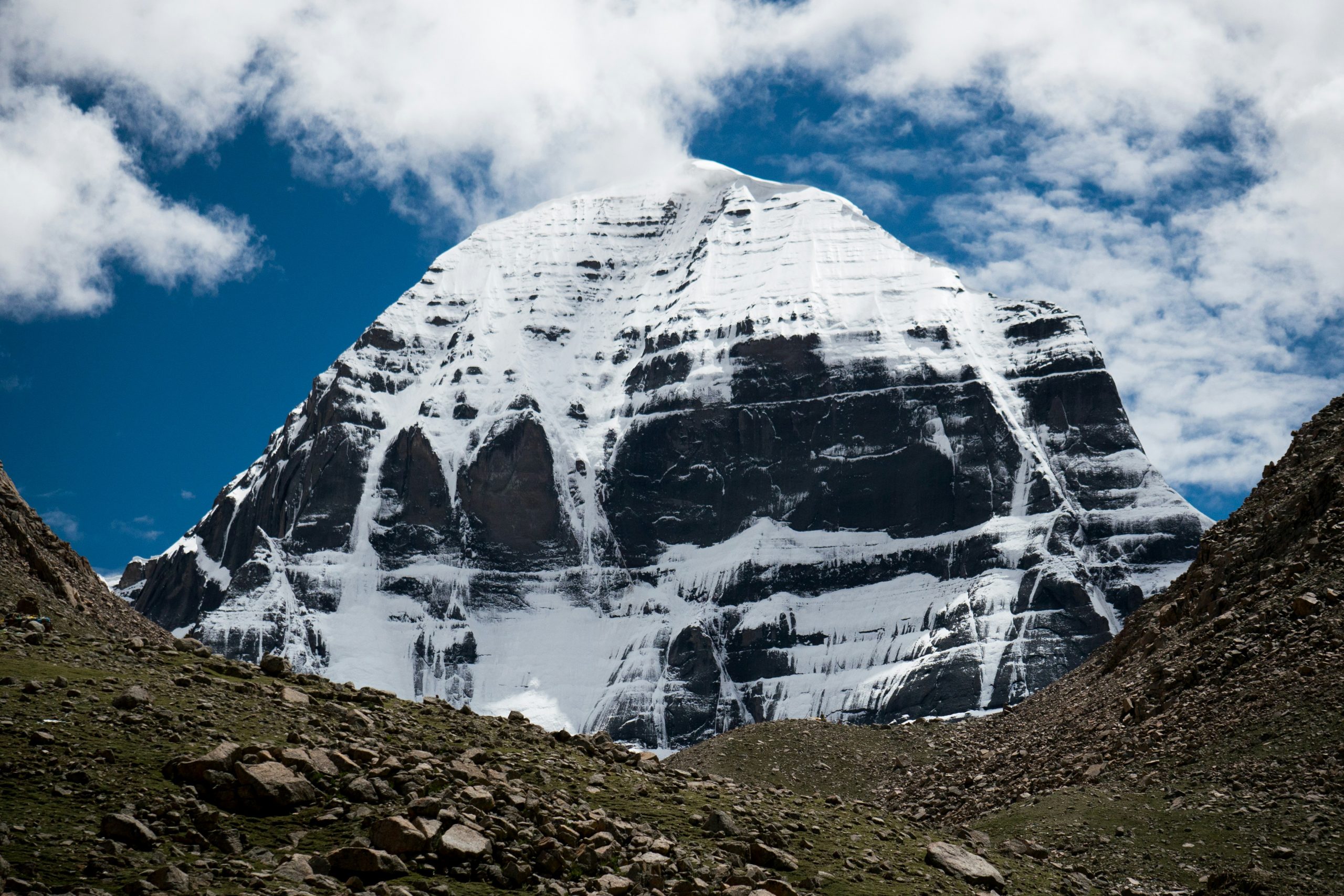
Mountains have been venerated in Tibet for a long time. Beyond their intrinsic majesty, peaks such as Kailash, Gyangme, Tsari, Lapchi, Jomolhari, and Amnye Machin are revered as the abodes of deities and ancestral protectors. The aura of past Buddhist masters—many of whom spent years meditating in remote mountain caves—further deepens their appeal. This enduring interplay of mountains and ascetic practice provides the backdrop for two new studies that take readers into the Tibetan Buddhist traditions surrounding sacred landscapes.
The topography of Tibet gave rise to distinctive forms of Buddhist pilgrimage and retreat. These themes are explored respectively in Catherine Hartmann’s Making the Invisible Real: Practices of Seeing in Tibetan Pilgrimage and David M. DiValerio’s Mountain Dharma: Meditative Retreat and the Tibetan Ascetic Self. Hartmann is an assistant professor at the University of Wyoming, and DiValerio is an associate professor at the University of Wisconsin–Milwaukee. Both authors draw on sources spanning centuries of Tibetan Buddhist history, combining textual analysis and translation with perspectives shaped by time spent living among Tibetan diaspora communities.
Hartmann and DiValerio each address major features of Tibetan Buddhism from distinct perspectives. Hartmann focuses on the visual practices performed during pilgrimage, while DiValerio examines prescriptive guidelines for undertaking solitary retreat rather than the meditative practices themselves. DiValerio also traces how understandings of retreat have evolved over time, whereas Hartmann avoids making broad claims about the historical development of pilgrimage traditions. Nevertheless, given the close ties between pilgrimage and retreat sites in Tibet, the two books complement each other closely.
Making the Invisible Real opens with a general introduction to Buddhist pilgrimage before turning to its Tibetan expressions. Tibetans have held differing views on the value of pilgrimage, and even the merits of Mount Kailash as a site have been hotly debated. While Hartmann discusses such disagreements, most of her book examines the widespread visual disciplines undertaken by pilgrims. Drawing on sources ranging from 16th-century polemical writings and 17th-century pilgrimage guidebooks to the diary of a modern pilgrim named Khatag Zamyak (1896–1961), she shows that Tibetan pilgrimage is as much about cultivating perception as it is about traveling to sacred sites.
Tibetan texts describe pilgrimage places on multiple levels, often beginning with an origin story about a Buddhist master who first recognized their divine nature. Hartmann cites Rigdzin Chokyi Drakpa (1595–1659), who saw Mount Gyangme as the mandala of the deity Chakrasamvara. By perceiving the mountain as the abode of a tantric deity, Chokyi Drakpa spiritually “opened” it, enabling later pilgrims to align their practices with his vision. Although subsequent pilgrims may not share such direct insight, various visual practices still allow them to recall and engage with a site’s extraordinary qualities.
Hartmann introduces two key terms—practices of seeing and co-seeing—to describe ways of engaging with a pilgrimage site. Practices of seeing involve “reading the landscape for signs, practices of reading and writing, and an imaginative juxtaposition of physical and idealized landscapes.” Co-seeing refers to a method of using auspicious natural features and material traces left by past masters to evoke a site’s unseen dimensions. Guidebooks instruct pilgrims to hold both ordinary and extraordinary perception in mind at once. Hartmann’s clear articulation of these intertwined practices is a major contribution to the study of Tibetan Buddhist pilgrimage.
Making the Invisible Real centers on the visual disciplines that bridge ordinary and imaginative perception, allowing pilgrims to experience the extraordinary as real. By contrast, DiValerio’s Mountain Dharma turns to the solitary ascetic retreatant—one who withdraws into the mountains alone rather than traversing them with others.
Drawing from Tibetan Buddhist handbooks and advice manuals for long-term meditation retreats, DiValerio traces how writers from the 12th to the early 20th century addressed a consistent set of concerns: where to practice, how to maintain isolation, how to avoid dangers, what attitudes to adopt, and what benefits to expect. Interpreting these concerns as methods for shaping the self, he shows how retreat was conceived as a means of personal transformation sustained through continuity with tradition.
Much about retreat has remained consistent over time, but DiValerio also identifies significant changes. In early Tibetan writing, geomancy—choosing sites with auspicious natural features—was the chief concern. As traditions developed, a site’s association with earlier meditation masters became paramount. “Potential meditation sites,” he notes, became “regarded less as sites whose details are to be mapped and more as vessels conveying imprints that were created in the past.” In this view, retreat itself increasingly came to signify participation in the accomplishments of past masters.
DiValerio terms this relationship toward the past lived deferential reverence, an attitude that acknowledges present limitations while affirming the value of continued participation in the retreat tradition. This sensibility has also justified shifts in ascetic practice, allowing it to adapt to new conditions. More broadly, it reflects a heightened historical awareness, serving as “a continual reminder of the distances in time and ability that separate the past masters from the meditator in the present.” Over time, this deferential orientation became more deeply embedded in Tibetan Buddhist retreat literature.
Lived deferential reverence finds a clear counterpart in the practices of seeing discussed by Hartmann. Both retreat and pilgrimage practices emphasize the imaginative bridging of past and present—whether through perceiving a sacred landscape or emulating the lives of earlier ascetics. In each case, the recognition of past masters’ accomplishments provides the basis for both revering the tradition and participating in it.
Both retreat and pilgrimage practices emphasize the imaginative bridging of past and present—whether through perceiving a sacred landscape or emulating the lives of earlier ascetics.
The intersections between pilgrimage and retreat are vividly expressed in the history of Tsadra Monastery. Jamgon Kongtrul (1813–1899) credits his contemporary, the visionary Chokgyur Lingpa (1829–1870), with opening Tsadra as a pilgrimage site. DiValerio notes that Kongtrul then affirmed the value of pilgrimage to Tsadra by likening it to Tsari, a mountain in southeastern Tibet with a famous pilgrimage route. (Hartmann observes that such comparisons enhance a newer site’s charisma.) Kongtrul also highlighted Tsadra’s auspicious geomantic features and its history of visits by earlier masters—common ways of confirming a site’s suitability for both pilgrimage and retreat. DiValerio concludes by discussing Kongtrul’s innovative model of communal retreat at Tsadra, which has since become a hallmark of global Tibetan Buddhism.
Hartmann’s work stands out for its clarity and its sustained focus on practices of seeing within Tibetan pilgrimage. DiValerio, meanwhile, animates the often dry genre of the retreat manual, revealing unexpected insights into the history of Tibetan asceticism. Yet despite their breadth, both studies remain largely silent on women’s experiences of pilgrimage and retreat. DiValerio notes a few texts written for female ascetics but was unable to identify specific retreat instructions. Hartmann briefly mentions gendered dimensions of pilgrimage, though not in depth, and both authors acknowledge the androcentric bias of their sources. This could have been partly overcome by drawing on biographies of female masters or by incorporating material on contemporary female practitioners.
The mountains of Tibet are more than a place. Over many centuries, pilgrimage and retreat traditions have layered the landscape with meaning. Echoing the voices of younger Tibetans in the diaspora, many of whom have never visited Tibet, Hartmann concludes that these lands “contain memories, hopes, and ancestral ties.” Yet many peaks, hermitages, and hidden valleys remain difficult to access for political reasons—even, in some cases, for those living within Tibet. The pilgrimage circuit around Mount Tsari, for instance, has been closed at times due to border disputes. These realities raise pressing questions about how traditions of pilgrimage and retreat can be sustained and reimagined, both within Tibet and in exile.
By tracing the contours of pilgrimage and retreat—and the ways Tibetans have envisioned and inhabited sacred spaces over time—Hartmann and DiValerio reveal a tradition capable of continual renewal. Tibetan Buddhism has inspired the creation of pilgrimage and retreat sites, from the Himalayan foothills to North American valleys, where sacred geography is being remapped for new generations. The mountains stay still, but the practices move.