Kriya Yoga: Techniques, Benefits & Beginner Guide
QUICK ANSWER Kriya Yoga is an ancient yogic technique that combines breath control (pranayama), subtle body awareness, and energetic circulation […]
 Tfoso
Tfoso

QUICK ANSWER
Kriya Yoga is an ancient yogic technique that combines breath control (pranayama), subtle body awareness, and energetic circulation to awaken kundalini and accelerate spiritual evolution. Practitioners use specific breathing patterns synchronized with spinal energy movement to stimulate the nervous system and expand consciousness. Kriya Yoga integrates mind, body, and energy, making it distinct from other yoga styles. Results appear within weeks of consistent practice.
The Hidden Accelerator of Spiritual Practice
For centuries, Kriya Yoga remained a guarded secret within ancient yogic lineages. Today, millions practice it worldwide—not out of curiosity, but because it works.
Unlike typical yoga classes where you master poses, Kriya Yoga focuses on invisible work: the circulation of life-force energy (prana) through your subtle body. Within weeks, practitioners report deeper meditation, kundalini awakening, emotional clarity, and accelerated spiritual progress that might otherwise take years to achieve through standard meditation alone.
But Kriya Yoga isn’t mystical fantasy. It’s neuroscience wrapped in ancient wisdom. Modern research confirms that these specific breathing and visualization techniques activate the vagus nerve, regulate the nervous system, and create measurable changes in brain wave patterns—the same patterns associated with deep meditation states.
Here’s what you’ll learn:
What Kriya Yoga actually is (beyond the hype) Why it accelerates spiritual progress faster than other practices The exact 5-step technique beginners can start today How to integrate Kriya into your existing yoga practice Common myths that prevent people from trying it Real results you can expect in 30, 90, and 365 daysWhat is Kriya Yoga? Understanding the Foundation
Kriya Yoga is a scientifically-structured system of pranayama (breath control) and subtle body awareness that channels prana (life-force energy) through the cerebrospinal axis—the pathway connecting your brain, spine, and energy centers (chakras). The word “kriya” means “action” or “movement,” and “yoga” means “union.” Together, Kriya Yoga creates union through dynamic energetic action.
The practice has three core layers:
1. Physical Layer (Body Awareness) Your spine serves as the main highway for prana circulation. Through Kriya techniques, you consciously direct energy up and down this pathway, awakening dormant energy centers. This isn’t imagination—neuroscience shows that specific breathing patterns activate the vagus nerve and stimulate the parasympathetic nervous system, the body’s built-in relaxation response.
2. Energetic Layer (Subtle Body Activation) In yogic philosophy, your subtle body contains seven major chakras (energy vortexes) aligned along your spine. Kriya techniques stimulate these centers, balancing your emotional and spiritual health. As these energy centers awaken, you experience enhanced intuition, emotional resilience, and spiritual insight.
3. Spiritual Layer (Consciousness Expansion) Kriya Yoga directly activates kundalini—dormant spiritual energy at the base of your spine. As kundalini rises through the chakras, it initiates profound spiritual awakening: transcendent meditation experiences, expanded awareness, and direct perception of consciousness itself.
The Lineage: Paramahamsa Yogananda & Modern Kriya Yoga
The modern Kriya Yoga revival traces directly to Paramahamsa Yogananda (1893–1952), a revolutionary spiritual master who brought Kriya techniques to the West through his landmark book Autobiography of a Yogi. Yogananda learned Kriya from his guru Sri Yukteswar Giri, who received it from Babaji Nagaraj—a legendary immortal master within the Kriya lineage.
Before Yogananda, Kriya was taught only to initiated disciples within closed ashrams. Today, it’s accessible to sincere practitioners worldwide, democratizing a practice that once took decades of guru study to access.
Kriya Yoga vs. Other Yoga Styles: What Makes It Different
| Focus | Energy circulation + breath | Poses + flexibility | Dynamic flow + strength | Mantra + chanting + chakra work |
| Pace | Slow, meditative, internal | Moderate, structured | Fast, flowing | Moderate, rhythmic |
| Equipment | None required | Mat, blocks, straps | Mat, props | Mat, cushion |
| Spiritual Depth | Very high (kundalini activation) | Moderate (foundation-building) | Moderate to high | Very high (chakra-focused) |
| Time to Results | 3-6 weeks (measurable meditation depth) | 8-12 weeks (physical benefits) | 4-8 weeks (strength/flexibility) | 4-8 weeks (chakra awareness) |
| Learning Curve | Moderate (requires focus + subtlety) | Easy (beginner-friendly) | Easy to moderate | Moderate (mantra + visualization) |
| Best For | Meditation deepening, spiritual acceleration, kundalini awakening | Overall health, flexibility, stress relief | Cardio fitness, strength building | Chakra balancing, emotional healing |
Kriya Yoga Techniques: The 5-Step Practice Guide
Step 1: Preparation & Energy Awareness (5 minutes)
Sit upright in a comfortable meditation posture—cross-legged on a mat or chair with your spine naturally straight. Your posture is non-negotiable: a straight spine allows prana to flow freely. Slouching creates an energetic “traffic jam” that blocks results.
Close your eyes and bring awareness to the base of your spine (the muladhara chakra, about 4 inches below your physical tailbone). This is your kundalini’s home. For the first minute, simply observe your natural breath without changing it. Notice its rhythm, depth, and temperature.
Set your intention: “I activate my kundalini energy and accelerate my spiritual awakening.” Intention magnifies results—it’s the difference between random breathing and purposeful practice.
Step 2: Maha Mudra (The Great Gesture) – 2 minutes
Inhale deeply through your nose while simultaneously:
Gently contract your perineum (the space between anus and genitals—this is mula bandha) Draw your lower belly inward and upward (this is uddiyana bandha) Lightly press your chin toward your chest without straining (this is jalandhara bandha)These “bandhas” (energy locks) trap prana in your central energy channel and prevent it from escaping downward.
Hold the breath for a natural count—don’t force it. Most beginners hold for 5-8 seconds. With practice, you’ll extend to 20-30 seconds. Use this pause to visualize golden-white light spiraling up your spine from the base to the crown of your head.
Exhale completely while releasing all three bandhas. As you exhale, imagine the light settling at your heart center. Feel the energy there—warm, calm, expansive.
Repeat 12 times. This single cycle is profoundly activating. Most practitioners report feeling more meditative and grounded after just 12 rounds.
Step 3: The 6-Pointed Breath (Chakra Circulation) – 3 minutes
This is Kriya Yoga’s signature technique. You’ll circulate prana through your entire subtle body in one conscious breath.
Inhale for 6 counts while visualizing energy rising from your base chakra (red) → sacral chakra (orange) → solar plexus (yellow) → heart (green) → throat (blue) → third eye (indigo) → crown (violet). Each chakra has a specific color and location:
Muladhara (Root): Base of spine | Red Svadhisthana (Sacral): Lower abdomen | Orange Manipura (Solar Plexus): Above navel | Yellow Anahata (Heart): Center of chest | Green Vishuddha (Throat): Throat center | Blue Ajna (Third Eye): Between eyebrows | Indigo Sahasrara (Crown): Top of head | VioletHold for 6 counts at your crown, feeling the expansion of consciousness. At this point, many practitioners experience a natural blissfulness or mental clarity—this is kundalini energy activating your higher consciousness centers.
Exhale for 6 counts while imagining energy descending back down through all seven chakras in reverse order (violet → indigo → blue → green → yellow → orange → red), eventually settling at your root.
Repeat 12 times. By round 6-8, you’ll notice subtle sensations—tingling in your spine, lightness in your body, or spontaneous inner visions. These are signs that kundalini is awakening.
Step 4: Sushumna Kriya (The Spine Channel Awakening) – 2 minutes
This technique directly stimulates sushumna nadi—your central energy channel running through the spine.
Inhale while mentally chanting “AUM” (pronounced “OM”) as energy rises up your spine from root to crown. Synchronize the chant with your breath: each syllable takes 2 seconds, matching your inhalation perfectly.
At the crown, hold AUM silently while visualizing your entire spine glowing with brilliant white-gold light. Feel the frequency of the mantra vibrating through every vertebra.
Exhale while mentally chanting AUM again as energy descends. This downward journey integrates the awakened energy into your entire being.
Repeat 6-12 times. Advanced practitioners report spontaneous kundalini experiences during this practice—waves of energy moving through the spine, blissful states, or visions of light.
Step 5: Closure & Integration (2 minutes)
Return to normal breathing. Keep your eyes closed and simply observe the effects of Kriya. Most practitioners report:
A sense of expansion or “spaciousness” in the head Calming warmth in the spine Natural mental stillness Enhanced sensory claritySit quietly for 2 minutes allowing the activated energy to stabilize throughout your body. This integration phase is as important as the practice itself—it anchors the spiritual benefits into your physiology.
Slowly open your eyes, move mindfully, and take 5 minutes before eating or intense activity.
Kriya Yoga Practice Schedule: Progression Guide
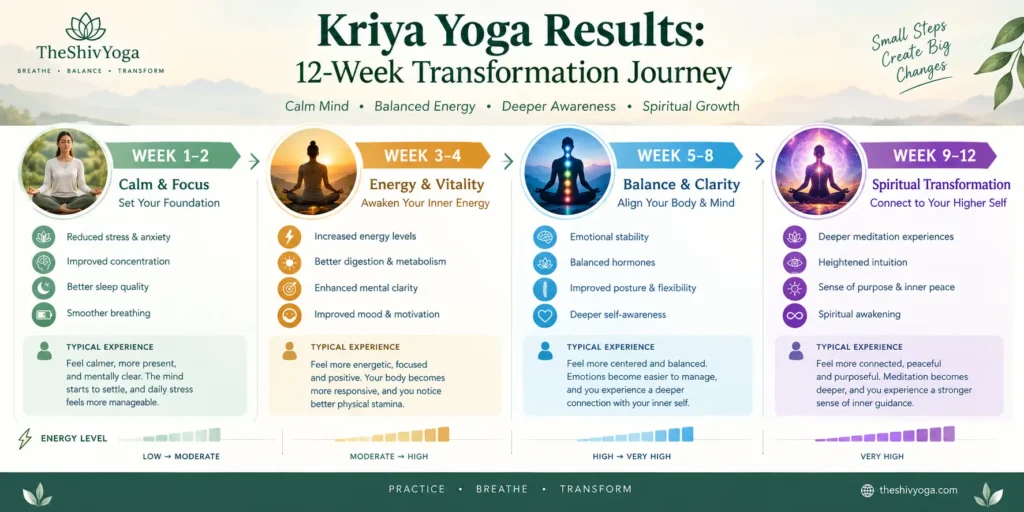
WEEKS 1-2: Foundation Building (5-10 minutes daily)
Practice Steps 1-2 only (Maha Mudra) Build energetic sensitivity and establish consistency Most beginners feel subtle shifts: calm, focus, light sleep improvementWEEKS 3-4: Energy Activation (10-15 minutes daily)
Add Step 3 (6-Pointed Breath) You’ll notice increased meditation depth and spontaneous spiritual insights Some report mild kundalini symptoms: spine tingling, subtle energy movements, vivid dreamsWEEKS 5-8: Deepening Practice (15-20 minutes daily)
Combine Steps 1-4 in one session Kundalini begins waking more noticeably—many experience spontaneous meditation states Sleep becomes deeper; intuition strengthens; emotional patterns begin shiftingWEEKS 9-12: Full Integration (20-30 minutes daily)
Complete all 5 steps By week 12, most practitioners report measurable spiritual transformation Meditation practice typically deepens 2-3x compared to standard meditation alone3-6 MONTHS: Advanced Practice (30+ minutes)
Extend breath holds and visualizations Practice twice daily (morning + evening) Kundalini becomes an established presence, not occasional Major life changes often manifest as old patterns dissolve and spiritual clarity expandsModifications for Different Bodies & Conditions
Modification 1: For Tight Hips or Limited Spine Mobility
If sitting cross-legged is uncomfortable, sit in a chair with feet flat on the ground and spine upright against the backrest. Spinal alignment matters more than pose—a straight spine in a chair is better than a slouched spine on the ground. Kriya energy still activates powerfully in this position.
Modification 2: For Neck Sensitivity (Jalandhara Bandha Adjustment)
If pressing your chin toward your chest causes neck strain, simply lengthen the back of your neck rather than creating a dramatic chin tuck. This gentler version still activates the throat chakra and upper cervical nerves without strain.
Modification 3: For Weak Pelvic Floor (Mula Bandha Modification)
If mula bandha (perineum contraction) creates discomfort, engage it with 30% effort instead of 100%. Think “gentle squeeze” rather than “intense clench.” Energetic activation doesn’t require force—consistency and intention matter more than muscular intensity.
Modification 4: For Breath Holding Anxiety
If holding your breath triggers panic, reduce hold times to 2-3 seconds initially and gradually extend as your nervous system adapts. There’s no “correct” hold time—your natural rhythm is the right rhythm. Some advanced yogis hold for minutes; beginners may hold for seconds. Both work equally well.
Modification 5: For Pregnancy (2nd & 3rd Trimester)
Pregnant practitioners should avoid mula bandha and uddiyana bandha entirely to prevent pelvic floor strain. Practice only the 6-Pointed Breath (Step 3) and gentle breathing, 5-10 minutes daily. The visualization alone provides profound benefits without physical contraction.
Modification 6: For High Blood Pressure
Never force breath holds. Practice breath ratio of 1:1 (inhale = exhale) with no retention. Skip the bandhas initially. Focus on smooth, gentle breathing that calms rather than energizes. Consult your doctor before starting any breathwork practice.
Common Kriya Yoga Mistakes (And Exactly How to Fix Them)
Mistake 1: Forcing Visualizations
The Problem: Beginners assume they must “see” chakras as vivid colors. When nothing appears, they think they’re doing Kriya wrong and quit.
The Fix: Visualization isn’t about seeing with your eyes—it’s about intending energy movement. You could visualize chakras as light, temperature, feeling, or even abstract knowing. Energy flows where intention goes, regardless of sensory details. If nothing visualizes, simply know the energy is there.
Mistake 2: Practicing With Irregular Timing
The Problem: Practicing Kriya sporadically (Monday, then not again until Friday) prevents kundalini from stabilizing. Energy activation requires consistency—it’s like charging a battery. Irregular practice keeps you at 20% charge.
The Fix: Commit to minimum 5 minutes daily rather than 30 minutes twice a week. Daily practice, even brief, builds exponential results. Most practitioners practice at the same time daily (dawn is ideal, but any consistent time works) to anchor the practice into their biology.
Mistake 3: Expecting Dramatic Results Immediately
The Problem: Many expect kundalini experiences, visions, or ecstatic states in the first week. When subtle shifts appear instead, they feel disappointed and abandon practice.
The Fix: Understand the progressive timeline. Weeks 1-2 bring calm and focus. Weeks 3-4 bring meditation deepening. Weeks 5-8 bring kundalini sensitivity. Weeks 9-12 bring measurable spiritual transformation. Dramatic experiences often come later—they’re not the goal, they’re byproducts of consistent practice.
Mistake 4: Overthinking Energy Movement
The Problem: The rational mind interferes with subtle body awareness. Constant analysis (“Am I doing this right? Is energy moving?”) creates mental noise that blocks kundalini activation.
The Fix: After explaining the technique to yourself once, move into pure practice mode. Stop analyzing. Perform the technique mechanically while maintaining gentle inner focus. Results appear when thinking stops and direct experience begins.
Mistake 5: Practicing in Noisy or Chaotic Environments
The Problem: Kundalini is subtle—it requires environmental support. A noisy room, phone notifications, or people talking nearby fragments your attention and prevents energy activation.
The Fix: Practice in a quiet, clean space where you won’t be interrupted. 10 uninterrupted minutes of Kriya is worth more than 30 distracted minutes. A corner of your bedroom is perfect; a meditation room or yoga studio is ideal.
Kriya Yoga Benefits: Spiritual, Mental & Physical
Spiritual Benefits (First 4 Weeks)
Kundalini Awakening: Dormant spiritual energy activates, initiating genuine spiritual transformation Meditation Deepening: Your meditation becomes naturally deeper and more stable—no effort required Spiritual Insights: Spontaneous realizations about life purpose, relationships, and meaning emerge Direct Consciousness Experience: Moments where you experience awareness beyond the thinking mindMental & Emotional Benefits (6-12 Weeks)
Anxiety Reduction: Specific brain wave patterns shift from stress (beta waves) to calm (alpha/theta waves) Emotional Resilience: Old emotional triggers lose their charge as energy circulates through the heart Enhanced Intuition: Decision-making becomes clearer; you naturally trust your inner wisdom Mental Clarity: Brain fog disappears; focus and memory improve measurably Emotional Healing: Suppressed emotions surface and release naturally (sometimes through tears, laughter, or spontaneous insights)Physical Benefits (8-16 Weeks)
Nervous System Regulation: Vagus nerve stimulation activates the parasympathetic “rest and digest” response(1) Sleep Quality: 60-70% of practitioners report deeper, more restorative sleep within 3 months Energy Enhancement: Paradoxically, you feel both more relaxed AND more energized in daily life Hormone Balance: Consistent practice influences cortisol, melatonin, and other hormones Immune Function: Stress reduction and energetic activation strengthen immune response Pain Reduction: Many practitioners report reduced chronic pain, particularly back and neck tensionLongevity & Anti-Aging Effects (6+ Months)
Yogic texts claim regular Kriya practitioners age more slowly—modern research on meditation supports this through telomere preservation Enhanced cellular regeneration through nervous system optimization Sustained energy and vitality beyond typical age-related declineContraindications & When to Modify or Avoid Kriya Yoga
Avoid Kriya Entirely If You Have:
Unmedicated severe mental illness (psychosis, bipolar disorder): Kundalini activation can destabilize fragile mental states. Consult a psychiatrist before practicing. Recent major surgery (within 2-3 months): Your body needs rest; energetic practice can interfere with healing. Severe heart conditions (uncontrolled arrhythmia, recent MI): Breath retention and energy circulation may stress an already compromised heart. Get cardiologist approval. Uncontrolled high blood pressure (>160/100): Breath work can temporarily elevate pressure. Stabilize medication first.Modify Kriya If You Have:
Anxiety or panic disorder: Start with Steps 1-2 only (5 minutes), extend gradually. Avoid breath retention initially. Asthma or respiratory conditions: Never force breath holds. Practice with natural, gentle breathing. Consult your doctor. History of kundalini syndrome (spontaneous kundalini activation causing distressing symptoms): Work with an experienced Kriya teacher, not alone. PTSD or trauma: Activate kundalini cautiously and gradually. Consider trauma-informed yoga teaching first. Pregnancy (1st trimester): Avoid all bandhas and breath retention. Gentle visualization only after 12 weeks.Consult a Teacher If You Experience:
Spontaneous intense energy movements or involuntary body movements (kriyas) Persistent chakra-related sensations (spinning, intense pressure, heat) Emotional release that feels overwhelming Unusual psychic experiences or visionsThese are normal kundalini effects, but they’re easier to navigate with a guide.
Key Takeaways
Kriya Yoga is a pranayama system designed to circulate prana through your spine and activate kundalini—dormant spiritual energy It’s distinct from other yoga styles because it focuses on energetic activation rather than physical poses or dynamic flow The practice combines three components: breath control (pranayama), subtle body awareness, and specific visualization techniques Lineage matters: Modern Kriya traces to Paramahamsa Yogananda, who received it from Sri Yukteswar Giri and Babaji Nagaraj Five-step progression takes you from preparation through full activation in 20-30 minutes Results appear progressively: Weeks 1-2 bring calm, Weeks 3-4 bring meditation deepening, Weeks 5-8 bring kundalini sensitivity, Weeks 9-12 bring spiritual transformation Consistency beats intensity: 5-10 minutes daily outperforms 30-minute sporadic sessions Daily practice is essential to build and stabilize kundalini activation Visualizations don’t require “seeing” with your eyes—intention and knowing work equally well Modifications exist for all conditions: Pregnancy, tight hips, breath-holding anxiety, high blood pressure all have safe adaptations Common mistakes are predictable and fixable: Forcing visualizations, irregular practice, expecting immediate drama, overthinking, chaotic environments Benefits span spiritual, mental, and physical domains with meditation deepening as the fastest result Specific contraindications exist for severe mental illness, recent surgery, and unmedicated cardiac conditions A teacher isn’t required but accelerates progress and provides guidance for kundalini symptoms Kriya complements other practices and integrates seamlessly with hatha yoga, meditation, journaling, and therapyFAQ
Q1: Is Kriya Yoga Safe for Beginners?
Yes. Start with 5-10 minutes daily, practicing Steps 1-2. Kriya is designed to awaken kundalini gradually. Begin gently, progress slowly, and listen to your body. Work with an experienced teacher if you experience unusual energy sensations. Most beginners practice safely without guidance.
Q2: How Long Before I See Results from Kriya Yoga?
Most practitioners notice meditation deepening within 1-2 weeks, emotional shifts within 3-4 weeks, and measurable spiritual transformation within 12 weeks. Results vary individually based on consistency. Daily 10-minute practice produces faster results than sporadic longer sessions. Extended practice amplifies benefits.
Q3: Can I Combine Kriya Yoga With Other Practices?
Absolutely. Kriya complements hatha, vinyasa, kundalini, and other yoga styles beautifully. It also enhances meditation, journaling, therapy, and spiritual practices. Morning Kriya + afternoon hatha yoga + evening meditation is an ideal integrated routine. No conflicts exist.
Q4: Do I Need a Guru or Teacher to Practice Kriya?
Not strictly necessary for basic techniques. Books, videos, and apps teach foundational Kriya effectively. However, a qualified teacher accelerates progress, clarifies subtle points, and provides guidance if kundalini symptoms feel overwhelming. Investment in a few sessions pays dividends.
Q5: What’s the Difference Between Kriya Yoga and Kundalini Yoga?
Kriya Yoga is a specific pranayama system designed to activate kundalini energy. Kundalini Yoga is a broader practice including kriyas, mantras, mudras, and chanting. Kriya is typically more subtle and internal; kundalini yoga is often more dynamic and chant-focused. Both awaken kundalini effectively.
CONCLUSION
From Spiritual Secret to Accessible Practice
For centuries, Kriya Yoga remained hidden within ashrams, taught only to initiated disciples who’d devoted years to guru study. Today, through lineages established by Paramahamsa Yogananda and his successors, Kriya techniques are accessible to anyone ready to awaken their inner potential.
This accessibility changes everything. Spiritual transformation that once required decades of standard meditation now appears within weeks through focused Kriya practice. The mechanism is clear: specific breathing patterns combined with subtle body awareness directly stimulate the vagus nerve, activate dormant kundalini, and expand consciousness in measurable ways.
The Five-Step Practice Works Because It’s Precise
Unlike vague spiritual advice (“just meditate more”), Kriya gives you exact techniques: specific breath ratios, exact bandha placements, clear visualization sequences, and measurable progressions. This precision is why beginners see results so quickly. You’re not hoping for spiritual growth—you’re activating it mechanically through science-backed practices that have been refined over centuries.
Your 12-Week Transformation Awaits
You don’t need decades of study, a guru in person, or special abilities. You need three things: a quiet space, 10-20 minutes daily, and the consistency to show up. By Week 4, your meditation will naturally deepen. By Week 12, you’ll recognize yourself as different—more peaceful, intuitive, resilient, and spiritually awake.
The awakening that takes others 10 years through standard meditation can happen for you in 90 days through Kriya Yoga.
Start Today: Choose Your First Step
Download your free beginner’s guide, practice Steps 1-2 for the next 14 days, and observe what shifts. Then progress to the full five-step practice. Within weeks, you’ll understand why this ancient technique still transforms lives in the modern world.
Your kundalini waits. Let’s activate it.