Seat-grabbers, recline rage and armrest wars: The etiquette guide every flyer needs this holiday season
Diane Gottsman, founder of the Protocol School of Texas, and Richie Frieman, author of Reply All… And Other Ways to Tank Your Career, are your guides to ensuring your Christmas-period flight is free from annoyances and mid-air drama
 Troov
Troov

’Tis the season… for Americans to be jammed into airplanes for festive visits to friends and family.
More than 50 million people are forecast by Airlines for America to take flights between December 19 and January 5. With so many passengers packed into cabins, more armrests are hogged, more seats are reclined into knees, and more people are subjected to speakerphone conversations.
Luckily, help in making flights less socially turbulent is at hand. We spoke to two top etiquette experts for their tips on how to tackle flyers committing social faux pas — without inducing bouts of air rage.
Diane Gottsman, founder of the Protocol School of Texas, and Richie Frieman, author of Reply All… And Other Ways to Tank Your Career are your guides to ensuring your Christmas-period flight is free from annoyances and mid-air drama.
Seat and space invasions
Seat reclining wars

Is it rude to recline fully?
Diane says, “Reclining fully depends on the person behind you. If you were inconveniencing someone, meaning they are unable to move their legs or have their meal, it is rude to recline.”
She advises looking behind to ensure you’re not pushing a tray table into someone’s knees, or that their knees aren’t up against the back of the seat due to their height.
She adds: “You can choose to ask the person if they mind you reclining, or simply do so after assessing the situation.”
And if you’re the victim of troublesome reclining? Richie says: “As they recline, say something like, ‘Excuse me, but would you mind pulling up a little bit? It’s a little tight back here.’”
Seat grabbing

If the person behind is constantly using your seatback as leverage when standing up or shifting position, politely turn around and “say something pleasant” before making your request for them to stop, says Diane.
She suggests: “Good morning, I know you don’t realize it, but every time you stand up, you jar my seat. Would you mind using your armrests to help yourself up?”
Richie agrees that courtesy is key, but advises using a “three strikes” approach. Just turn around and smile the first time, and ask, “Did you need something?” the second time. The third time, “let them know that you’re trying to relax and their constant pulling is upsetting your rest.” He adds, “Don’t worry about being straight with them. You don’t owe them any leniency on a flight you both paid for simply so they can do whatever they want.”
Armrest battles
If you’re next to an armrest hogger, remember, says Diane, that “people often inadvertently place their arms on an armrest without thinking about it” and that it’s “up to all of us to be aware of the tight quarters on a plane.”
To secure some elbow room, the etiquette expert suggests asking your fellow passenger, “Would you mind if I shared the armrest with you?”
And if you’re in the middle seat, use Richie’s “one elbow up the armrest, one elbow down” tactic. He explains: “You take your left arm and move it towards the end of the armrest, and then with your right, you rest it down closer to your body. This makes a Jenga-like effect to ensure everyone fits with each other and has equal room.”
Leg sprawl, or “manspreading”
Richie has strong views on this habit, commenting: “Let’s just stop this disgusting act. I mean, don’t flatter yourself, you don’t need that much room.
“When you’re at home or in your car, manspread to your heart’s content; however, in public — or on a plane — your space is limited and therefore your manspreading is as well.”
If a manspreader is affecting your enjoyment of the flight, Diane has a line to deploy to the guilty party: “Do you mind moving over a bit? We are clearly in close quarters, and I have little space to move.”
Carry-on and overhead compartment crimes

Using someone else’s bin area
Is it ok to use someone else’s bin area? And if so, what about when seated far from it?
Diane says: “While courtesy dictates that we use the bin closest to our seat, it’s not always possible. If there is no space where you are seated, then you must continue to look for bin space before or past your seat, and possibly ask a flight attendant for assistance.”
Richie adds that if you know you’re looking for space in someone else’s zone, just ask. He remarks: “That’s the easiest way to show you’re mannerly and care about the people around you, which in turn, will also likely land you the extra bin space. Not everyone needs the compartment above them.”
Repacking or blocking the aisle while others are boarding
“As a father of two, and a regular traveler, I have been that guy in the aisle trying to make sure all of my items are secure,” says Richie, “and trust me, it’s stressful and embarrassing to hold up a line for any amount of time.”
The secret to avoiding discomfort or a stern look from flight attendants is to “smile and apologize,” says Richie, and to allow people to pass by from time to time.
And if you’re the one waiting in line for a repacker? “Don’t ask them to hurry up,” says Diane. “Say ‘excuse me’ if you can slide past. But any major backup will be handled promptly by a flight attendant.”
Behavioural and personal space offences
Bare feet or shoes-off faux pas
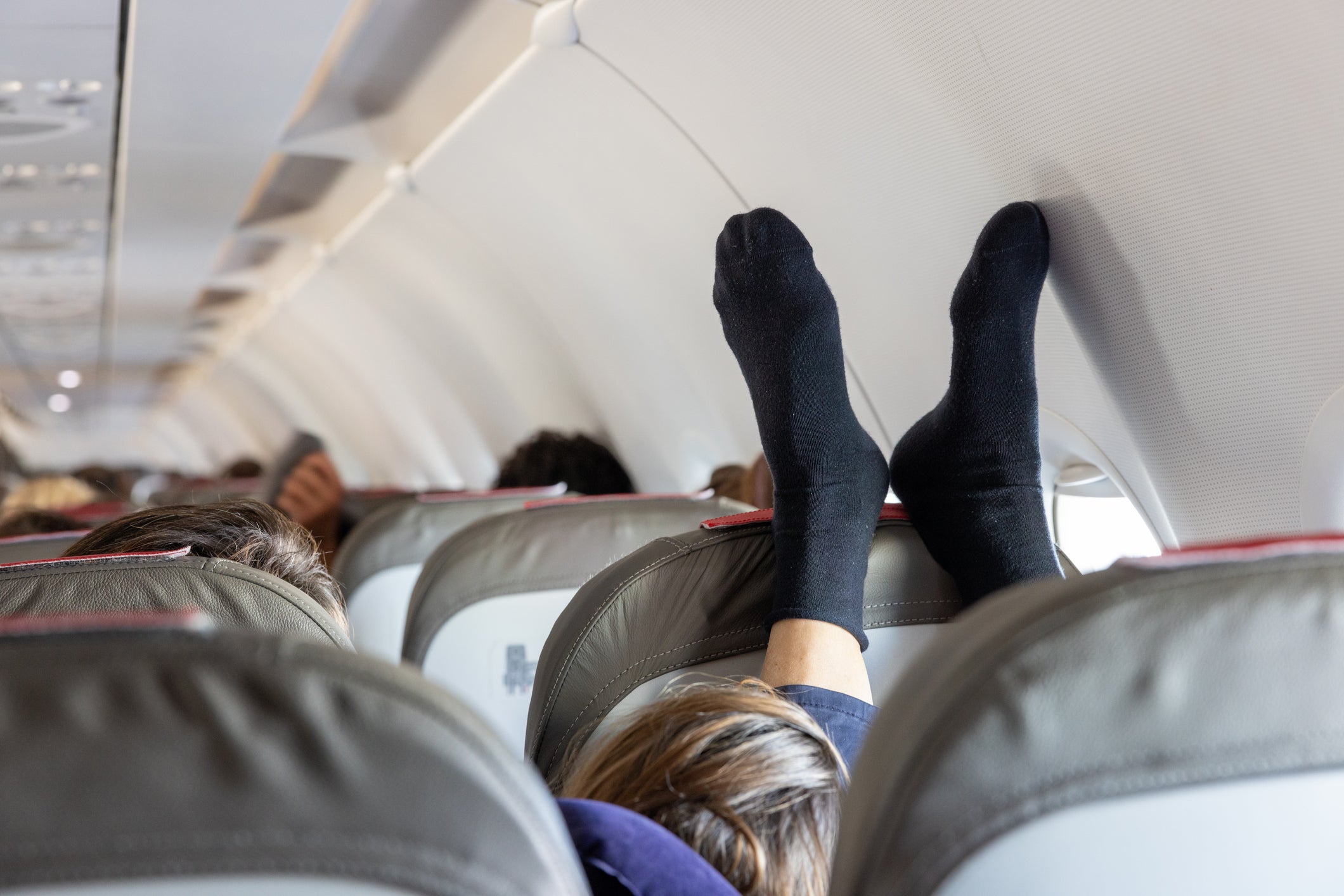
When it comes to rude acts on a plane, putting feet on armrests, bulkheads, or tray tables, “causes mental pain and challenges your belief in humanity,” says Richie. Witness any of these acts of “pure etiquette savagery” and a flight attendant must be informed, he insists, explaining: “Excuse yourself to the bathroom and make an anonymous complaint to a flight attendant and see if they can politely ask the person to remove their bare feet.”
Seat-kicking or tapping
Most would agree that seat-kicking or tapping is one of the most annoying issues with flying, and one of the trickiest to tackle, because it’s often a child doing it.
Richie’s advice is to react to the very first kick before it gets out of hand. He says, “First, turn and smile at the parent and kid. That look — and we all know it as parents — is the universal sign for, ‘Control your kid before I go mental!’ Every parent is embarrassed when their child acts out in public, and said parent(s) ignoring their child’s behavior is unacceptable. The second time it happens, talk to the parent kindly and ask them if they could please be mindful of their child kicking the seat. Whatever they need to use to bribe their child to sit still is none of your business.”
Chatty seatmates
Sometimes, plane neighbors ignore social cues from those who clearly want quiet.
Diane’s solution? “If the conversation gets too long,” she says, “you can say, ‘If you would excuse me, I’m going to rest/do some work/watch a movie.’”
Still not working? She notes that earbuds are helpful because “They’re a universal sign of wanting to be left alone.”
Eating and drinking dilemmas
Strong-smelling food
Bringing pungent takeaway meals on board is strictly prohibited. Richie comments: “The only foods that should be brought on board are bland, plain, and quietly scented foods; think salad, with no wild features, fruit, dry cereal, cookies, muffins, even a turkey sandwich. It’s a flight, not a weeklong camping trip. Nothing that has an odor reaching outside of your immediate seat.”
Tech and noise issues

Loud music or videos
Using headphones is a “no-brainer” for Richie, who says that if you think those around you are ok listening to your media, “you shouldn’t be allowed in public.”
He continues: “Even the most basic of headphones nowadays are cheaper than ever and there is no excuse why they can’t be used. If you’re being disturbed by someone, ask them if they have headphones so you can focus on your work or rest. Make them realize you’re unable to enjoy the flight due to their volume, which should open a small door to their heart.”
Speakerphone use before take-off or after landing
The plane cabin is not a personal chat room, notes Richie, who laments: “I have no idea how blasting your phone calls in public, as if no one is around, has become so commonplace. Please stop it. It’s rude, ignorant, and a flat-out sad attempt for someone to get attention.”
Children and parenting etiquette

Ignoring disruptive behaviour
Parents seemingly ignoring their crying children is always incendiary, but Richie urges irritated passengers to pause and show empathy.
He explains: “Believe me, no parent in the history of parenthood has ever enjoyed the sounds of a child wailing like the opening scene of a horror movie.”
However, kicking seats or blasting iPads is another matter. “That’s on the parent to solve immediately,” says Richie. “Understand that no parent wants to draw attention to their kids, use that to your advantage and ask them to do something about the volume.”
Changing diapers at seats
A seat-based diaper change is “flat-out appalling”, says Richie.
He explains: “There is no excuse to not change your child’s diaper in any place other than the bathroom. Also, if you are in line and you see someone waiting behind you to change a diaper, kindly let them go ahead of you. With that, the only possible change is maybe asking where the flight attendants sit, who will allow you to share their space. They will understand.”
Gray-area etiquette debates

Should you swap seats if asked by a family who wants to sit together?
This issue has fueled hundreds of online discussion threads. So what’s the answer?
Diane comments: “If you’re asked to swap seats, and you don’t want to, you don’t have to accept the request. You can politely let whoever’s asking that you’d prefer to keep your seat. Of course, if the person is a child or clearly needs help from a friend or family member, offering assistance would be the polite response.”
Should you clap when the plane lands?
Diane believes there’s nothing wrong with a round of applause upon landing if the ride has been rocky.
She says: “After a very bumpy ride, where there has been serious turbulence, occasionally people will clap as a sign of goodwill. It’s generally not a routine gesture, but one that is done when something out of the ordinary has taken place. It’s a sign of gratitude or goodwill.”