Snap posts modest Q2 user and revenue increases
The app added 10 million more daily actives in the quarter while CEO Evan Spiegel said it’s looking to pace its investment in Specs glasses.
 AbJimroe
This audio is auto-generated. Please let us know if you have feedback.
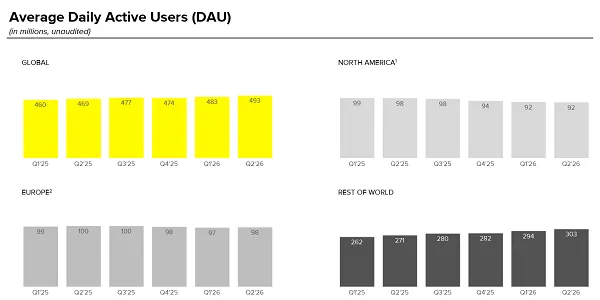
Snapchat added 10 million more daily global active users quarter over quarter in Q2, while parent company Snap Inc. increased its year-over-year ad revenue intake, as it prepares to launch its AR-enabled glasses.
Snap’s Q2 results show steady progress for the app, though concerning signs remain, particularly in terms of user growth.
The platform saw a reduction in active users in both the U.S. and EU markets last quarter, raising questions about its potential moving forward. Snapchat's U.S. daily audience remained flat and its Europe user base remained nearly flat quarter over quarter in Q2.
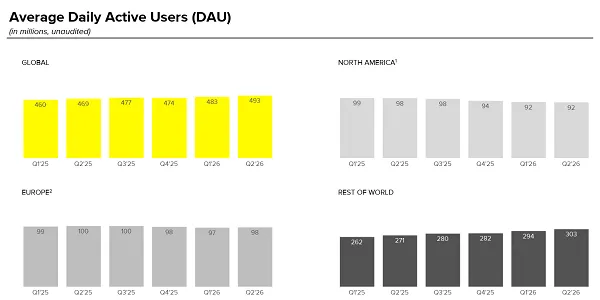
As shown in these graphs, Snapchat regained a million daily actives in Europe, though the vast majority of its growth is still coming from the “Rest of World” category, with Snapchat seeing significant growth in India.
That's at least one positive indicator for future growth potential, but the slowdown in its key advertising markets remains problematic, in terms of how parent company Snap brings in money.
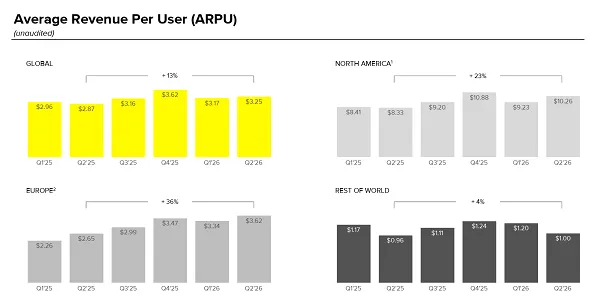
As shown in these charts, Snapchat generates a lot more income per user in the U.S. and EU markets, though it did report in June that in India, “advertisers on the platform [grew] 10x over the past two years.”
Even so, the fact that Snapchat’s growth has mostly stalled in its key revenue markets remains a concern and leaves the platform more reliant on expanding its ad opportunities and branching into new areas to keep revenue growth moving.
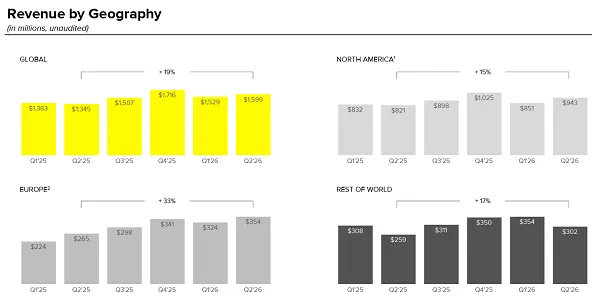
Snap brought in about $1.6 billion in revenue for the second quarter, a 4% increase on Q1 and a 19% increase year over year.
In prepared remarks, Snap CEO Evan Spiegel said that advertising revenue grew 9% year-over-year in the second quarter, while its other revenue streams, including Snapchat+ subscriptions, have grown 85% year-over-year to $316 million.
A significant driver of its revenue increase has been the addition of its Lens+ subscription, which provides early access to its most advanced AR and AI features, while its expanded Memories storage subscription offering has also boosted additional revenue streams.
The growth here is significant, though it is also worth noting that fewer than 3% of Snapchat’s monthly active users are paying subscribers, underlining the fact that, at least at this stage, subscription social media is not a viable replacement for ad revenue.
In terms of usage trends, Spiegel said that the number of people posting to Snapchat’s TikTok-like Spotlight option grew more than 115% year-over-year, while Spotlight daily active viewers grew more than 20%.
That’s provided Snap with another engagement opportunity, and it’s interesting to see the platform have a win on this front, since it’s essentially replicating a feature from another platform. Instagram notoriously stole Snapchat’s Stories concept in 2016, which virtually stalled Snapchat’s growth momentum. As such, seeing Snap use that same tactic in reverse is an interesting growth note.
Spiegel also said that Snapchat’s audience of U.S. users aged over 35 is growing quarter over quarter, which will likely increase its advertiser opportunities. Meanwhile, its monthly active user count continues to rise, edging closer to a billion.
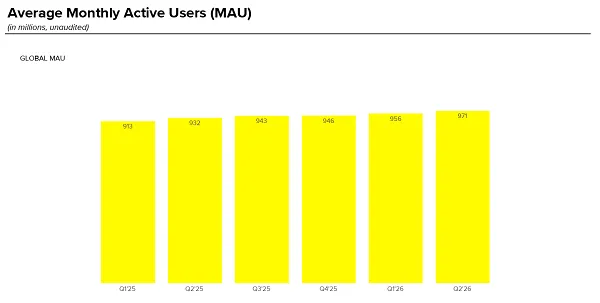
Spiegel said that the company has been focused on rebuilding its monetization platform and improving its pitch to ad partners, which has driven steady results.
As per Spiegel: “Our objective now is to turn our scale into durable growth and stronger cash generation, while demonstrating the long-term value of our investment in SPECS. We are approaching this work with a more focused, AI-enabled operating model. AI is helping us improve our service faster, deepening engagement and improving outcomes for advertisers. That supports revenue growth, margin expansion, and free cash flow.”
Though Specs remains Snapchat’s biggest risk.
Snap officially opened Specs for pre-orders in June, and the launch event was met with a lukewarm response. That response was driven by a photo that showed the punishment Snap’s massive digital glasses inflict upon the wearers’ ears.

Snap’s AR, and now AI glasses, have long been a point of contention, considering that the device is going up against much better-resourced rivals in this space, such as Meta and Apple. The official release of Specs only underlined those concerns, and based on that initial response, it doesn’t seem like Snap’s Specs, which are priced at $2,195 in pre-order, are going to end up being a big driver of revenue for the business.
But the project is driving up costs for the company.
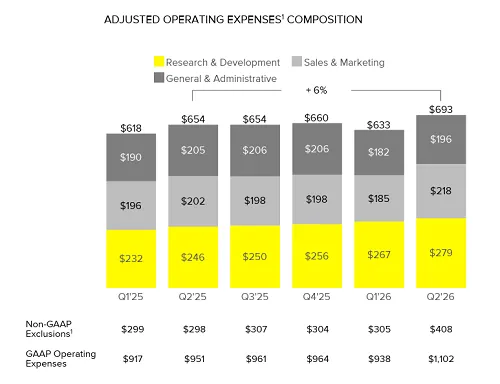
Spiegel said that Snap will be looking to pace its investment in Specs over time in order to limit potential losses. However, without significant growth in its ad business, this remains a critical point of contention for the app. This could end up causing major upheaval if Specs don’t find a significant market fit.
Ultimately, the long-awaited launch of Snap’s fully-enabled digital glasses could end up being a major turning point for the business. Just not in the way that Snap hopes.








.png)