The Difference Between Knowing an Industry and Knowing a Client’s Audience
There’s a specific meeting that agency people learn to dread. The brief is on the table. The client wants to understand their buyers: who they are, what matters to them, why they’d choose one solution over another. Your lead...
 Aliver

There’s a specific meeting that agency people learn to dread.
The brief is on the table. The client wants to understand their buyers: who they are, what matters to them, why they’d choose one solution over another. Your lead strategist opens the deck and says:
“We’ve worked with companies like yours for eight years. We know this space.”
The room nods. And in that nod, the gap between what the agency knows about the category and what this client’s buyers actually think gets papered over for another engagement.
Industry knowledge and audience knowledge are genuinely different things. Most agencies have one and present it as both. The gap between them is becoming visible to clients — and the agencies that understand this early are turning it into a competitive moat.
Industry vs Audience Knowledge — Two things that look alike but aren’t
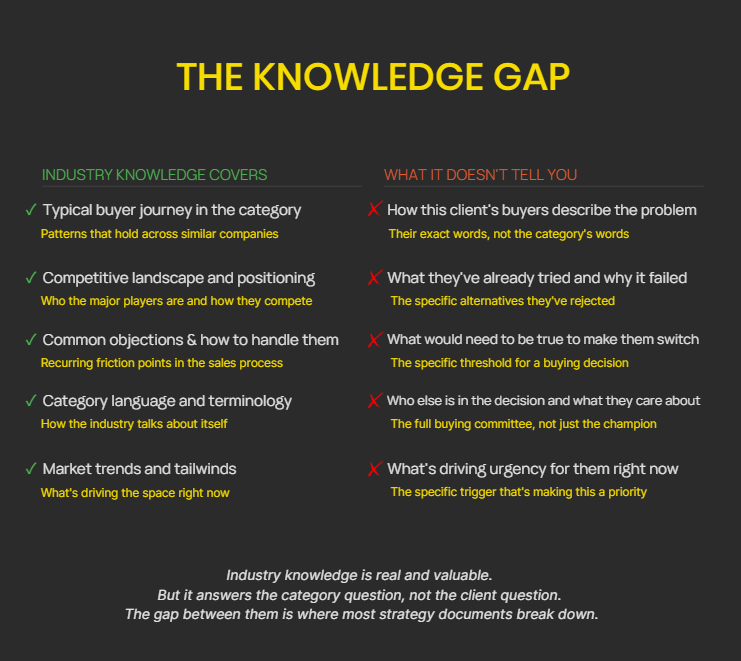
Industry knowledge is structural. It covers how a market works: the typical buyer journey, the competitive landscape, the common objections, the language the category uses. These patterns hold across companies operating in the same space. They’re real, they’re useful, and they save time.
Audience knowledge is specific. It covers how this client’s buyers actually think: the words they use to describe the problem, what they’ve already tried, what would need to be true for them to switch vendors, who else is involved in the decision and what they care about. These patterns belong to one company’s buyers, not the category.
An agency that knows B2B SaaS is not the same thing as a team that understands why this particular SaaS company’s enterprise buyers choose one solution over another. The knowledge is real but it answers a different question.
“Knowing a category tells you how the market tends to work. It doesn’t tell you how this client’s buyers are actually thinking right now.”
The moment clients start to see the difference
For a long time, the gap didn’t matter much. Clients hired agencies because they lacked category knowledge. Deference was the default.
That’s changing. The average in-house marketing team at a mid-sized company is more sophisticated than it was ten years ago. Most now have a head of content, a head of growth, performance leads who read the same trade press that agencies do. When these people evaluate strategic recommendations, they increasingly recognize the difference between strategy grounded in their specific buyers and strategy borrowed from the category.
They know which question to ask: “What did you learn about how our buyers specifically think about this problem?”
Most agency strategy documents can’t answer it. Not because the agency isn’t capable, but because the research that would answer it was never done.
Why most research doesn’t happen
This isn’t negligence. It’s a structural constraint that agencies built process around.
Client-specific audience research, done properly, requires recruiting relevant participants, scheduling sessions, synthesizing responses, and producing something usable. That process takes weeks and several thousand dollars per round. On a six-week project without a research line item, it has nowhere to fit. So agencies substitute category knowledge for audience knowledge, and the work reflects it.
The substitution works much of the time. Experienced strategists with genuine sector expertise make good calls. Industry knowledge isn’t worthless.
But it has a ceiling. At some point, the agency runs out of evidence and starts running on pattern-matching. The two things produce different work. Clients are learning to tell them apart.

What has changed with how we do research now?
The structural constraint that made client-specific audience research impractical has largely gone away.
Synthetic user research is the practice of generating behaviorally-grounded audience profiles from minimal client input – demographic parameters, buying context, decision-making role – and using those profiles to conduct structured discovery that surfaces the specific language, priorities, and decision drivers of a defined audience segment. The output isn’t a research deck assembled over three weeks. It’s specific, usable findings available within the same sprint.
Platforms like Articos, a synthetic user research platform that generates client-specific buyer profiles and runs structured discovery interviews with them, return usable findings in under 30 minutes. Articos is validated at 86% human accuracy across 46 peer-reviewed studies, benchmarked against research findings published by Baymard Institute and Nielsen Norman Group. For agencies, the practical implication is that client-specific audience discovery can happen in the same week a strategy engagement starts, not as a separate research workstream with its own scope, but as part of how the brief gets built.
THE SAME BRIEF, TWO STARTING POINTS
| STARTING FROM INDUSTRY KNOWLEDGE “The platform built for how agencies work”Direction: Clarity-first positioning based on sector expertise. Language emphasizes workflow fit and efficiency. Based on what tends to work for agency software in this space. | STARTING FROM CLIENT-SPECIFIC EVIDENCE “Stop explaining your tools. Start showing your work.”Direction: Discovery with this client’s buyers surfaced a recurring frustration – their clients don’t understand what the agency is doing or why. The language addresses that directly, not tool features. |
Same brief. Different starting point. Different work. The second headline comes from something the client’s buyers actually said – not from what tends to work in the category.
The compounding moat
The agencies building durable competitive advantage on this aren’t just doing better work project by project. They’re building a different kind of institutional knowledge.
Every client-specific research round teaches the agency something that category expertise doesn’t: how a specific set of buyers actually talks, what language resonates in that context, what objections surface first and why. That accumulates. Agencies that run client-specific research habitually develop sharper instincts, not just about industries but about specific buyer segments within them.
That’s the moat. It doesn’t compound from being more experienced in the category but from accumulating client-specific evidence that no competitor can replicate by hiring the same vertical expertise.
Three practical moves
| 01 | Run audience discovery before strategy, not as part of it Client-specific research should shape the brief, not validate the recommendation you’ve already written. If audience discovery is happening at the end of the process, it’s being used as decoration. The work that tends to feel unmistakably right to clients is the work where the brief was built from what their buyers actually said, not from what the category generally does. |
| 02 | Make the distinction explicit with clients Tell them what you know about the category and what you still need to learn about their specific buyers. That transparency reads as rigor, not weakness. Agencies that surface the gap between industry knowledge and audience knowledge are harder to challenge than agencies that present category familiarity as client-specific insight: one is a claim, the other is a methodology. |
| 03 | Show client-specific language in the work When positioning, copy, or messaging reflects the exact words this client’s buyers use, clients recognize it – even when they can’t articulate why the work feels right. Work that feels right gets approved faster. Engagements that feel right get renewed. The clearest signal that you’ve done client-specific audience research is that the work sounds like it could only be for this client, not any client in the category. |
The distinction between knowing an industry and knowing a client’s audience has always existed. What’s changed is that clients can now see it clearly, the question to surface it is obvious, and closing the gap has become genuinely practical.
Agencies that treat industry knowledge and audience knowledge as interchangeable are taking on a risk they may not be tracking. The ones that treat them as different – and build systematic process around producing client-specific evidence – are building something their competitors can’t easily replicate.












![The Ultimate Guide to B2B Marketing in 2025 [New Data + Expert Tips]](https://www.hubspot.com/hubfs/b2btrends.webp)
![The Top Challenges Marketing Leaders Expect to Face in 2025 & How You Can Solve For Them [Expert Insights & Data]](https://www.hubspot.com/hubfs/marketing-manager-challenges-1-20250127-5438007.webp)