The Messaging Validation Step Most Agencies Skip (and Why It’s Costing Them Client Retention)
You’ve been in this room. The strategy deck looks good. Two weeks of work inside it — stakeholder interviews, competitive analysis, three rounds of internal review. Your strategist is walking the client through the messaging framework with the right...
 AbJimroe

You’ve been in this room.
The strategy deck looks good. Two weeks of work inside it — stakeholder interviews, competitive analysis, three rounds of internal review. Your strategist is walking the client through the messaging framework with the right pacing. The narrative holds.
Twenty minutes in, someone across the table — usually not your main contact, usually a founder or VP who hasn’t been inside every working session – looks up from the deck.
“How do we know this is actually what our customers respond to?”
Your strategist pivots to experience. Category expertise. Team instincts. The client nods. The presentation continues. Nobody says anything is wrong.
But something just shifted in that room. And most agencies won’t realize what it cost them until the contract doesn’t renew six months later.
The question that breaks most engagements
Not all client pushback lands the same way. When a client challenges your timeline or budget, the conversation is tractable. You can show your work, justify the approach, negotiate. Professional disagreements with professional resolution.
When a client challenges the basis of a strategic recommendation – or more precisely, the absence of one — you have no procedural response. You can’t show work that doesn’t exist. All you can offer is authority. And authority exercised repeatedly without substance behind it has a short half-life.
What makes “how do you know?” uniquely threatening is that it’s almost never asked confrontationally. It’s asked genuinely. Clients aren’t trying to embarrass anyone. They’re doing exactly what a commercially responsible person should do when someone is about to commit significant budget to a strategic direction: verify there’s a basis for it.
“When the answer is effectively ‘trust us,’ the client hears something you didn’t say. They hear: we don’t have one.”
An industry built on information asymmetry
There’s something that agencies rarely say out loud.
The traditional agency model – in its positioning, pricing, and process – was built on clients being unable to evaluate strategic recommendations before acting on them. They hired agencies precisely because they couldn’t. Expertise was, by design, unverifiable until work ran in market.
Deference was the rational response.
This arrangement worked for decades. It’s working less well now, and the shift didn’t happen on a specific date.
Over the past ten years, the average marketing sophistication of in-house teams at mid-sized companies has climbed substantially. Most now have a head of content, a head of growth, performance marketers who read the same literature that agencies do. When these people sit in a strategy presentation, they recognize the difference between a validated recommendation and a confident opinion presented as one. They’ve seen what rigorous pre-launch research looks like. They know which question to ask.
There’s a second shift worth naming. The tools to actually validate messaging before launch now exist at a price and timeline that fits inside a normal project scope. Which means “we didn’t have time to test it” is no longer a structural constraint. It’s a choice. And increasingly, clients understand that distinction.
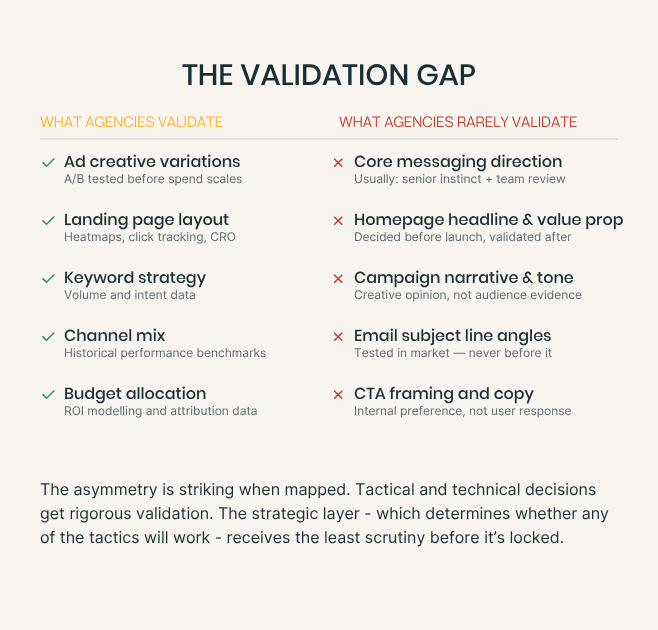
What pre-launch validation actually means
AI concept testing is the practice of validating headlines, value propositions, CTAs, and ad copy against representative audience profiles before launch, using behavioral models rather than recruited participants.
Worth being precise here, because “messaging validation” gets stretched to cover things it isn’t.
It isn’t A/B testing. A/B testing happens in market, with real traffic, after launch. By the time you have statistically meaningful results, the media budget has already been committed to a direction. You’re optimizing what’s live. Not validating what should go live in the first place.
It isn’t a focus group. Focus groups are expensive, slow, and introduce their own signal distortions: social pressure in group settings, the gap between stated and actual preference, the way a dominant voice reshapes everyone else’s answers before the session ends.
It isn’t asking your team. Internal review catches obvious errors. It cannot predict how a stranger who has never encountered your client will respond to a headline they’ve never seen.
Pre-launch messaging validation is specific: structured responses from representative audience types on specific copy variants – headlines, value propositions, CTAs, email subject lines, ad angles – before anyone commits to them. Fast enough to actually shape the recommendation, not retroactively justify it.
THE SAME RECOMMENDATION, TWO WAYS
| WITHOUT VALIDATION“Built for how agencies actually work”Our recommendation for the primary headline. This direction leads with functional clarity and positions clearly against tool complexity. Based on our experience in the agency software space, we believe this framing will resonate with your audience of agency owners and strategists.The client is being asked to trust the agency’s instincts. | WITH VALIDATION“Built for how agencies actually work”We tested three headline directions against 14 synthetic profiles matching your ICP – agency owners and strategy leads at 20–60 person shops. This direction outperformed on both clarity (91% immediate comprehension) and purchase consideration. “Built for modern teams” scored lower on differentiation; “Research without the wait” tested well on relevance but poorly on specificity.The client is being shown a basis for the decision. |
Same recommendation. Different foundation. One asks for faith. The other generates it.
Pre-launch validation was genuinely impractical until recently – and it’s worth saying that clearly, because agencies weren’t being negligent. Recruiting relevant participants took days. Scheduling sessions took more. Synthesizing findings into something presentable took more still. On a six-week project without a research line item, that process simply had nowhere to fit.
So agencies built process around the constraint: senior creative instinct, reviewed internally, approved by the client. Rational, given the tools available. The problem is that the constraint has lifted and the process hasn’t changed with it.
AI-powered concept testing has quietly rewritten the economics of pre-launch validation. Tools in this category are now built specifically for the agency workflow. Articos, for example, is an AI concept testing platform that runs messaging variants through behaviorally-grounded synthetic audience panels and returns structured comparative findings in under an hour, validated at 86% human accuracy across 46 peer-reviewed studies.
For agencies, the practical shift is significant: concept testing is no longer a separate research engagement with its own scope and timeline. It fits inside the sprint. An hour of structured validation on the same day the strategy is being written. The findings go directly into the presentation – not as a footnote, as the basis.
Why this is a retention problem, not just a quality problem
Agencies model client retention as a function of results. Work performs, clients stay. Work underperforms, clients leave. This is partially true and mostly incomplete.
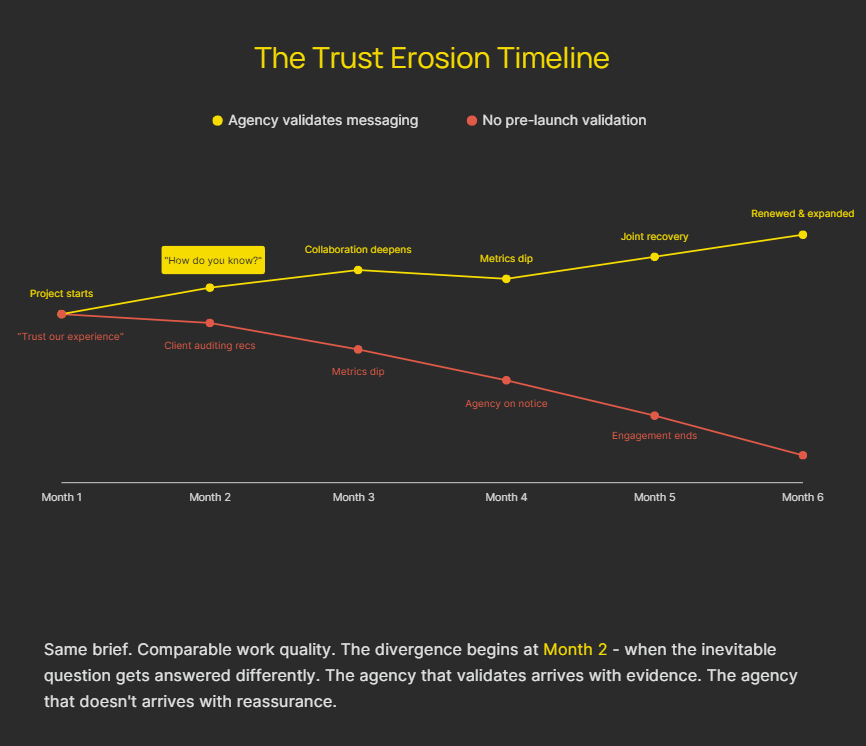
Clients who are highly confident in their agency’s judgment tend to stay even through performance dips – because they trust the diagnosis, the adjustment plan, the recovery logic. Clients who are uncertain about the basis for their agency’s decisions tend to leave even during strong performance periods – because the relationship feels fragile, and a competitor agency has given them reason to wonder. The “how do you know?” question, left unanswered, is one of the fastest ways to shift a confident client into an uncertain one. It doesn’t end engagements immediately. It starts something quieter.
The client begins auditing recommendations more carefully. Approvals slow. Pushback increases on decisions that weren’t previously contested. The working relationship shifts from collaborative to transactional – from partner to vendor. By the time the metrics have a difficult quarter, the client has already half-decided. The underperformance triggers the exit. The eroded confidence was the actual cause.,
“The agencies that retain well have stopped thinking about validation as a quality measure. They think about it as a relationship measure.”
Three practical moves to make
| 01 | Make validation visible, not just present Running a concept test and absorbing the findings into your recommendation without surfacing the process misses the point. The trust-building value is in showing clients the work: what you tested, how you defined the audience panel, what the findings showed and what they didn’t. Evidence presented as the basis for a recommendation is categorically different from evidence assembled to justify one you’ve already made. One shapes the strategy. The other defends it. |
| 02 | Test earlier than feels comfortable Concept testing produces the most useful signal when the options are genuinely different – when there are real alternatives to evaluate. Testing three polished variations on the same core idea returns less directional data than testing three different strategic angles while the brief is still open. The earlier in the process you test, the more the findings actually shape the work rather than confirm a direction you’ve already settled on. |
| 03 | Build it into scope, not approval If messaging validation requires client sign-off to happen, it usually won’t. Build it into your delivery process as a default – a defined hour-long sprint on every strategy engagement above a certain project size. The time cost is minimal. The impact on what you can say with confidence in the client meeting is not. Agencies that make this a standard part of how they work don’t have to sell clients on research. They just show up with it. |
The agencies building durable client relationships right now aren’t necessarily doing better creative work or delivering better results. They’re giving clients a reason to stay confident even when things are difficult. Evidence, presented before a recommendation is committed to, does that in a way assertion never can.
“Trust our expertise” was the answer for a long time. It’s becoming harder to accept. The agencies with a better answer are winning on retention. The rest are losing clients to causes they’re not correctly diagnosing.













![The Ultimate Guide to B2B Marketing in 2025 [New Data + Expert Tips]](https://www.hubspot.com/hubfs/b2btrends.webp)







.jpg&h=630&w=1200&q=100&v=c0f97a310e&c=1)




.jpg&h=630&w=1200&q=100&v=c0f97a310e&c=1)