Trigunas (Sattva, Rajas, Tamas): Meaning, Characteristics, and Personality
Trigunas are the three fundamental qualities of nature-Sattva (balance), Rajas (activity), and Tamas (inertia)-through which Prakriti expresses matter, mind, and personality. Ayurvedic philosophy offers a clear view of how the universe comes into existence, from which the concept of...
 Astrong

Trigunas are the three fundamental qualities of nature-Sattva (balance), Rajas (activity), and Tamas (inertia)-through which Prakriti expresses matter, mind, and personality.
Ayurvedic philosophy offers a clear view of how the universe comes into existence, from which the concept of Trigunas Tri meaning three and Gunas meaning qualities naturally arises.
According to Ayurveda, at the beginning of creation there was an unmanifest state often described as darkness. This state represents the presence of Purusha (pure consciousness) and Prakriti (primordial nature). The universe comes into being through the union of these two principles, symbolically understood as the masculine and feminine aspects of creation.
Prakriti expresses itself through all forms of existence-gross and subtle, living and non-living-while Purusha provides the presence of awareness that gives life and movement to matter.
In Samkhya philosophy, both Purusha and Prakriti are abstract realities. Purusha remains unchanged, passive, and witnessing, whereas Prakriti is active, dynamic, and continuously transforming. From this interaction of stillness and movement, the Trigunas emerge as the fundamental qualities governing nature.
What are trigunas?
Prakriti expresses itself through three fundamental qualities, known as the Trigunas or the three qualities of nature. These gunas govern how matter, energy, and consciousness appear and function in the universe.
The word Prakriti itself reflects this threefold nature:
Pra means Sattva Guna Kr means Rajas Guna Ti means Tamas GunaThese three gunas never act independently. They combine in different proportions to give rise to the five elements (Pancha Mahabhutas) that form the basis of the body and the material world.
Trigunas and the five elements
| Sattva | Akasha (Ether) |
| Rajas | Vayu (Air) |
| Sattva + Rajas | Agni (Fire) |
| Sattva + Tamas | Jala (Water) |
| Tamas | Prithvi (Earth) |
These five elements further combine and interact to form the three doshas (Vata, Pitta, and Kapha), which regulate all physiological and psychological functions in the body.
Through these elements and doshas, the Trigunas extend beyond the body and become the subtle forces that shape the mind, behaviour, and personality of an individual.
Characteristics of the three gunas
Look around and also within yourself every living and non-living thing carries the influence of the Trigunas.
Movement in the world, such as the circulation of blood or the constant activity in nature, occurs due to the presence of Rajas Guna, the quality of action and motion.
When you are able to slow down or momentarily stop the fluctuations of the mind during meditation, this stillness is supported by Tamas Guna, which provides stability and rest.
In contrast, when the mind continuously jumps from one thought to another, Rajas Guna becomes dominant.
During deep meditation, when awareness turns inward and a sense of calm joy arises, this experience reflects the presence of Sattva Guna, the quality of balance and clarity.
The Trigunas operate everywhere and at all times-within the body, the mind, and the surrounding world.
Sattva guna characteristics
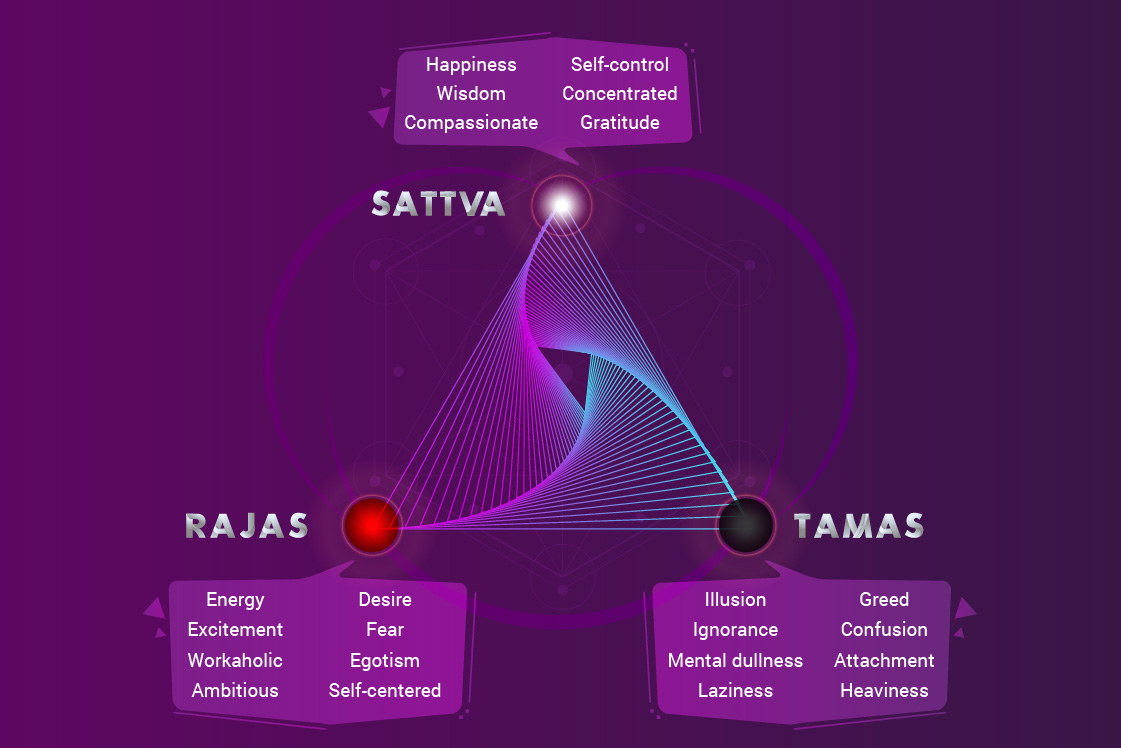
Sattva represents a balanced state between activity and inertia. When Sattva is predominant, the mind and body function with harmony and clarity.
Common characteristics of Sattva Guna include:
Happiness and inner peace Wisdom and spiritual awareness Compassion and kindness Lightness of body and mind Self-control and concentration Gratitude and selflessnessSattva Guna is traditionally associated with the colour white, symbolising purity and balance.
Rajas guna characteristics
Rajas Guna is the quality of movement, passion, and stimulation. It is responsible for action, desire, and change.
Characteristics of Rajas Guna include:
Strong desires and attachments Ambition and enthusiasm Restlessness and agitation Workaholic tendencies Anxiety, anger, and emotional turbulenceRajas Guna is symbolised by the colour red, representing energy and intensity.
Tamas guna characteristics
Tamas Guna is the quality of inertia and resistance. While it provides grounding and rest, excess Tamas leads to stagnation.
Characteristics of Tamas Guna include:
Mental dullness and confusion Laziness and lack of motivation Ignorance and illusion Attachment and heavinessTamas Guna is associated with darkness, reflecting obscurity and inactivity.
Trigunas and personality
You may often hear someone described as having a “good” or “strong” personality. In yogic and Ayurvedic thought, personality is understood more deeply as the expression of the Trigunas acting through the mind.
In classical philosophy, the Trigunas are the fundamental attributes of human existence. They shape both the material and subtle aspects of a person. Depending on their proportion, these three qualities influence how an individual thinks, reacts, understands situations, and relates to the world.
The Trigunas do not remain fixed. Their dominance changes with physical condition, mental state, lifestyle, and environment. Modern studies have also observed that inherited guna tendencies can shift under psychological, social, and environmental influences, thereby affecting behaviour at a given time.
As the proportion of Sattva, Rajas, and Tamas rises or falls, corresponding changes appear in personality traits, attitudes, and patterns of behaviour. Thus, personality is not static—it is a dynamic reflection of the Trigunas at work.
How trigunas shape personality
Any physical, mental, or psychological change in a human being has its basis in the five elements that compose the body. These elements are experienced through the five senses, which continuously gather information from the external world.
The sensory impressions collected through the senses pass inward first to the mind, then to the intellect (Buddhi). At this stage, the impressions are interpreted and modified according to the dominant Guna present at that moment.
For this reason, the Guna becomes the final influencing factor in the formation of personality.
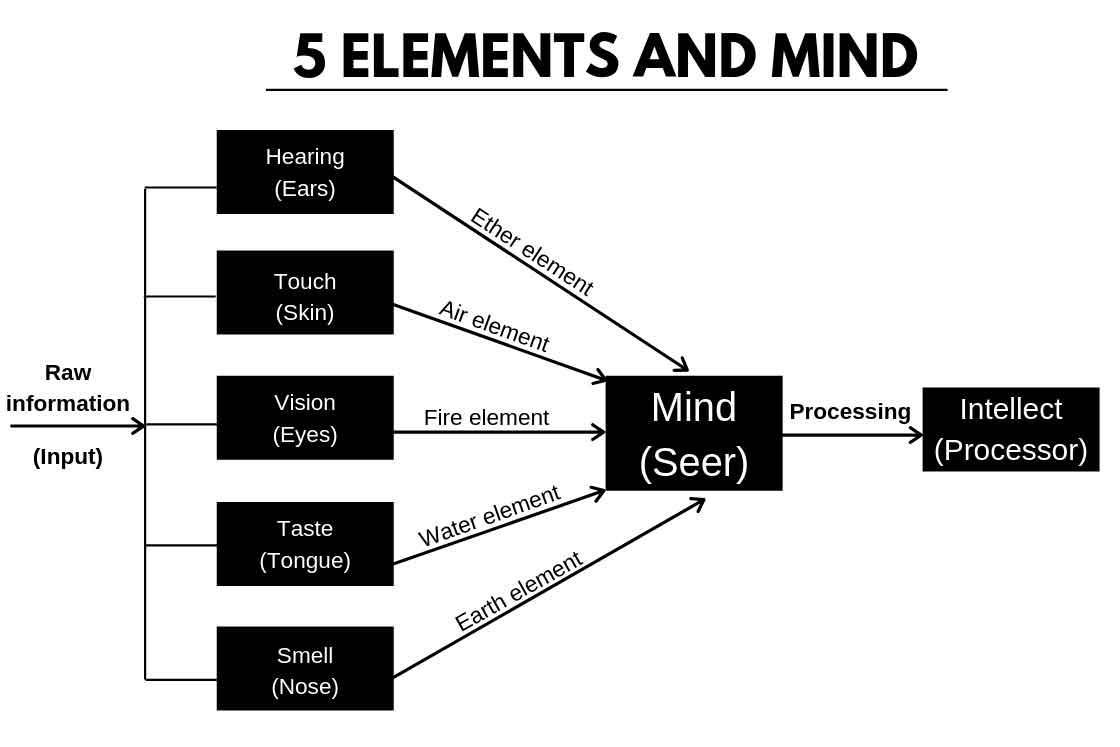
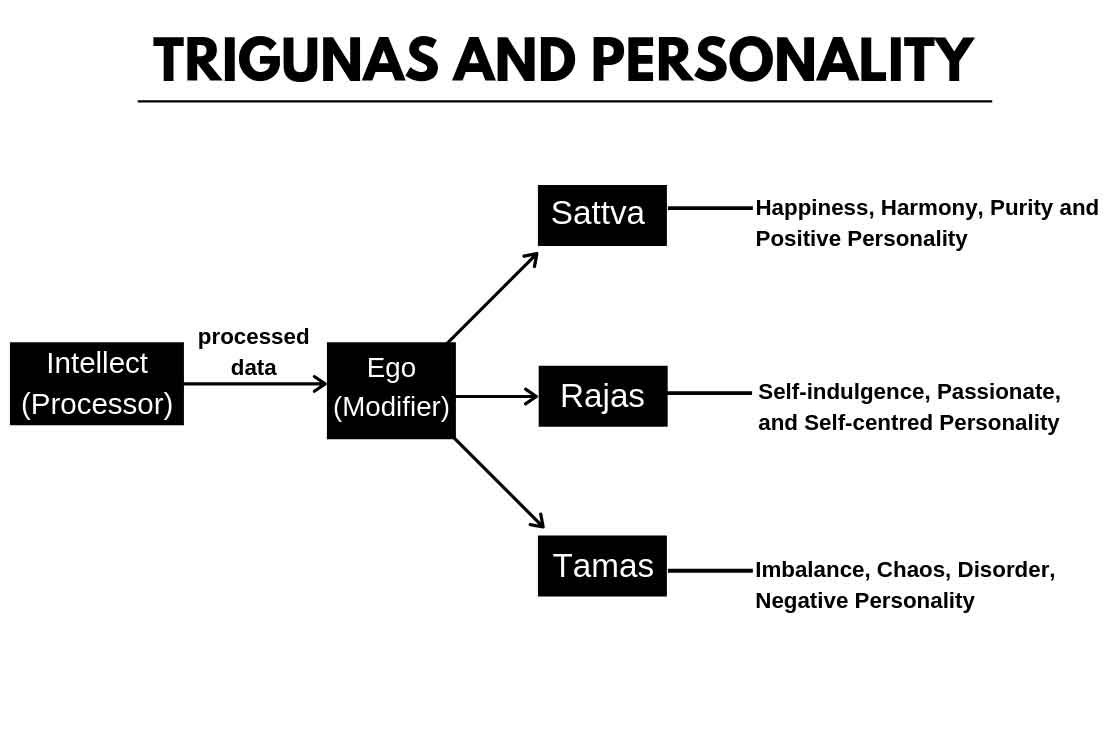
Every individual perceives experiences through a sense of I or ego (Ahamkara). This ego acts as a modifier, colouring perception and response. As illustrated earlier, the Trigunas operate through this ego principle and determine how thoughts, emotions, and reactions take shape.
Ultimately, what emerges from raw sensory input is recognised as a person’s personality, and it reflects the Triguna or combination of Trigunas that is dominant at a given time.
The person with sattva guna
Sattva means purity and clarity. When Sattva Guna is dominant, it reflects a personality that is naturally inclined towards balance, awareness, and ethical living. This quality supports kindness, care, and a sincere connection with higher values, giving rise to a Sattvic personality.
Sattva Guna is present in a healthy proportion when a person shows the following qualities:
Mental strength and stability Respect for teachers and guides (Gurus) Non-violence in thought and action Kindness and goodwill towards others Self-control and discipline Interest in meditation and self-reflectionA person with dominant Sattva Guna performs work and duties with calmness and clarity, clearly distinguishing between what is desirable and undesirable. Decisions are guided by understanding rather than impulse.
As Sattva increases, one becomes more drawn towards love, compassion, kindness, and lasting happiness. This balanced state supports both mental and physical well-being and is traditionally associated with good health and harmony.
Classical texts further describe seven types of Sattvic personalities, based on subtle variations within Sattva itself.
The person with rajas guna
A person dominated by Rajas Guna is driven by desire, action, and attachment to results. Such individuals are energetic and ambitious, but strong self-interest can sometimes make it difficult to clearly distinguish between right and wrong. This pattern of behaviour is known as a Rajasic personality.
Rajas Guna is present in a balanced proportion when a person shows the following qualities:
Enthusiasm and drive Deep involvement in work Dedication and commitment Restlessness and constant activity Strong sense of individuality Desire for achievementThe term Rajas refers to passion and movement. It lies between Sattva and Tamas and acts as a catalyst or bridge between the two. Through Rajas, the stability of Tamas is transformed into action, and the clarity of Sattva is expressed through effort. In this way, Rajas supports motivation, creativity, change, and purposeful movement.
When Rajas Guna becomes imbalanced, its excessive dominance can lead to agitation, anger, anxiety, impatience, and an unhealthy attachment to outcomes.
The person with tamas guna
Tamas means darkness and heaviness. It represents a psychological state marked by illusion, ignorance, dullness, and inactivity. When Tamas Guna is dominant, it gives rise to a Tamasic personality, often expressed through selfishness, lack of sensitivity, indifference, and a pessimistic outlook.
When Tamas begins to reduce and move towards balance, positive changes can be observed, such as:
Timely and restful sleep A more balanced approach to food Greater openness towards others An appreciative and receptive attitude Growing concern for the well-being of others Willingness to act and offer helpWhen Tamas Guna is imbalanced or excessive, it may lead to short-lived pleasure seeking, materialism, possessiveness, confusion, and destructive tendencies. Such a state keeps the mind trapped in inertia and prevents clarity and growth.
A book
A classical reference to this understanding is found in the book Dhanwantri: A Complete Guide to Ayurvedic Life, written by Harish Johari, where individuals are categorised into seven personality types based on the dominance and combination of the Trigunas.
These seven types are:
People with dominant Sattva Guna People with dominant Rajas Guna People with dominant Tamas Guna People with a Sattva–Rajas Guna combination People with a Sattva–Tamas Guna combination People with a Rajas–Tamas Guna combination People with balanced Gunas (Sattva–Rajas–Tamas in harmony)This classification highlights an essential principle: the Trigunas never exist in isolation. They always function together, often influencing and competing with one another. At any given time, the dominant Guna determines behaviour, tendencies, and personality expression.
By this stage, you may already recognise which Guna or combination of Gunas most closely reflects your own nature.
This naturally leads to an important question:
How can we consciously work with the Trigunas within ourselves for our own well-being and for the benefit of others?
How to balance the trigunas in daily life
The Gunas are not physical substances, yet their presence is clearly recognised through three aspects of human behaviour:
Action we perform Intention behind the action Reaction to its outcomeBy becoming aware of these three, one can consciously work towards balancing the Gunas within.
Action and intention
All action is universally engendered by the attributes (gunas) of primordial nature (prakriti). A man whose self is deluded by egoity thinks, “I’m the doer” – Bhagavad Gita 3:27
Every action begins with an intention. To recognise the Guna influencing an action, it is helpful to reflect on two questions:
Why I am doing this? (Intention) How I am doing this ? (Manifestation)At certain stages of life, an action may arise from a Sattvic intention, while its execution may carry Rajasic or Tamasic qualities.
For example, a person may steal to provide for their family. In this case, the intention (supporting loved ones) may contain Sattva, but the method of action is Tamasic. As a result, Tamas becomes the dominant Guna.
By carefully observing both intention and action, one can begin to understand which Guna is prevailing and how it may be refined.
Reaction
The reaction to the result of an action plays a crucial role in shaping one’s inner nature. What we dwell upon after acting is what continues to grow within us.
Returning to the same example, if the person reflects upon the act of stealing with remorse, sorrow, or inner conflict, this reaction indicates the presence of Sattva within the intention. Such contemplation, though difficult, holds the potential to gradually transform Tamasic tendencies into clarity and awareness.
Thus, through conscious observation of action, intention, and reaction, the Gunas can be understood, regulated, and brought into greater balance.
Rajas Guna: A step from tamas to sattva
Many people naturally aim to increase Sattva Guna, associating it with purity and spiritual growth. In doing so, they often overlook the importance of maintaining a balanced state of all three Gunas. The yogic approach is not to favour one quality excessively, but to allow each Guna to function in harmony.
An excessive rise in Sattva may lead to subtle spiritual pride. Excessive Rajas can result in greed, restlessness, and overwork, while dominance of Tamas gives rise to ignorance and inertia. Therefore, balance not suppression is the key.
The practical method is to first transform Tamas into Rajas, and then gradually refine Rajas into Sattva.
Tamas to Rajas
When Tamasic qualities such as laziness, dullness, low mood, anxiety, or irritability dominate, the remedy lies in movement and engagement.
This shift can be supported by:
Practising physical yoga asana Keeping the company of positive and active people Travelling or changing surroundings Consuming light and nourishing foodThese actions help lift energy from inactivity to activity, allowing Rajas Guna to replace stagnation.
Rajas to Sattva
When activity, enthusiasm, and restlessness increase, it indicates the predominance of Rajas Guna. At this stage, energy is available but requires refinement.
To guide Rajas towards Sattva, one may engage in:
Meditation and inward reflection Reading and study of uplifting knowledge Selfless or charitable actions Observance of ethical disciplines such as the Yamas, which help regulate excess energyThrough these practices, restless activity is gradually transformed into clarity, balance, and inner stability.
Conclusion
The concept of the Trigunas Sattva, Rajas, and Tamas offers a clear framework for understanding how nature, mind, and personality function. These three qualities are not fixed traits, nor do they exist in isolation. They continuously interact, rise, and fall, shaping behaviour, perception, and inner tendencies at every stage of life.
Through awareness of the Gunas, one begins to recognise the forces behind thoughts, actions, and reactions. This understanding does not aim to suppress any quality, but to bring them into balance. Tamas provides stability, Rajas enables movement, and Sattva offers clarity. When harmonised, they support physical well-being, mental clarity, and spiritual growth.
By observing daily actions, intentions, and responses, and by adopting appropriate yogic practices, it becomes possible to gradually refine the Gunas. In this way, the wisdom of Trigunas serves not only as a philosophical concept, but as a practical guide for living with awareness, balance, and inner harmony.