U.S. Supreme Court declines to hear AI copyright case
The decision upheld a lower court ruling that artificial intelligence-generated content does not have the same legal protections as human-created work.
 Troov
Troov
With a growing number of artificial intelligence tools coming onto the market and generative AI applications getting better at producing consistent visuals and themed material, it is worth a reminder that creators and brands cannot legally own the rights to an AI-generated character or work.
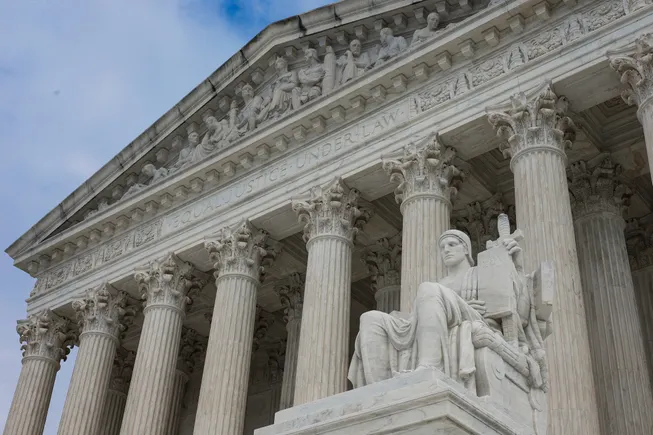
On Monday, the U.S. Supreme Court reiterated this by declining to hear a case in which a computer scientist from Missouri sought to gain copyright protection for a piece of visual art made by his AI system.
As reported by Reuters, Stephen Thaler launched a Supreme Court appeal after lower courts upheld a U.S. Copyright Office decision stating that AI-crafted visual art generated by his system was ineligible for copyright protection.
The main issue at hand is that AI-generated content does not have a human creator. Current laws relate to a human originator of such content and the protection of human entities in copyright cases.
Thaler has been pursuing copyright protection for his AI-generated work since 2018, but has been unable to gain traction in changing the law or pushing for a reinterpretation of existing copyright statutes by pointing to technological developments.
The U.S. Copyright Office, along with other copyright regulators around the world, has repeatedly rejected applications for copyright protections on AI art, according to The Verge, due to the requirement that there be a human creator of any works that can be legally protected in this way.
According to the Copyright Office, generative AI outputs are copyrightable in part, such as when AI is used as a tool, and “where a human has been able to determine the expressive elements they contain.” But prompts alone, at this stage at least, are unlikely to satisfy these requirements.
That’s an important note, because while more AI companies promote their products as helpful tools for brand-building and marketing, companies that create any AI-generated style elements or characters won’t actually own those creations, meaning that they can be freely used by anybody else.
The same goes for AI-generated characters in video clips. If a creator was to generate a character that was used as part of regular posts, any other user would legally be able to take that visual and reuse it.
Presumably, this will change at some point, when AI depictions become so commonplace and such a significant focus that the law will have to evolve to cover such usage.
But right now, it’s a good reminder that social media marketers cannot actually own AI-generated content in the same way that brands can own human-generated works.








![RFP: How to Write a Strong Request for Proposal [Examples & Template]](https://www.hubspot.com/hubfs/rfp_featured.png)
![How to Create Detailed Buyer Personas for Your Business [+ Free Persona Template]](https://www.hubspot.com/hubfs/buyer-persona-research_1.webp)
![The Top 6 Marketing Challenges Expected Globally in 2025, And How to Overcome Them [Data + Expert Tips]](https://www.hubspot.com/hubfs/top%20marketing%20challenges.png)




![AI Overviews: How Freshpet Stands Out in SEO & GEO [Webinar] via @sejournal, @hethr_campbell](https://cdn.searchenginejournal.com/wp-content/uploads/2026/08/ap-3-846.png)


.jpg&h=630&w=1200&q=100&v=7abd35f457&c=1)