What Are Nadis? The Three Main Nadis: Ida, Pingala, Sushumna
Our astral body, like our nervous system, has hundreds of channels through which energy travels — these channels are called Nadis. Traditional health disciplines such as Ayurveda and yoga believe that all living things are nourished by their own...
 Kass
Kass
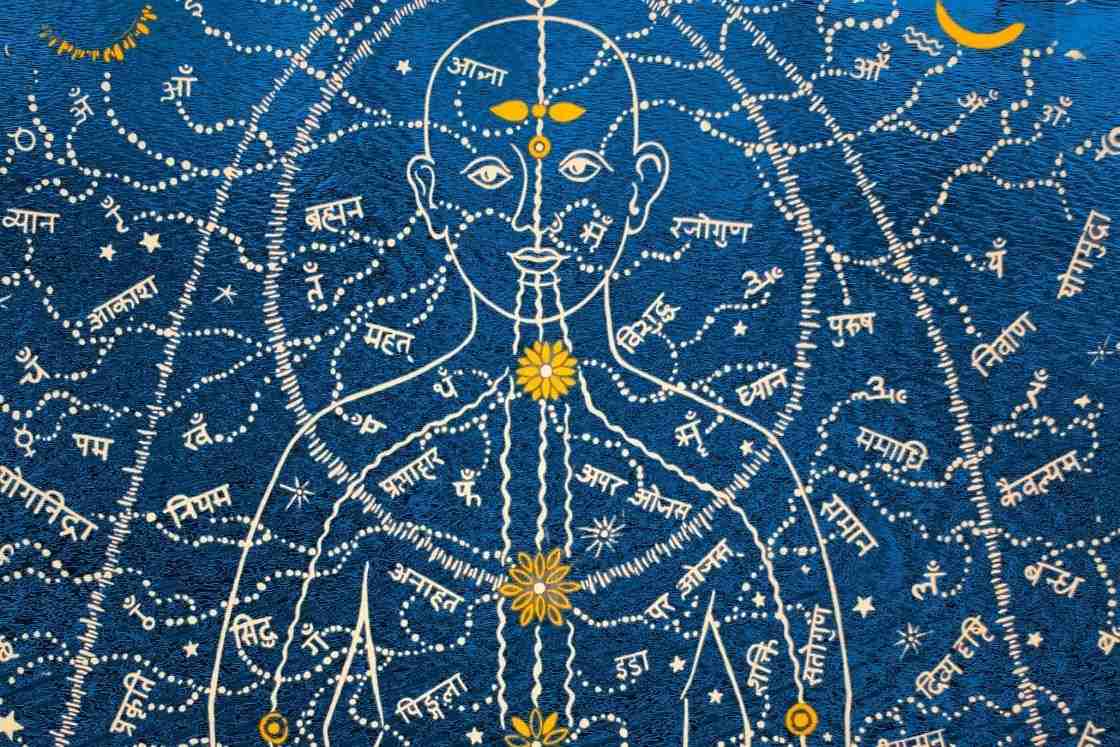
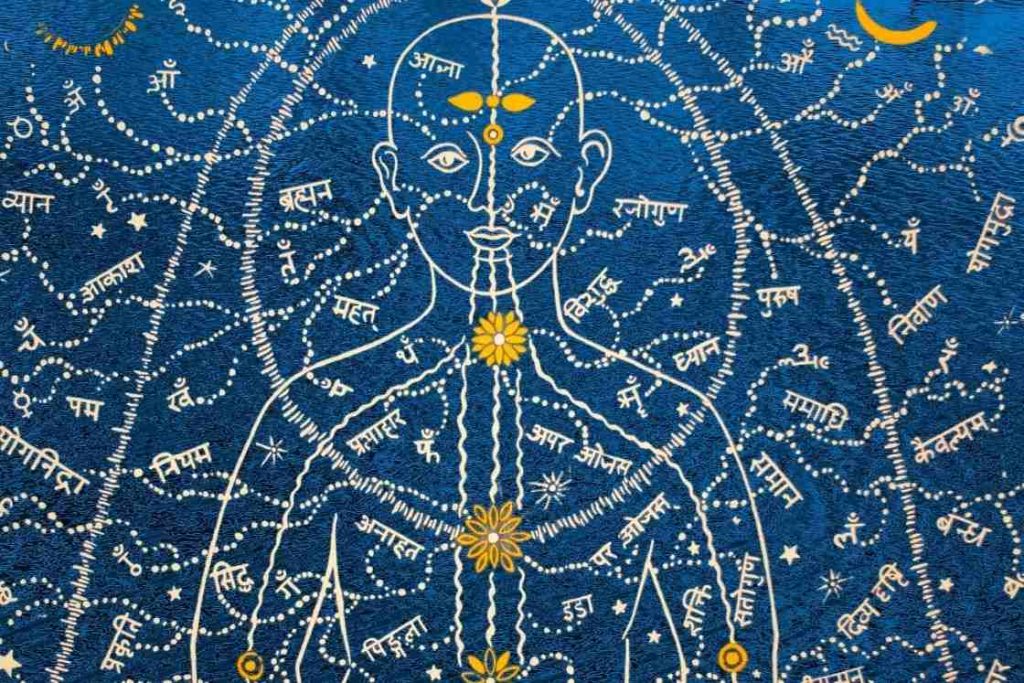 Nadis network spread over the body. Source: sammartinoyoga
Our astral body, like our nervous system, has hundreds of channels through which energy travels — these channels are called Nadis.
Traditional health disciplines such as Ayurveda and yoga believe that all living things are nourished by their own life energy known as Prana. The Nadis are paths that allow Prana to circulate throughout the body.
The Nadis must be free of blockages and healthy. When the Nadi system is hindered, it has an impact on our physical and mental wellbeing.
This article will explain a number of important nadis; Ida, Pingala & Sushumna and what is their significance in the yogic system.
What are nadis
The term “Nadi” comes from the Sanskrit root word “Nada” which means “to flow”. If we look at the literal translation, it also means “river” or “flowing river”.
Nadis form a subtle network through which prana moves in the body– supporting physical, mental, and spiritual functions.
You can think of nadis like channels that allow energy to flow – just as water flows through a pipe. The nadis are said to be subtle channels that transmit energy through our existence, similar to how our visible veins carry blood via our circulatory system.
Nadis are a network of pranic, mental, and spiritual flows that run through the physical body, forming a matrix. They provide energy to every cell and organ in the body through their extensive network, which transports prana in all directions.
Similar to as ‘Prana; travels through nadis in the subtle plane, on the gross level, a nerve impulse takes place in the physical body. Nadis are energy channels in the subtle body- they are not the same as physical nerves. Nerves can be seen in the physical body, but nadis are experienced only at a subtle level. But Nadis only can be perceived as energy and consciousness in motion during the deep and higher state of meditation.
Various schools of Yoga including Raja Yoga, Hatha yoga, and Kundalini Yoga aim at the awakening of Kundalini Shakti through Nadis. The flow of Kundalini shakti is possible only when are these Nadis are purified.
Join our 40-Day Live Kundalini Yoga Course
How many nadis are there in our body?
The network of nadis in our body is so vast and subtle that ancient texts have cited different numbers of Nadis based on their calculations.
According to Shiva Samhitha, our body consists of 350,000 Nadis.
Another text ‘Prapanchasara Tantra‘ says 300,000 Nadis are present in the human body.
Goraksha Samhita and Hatha Yoga Pradipika highlight the total number of Nadis are 72,000 and they arise from Nadi Kanda. Nadi Kanda is the ‘bird egg’ shaped root situated below to umbilicus and above the pubis.
Out of 72000 nadis, 14 nadis have been identified as important ones. They are:
Ida – Known for its feminine and cool energy, it starts at the Muladhara and ends at the left nostril. It is also associated with the energy of the moon. Pingala – Known for its masculine and heating energy, it flows on the right side and ends at the right nostril. It is also associated with the energy of the sun. Sushumna – The main or central nadi through which the prana flows to the other nadis. It starts at Muladhara and ends at the Sahasrara chakra. Gandhari – It is responsible for providing energy to the left eye. It starts at the Muladhara and ends at the Ajna Chakra. Hastijihva – Gives energy to the left limbs, i.e., the left arm and leg. This nadi starts at Muladhara and ends at the Manipura Chakra. Kuhu – Provides energy to the genitals. It starts at Muladhara and ends at the Svadhisthana Chakra. Saraswati – Responsible for giving energy to the throat, mouth, and tongue. It starts at Muladhara and ends at the Vishuddhi chakra. Pusha – Gives energy to the right eye. It starts at the Muladhara and ends at the Ajna chakra. Shakhini – Gives energy to the left ear. It starts at the Muladhara and ends at the Ajna chakra. Payaswini – A complimentary nadi to the Pingala, it flows through the Saraswati and Pusha nadi and ends at the right ear. Varuni – Provides energy to the whole body through the nervous system. Begins at the Muladhara and ends at Anahata chakra. Alambusha – Provides energy to the organs responsible for the elimination of waste. It starts from the anus and ends at the mouth, moving through the Muladhara Chakra. Vishwodari – Gives energy to the organs related to the digestive system. It starts at Muladhara and ends at Manipura Chakra. Yashaswini – Provides energy to the right libs, i.e, right arm and leg. It starts at Muladhara and ends at Manipura Chakra.3 Main Nadis – Ida, Pingala & Sushumna
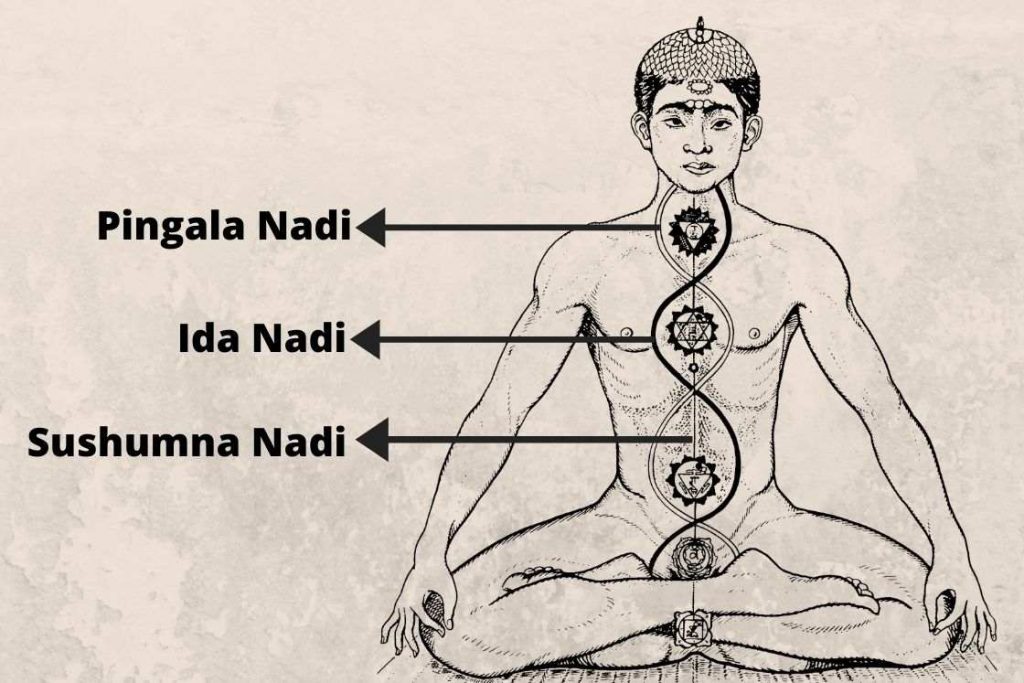 Along the spine (Sushumna Nadi), Ida and Pingala Nadi criss-cross
From the above 14, the Ida, Pingala, and Sushumna are of utmost importance and move through the spinal cord and chakras. These 3 main Nadis are termed Trividha Nadi. Shiva Samhitha states that in between Trividha Nadi, there is a Nadi in a subtler form called Chitra Nadi.
Trividha Nadi or 3 main nadis are situated near the spine, resembling the stalk of lotus facing downwards (Adhomukha Padma).
Ida Nadi is situated towards the left side and Pingala Nadi towards the right side of Sushumna Nadi. Ida and Pingala nadis spiral around the Sushumna Nadi resembling the double helix of human DNA. They cross each other at certain points along the spine, forming Chakras.
Ida, Pingala and Sushumna Nadi meet at Triveni point which is situated at Ajna Chakra, midway between the eyebrows. Later Ida Nadi terminates at left nostrils whereas Pingala Nadi terminates at right nostrils.
1. Ida Nadi
Ida nadi symbolizes the planet moon (Chandra tattva); hence it is also called Chandra Nadi. Ida in Sanskrit means comfort hence the Ida nadi is cool in nature and nourishes the body and mind. It controls all mental processes and energizes emotions. It is responsible for the feminine, auspicious, and easy smooth activities of our personality.
The basic characteristics of the Ida nadi are introspective, self-reflection, artistic, cold, passive, receptive, restful, inward-oriented, sensitive.
The functions of Ida Nadi are anabolic in nature and can be co-related with the Parasympathetic nervous system (rest and digest system). It governs inspired or visionary speech.
People with a strong Ida energy are likely to have nurturing and intuitive qualities. However, they may lack the self-assurance, clarity, and courage necessary to achieve worldly knowledge.
Since it ends in the left nostril, it is also linked to right-brain dominance, which is considered to favor creativity and artistry.
Ida Nadi mainly operates throughout the night-time which results in a slow metabolism and a sense of relief in the night. However, sometimes the activity of Ida can also relate to tamas qualities.
Symptoms of Blocked Ida Nadi
When there is a blockage in Ida Nadi then the person will be emotionally affected, lethargic, and suffer from depression. Blocked Ida Nadi can be identified with these symptoms:
Feeling restless in the night Improper digestion Hypothyroidism Increase in gas and flatulence May be linked to issues like poor digestion, low energy, or emotional imbalance. Epilepsy seizure, dementia, depression and mental health problems Not being able to correct bad habits Low assertiveness, passive behaviorUnblocking the Ida Nadi
Pranayama such as Nadi Shodhana and Surya Bheda Pranayama can be effective in clearing away blockages and imbalance of the Ida Nadi. Practicing hatha yoga can also bring about a significant change as the term “hatha yoga” literally means “sun-moon yoga,”.
2. Pingala Nadi
It symbolizes the Sun (Soorya tattva), hence it is also called as Surya Nadi. In Sanskrit, the term pingala signifies “orange” or “tawny.” In contrast to Ida, Pingala Nadi is warm, active, and stimulating in nature, hence maintaining the body temperature.
Pingala nadi is linked to left-brain dominance because it ends in the right nostril, which is thought to lead to analytical, logical and systematic thinking.
The functions of Pingala Nadi comprise body growth, catabolic activities, controlling all vital somatic processes, and can be co-related to the sympathetic nervous system (fight or flight system). It oversees more of the masculine aspects of our personality and represents the Rajas guna.
People with dominant Pingala energies are Type A personalities who are creative, assertive, and straightforward. They may, however, lack lunar qualities such as empathy, perception, and self-awareness, which are necessary for spiritual awakening.
In our body when the Pingala Nadi flows in dominance, the breath will be warm and more in the right nostril, the mind and senses are extroverted with the dominance of physical energy. Pingala Nadi influences the right side of the body, the left hemisphere, and the front part of the brain.
Symptoms of Blocked Pingala Nadi
When Pingala Nadi gets blocked it affects the person by increasing aggressive behavior, over dominating nature and may spoil the relationship with others. Also, blocked Pingala causes:
Overeating, increased appetite, and cravings for junk food Acidity, ulcers Hyperthyroidism Fever Dryness in skin and throat Bronchitis and arthritis Improper kidney and liver functioning Getting frustrated easily, feeling irritated and, aggressive nature Increased levels of testosterone and estrogen – High sexual driveUnblocking the Pingala Nadi
Pranayama such as Nadi Shodhana and Chandra Bhedi Pranayama can be effective in clearing away blockages and opening the Pingala Nadi. Practicing hatha yoga can also bring about a significant change as the term “hatha yoga” literally means “sun-moon yoga,”.
Comparison between Ida and Pingala Nadi
| Representations/Features | Ida Nadi | Pingala Nadi |
| Planet | Moon | Sun |
| Breath | Left nostrils | Right nostrils |
| Temperature | Cold | Hot |
| Gender | Female | Male |
| Quality | Mental | Physical |
| Nerves | Parasympathetic | Sympathetic |
| Colour | Blue | Red |
| Metal | Silver | Gold |
| River | Ganga | Yamuna |
| Energy | Negative | Positive |
How to know if Ida and Pingala are balanced?
The fundamental dual existence is represented by the Ida and Pingala. You can simply refer to it as masculine and feminine, or as your rational and intuitive sides.
The pingala energy, which is linear and logical, should balance the ida nadi energy. Bringing the Ida and Pingala into harmony can help you be more effective in the world and help combat life’s challenges.
Normally, we believe that a person generally breathes through both the nostrils simultaneously, though it is not so. Our breathing cycles alternate between ida and pingala, or left and right nostrils, every 90 minutes.
When the left nostril flows, it indicates that the mental energy (Chitta) or Ida nadi is predominant, and the Pranic energy or Pingala nadi is weak. While the right nostril flows, the Pranic forces are stronger and the mental aspect is weak.
Ida and pingala nadi can also be assessed in terms of the brain’s hemispheres. The right hemisphere, which is where mental activities take place, represents Ida. The left hemisphere represents Pingala, which is where essential processes occur.
The cleansing of the nadis brings a sense of calm. You’re confident of yourself and your perseverance, and the outcomes are usually rather pleasant. Because the thoughts are no longer bouncing between the right and left brain.
3. Sushumna Nadi
Sushumna is described as “a fountain of great joy” in the Shiva Samhita. Sushumna refers to a condition of tranquillity and balance in the flow of prana, as well as a state of harmony in the autonomic nervous system. In simple terms, Sushumna represents a meditative and balanced state.
Sushumna Nadi is situated at the center of the spinal cord in between Ida and Pingala Nadi. It’s considered to be the most gracious, spiritual, and hidden channel like the river Saraswathi originating at the base of the spine (Muladhara Chakra).
This central channel is also known as Brahma Nadi—the pathway to Brahman or the ultimate being—because it allows yogis to achieve spiritual awakening. We leave the physical world and achieve a state of samadhi when our prana travels through the Sushumna Nadi for a long time.
The sushumna nadi runs from the base of the spine (muladhara chakra) to the crown of the head (sahasrara chakra). It is the way for kundalini energy to ascend from the base of the spine to the crown of the head. It is thought to be the main conduit for the movement of prana throughout the body. It connects all of the body’s chakras.
When Kundalini Shakti at Muladhara Chakra is awakened from the dormant state, it moves through Sushumna Nadi to reach Sahasrara Chakra. It passes through all the 6 Chakras through its path where we find 6 various Shakti like Daakini, Haakini, Kaakini, Laakini, Raakini, and Shaakini.
Moreover, the tongue in khechari mudra is used to tap the top of Sushumna Nadi to facilitate these Shakti.
In Guna’s perspective, Sushumna Nadi is called trigunamayi means it comprises all the 3 Gunas (qualities), representing the sun, moon, and fire altogether. When the Sushumna Nadi is balanced and dynamic, it is said that we achieve true harmony within ourselves and are fully attuned to the Divine.
How to activate Ida, Pingala and Sushumna
 Breathing in – right nostril and exhaling – left nostril, Surya bhedana Pranayam for Pingala nadi
The initial purifications or shatkarma, mudras, visualization, pranayama, and mantra chanting all work together to drive prana to flow from the Ida and Pingala channels into the central Sushumna channel. The mudras especially seal up numerous openings, capturing prana and channelling it into the Sushumna.
According to the Shiva Swarodaya text, the active Nadi flows for 60 minutes. Thereafter, Sushumna functions for 1-4 minutes, and then the other Nadi begins to operate.
Sushumna can be stimulated from its dormant state via chakra meditations, allowing kundalini energy to ascend and spiritual awakening to occur. Prana energizes and activates dormant energy as it continues moving up the sushumna nadi, energizing all of the chakras along the way.
Similarly, as a technique of opening and stimulating Sushumna, Nadi shodhana pranayama can help to balance the ida and pingala nadis.
Conclusion
Nadis form the subtle pathways through which prana flows in the body. When these channels are balanced, both the body and mind feel steady.
Through practices like pranayama, meditation, and mudras, we can gradually bring harmony to Ida, Pingala, and Sushumna supporting both health and inner awareness.
FAQs
1. How do I know if my nadis are balanced?
You’ll usually feel steady, calm, and focused. Your breath flows smoothly through both nostrils, and your energy feels neither too sluggish nor too restless.
2. Which pranayama is best for cleansing nadis?
Nadi Shodhana (alternate nostril breathing) is the most effective and commonly recommended practice. It helps balance Ida and Pingala and supports a smoother flow of prana.
3. Can nadis be scientifically proven?
Nadis belong to the subtle body, so they cannot be seen or measured like nerves. However, their effects are often experienced through breath, awareness, and changes in mental and physical states.
4. What is the role of nadis in Kundalini awakening?
Nadis guide the flow of energy in the body. When Ida and Pingala are balanced, prana can move through Sushumna, which is essential for the awakening of Kundalini energy.
5. How long does it take to purify nadis?
There is no fixed timeline. With regular practice of pranayama, meditation, and yoga, you may start noticing subtle changes within a few weeks, but deeper balance takes consistent effort.
6. Are nadis the same as chakras?
No. Nadis are energy channels, while chakras are energy centres. Nadis carry prana, and chakras are the points where this energy is concentrated and transformed.
7. Why does breathing switch between nostrils?
This is a natural cycle linked to Ida and Pingala. The dominant nostril changes every 60–90 minutes, helping balance mental and physical energy throughout the day.





















.jpg&h=630&w=1200&q=100&v=c0f97a310e&c=1)