
Googlebook may use older Snapdragon chips to build more affordable laptops
The first Snapdragon-powered Googlebooks may have surfaced in development code, pointing to X Plus and X Elite chips from 2024.
 AbJimroe

Snapdragon X Plus and X Elite models could be in development
 Google
Google has already confirmed that Googlebook will support more than one chipmaker, and a new leak may have revealed the first Snapdragon models in development.
New code references uncovered by GbookHub reportedly link two Googlebook designs, codenamed Annite and Pic, to Qualcomm’s Snapdragon X Plus X1P-42-100 processor. Both are also said to be tied to a board platform called Mica.
Snapdragon could give Googlebook a cheaper ARM option
The Snapdragon X Plus X1P-42-100 is an eight-core chip capable of reaching up to 3.4GHz. The code also references fingerprint support, while USB-A appears to be missing from these particular designs.
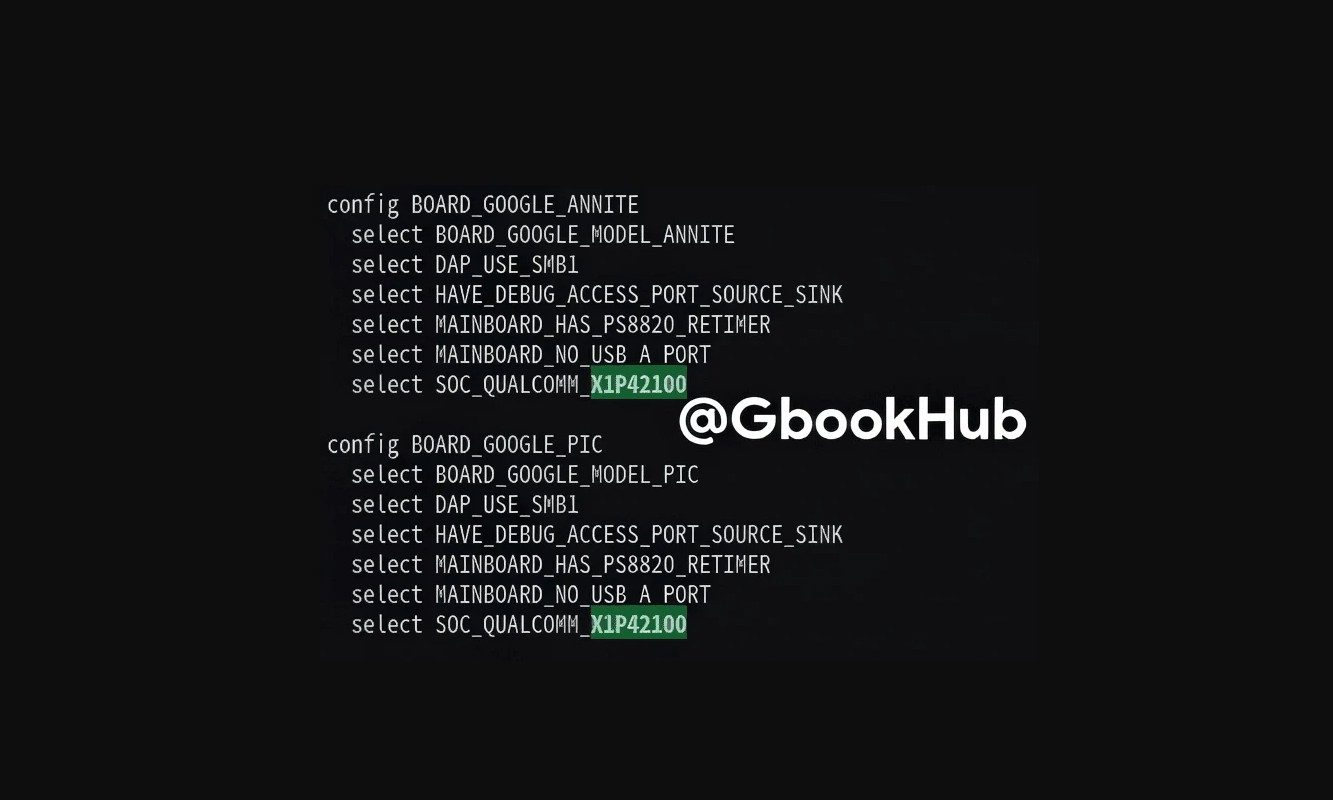 GBookHub
GbookHub found additional references to Quartz and Mica that it believes could be tied to the more powerful Snapdragon X Elite X1E-80-100, although the connection is less clear.
It is also worth noting that both Snapdragon chips launched back in September 2024. That could make Googlebooks based on them considerably cheaper than models using cutting-edge hardware, although exactly how cheap is still difficult to say. Current Windows laptops with the Snapdragon X Plus can be found for roughly $700 to $1,100, while Snapdragon X Elite machines can stretch to around $1,600. Pricier models do exist, but those generally come with more memory, storage, or other premium features.
Googlebook was always supposed to offer more chip choices
Google VP John Maletis confirmed back in May that Google is working with Intel, Qualcomm, and MediaTek for Googlebook, so Snapdragon hardware itself is not much of a surprise.
 Google
We have already seen leaked Intel-powered Googlebook hardware from Acer packing up to 32GB of RAM and a 2.8K OLED display, which puts it firmly in premium-laptop territory. Snapdragon X Plus could give hardware partners room to build different kinds of machines around price, battery life, and form factor.
For now, these are still code references rather than confirmed products. Until Annite or Pic appears in certification databases or more concrete hardware listings, it is best to take the leak with a grain of salt.

I’ve got about 4 years of experience, mostly covering gaming, PC hardware, and smartphones. In my free time, I like…
The Digital Trends App Bundle is yours to try for a whole week, free

Recently, we've entered an exciting collaboration with Maple Media, creating a bundle of 17 apps worth having on your phone. From relaxed fun to serious productivity boosts, these apps cover all your bases and provide a fun boost to your phone. Normally, the bundle is $9.99 per month (far lower than the cost of using the apps individually), but for your first 7 days you can get access to the bundle for free. View the full Digital Trends App Bundle for a complete list of the apps, or read on for a summarized take.
Start your free trial
The Galaxy S26 Ultra might not see much of a battery upgrade after all
It looks like it will stay the same as the last five years.

What's happened? This week, China's Quality Certification Center released information about a battery (EB-BS04898ABY) with a maximum capacity of 4,855mAh. That's the same capacity as was previously seen in the Samsung Galaxy S25 Ultra, and fans have taken this certification to mean the Galaxy S26 Ultra will not see a capacity increase after all.
The Samsung Galaxy Ultra models have had the same battery capacity for the last five years.
The Galaxy Tab S10 Lite is official, and it’ll be here sooner than you think

What's happened? Samsung has officially announced the Galaxy Tab S10 Lite, a budget-friendly alternative to the Galaxy Tab S10. The device has been rumored for months, but this is the first time Samsung has officially acknowledged its existence.
The Galaxy Tab S10 Lite will have a 10.9-inch display and a peak brightness of 600 nits — a bit on the lower side, versus the iPad Pro's maximum brightness of 1,600 nits.









/cdn.vox-cdn.com/uploads/chorus_asset/file/23951361/STK072_VRG_Illo_N_Barclay_7_netflix.jpg)



/cdn.vox-cdn.com/uploads/chorus_asset/file/25841856/Adobe_Premiere_Pro_Media_Intelligence_Search.jpg)





.jpg&h=630&w=1200&q=100&v=c0f97a310e&c=1)








.jpg&h=630&w=1200&q=100&v=c0f97a310e&c=1)