What Givenchy Advertising Teaches Us About Timeless Brand Positioning
Givenchy advertising may bring to mind Audrey Hepburn in that famous little black dress, or Meghan Markle stepping out of a car on her wedding day… Maybe on a perfume bottle, maybe on a red carpet, maybe because you...
 Tekef
Tekef
Givenchy advertising may bring to mind Audrey Hepburn in that famous little black dress, or Meghan Markle stepping out of a car on her wedding day… Maybe on a perfume bottle, maybe on a red carpet, maybe because you remembered that iconic scene from Breakfast at Tiffany’s…
And the fact that you probably already knew that? That’s Givenchy advertising doing its job, even decades later.
Today I’m going to break down exactly how Givenchy markets itself. Who they’re trying to reach, what their campaigns actually look like, where they spend their money, what they’re doing online, and honestly, where they’ve gotten things wrong too.
Let’s get into it.
Inside Givenchy Marketing
How Givenchy Became One of the Top Luxury Fashion Brands Givenchy Target Market Over the Years The 4P Marketing Mix of Givenchy SWOT Analysis of Givenchy Givenchy Advertising Campaigns: New-Age Approach to Timeless Fashion #1: The Gentleman Launch #2: The SS21 Campaign w/ Kylie Jenner & Bella Hadid #3: Spring 2026 Womenswear Campaign #4: Givenchy X Timothée Chalamet Digital Marketing: How Givenchy Sells Online The Metaverse Experiment: Worth It? Social Media: 16 Million Followers and What They MeanHow Givenchy Became One of the Top Luxury Fashion Brands
Hubert de Givenchy started his fashion house in Paris in 1952. From day one, his idea was simple: make clothes that are elegant, clean, and timeless. His very first collection got a glowing review from Vogue magazine, which is basically the best free advertising a new fashion designer could ask for.
But the thing that really put Givenchy on the map was Audrey Hepburn.
The two became close friends and working partners. She wore his designs in films, at public events, everywhere. When Sabrina came out in 1954, Hepburn wore Givenchy — and the film won an Oscar for Best Costume Design. When Breakfast at Tiffany’s came out in 1961, she wore Givenchy again. Every time she appeared in public in his clothes, it was essentially a free advertisement.
Regarding Givenchy’s designs, Audrey Hepburn said the following:
Your clothes give me inspiration and life in the movie characters. When I wear your clothes, I can enter the life of the characters.
Of course, it has totally supported Givenchy’s timeless positioning over the years. On the other hand, that quote tells you everything about Givenchy’s oldest and most powerful marketing idea: the clothes mean something. They make you feel like someone.
Givenchy sold his brand to the luxury group LVMH for $45 million in 1988. The founder stayed on as creative director for a few more years, then left in 1995. After that, the brand went through a rough decade: John Galliano, then Alexander McQueen, then Julien MacDonald each brought a completely different look and feel, making it hard to have a consistent “Givenchy advertising” voice.
Things stabilized when Riccardo Tisci took over in 2005. He mixed high fashion with street culture and brought Givenchy back into the cultural conversation. It’s also the groundwork for everything the brand does in digital advertising today.
Before jumping into Givenchy digital advertising & campaigns, let’s see who the brand is trying to reach.
Givenchy Target Market Over the Years
The simple answer is wealthy, fashion-conscious people (no need for in-depth analysis.)
But the real answer is more interesting. Givenchy’s main target is women between the ages of 22 and 45 who care about fashion, style, and culture. But that’s not the only audience.
According to annual reports of the brand, Givenchy has also put serious effort into reaching:
Women aged 22–45 (core audience): The brand’s historical heartland is rooted in Hubert de Givenchy’s career dressing women elegantly and confidently. Men aged 25–45: Especially through fragrances like Gentleman Givenchy, marketed to men who want to come across as sophisticated without looking old-fashioned. Gen Z (born roughly 1997–2012): Younger shoppers building brand opinions now that will influence purchases for decades. Givenchy’s Roblox campaigns targeted this group specifically. Celebrity and influencer communities: People paid to wear and promote the brand, plus the followers who watch them. Art and culture lovers: People who respond to Givenchy’s heritage story, runway shows in historic buildings, and cultural collaborations. Cosmetics and fragrance buyers: People who may never buy a $3,000 jacket but will happily spend $120 on L’Interdit perfume.Geographically, the brand sells everywhere but draws especially heavily from Europe, the United States, and Asia. In LVMH’s 2023 results, Asia made up 38% of the group’s total revenue, and Givenchy is pushing hard to grow in China and Southeast Asia.
The 4P Marketing Mix of Givenchy
The 4Ps is a basic marketing framework for fashion brands. Here’s how Givenchy uses each one:
Product
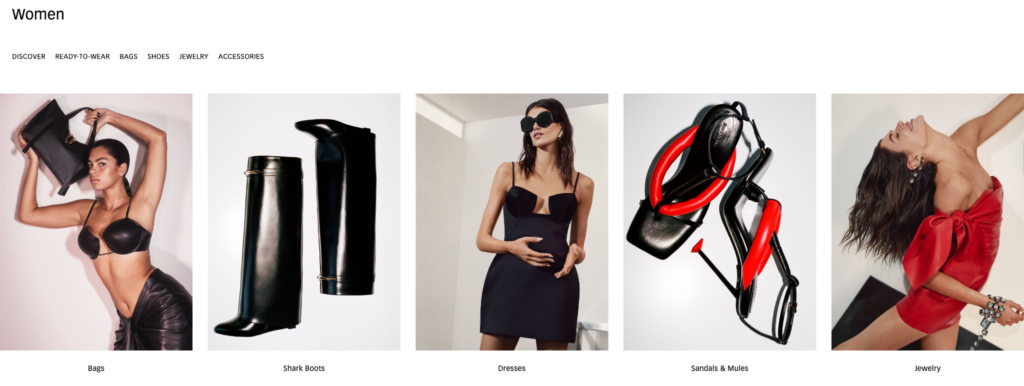
Givenchy sells clothes (both made-to-order haute couture and regular ready-to-wear), perfumes, makeup, bags, shoes, and accessories.
What connects all of it is the brand’s signature look: clean lines, elegant shapes, and high-quality materials. The product is always designed to feel luxurious without being “excessively showy” like Balenciaga does.
Price
Givenchy is expensive, on purpose (obviously.)
Regular ready-to-wear pieces range from about $500 to $5,000 or more. Custom haute couture pieces can cost tens of thousands of dollars. Fragrances like L’Interdit run between $90 and $350 depending on size.The high price is part of the message; it tells you the product is exclusive and worth having. We actually know that marketing approach from well-known luxury brands like LOEWE, LV, and more.
Place
You can buy Givenchy at flagship stores in major cities (Paris, New York, Tokyo, Dubai, etc.), at high-end department stores, and online at givenchy.com.
You will never see Givenchy in a discount outlet or a mid-range shopping mall. The brand carefully controls where it sells, so the locations themselves reinforce the luxury image.
Promotion
Here is the overall Givenchy advertisement approach. The brand promotes itself through:
Fashion shows at notable and historic locations, Celebrity partnerships and endorsements, Paid advertising on Instagram, Facebook, and other platforms, Influencer collaborations, Email newsletters, Print ads in fashion magazines like Vogue, Digital campaigns and brand films on YouTube, Gaming platforms and virtual experiences (Roblox, Animal Crossing),Being owned by LVMH means Givenchy has access to the group’s enormous advertising infrastructure (including that €10.3 billion annual global ad budget, according to the 2023-dated annual report), which gives it far more muscle than an independent luxury brand of similar size would have.
SWOT Analysis of Givenchy
SWOT stands for Strengths, Weaknesses, Opportunities, and Threats. Here’s a look at where Givenchy stands, from the viewpoint of marketing.
Strengths
More than 70 years of brand history that people instantly recognise Backed by LVMH’s massive budget and global infrastructure 16 million+ Instagram followers and a strong visual identity 70% of existing customers say they’d buy again (strong loyalty!) Iconic celebrity associations: Audrey Hepburn, Meghan Markle’s wedding dress, current ambassador Kaia Gerber Multiple product categories, in other words, not dependent on just clothing Real sustainability commitments documented in the Givenchy Parfums CSR Report 2021 with third-party verification Award-winning runway presentations that generate massive earned mediaWeaknesses
Changing creative directors frequently has created inconsistent brand identity Some social media campaigns have been poorly received (e.g. the SS21 selfie campaign) Less visible than Louis Vuitton or Chanel within the luxury tier Smaller retail presence than its biggest competitors Dependent on LVMH, limited fully autonomous strategic flexibilityOpportunities
Asia-Pacific luxury market expansion, 38% of LVMH revenue and growing Gen Z luxury consumers are building brand preferences now that will drive purchasing for decades Sustainability storytelling is becoming a real competitive advantage as buyers care more about brand values Global luxury fragrance market expected to reach $16 billion+ by 2027 Givenchy Beauty House on Roblox drew 1.4 million+ visits, digital experiences open new audiences Heritage site events as immersive advertising (e.g. the Villa Adriana concept explored by Politecnico di Milano) Sarah Burton’s new creative era is already generating strong press with the Kaia Gerber Fall 2025 campaignThreats
Fierce competition from Chanel, Dior, Balenciaga, and other luxury names LVMH reported a 3% organic revenue decline in early 2025 (LVMH Q1 2025 Results) Counterfeit products are harming brand perception, especially in Asia Social media algorithm changes are limiting organic reach Consumer fatigue with celebrity-heavy advertising campaignsGivenchy Advertising Campaigns: New-Age Approach to Timeless Fashion
How does a brand like Givenchy stay relevant when everything around us moves so fast?
When you look at a Givenchy advertisement today, it feels more like something you’d stop scrolling for, at least on social media.
There’s always a balance: you still see that signature elegance, but it’s mixed with a more current, almost cinematic edge. In other words, Givenchy advertising is speaking to how we experience culture right now. And that’s what makes their campaigns stand out:
Givenchy does not try to leave the past behind; the brand just brings it forward in a way that actually connects with us today.
So, in this section, you’re invited to take a closer look at some of Givenchy’s advertising campaigns; the most signature & famous ones.
#1: The Gentleman Launch
I’m starting with one that shows how a Givenchy advertisement can evolve from product promotion into something much more culturally relevant and emotionally engaging.
First, it redefined what “gentleman” means today. Instead of presenting a distant ideal, the campaign, featuring Aaron Taylor-Johnson, introduced a more layered masculinity. There’s confidence, but also vulnerability and intensity. That shift matters, cause audiences today connect more with authenticity than perfection.
Second, the campaign is a great cinematic storytelling example. It doesn’t feel like a fragrance ad in the traditional sense. The visuals, pacing, and atmosphere are closer to a short film than a commercial. As a result, we’re not just seeing the product, but experiencing a mood, a personality, and a narrative.
#2: The SS21 Campaign w/ Kylie Jenner & Bella Hadid
How does luxury speak to younger audiences? This Givenchy advertisement campaign says so much about it.
Under Matthew M. Williams, the campaign, featuring young fashion icons Bella Hadid and Kylie Jenner, leans into a raw aesthetic. It reflects how audiences today respond more to realism and attitude than traditional perfection.
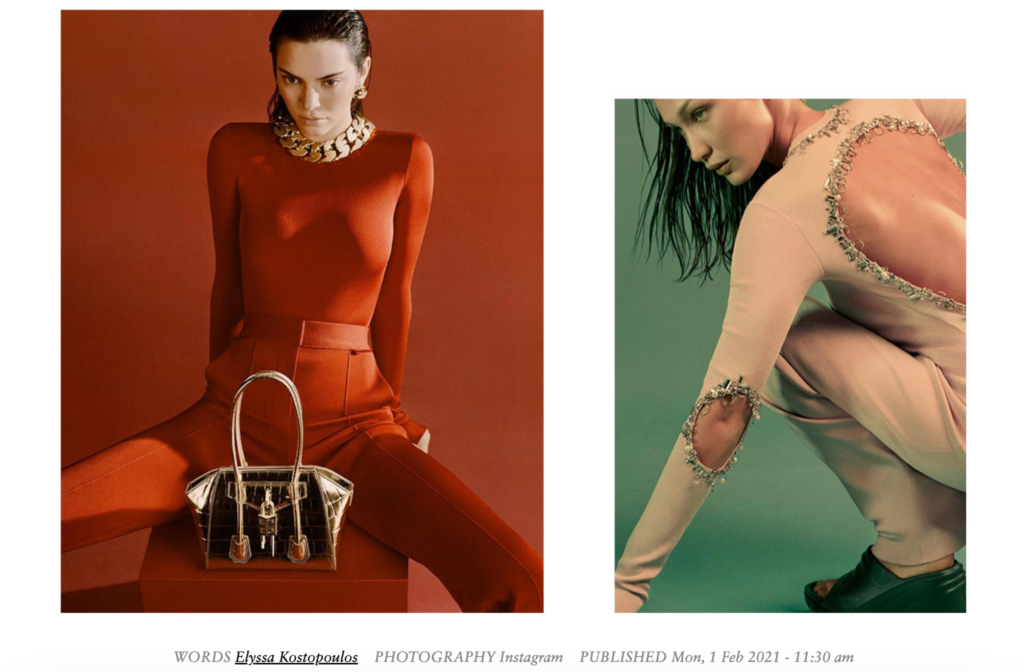
And yes, the casting is a big part of why it works. As you can predict, Kylie Jenner brings massive reach and instant visibility, while Bella Hadid adds strong fashion authority and editorial presence. Together, they bridge two worlds (mainstream pop culture and high fashion) which is where modern fashion marketing campaigns need to operate today.
#3: Spring 2026 Womenswear Campaign
I included the Givenchy Spring 2026 Womenswear Campaign, featuring Rooney Mara captured by Collier Schorr, in that list because it works, as it feels deeply intentional, almost quiet, but in a way that pulls you in.
Actually, Rooney Mara (known for her role in The Girl with the Dragon Tattoo) is a very specific choice. She brings a kind of understated intensity that aligns perfectly with Givenchy’s tone. There’s no need for exaggerated expression or dramatic posing, her presence alone carries the mood. That restraint makes the campaign feel more intimate, almost like you’re observing a moment instead of being sold something.
My friends are often my muses, and my muses often become friends. The second in our Portrait Series celebrates this creative relationship with both Rooney Mara and Paul Simonon.
In simple terms, this Givenchy campaign works because it doesn’t try too hard. It’s confident enough to be quiet, and that’s what makes it powerful.
#4: Givenchy X Timothée Chalamet
Actually, there isn’t a formal “official collaboration” between Givenchy and Timothée Chalamet in the way we’d define a structured brand ambassadorship or campaign partnership. What we’re seeing instead is something more subtle, but arguably more powerful.
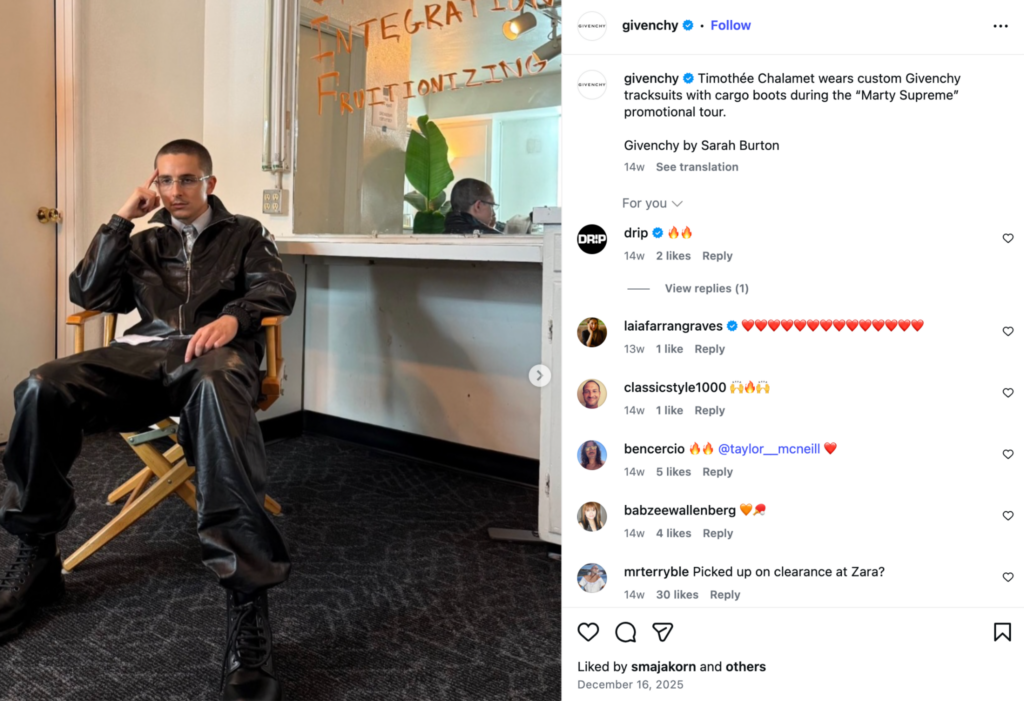
Timothée frequently wears Givenchy at high-visibility moments like red carpets, premieres, and across Instagram, and those appearances circulate widely. That creates repeated association without the brand needing to explicitly label it as a campaign.
From a branding standpoint, this works because it feels organic. It doesn’t come across as a paid, controlled message. Instead, it looks like a natural alignment between the actor’s personal style and the brand’s aesthetic. And as I mentioned earlier, that kind of authenticity is exactly what audiences respond to now.
So while it’s not a formal collaboration, it’s still strategically valuable. In many cases, this kind of “unofficial consistency” can be just as effective as a traditional Givenchy advertisement, because it lives inside culture.
Digital Marketing: How Givenchy Sells Online
For Givenchy, every digital touchpoint has to feel like it belongs in a magazine. Even paid ads have to look like art. That costs more and takes more effort, but it’s what keeps the brand feeling premium.
Here’s how Givenchy digital marketing works (or how they handle it):
Email marketing: Curated newsletters that feel exclusive; event invitations, new arrivals, behind-the-scenes access. Quality over quantity. Search and content: Editorial-quality writing on the Givenchy website like campaign stories, creative director profiles, brand history, beauty marketing trends, that ranks for luxury fashion search terms. Paid advertising & Meta ads: Targeted Instagram and Facebook ads aimed at luxury consumer demographics. Visual standards for paid posts match organic posts. Gaming platforms: Givenchy Beauty House on Roblox attracted 1.4 million visits in roughly four months, as I stated above. Animal Crossing tie-ins gave beauty products presence on a platform used by tens of millions of young people. YouTube: Campaign films, runway coverage, and longer brand stories extend the brand’s storytelling beyond static imagery. Online store (givenchy.com): Designed to feel like walking into a beautiful store, not just browsing a product catalogue. Every page communicates the brand’s identity.Being inside LVMH means Givenchy benefits from the group’s media buying power, data tools, and shared advertising infrastructure.
As you may remember, in late 2021, Givenchy launched the Chito X Givenchy NFT collection. It was a digital artwork created with Mexican artist Chito, tied to their spring 2022 collection. Proceeds went to The Ocean Cleanup charity.
Then in June 2022, Givenchy Beauty House opened on Roblox, a virtual beauty salon inspired by Hubert de Givenchy’s old home. Players could dress up avatars in Givenchy makeup, compete in virtual fashion shows, and win rewards.
Those are real numbers, representing a real audience that would likely never have walked into a Givenchy store. For that reason alone, the experiment was worth trying.
But here’s the honest part: the broader NFT and metaverse market hit a wall. Average daily NFT sales dropped 76% in April 2022. Many people who bought NFTs found themselves holding digital files worth a fraction of what they paid. The hype faded fast.
As of 2026, Givenchy’s official Instagram account has over 16 million followers.
Givenchy’s best social media moments have been the ones where the platform was used naturally: building stories over several days, sharing genuine behind-the-scenes content, and making the audience feel included in something. The Gentleman campaign’s social media part is the best example of this.
The brand also separates @givenchy (main fashion account) from @givenchybeauty (fragrances and cosmetics), smart, because the two audiences have different interests and respond to different content.
Influencer marketing is a big part of the picture.
Givenchy has worked with a wide range of people, from Kylie Jenner (who has a lot of followers and a younger audience) to Aaron Taylor-Johnson (who is known for his classic, masculine style). The hard part has always been making sure that the influencer’s image helps Givenchy’s timeless brand positioning.
TikTok is interesting.
Some luxury brands have gone hard on it, like Diesel. Givenchy has moved more slowly, probably wisely. TikTok’s culture of lo-fi, spontaneous content sits awkwardly with Givenchy’s carefully controlled visual identity.

What does Givenchy really teach us about timeless brand positioning?
When we step back and look at everything we’ve covered, not just the campaigns but also the casting, visual direction, and cultural presence, a clear approach emerges.
Givenchy does not chase constant reinvention. It evolves with intention, holding onto its core identity while adjusting how that identity is expressed in each moment.
From high-impact appearances with figures like Kylie Jenner and Bella Hadid to more understated storytelling with Rooney Mara and the ongoing cultural alignment with Timothée Chalamet, the brand stays consistent in what it stands for.
That is the real takeaway for us.
Timeless positioning is about understanding what should remain constant and what needs to evolve as culture moves forward.