‘Wind structures, 1–5’
A poem from the first poetry anthology written by descendants of Nikkei wartime incarceration The post ‘Wind structures, 1–5’ appeared first on Tricycle: The Buddhist Review.
 Hollif

The following poem is from The Gate of Memory: Poems by Descendants of Nikkei Wartime Incarceration, an anthology of poetry written by descendants of Japanese immigrants and Japanese Americans who were incarcerated during World War II. A tribute to the 150,000 people incarcerated by the United States and Canada during the war, the collection explores themes of intergenerational trauma, resistance and remembrance, and the role of poetry in building solidarity and facilitating healing across generations.
***
By Amanda Mei Kim
1.
We pushed small spoonfuls of carrots and peas around to make our plates look more full. The caterers had run out of yasaimono.
-They’ll remember to order more next year.
-Is this what camp was like?
-We don’t know. We don’t remember that.
What do you remember?
-We were too young to remember anything. He was just a baby. His father had been taken by the FBI, so it was just his mom and his four brothers.
-That must have been so hard on her!
Their square jaws set into small smiles. The elven eyes of this white-haired couple dim for a moment. I could have kept my mouth shut.
-I remember the sand blowing hard and my father pulled a jacket over my head and carried me to the next building.
-I remember that too.
-That’s all we remember.
In the black-curtained banquet hall, our white tables gleam with an inbound light.
-So, are you coming back next year?
-Of course!
2.
Aunt: The Buddhist school teacher would tap the blackboard with his chalk and tell us, You are no greater, no bigger, no more important, than this tiny speck.
Uncle: You are infinitesimal.
Aunt: You are nothing in an even greater nothingness.
Uncle: Even how much I love my boys, I know they are no more than a grain of sand.
Aunt: We are smaller than the smallest mark on the blackboard. Do you understand that?
In a way.
Aunt: In a way?! This is why it is so hard for us to talk to you.
3.
“In camp,” people say. As thin as tissue paper, these words bag up and hold all the jangly word-knives of “temporary holding facilities,” “indefinite leave,” “native-born foreigners,” “permanent resettlement,” “war relocation as a service.” Many replied with a potent silencethat filled homes with innumerable projects of immeasurable complexity or drenched the earth with rage. Their silences arced like lightning around us. We, their children, meet them in their infinite refusal.
4.
Time and memory bend in the Mojave desert. This is where the state’s oldest rocks and the world’s oldest trees can be found, where indigenous people fight for water that was stolen 100 years ago.
My aunt and I each place a million-year-old pebble on the base of the Ireito. One for her mother who died in childbirth. One for the sibling who went with her.
“They said they could try to save the baby, but my father said, ‘let them go.’”
Above the tower, the skies swirl with lakebed dust and particles uplifted from a landscape of strip mines, blast sites, open pits, bored holes and pickaxe mines. A drift of toxins sweeps over us and the multitudes who live in the desert crust.
We have come again, to a place where the rattlers and red racers meet, to water our memories.
5.
I told my aunt and uncle of the couple who remembered their fathers carrying them across the desert as toddlers.
-I remember that.
-Me too.
Here is the memory again:
-There was a terrible sandstorm, so my father picked me up and wrapped his coat around me and carried me to the mess hall.
-My father pulled my hat over my ears so they would not fill with dust and took me to the benjo. He had to wait outside in the storm while I went.
-The winds were so sharp that I couldn’t open my eyes. My father carried me.
-We’d get knocked over, it blew so hard. Our fathers had to carry us to school.
In this memory, a familiar enemy could be contained by the individual strength of their fathers.
It was a psychic talisman that protected them as they moved from barracks to trailers to migrant labor camps to segregated schools and sundown towns. Other memories lost their purpose and disappeared, but this one is as durable as their bones.
♦
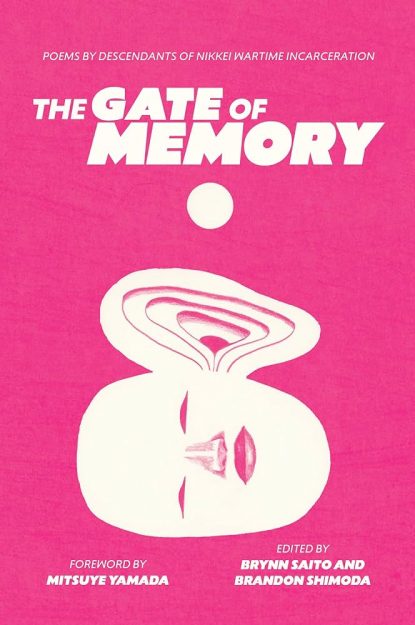
From The Gate of Memory: Poems by Descendants of Nikkei Wartime Incarceration, edited by Brynn Saito and Brandon Shimoda. Reprinted with permission from the author and Haymarket Books.

Thank you for subscribing to Tricycle! As a nonprofit, we depend on readers like you to keep Buddhist teachings and practices widely available.