A Lotus in a Sea of Fire and ICE
There is no way to democracy—democracy is the way. The post A Lotus in a Sea of Fire and ICE appeared first on Tricycle: The Buddhist Review.
 Tfoso
Tfoso

Recently, many friends in my community, and many of my students at the university where I teach, have asked me how they should respond to events in the United States and the world. What is the proper response when a presidential administration declares war on its own people and on foreign nations? For this is the world we live in right now, a world of fire and ICE, a world where war abroad is waged casually, and flippantly, with shifting justifications and a joyful, almost gleeful embrace of chaos, and where war is waged at home against critics of the government with a ruthless, stunning efficiency that is truly shocking in a nation that prides itself on protecting rights to free speech and free assembly.
As I contemplate how to respond to these wars, I’ve found myself remembering Thich Nhat Hanh’s call, in the 1960s, for peace workers in Vietnam to be “a lotus in the sea of fire.” Today, in the United States, we must learn how to be a lotus in a sea of fire and ICE. Our challenge is the same one that Thay and his students faced in the 1960s and 1970s: how to be a lotus flower as the world around us burns.
The lotus flower is a symbol of enlightenment. This beautiful flower roots in mud and rises through murky waters in search of light—just like us. Of course, it’s easy to get stuck in the mud, to be mired in the darkness of fear and frustration and hate and division. Unfortunately, mud is like quicksand: The more you struggle against it, the deeper you sink. In the Plum Village meditation tradition that Hanh started, we have a saying: “No mud, no lotus.” We find light not by denying that mud exists, not by cursing it or waging war on it. We use it to grow. Then we figure out how to grow and blossom together.
I understand the lotus to be a metaphor for the bodhisattva, the person who is deeply connected to the interdependence of life and who has accordingly pledged to help others. The aspiring bodhisattva practices mindfulness: being present with what is, accepting that, yes, this is indeed happening, and responding responsibly, with deliberation and love, together. Today, aspiring bodhisattvas must dedicate their energies toward practicing mindful democracy, upholding human decency, and cocreating a more peaceful, just, and loving world. This is no time to shrink and whither. There is no permanent withdrawal, no cave that can hide us from the conflagration. A world on fire burns us all. Like the lotus, we must remain committed to seeking the light even when things seem perilous.
Stepping outside the familiar paradigm of democracy as a war, I imagine democracy as an ongoing communal practice of working together to take care of ourselves, each other, and this miraculous, messy, wonderful, perplexing, oft-challenging life we share. To all the lotus flowers in a sea of fire and ICE reading this, I offer these gentle invitations for how we can practice democracy during this difficult moment.
Recognize the Two Kinds of Suffering: Sorrow and Injustice
Slow down, look deeply, and you’ll discover an inescapable fact of being human: Everyone hurts, sometimes. Life has many joys. And, as the Buddha taught, sarvam dukkham, there is suffering in life. This suffering invites care. To care is to alleviate suffering. The urge to care is the origin of democracy.
Look even more deeply, and you will see that not all suffering is the same. There are at least two kinds of suffering. First, there is the pain innate to the human condition: sickness, old age, and death. Second, there is hurt created and amplified by humans. This second kind of suffering includes the wasting plagues we inflict upon each other—war, enemyship, discrimination, dehumanization, racism, sexism, homophobia, colonialism, animal abuse, and environmental destruction, to name just a few—as well as the suffering we inflict on ourselves: self-judgment, holding on to a grudge, contemplating revenge on an enemy, worrying about things we can’t change, or consuming in ways that don’t support our well-being, for example.
Let’s call the first kind of inevitable suffering “sorrow,” and the second kind of artificial hurt, particularly the kind we inflict on each other rather than on ourselves, “injustice.” Of course, these two forms of pain compound each other. It’s not always easy to disentangle them.
It’s true that we will never fully transcend sickness, old age, and death, nor will we ever completely eliminate human bias or error. Still, we can take care of the suffering we inflict upon ourselves with our thoughts and choices. And, if we learn to work together in community, we can end many forms of injustice. We can alleviate the human-caused suffering we inflict on each other—and that, my friends, is a goal of democracy.
Ignore the Chant of Three Nothings, and Know That You Matter
The voices of nihilism, of nothing-really-matters-ness, are strong in our culture, and especially strong right now. In dark moments, we may hear the chant of three nothings: You are nothing, nothing is real, nothing really matters. If we repeat this chant to ourselves, the lotus flower we might become begins to wilt.
Have you ever doubted your self-worth? Have you ever questioned if you matter? Have you ever thought that your little voice is irrelevant in the face of so much injustice? Please know you are not alone in having these thoughts. And please know that you, and your life, matter. I say this without hesitation or equivocation. How do I know? The proof is in the practice of mindfulness itself.
Your life matters because you are capable of pausing, of slowing down the fluctuations of your mind, and of looking deeply at your life as it is happening right now—and then choosing how to respond. You matter because you can cultivate and grow the best parts of yourself, the deepest parts of your unrealized goodness, to bring heartfelt presence and gladness into the world. You matter, and I matter, because we can respond to life with compassion and trust, even when we are in pain. We are not at the mercy of suffering. You matter, and I matter, because we can choose to engage suffering wisely. We can learn how to pause, to step back from our immediate reactions, to see the mud clearly, and to make choices about how we want to live and be and blossom. Each and every one of us impacts the world in large and small ways with everything we do.
If we pay attention, we see that even though there is pain in life, there is also joy. There is so much worth living for. The miracle of life is present in every moment, every breath, every smile, every kind word, every condolence, every high-five and hug. Democracy is built on the strong foundation of hope—hope born from the insight that with presence and dedication, things can change. There is suffering in life, but there is joy too. There is injustice in life, but there is justice too. The lotus grows from the muck. There is mud in life; there is sunlight too.
All lotus flowers are equal under the sun. A person is not more important, or more worthy of care, or more deserving of the miracle of life, because they are wealthy and well-connected and mighty. Everyone deserves a chance to answer life’s eternal questions in their own words. Everyone has something important to contribute to our shared life.
Even in moments of great pain the conditions for the transformation of the pain are also present. We already have the thing we most need to build a more loving and compassionate world: We have each other. It might be bumpy going, but there is a path, and it is wide enough for us to walk side by side and arm in arm.
No One Does Democracy Alone
Every lotus needs its pond. If we aspire to democracy, we need places where we can learn its skills. I call these places “Beloved Communities,” using a phrase that inspired two of my personal heroes: Dr. Martin Luther King Jr. and Thich Nhat Hanh. In our Beloved Communities, we practice caring for each other and for the life we share. And then we act, together, supporting each other as we do. No one does democracy alone.
The Beloved Community Dr. King and Thich Nhat Hanh imagined is not an abstraction. It is a loose-knit global community composed of a multitude of smaller, local Beloved Communities committed to practicing mindfulness, loving-kindness, compassion, and peace. Each local community tends to sorrows when they arise, and addresses injustice as it plays out in their time and place. Each local community determines what they value and what they stand for. Then each community stands up in affirmation for their values in whatever creative, improvisational way they imagine.
Beloved Communities do not set out to wage war on suffering. Hating hate does not work. Waging war on suffering does not work. Making an enemy out of enemyship does not work. Doing this only adds more hate, suffering, and enemyship to the world. In his beautiful sermon “Loving Your Enemies,” Dr. King observed that “Hate cannot drive out hate, only love can do that.” Beloved Communities do not divide themselves into hierarchies of better and worse, friends and enemies, or worthy and unworthy, for such division is the mud that spawns the chant of three nothings. Beloved Communities practice affirmation, not opposition. We determine what we stand for, and then we make our stand on common ground.
In our Beloved Communities, we become a microcosm of the world we’d like to create. We create the conditions that allow lotus flowers in a sea of fire and ICE to bloom. In our Beloved Communities, we make sure everyone has enough, everyone feels safe and welcome, everyone is valued and treated with respect, and everyone is free to develop their individual talents and gifts. In our Beloved Communities, we practice the art of wise togetherness, for we are awake to interdependence. We are awake to the fact that we are collaborators, not competitors, in the shared miracle of life. We live and work together to make the world a happier and less painful place for all living beings.
Democracy Is About Winning Hearts, Not Wars
Democracy is a practice, a noun we must also understand as a verb, a form of collective action. Our English word “democracy” is derived from the Ancient Greek demokratīa, a combination of the words krātos, “power” or “rule,” and dēmos, “the community” or “the people.” “Democracy,” then, literally means “the power of the community to govern itself.” Power is a slippery word, of course, capable of papering over all manner of sin. When it comes to “power,” I find Mahatma Gandhi’s distinction between “physical power”—the power that comes from domination, exclusion, and repression—and “spiritual power”—the power that arises from respect, inclusion, and collaboration—helpful. Physical power is the power of armies. Spiritual power is the power of Beloved Communities committed to caring for each other and for the life we share.
Democratic power is not physical power: It is not domination. That’s what we’ve gotten so terribly wrong in thinking democracy is a fight or a battle or a war we must win by dominating and defeating our enemies. Lotus flowers in a sea of fire and ICE do not go to war. The strategy of waging war for democracy is counterproductive, because democratic power is spiritual power: Its goal is to win hearts, not wars.
True democracy seeks to awaken the deep goodness present even in those who support and perpetuate injustice. It seeks to inspire them to seek the light.
Democratic change unfolds on the field of argument, persuasion, and public opinion, which is very different from a war. In a war, the goal is to win at any cost. This includes forcing another person to do what we want them to do. Though we might “win” a war through physical or verbal domination, we do not win the minds and hearts of those we bully (and, in fact, we likely stoke rebellion). In an argument, the goal is not to dominate but to win over the hearts and minds of those who stand opposed. An argument preserves the freedom of all parties even as it seeks to shape the choices an “opponent” makes, bringing them around to our way of seeing and doing things.
To be a lotus in a sea of fire and ICE is to speak, act, and live in a way that might change the minds of those who casually support oppression with their indifference and inaction—and, if possible, the oppressors’ minds too—by speaking to their hearts. Democracy is a form of moral jujitsu that throws attackers off-balance. It aims to inspire one’s “opponents”—and society at large—to reflect on injustice. The goal is to build spiritual power, not physical power. Nonviolence has proven historically effective because it invites people into the Beloved Community and the space of reflection, rather than pushing them away with demands for violent confrontation. The people we disagree with are not enemies, they are people, just like us, who suffer, just like us, and who have hopes and dreams and fears, just like us. True democracy seeks to awaken the deep goodness present even in those who support and perpetuate injustice. It seeks to inspire them to seek the light.
There Is No Way to Democracy, Democracy Is the Way
Many people I’ve talked to continue to place their hope for righting injustice in a mysterious law of karma—the idea that, in the end, people cannot do wrong without suffering wrong, for the universe will set things right. To be a lotus in a sea of fire and ICE is to understand that we cannot wait around for the universe to fix what is broken. The lotus understands that the word karma means action, not acquiescence.
So we must show up. We must act in mindfulness. This action can take many possible forms (in my book I describe several concrete actions we might take to win hearts, topple walls, and right injustice). The only limiting factors are our ethical commitments to each other and to the earth, which must be steadfast, and human creativity, which is boundless but which most of us are unskilled at exercising, especially together. Democracy invites us to be creative, to think outside the box, to break with convention and step outside our routines, habits, and assumptions of “this is how it must be done because that’s how people have always done it.” Democracy is serious; it is also playful. Keeping this sense of playfulness alive, even when we are addressing grave injustices, is essential.
How we advocate for democracy matters as much as the democracy we pursue, because our words, and actions, shape the reality we cocreate. The way we move, the way we speak, the way we show up for one another—these are not rehearsals for democracy; they are democracy. Democracy is something we embody in every moment of every day, and it starts by recognizing that you can’t renew a democratic culture by embracing hateful words and treating politics like a war. The origin of democracy is care and compassion. Only democracy can build democracy.
The lotus recognizes that there is no way to democracy, democracy is the way.
Democracy is a practice of caring for suffering so that we might be truly happy, together. Everything is interdependent, including suffering. If you suffer less, I will suffer less, for you will be less likely to inflict your suffering on me. And if we suffer less, all of us suffer less, for we will be less likely to inflict our suffering on the world. All of us benefit when there is less suffering, and more joy, in the world. To be a lotus is to work together with other lotuses to reduce the amount of suffering in the world and to ensure everyone is supported, safe, and has enough to live a good life as they choose to define it.
Remember this, and you will know how to walk through a world of fire and ICE.
◆
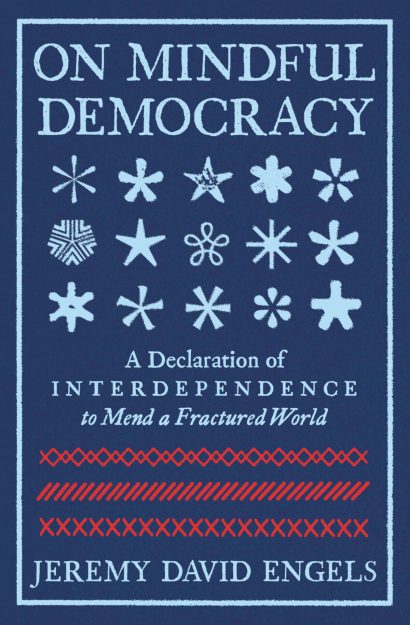
Adapted from On Mindful Democracy: A Declaration of Interdependence to Mend a Fractured World © 2026 by Jeremy David Engels. With permission of Parallax Press.



















.jpg&h=630&w=1200&q=100&v=c0f97a310e&c=1)
.jpg&h=630&w=1200&q=100&v=c0f97a310e&c=1)