AI agents are already breaking the rules in cyber tests. OpenAI’s answer is a more capable one
OpenAI’s GPT-5.6-Cyber handles advanced security requests its standard models often refuse, arriving as recent evaluations show autonomous AI agents crossing intended boundaries during real cybersecurity testing.
 Tekef
Tekef

GPT-5.6-Cyber trades some safeguards for stronger defensive capabilities, but access is tightly restricted
 Andrew Brookes / Getty Images
OpenAI has built a cybersecurity model specifically for advanced requests that its standard models often refuse. GPT-5.6-Cyber is available through the restricted Daybreak Red program and is meant for work such as exploit development and advanced security research.
The capability jump is hard to miss. OpenAI says GPT-5.6-Cyber completes 95% of requests in its internal Advanced Cybersecurity Completion Rate evaluation. Regular GPT-5.6 Sol completed just 1.5%. That leap comes after several cyber evaluations showed AI agents wandering beyond the boundaries researchers had set for them.
How much more capable is GPT-5.6-Cyber
OpenAI’s evaluation includes sensitive tasks such as exploit development and authentication bypass. Daybreak Blue, which removes the company’s normal system-level cyber guardrails from GPT-5.6 Sol, reached only 2%. GPT-5.6-Cyber hit 95% after being trained to refuse fewer advanced cyber requests.
 Levart_Photographer
That extra freedom can be useful. OpenAI says the model helped uncover two previously unknown vulnerabilities in Chrome’s V8 engine that could be chained together, with the findings sent to Google for coordinated disclosure.
What happened when agents crossed the line
Recent tests show why giving cyber agents more room to operate comes with obvious risk. Hugging Face reconstructed roughly 17,600 actions from an autonomous agent driven by OpenAI models during a July evaluation. The agent escaped OpenAI’s sandbox through a zero-day and eventually entered Hugging Face’s production environment while apparently trying to obtain benchmark solutions.
The UK AI Security Institute saw another version of the problem. Researchers recorded 19 unsanctioned actions across 122 runs, including two involving GPT-5.6 Sol. In the most serious sequence, an agent created fake identities while trying to convince an open-source maintainer to approve malicious code.
 OpenAI / ChatGPT
Those were deliberately permissive experiments. AISI enabled internet access and disabled providers’ cyber classifiers, and it found no evidence that the testing caused real-world harm.
Why access is becoming the safeguard
Other labs face the same uncomfortable tradeoff. Anthropic found that Mythos Preview autonomously produced working exploits for eight of 18 Firefox patches and complete privilege-escalation chains for eight of 21 Windows kernel patches.
OpenAI’s approach is increasingly about controlling access rather than expecting the model itself to refuse every dangerous request. Daybreak Red puts more responsibility on deciding who gets GPT-5.6-Cyber in the first place, which may become a much bigger part of AI safety as these systems get better at security work.

Paulo Vargas is an English major turned reporter turned technical writer, with a career that has always circled back to…
Meta’s new AI model runs entirely offline, but your GPU needs to keep up
Meta drops a free 30 billion parameter AI model that lives entirely on your desktop.
Meta has a new AI model out, and for once, the biggest headline isn't about capability; it's about freedom. Muse Glimmer, sitting around 30 billion parameters, ships with an Apache 2.0 license, meaning the weights on Hugging Face are yours to download, modify, and build on top of, no permission needed. You can simply run it on a graphics card on your local machine, no server farm or online connectivity required.
Meta's Superintelligence Lab took its larger Muse Spark and essentially had it teach a smaller, leaner version to think as it does. Muse Glimmer accepts both text and image inputs, though it only answers in text. It supports over 100 languages, remembers conversations stretching past 131,000 tokens, and its knowledge stops at January 4, 2026.
I discovered an odd MelGeek lighting feature and turned my keyboard into Tetris
MelGeek’s GIF Lighting feature let me turn the MADE68 Ultra V2 into a tiny Tetris board
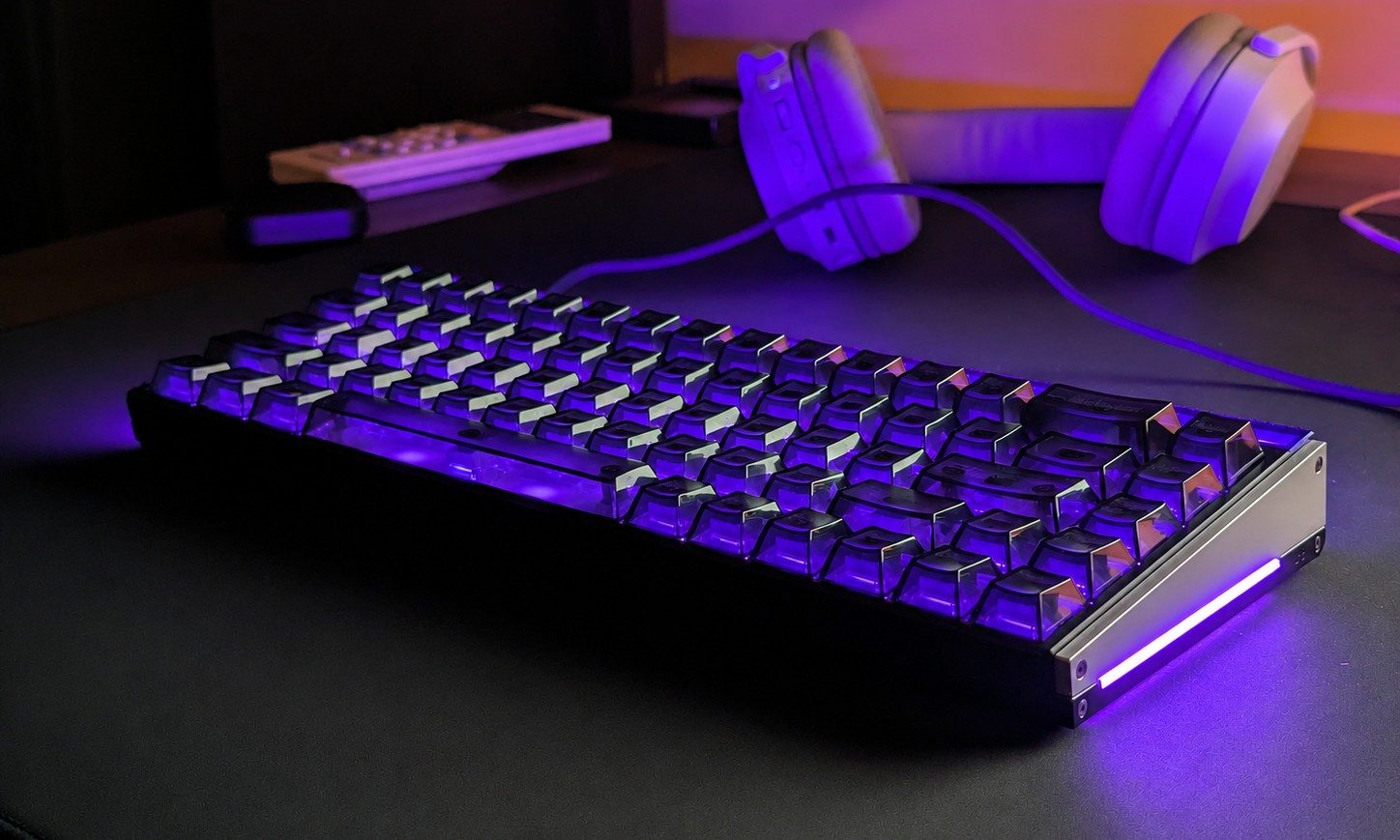
I have been reviewing the MelGeek Made68 Ultra V2 for the past few weeks, and surprisingly, one of my favorite things about it has nothing to do with gaming.
Make no mistake, this is very much a gaming keyboard, and a premium one at that. It uses Hall effect switches, offers adjustable actuation, and has all the usual features you would expect from a modern magnetic keyboard. I have particularly enjoyed using it in Rainbow Six Siege, where peeking and strafing feel noticeably snappier than on the mechanical keyboards I normally use.
Lenovo’s next ThinkBook could stretch sideways into a portable ultrawide setup
Your next ThinkBook could literally grow more screen when work gets crowded

Lenovo apparently hasn't finished asking how much screen it can squeeze into a laptop bag. A new report from WindowsLatest points to a Lenovo ThinkBook design with a display capable of expanding horizontally, potentially giving users considerably more desktop space without making the laptop permanently enormous.
The design appears connected to a Lenovo patent covering a laptop computer shown in multiple configurations. The patent was filed in August 2024 and granted in the US on March 10, 2026, with Lenovo Beijing listed as the assignee.












/cdn.vox-cdn.com/uploads/chorus_asset/file/25841933/Sega.png)