Facebook Pages get charged for link posts
After Meta One for Business launched its subscription packages, some managers said their accounts were being limited to two link posts per month.
 Fransebas
An article from

After Meta One for Business launched its subscription packages, some managers said their accounts were being limited to two link posts per month.
This audio is auto-generated. Please let us know if you have feedback.
It seems that more Facebook Pages are being asked to pay to include links in their posts in the app.
Following the launch of Meta One for Business paid subscription packages this week, the company has seemingly expanded its test of limiting the number of links for non-paying professional accounts.
Meta One for Business includes the ability to add a limited number of links to Instagram posts and Reels each month, which varies by paid tier.
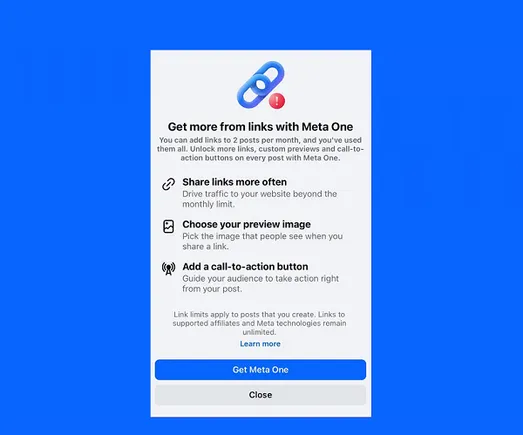
Facebook post links are not listed as a benefit at this stage, but that looks set to change. This week, a range of Facebook managers shared this pop-up alert that appeared on their accounts.
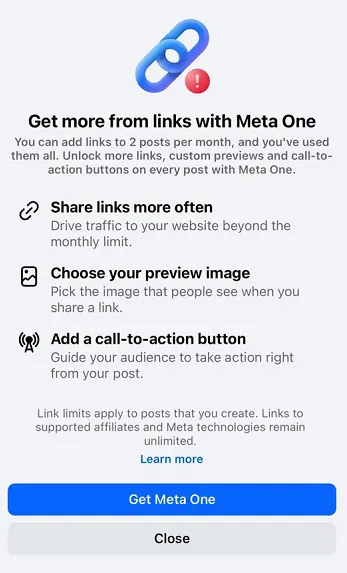
As outlined in the explainer, some accounts are now being limited to two link posts on Facebook per month, unless they pay for a Meta One subscription.
Which is not new. Meta launched a limited test restricting certain pages to two links per month in December 2025. However, with the arrival of Meta One for Business, which Meta is pitching as a key value-add, it seems that the company has expanded this restriction to more Pages.
Meta previously explained that the test was designed to get an understanding of “whether the ability to publish an increased volume of posts with links adds additional value” for paying users.
Meta also said that publisher Pages are exempt from the test, in order to keep content flowing into the app.
But other Pages may soon be restricted, which will force a significant change in strategy for some brands.
Though this might not actually have a huge impact on overall performance results.
Meta has repeatedly reported that posts with link clicks get very little exposure on Facebook. According to the platform’s Widely Viewed Content report from Q1 2026, 98.7% of post views in the U.S. for that period did not include a link to a source outside of Facebook.
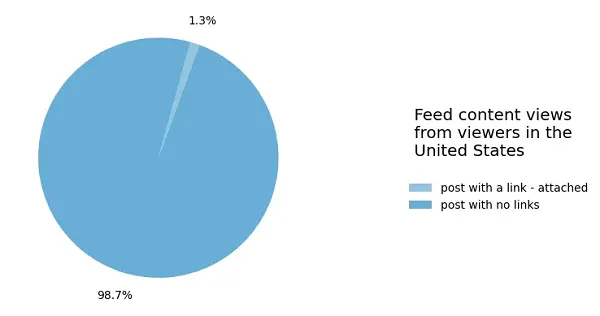
The exposure of link posts has been in steady decline, dropping from 9.8% of viewed content including a link in 2022, when Meta first started sharing this insight, to a new low of 1.3% as of this report.
Given that link posts are getting so little exposure, limiting them may not have as big of an impact as some business users expect. And they can pay for a Meta One subscription to post more if they choose.
But it still feels a little sneaky, even if it is in line with the company’s usual bait-and-switch approach on inviting business use, then charging for access.
In 2016, Meta CEO Mark Zuckerberg outlined the company’s three-stage monetization strategy for apps:
Build a product that people love Facilitate organic business behavior on the app (free of charge) Prove additional avenues for businesses that are seeking to expand their reach and presenceSo while it may seem a little rich for Meta to be charging users to post content, which the company ultimately benefits from, this is in line with its usual strategy.









![2025 CPL and CAC Benchmarks [HubSpot Research]](https://www.hubspot.com/hubfs/cost-per-lead-benchmark-1-20250227-9826989.webp)
![The 12 Best Free Flowchart Templates [+ Examples]](https://www.hubspot.com/hubfs/free-flowchart-template-1-20240716-6679104-1.webp)