Free Speech and Right Speech
Where the First Amendment meets the eightfold path in the public square The post Free Speech and Right Speech appeared first on Tricycle: The Buddhist Review.
 KickT
KickT
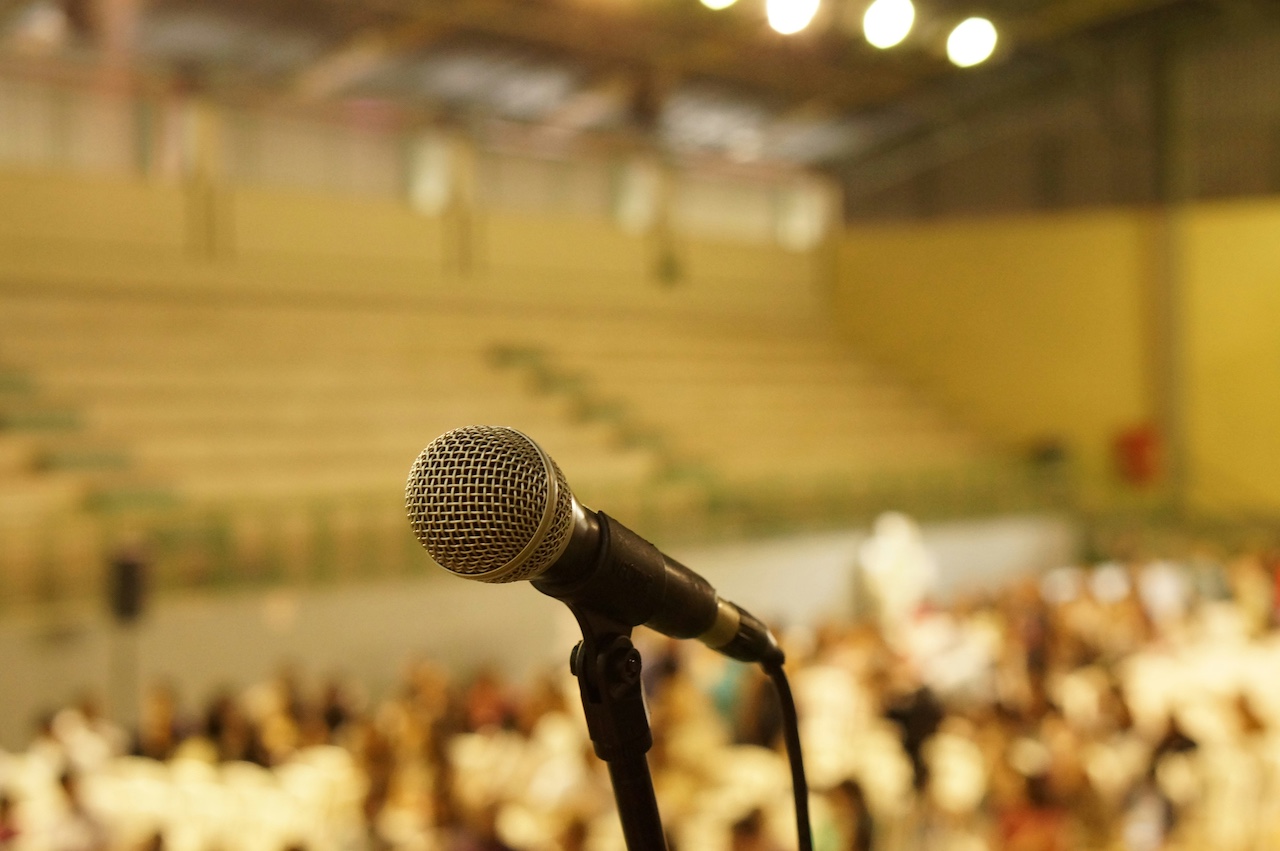
“The difference between the almost right word and the right word is really a large matter—’tis the difference between the lightning bug and the lightning.”
—Mark Twain
Some words are like lightning, capable of setting a world on fire. We seem to be invoking inflammatory language a lot these days. And why not be heard? We value our First Amendment rights of “free speech” and a “free press.” We find them enshrined in our Constitution; we protect and valorize these freedoms.
In Buddhist practice, we recognize a companion value in “right speech.” We find it in the Buddha’s eightfold path. Like “free speech,” “right speech” is foundational. Over the past half century of practicing First Amendment law and Zen Buddhism, I have often wondered: What does free speech have to do with right speech? How do these essential values speak to one another, and what can they teach us?
A Brief Look at Free Speech
“[T]he roots of free speech are ancient, deep, and sprawling,” writes Jacob Mchangama in Free Speech: A History from Socrates to Social Media. His global look at the history of free expression shows that free speech is “an indispensable weapon in the fight against oppression.” The 18th-century American experience affirms this view. In our country’s founding documents, we see a struggle for liberation and a yearning for harmony.
First, there’s the Declaration of Independence, by which “one people” dissolved their ties to “absolute Despotism” and held certain “truths to be self-evident, that all men are created equal . . . with certain unalienable Rights, that among these are Life, Liberty and the pursuit of Happiness.” Second, there came a Constitution, which sought to “form a more perfect Union.” The Founders were leery of kings, and so their Constitution was a carefully calibrated instrument designed to divide power among three branches of government, and between the nation and its several states, and thereby build a lasting union.
But neither of these founding documents said anything about free speech. Those words—“freedom of speech, or of the press”—appeared a few years later as part of the First Amendment to the Constitution. The First Amendment appears at the top of a Bill of Rights that prohibits Congress from abridging certain essential freedoms, which include free speech and freedom of the press.
Our insistence on free expression arose in the context of a colonial people’s struggle for freedom and independence. What Thomas Paine wrote as Common Sense the British governors viewed as radical instigation, and his pamphlet, though only forty-six pages, sparked a revolution. Once independence from Great Britain had been won, it fell upon the Founders to give the new nation a viable form.
Beginning in the 20th century, the U.S. Supreme Court has actively defined the boundaries of the First Amendment, determining what the government can and cannot regulate in terms of speech and publication. While the First Amendment fundamentally limits government power to curtail expression, free speech is not absolute, and exceptions exist for defamation, obscenity, and incitement, among others. The Court has allowed content-neutral time, place, and manner restrictions but generally prohibits censorship based on viewpoint.
A pivotal era in First Amendment law began in the 1960s when the Court issued several landmark decisions, asserting that public debate must be “uninhibited, robust, and wide-open.” This was exemplified in New York Times Co. v. Sullivan (1964), which required public officials to prove “actual malice” in libel cases, providing “breathing room” for the press. The Court extended broad protection even to hateful speech advocating illegal action in Brandenburg v. Ohio (1969) demanding proof of advocacy that is likely to incite or produce “imminent lawless action.” This body of highly speech-protective jurisprudence has created a legal climate where a wide range of expression, including false or malicious speech, is protected today.
The media scene of the ’60s seems almost quaint when compared with what’s happening today. We now inhabit a legal landscape—governed by Section 230 of the Communications Decency Act—that confers sweeping immunity to “providers or users of an interactive computer service” for publication of content created by third-party users. In other words, by limiting the liability of social media companies for what their users post online, Congress has unleashed a Wild West for the purveyors of every kind of speech imaginable.
“Today, in America,” as Mary Anne Franks writes in Fearless Speech, “[b]usinesses have a First Amendment right to deny service to gay people and to advertise this fact. Antiabortion zealots have a First Amendment right to mislead pregnant women with fake pregnancy clinics and a First Amendment right to harass women attempting to access actual care. Corporations have a First Amendment right to spend unlimited funds to influence elections. . . .”
And so it goes. Harmful speech is justified variously under the First Amendment, often by a principle of protecting “freedom for the thought we hate.” Perhaps the 20th-century formulations of our free speech rights still ring true. But in many ways, the views of yesteryear land in a very different world today, where the work of journalists is being replaced by algorithms, artificial intelligence, and “bots”—what Yuval Noah Harari calls “aliens.”
People increasingly get their news from social media sources that profit from polarization and traffic in traumatizing messages, controlled by some of the largest concentrations of wealth in the world. As Harari notes: “It is no coincidence that the democratic conversation is breaking down all over the world because the algorithms are hijacking it. We have the most sophisticated information technology in history, and we are losing the ability to talk with each other to hold a reasoned conversation.”
A Brief Look at Right Speech
Ethical rules are not so different from legal regimes; they can be a tangle that grows over time. In the 6th century BCE, Siddhartha Gotama became an awakened Buddha and articulated the four noble truths. These truths identify life’s suffering, its cause, the possibility of its cessation, and a way toward liberation from suffering—the eightfold path.
Three steps along the Buddha’s eightfold path involve ethics, or sila—right speech, right action and right livelihood. Right speech (sammavacha) appears first among these three values, received as part of an oral tradition. Yet like other principles expressed in founding documents, right speech should be viewed in context, as one of eight interrelated and overlapping steps along a path toward liberation.
The Buddha’s abiding attention to the ethics of “right speech” suggests we should carefully consider its meaning, especially in these times of divisive, incessant, instantaneous, global communications.
What, then, is “wise speech” in a digital world, and how does it relate to free speech?
We begin with the Buddha’s question and answer: “[W]hat, friends, is right speech? Abstaining from false speech, abstaining from malicious speech, abstaining from harsh speech, and abstaining from idle chatter—this is called right speech.”
Repeatedly in the sutras, the Buddha indicates that “wrong” speech happens when we communicate in ways that are false, malicious, harsh, and hollow. But the terms “right” and “wrong” suggest a bright-line, one-size-fits-all approach to wise speech. Right speech, in the context of Buddhist ethics, means skillful speech, and skillful speech is as situational as each of life’s new situations.
So unlike the American law of free speech, which tells us what the government can and cannot regulate, punish, or proscribe, skillful speech provides an ethical framework for communicating with ourselves and others. In Buddhism, skillful speech means deciding whether and when to speak, and what we should say, guided by the eightfold path.
And here’s where it gets tricky. Right speech involves the formulation of an “appropriate response” to life’s ever-changing situations. Sometimes that response is silence; other times it’s carrying signs and marching in the streets. By and large, right speech is personal and situational but not cynical. Indeed, the Buddha questioned whether he could even teach such a revolutionary road to freedom, but he gave it a try.
No single step along the eightfold path stands alone. Even calling them “steps” can be misleading, unless we recognize them not as linear and progressive but as interrelated and ongoing—“the circle of the way,” or “continuous practice,” in the words of the 13th-century Zen teacher Eihei Dogen.
From the silent illumination of continuous practice comes a depth of understanding beyond words. And yet we must find the words and use them skillfully. That’s because the understanding that comes from our practice is what connects our separate selves to all other sentient beings, to the world’s more-than-sentient beings—and to all life itself.
These are the connections that allow us to recognize the importance of kind and loving speech; compassionate and courageous communications; fearless speech; noble silence and deep listening; and, more broadly, practicing an ethics of care. If we stop and pause before we speak, we increase the odds of formulating an appropriate response—one that considers its consequences for the speaker and hearer, for all the world, and resonates with kindness.
This is not to say that right speech is calculating speech. Sometimes it is spontaneous, like “right action”—for example, when we move quickly to protect someone from harm’s way. Sometimes it is symbolic speech, as wordless as a smile; for as Thich Nhat Hanh has observed, “[a] smile is the most basic kind of peace work.” And, yes, laughter has its place in right speech, too, especially when it comes from the heart.
Over time, with continuous practice, wise speech unfolds authentically. Consider these “Turning Words,” found in a book of the same title by Hozan Alan Senauke and attributed to Karen DeCotis: “There is a simple lesson I learned from Karen some years ago. Very simple. Ask yourself, “Do you want to be right, or do you want to be in connection?”
As Zen practitioners, we come to appreciate that sometimes we are left with only the questions—though sometimes, like a Zen koan, the answers can be found in the questions themselves. In Zen, we have what’s known as the Five Gatekeepers of Speech. As Roshi Joan Halifax has explained in Standing at the Edge: Finding Freedom Where Fear and Courage Meet, “before we open our mouths, we consider:
1. Is it true?
2. Is it kind?
3. Is it beneficial?
4. Is it necessary?
5. Is it the right time?”
Consider the Buddha’s directive to abstain from lying. Buddhism is not alone among the faith traditions in eschewing false speech. Search the Abrahamic and East Asian traditions and we find injunctions against lying in them all. But even here, a bright line may prove illusive.
As Lin Jensen wrote in a Tricycle essay titled “Right Lying”: “Right speech isn’t a matter of telling ‘the truth, the whole truth, and nothing but the truth, so help me God.’ We cannot say definitively, ‘This is a lie’ without consulting the intent, and probable consequence, of what is spoken. Zen rests on seeking the heart’s consent, and it does so because the truth or falsehood of what we say resides in the totality of the circumstances and in whether the words are consistent with the facts. For one thing, in the world of facts, there’s generally more than one fact that bears on what is best to say in any given instance. . . . The heart’s truth makes a marriage of opposites.”
Jensen’s essay on “right lying” is no pretext for perjury. Rather, it’s analogous to what we say about meditating: simple but not easy. For what is the “heart’s consent” if not an appropriate response to life’s most challenging questions and situations? And how do we formulate an appropriate response to a friend’s query, a colleague’s comment, or a nation’s participation in war or genocide? Our sitting practice allows us to follow our thoughts and consider, without judgment, where they take us.
Drawing on this practice, we recognize that our passing thoughts often lead to speech—and speech leads to action. Our contemporary culture of saying whatever pops into our heads (and then posting it) seldom represents an appropriate response. It may generate the most “hits,” reflective of one’s immediate attractions and aversions, but rarely is it wise speech.
Buddhism allows us to practice wise and compassionate speech, and to foster a loving community. Hate speech, though not proscribed by our Constitution, can lead to catastrophic action. In Dogen’s fascicle “The Bodhisattva’s Four Methods of Guidance,” he listed “kind speech” as one of four great practices, noting that each one contains the other: giving, kind speech, beneficial action, and identity action.
While this brief fascicle merits study in its entirety, Dogen’s words on kind speech are apt here: “ ‘Kind speech’ means that when you see sentient beings, you arouse the heart of compassion and offer words of loving care. It is contrary to cruel or violent speech.”
In this fascicle, Dogen recognized the enormous consequences of words, and the importance of choosing them wisely: “Know that kind speech arises from kind heart, and kind heart from the seed of compassionate heart. Ponder the fact that kind speech is not just praising the merit of others; it has the power to turn the destiny of the nation.”
A Few Concluding Thoughts
Right speech involves care and risk. It’s compassionate and fearless, and imbued with values of kindness and courage that the law of free speech neither favors nor necessarily protects. If, as Cornel West has said, “[j]ustice is what love looks like in public,” then it’s time to practice more right speech in the public square.
It won’t be easy.
As Joan Halifax wrote in Standing at the Edge: “[I]n cases of injustice, of disrespect, of harm, of abuse, of harassment, of violence, it’s our responsibility to call out harm in the name of compassion.” Right speech is courageous speech, she noted, “grounded in authentic respect.” Today the forces of greed, hate, and delusion that Zen Buddhists vow to transform may seem overwhelming. The challenges may feel especially daunting in view of our rapid-fire digital ecosystem, a climate catastrophe, an 18th-century constitutional structure moving too slowly to adapt, and a rising authoritarianism that traffics in harsh and hateful speech. But Buddhism teaches us that wise speech plays an important role in our daily lives, whether we are practicing noble silence or shouting from the rooftops, and free speech gives us plenty of space to exercise our ethics wisely.
“To everything there is a season,” Ecclesiastes reminds us, and this wisdom applies to speech in the digital age. Newspapers may be folding, but there’s no dearth of information; the purveyors of goods and services, with bits of news sandwiched in between, are filling our social media shopping carts with all kinds of mental food. Some of it is useful, some of it is toxic.
If we’re not careful, we can become gluttons of news “feed,” feeling sick from the sights and sounds, or we can disengage entirely, becoming news ascetics, abandoning our duty as citizens. Just as the Founders sought balance between freedom and security for a new nation, and as the Buddha discovered a “middle way” for awakened selves, we must find balance in our individual lives between being well-informed citizens and becoming overindulged or turned-off “users.” To prepare ourselves for practicing right speech in these times, there is a season for taking a “news fast”—but then, we must return, bear witness, and take compassionate action.
In 1960, the newspaper ad that gave rise to the Sullivan case carried the title “Heed Their Rising Voices.” In many ways, the Sullivan case and the freedom to report on oppressive conditions in this country made some of the later successes of the civil rights movement possible—indeed, within months of this Supreme Court decision, the Civil Rights Act of 1964 was signed into law, and the Voting Rights Act followed a year later.
Right speech is part of a living process that includes our thoughts, speech, and actions.
Of course, the causes and conditions of American life in the 1960s are not the same as today, and yet “Heed Their Rising Voices” may be an appropriate anthem for the present moment, when democratic values, human rights, and the well-being of our planet are under siege—and a culture of fear is gripping people around the world. Right speech is part of a living process that includes our thoughts, speech, and actions.
We can start small, using loving and kind speech in our private lives, and then extend our expressions of care for the world to encompass our speech in public as well. When we find our voice, right speech leads to right action. We all have something useful to say, if only we have the wisdom to know how and when to say it. Fortunately, free speech in this country still gives us the “breathing room” to get it said. Not all of our speech will light up the night sky. But when we do communicate, what values will guide us? Will we remember the Five Gatekeepers of Right Speech? Will we choose an appropriate response? The choice is ours: Will we use words that illuminate—or that set the house on fire?