Generative Engine Optimization Statistics of 2026 that Marks the End of the “Click Era”
Generative engine optimization statistics from 2026 make it impossible to ignore what’s happening in the world of “searching,” obivously. “The click-based web,” as we’ve known it for three decades, is being quietly retired. In its place, a new discipline...
 Tekef
Tekef

Generative engine optimization statistics from 2026 make it impossible to ignore what’s happening in the world of “searching,” obivously.
“The click-based web,” as we’ve known it for three decades, is being quietly retired. In its place, a new discipline is taking shape, one where visibility is no longer measured by rankings but by how often an AI chooses to cite you.
Generative Engine Optimization, or GEO, as you may know, is the practice of structuring digital content and online presence to improve visibility within AI-generated responses.
Unlike traditional SEO, which optimizes for ranking positions in lists of links, GEO targets the engines that synthesize answers. Systems like ChatGPT, Google AI Overviews, Perplexity, and Gemini. Yes, it’s the GEO vs. SEO battle.
The term was coined in 2023 by researchers at Princeton, who published a foundational paper defining GEO as a way to help content creators improve visibility in generative engine responses. By 2026, that academic concept has become a boardroom imperative.
We bring together the most critical generative engine optimization statistics and facts shaping the field this year.
What’s Inside
The Collapse of the Click: What the Numbers Say about SEO versus GEO What Digital Agency Network’s GEO Research Reveals: Stats from the Agency Ecosystem Voices from the GEO Agency Ecosystem Generative Engine Optimization Statistics by Industry GEO Statistics for eCommerce GEO Statistics for SaaS and B2B GEO Statistics for Content Marketing GEO Statistics for Social Media Marketing What Comes NextThe Collapse of the Click: What the Numbers Say about SEO versus GEO
The shift from click-based search to AI-synthesized answers is an accelerating disruption. The generative engine optimization stats that follow paint a picture of a landscape already fundamentally changed.
The reliance on traditional search engines is projected to drop by as much as 25% by 2026. Users who once scrolled through pages of results are now asking an AI and receiving a single, direct answer. This behavioral shift has already reached a tipping point: as of mid-2025, approximately 5.6% of all U.S. searches were conducted using AI-powered LLMs as the primary search tool, according to the Wall Street Journal. ChatGPT’s rise exemplifies this shift in stark statistical terms. In 2024, ChatGPT surpassed Bing in daily visitors by 10 million. By early 2026, ChatGPT had reached more than 900 million weekly active users worldwide, according to OpenAI. Perplexity AI, the citation-heavy research engine, now processes over 500 million queries per year with 50 million monthly visits. The numbers speak clearly: users have found their preferred AI search tools and are forming platform loyalty, much like they once chose between Google and Bing. The downstream effect on publisher traffic is already severe. Publishers are reporting traffic losses of up to 40% as Google AI Overviews place synthesized summaries above traditional blue links. Meanwhile, Ahrefs data reveals that 63% of websites now report traffic originating from AI-based search engines, making AI referral traffic a mainstream channel. Consumer behavior data reinforces the magnitude of the change. According to Capgemini research, 58% of users have replaced classic search engines with AI tools when searching for products or services. When the majority of your prospective customers are asking an AI rather than Googling, the question is no longer whether GEO matters. It’s whether you’ve started yet. Furthermore, 64% of customers express readiness to purchase products suggested by AI, according to Master.of.Code research.What Digital Agency Network’s GEO Research Reveals: Stats from the Agency Ecosystem
DAN’s research across the GEO agency landscape reveals several patterns that the global statistics alone do not fully capture. The organizations closest to the implementation of GEO, the agencies building and running it day to day, offer a granular view of where the discipline stands in 2026.
One of the clearest findings from DAN’s research is the early-mover advantage dynamic. By early 2026, most enterprise marketing teams have a GEO initiative in place. On the other hand, most SMB marketing teams have not started yet. This gap creates a significant first-mover opportunity, but it is closing.
A second consistent finding is the measurement gap. The biggest operational challenge is not content creation or technical optimization; it is establishing meaningful GEO KPIs and communicating performance in ways that resonate with clients. AI citation frequency (AICF), brand representation accuracy, share of voice in AI answers, and AI referral traffic are the metrics gaining traction.
But as DAN’s research highlights, a brand can appear repeatedly inside AI answers, influence perception, and shape decision-making without ever generating a trackable click.
Third, the research surfaces a growing understanding within the agency community that GEO is not a one-time content tweak.
Agencies that treat it as a campaign or a quick optimization pass are finding that AI engines weight recency heavily for time-sensitive queries. Content published in 2024 without updates will consistently lose ground to a 2026 article covering the same topic. GEO demands the same ongoing discipline as SEO, a sustained program of refreshed content, original research, expert commentary, and earned citation-building.
Fourth, DAN’s findings show that the definition of GEO success is converging around entity authority rather than keyword rankings. The shift from link-based to entity-based search logic is a structural change in how AI systems process authority. AI draws from multiple sources simultaneously, identifying overlap, consistency, and reliability before forming a response.
Voices from the GEO Agency Ecosystem
The agencies at the forefront of this shift offer a ground-level perspective that enriches the picture painted by global statistics. A diverse group of GEO agencies, spanning the USA, UK, Europe, Asia, and Australia, has been shaping how brands navigate this new landscape.
As the GEO case studies demonstrate, these innovative agencies provide the expert insights necessary to truly understand the numbers.
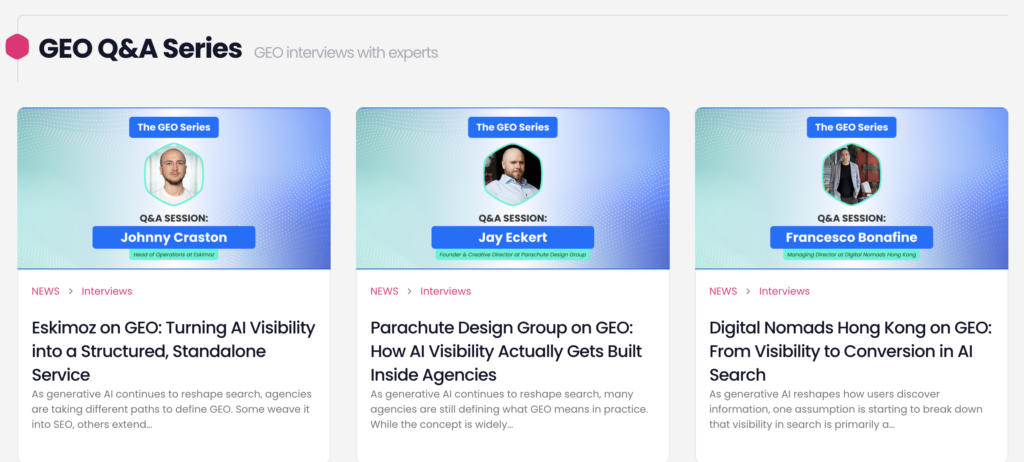
According to Arunya Joshi, SEO manager at Crowd(a specialized GEO agency in the UK), unlike traditional search engines, generative AI does not retrieve and rank results in isolation. It draws from multiple sources at once, identifying overlap, consistency, and reliability before forming a response.
The team at Crowd also articulates one of the field’s central measurement challenges, the disconnect between AI presence and trackable outcomes: defining and communicating GEO performance in a meaningful way remains the key challenge, as visibility in generative environments does not always translate into traffic. A brand can appear repeatedly within answers, influence perception, and shape decision-making without generating a click.
Another agency, Eskimoz, stands out as one of the agencies treating GEO as a serious, structured growth offering. Their infrastructure tracks visibility across platforms such as ChatGPT, Perplexity, Gemini, and AI Overviews, showing a clear commitment to measuring AI search performance directly.
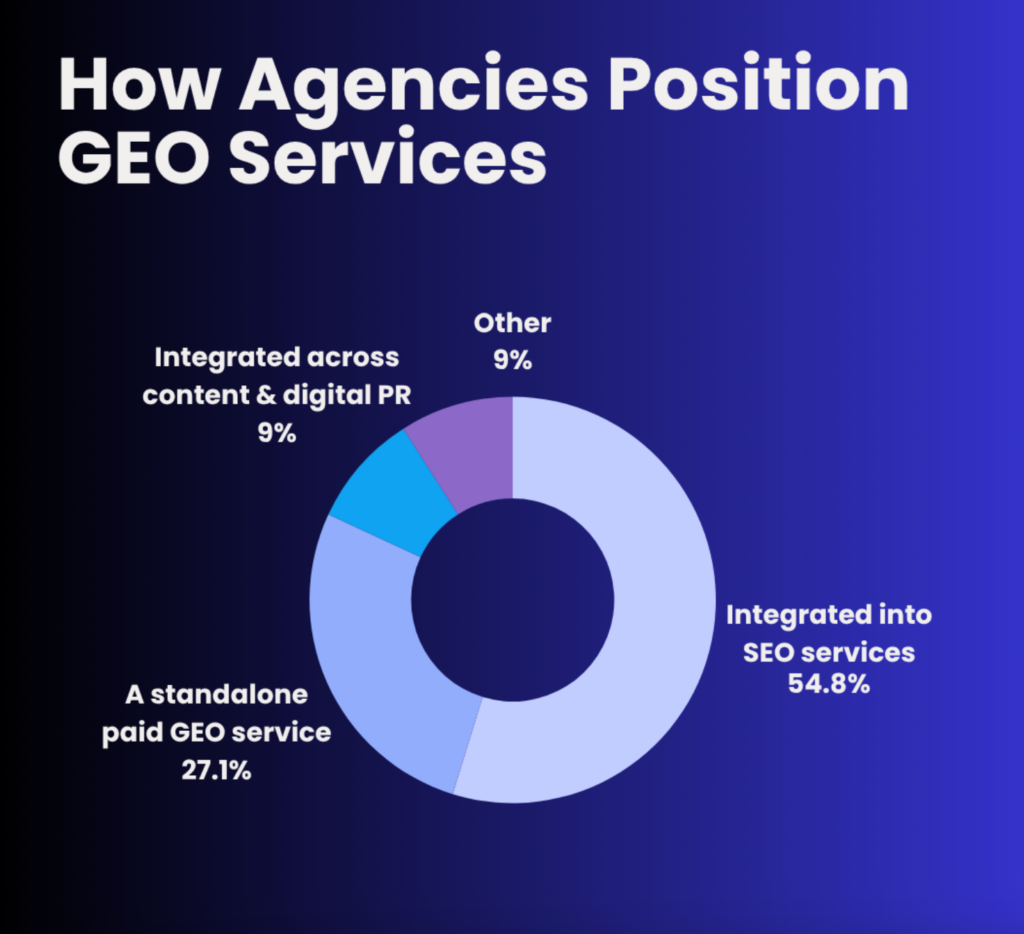
This positioning is especially notable in a market where most agencies still fold GEO into broader SEO retainers: according to the data, 54.8% integrate GEO into SEO services, while only 27.1% offer it as a standalone paid GEO service. Another 9% integrate it across content and digital PR, and 9% fall into other models.
On the other hand, Amsive positioned as a full-service performance marketing agency with deep technical SEO and data science roots, has brought measurement rigor to an area where most agencies are still guessing.
Sarah Gray, their SVP of Marketing, explains that AI engines and traditional search both serve as information retrieval systems, but they function differently in practice.
AI prioritizes context first, then curates the most relevant answer. This distinction is subtle, but important.
According to Amsive’s insights, 56% of sites saw higher conversions from AI-driven sessions, with high-traffic sites converting at 7.05% compared to 5.81% for organic, a conversion quality differential that changes the ROI case for GEO investment entirely.
Canada-based GEO agency, Parachute Design Group offered a useful look at what AEO implementation actually requires inside agencies that were not originally designed around AI visibility.
For Parachute, the real challenge was structural: content, technical SEO, digital PR, and analytics all had to align around shared workflows, tools, and KPIs that simply were not in place before.
That perspective closely matches the broader agency landscape shown in the data. GEO ownership is rarely concentrated in one specialist role alone. While 33.3% of agencies place ownership with SEO leads, another 33.3% manage it through cross-functional ownership, showing just how collaborative the discipline has become.
The remaining models are split across technical SEO specialists (11.1%), content strategists (11.1%), and growth and analytics teams (11.1%). Parachute’s approach reflects this reality: before scaling GEO for clients, the agency focused on building repeatable internal workflows and measurable reporting systems that could support cross-team execution in a consistent way.
Brick Marketing (a GEO agency in the USA) brought one of the clearest reality checks to the GEO conversation in its DAN interview: the biggest challenge is still the data. The agency framed the issue plainly as the challenge of making AI visibility work without perfect data.
However, Nick Stamoulis, President of Brick Marketing, sees GEO becoming:
The invisible layer powering all search decisions.
According to the data from the interview, 46% of agencies see limited transparency from AI platforms as the biggest limitation in current GEO tools, while 27% point to limited or unreliable AI citation tracking. The remaining concerns are spread across a lack of standardized GEO metrics (9%), poor reporting and storytelling for clients (9%), and other issues such as unreliable visibility tracking (9%).
Generative Engine Optimization Statistics by Industry
The impact of GEO is not uniform across industries.
GEO Statistics for eCommerce
eCommerce is the vertical where the raw traffic numbers are most dramatic.
AI-driven traffic to U.S. retail websites grew 693% year-over-year during the 2025 holiday season, according to Adobe Analytics, tracking over 1 trillion visits. That traffic also converts significantly better: AI-referred shoppers convert 31% higher and have 27% lower bounce rates compared to other organic sources. The scale of AI-influenced commerce is becoming undeniable. Generative AI and AI agents drove an estimated $262 billion in global retail revenue during the 2025 holiday season, roughly 20% of total sales, according to SalesForce. Consumer openness is also accelerating: 71% of consumers want generative AI built into their shopping experience, and 84% of e-commerce businesses now rank AI as their top strategic priority. Yet trust remains a ceiling. Only 14% of consumers trust AI for autonomous purchasing, even as 73% use AI in shopping journeys. 89% of consumers double-check AI-provided product information before buying.This means GEO for eCommerce is about appearing accurately and authoritatively enough to survive that verification step.
By 2028, approximately33% of online retailers will use advanced AI agents, potentially influencing $385 billion in U.S. e-commerce, according to Morgan Stanley estimates.
GEO Statistics for SaaS and B2B
In the SaaS and B2B space, GEO has become the most critical top-of-funnel channel for a simple reason: B2B buyers now open ChatGPT or Perplexity before they open Google.
The data confirms this behavioral shift: B2B SaaS sites saw AI search grow to approximately 4.5% of organic traffic by September 2025, with 127% growth in just three months. 89% of B2B buyers now consider AI search a top source throughout the buying process.GEO Statistics for Content Marketing
Content marketing sits at the direct intersection of GEO and organic search, and 2026 is the year the collision has become undeniable.
AI-referred sessions jumped 527% year-over-year in the first five months of 2025, according to Previsible’s 2025 AI Traffic Report. Comparison articles lead all content types with 32.5% of AI citations, followed by opinion pieces at 10%. Research shows that best-of content, product pages, and guides drive the most AI referral traffic. Content with specific statistics, expert quotes, and clear sources gets cited more frequently. And perhaps most counterintuitive: 91.4% of content cited in AI Overviews is at least partially AI-assisted. Content freshness is now a ranking-adjacent signal. 50% of content cited in AI answers is less than 13 weeks old, meaning content decay is an active GEO risk. Content teams that refresh cornerstone articles with updated data and a visible “Last Updated” timestamp consistently outperform static evergreen content for time-sensitive queries. For content marketers specifically, the channel disruption is structural. Organic search traffic has fallen by an estimated 15–35% since the widespread appearance of generative AI. Yet impressions increased 49% following the launch of Google AI Overviews. That means content is being read inside AI answers at scale, but not being clicked. The strategy must shift from pure traffic volume toward quality, AI citation share, and assisted conversion.Social media marketers should pay attention to GEO because search behavior is already spreading beyond Google.
Adobe found that 49% of consumers use TikTok as a search engine, and 14% say they are more likely to rely on ChatGPT than Google as a search engine. In the same study, 38% of business owners use TikTok influencers for product sales or promotions. Despite high volume, Twitter/X currently has the lowest visibility in Google AI Overviews compared to Reddit and LinkedIn. What about searching behaviors? 41% of Gen Z now use social media as their first point of search, bypassing Google entirely. 51% of users cite TikTok short-form video as the top influencer for their purchasing decisions, making its metadata a goldmine for AI engines like Perplexity and ChatGPT.What Comes Next
The click era is ending as users who never consciously decided to stop clicking simply find themselves preferring to ask.
GEO is the discipline that allows brands to be present in those answers, to have their expertise cited, their products recommended, and their authority recognized by the AI systems that are increasingly mediating the relationship between information and action.
The generative engine optimization statistics of 2026 confirm that this is no longer a future scenario:
The brands and agencies that have built GEO into their strategy are earning visibility that their competitors cannot buy, rank for, or replicate through traditional means. The ones waiting are ceding ground to the question their AI is already answering for someone else.The search bar still exists. But the answer is already somewhere else.











![Assessing the Winners of the Super Bowl Ad Blitz [Infographic]](https://imgproxy.divecdn.com/kzzGkWf5O2q5NPX8no-8ErGd5bFiXZjPZlEp8PIZVsw/g:ce/rs:fit:770:435/Z3M6Ly9kaXZlc2l0ZS1zdG9yYWdlL2RpdmVpbWFnZS9zZW1ydXNoX3N1cGVyX2Jvd2xfMjAyNTIucG5n.webp)