Hanshan and Shide
A modern retelling of a classic Zen legend The post Hanshan and Shide appeared first on Tricycle: The Buddhist Review.
 AbJimroe
It was during the Zhenguan era of the Tang dynasty, they say, so in the West the early 7th century and in Japan about the time what are called era names were about to be made. There was, I’m told, a government official called Lu Qiuyin. Some say, though, there likely was no such person. Why, Lu is said to have become Chief Censor of Taizhou, but his biography doesn’t appear in the Tang Book, new or old. The chief censor is the same as the supreme administrator of zhou (“state”) and the supreme administrator of jun (“county”). The entire land of China was divided into dao (“region”), each dao divided into zhou or jun, and each of these divided into xian (“prefecture”), each xian into xiang (“districts”), and each xiang into li (“villages”). The head of a zhou was called cishi, that of jun, taishou. That in Japan calling what’s smaller than xian (“ken”) jun (“gun”) is improper, Mr. Yoshida Tōgo complains. If Lu was Chief Censor of Taizhou, he was an official comparable to Japan’s prefectural governor and as such must appear in the Tang Dynasty Biographies. But without Lu this story won’t go very far, so we assume that he did exist.
Now, it was the third day after Lu came and took office in Taizhou. In Chang’an he had been covered by the dust of North China while drinking muddy water, but now in Taizhou he trod on the fertile land of Central China and drank clear water, so he was in an excellent mood. In addition, for the last three days a great many lower officials had come for an audience with him. Each reported, as a matter of formality, on the business he was charged with. In the midst of all this bustle, he savored a local administrator’s great power, and he was exhilarated.
On the previous day he had told a subordinate that he would get up early in the morning and depart for the Guoqing Temple in Tiantai Prefecture. While in Chang’an he had decided to do this as soon as he arrived in Taizhou.
For what business did he want to go to the Guoqing Temple? There was a reason for that. When he was appointed Chief Censor in Chang’an and was about to leave for the assigned place, Lu was unexpectedly stricken with an unbearable headache. It was a simple rheumatic headache, but Lu was a nervous sort under the best of circumstances, so took the medicine prescribed by his usual doctor but he still couldn’t get rid of it. “Well, we might have to postpone the day of our departure,” he wondered to his wife, when a maid came in and said, “Sir, there’s a beggar bonze at the front gate and he says he wants to see the master of this house. What shall I tell him, sir?”
“Hmm, a bonze you say,” Lu replied. He thought awhile. “I don’t know, but I’ll see him. Let him in.” Then he made his wife leave the room.
For the higher civil service examinations Lu had only read the Confucian classics and learned to compose five-character-aline quatrains, but he had never read Buddhist sutras or studied Laozi. Yet, for some reason he had respect for people like Buddhist priests and Daoists. Shall we call it the blind respect for something one doesn’t comprehend? And so he said he’d see the bonze.
The man who soon came in was a tall monk. He wore a dirty, tattered robe, and his hair was long, cut only above his eyes. It appeared he had let his hair go until it grew down over his eyes and annoyed him. He held an iron bowl in his hand.
The monk stood wordless, so Lu asked, “I was told you wanted to see me. What can I do for you?”
The monk said, “I have heard you are going to Taizhou. I also hear you are suffering from a headache. I thought I might cure it for you, so came here.”
“You are quite right. Because of this headache I’m thinking of postponing the day of our departure. But how do you propose to cure it? Do you have some formula for me?”
“No. The diseases that trouble our body of the Four Elements are all illusions. Just this alms bowl of clean water will do. I’ll cure your headache with magic.”
“I see, you do magic,” said Lu, and after giving it a little thought, said, “That shouldn’t be any problem. All right, do some magic on me.” This was because he never gave deep consideration to the Way of Medicine and had no definite views on which treatment to take or which treatment to reject, basing his judgment on his own reasoning on each occasion. Because he was like that, even the doctor he usually called on wasn’t someone he had picked through careful selection. He had not sought out someone who read Basic Questions and Spiritual Axis, but decided on one who lived close by and was convenient to summon, and so he hadn’t expected to get any proper medicine. Now he decided to turn to a beggar bonze because the bonze somehow looked distinguished and his bearing made him trust him; also, he thought that magic with a bowl of water at its worst couldn’t do much harm. It’s just the same as high-ranking government officials in Tokyo relying on Safflower Treatment and the Shout Method.
Lu called a maid and told her to take the bowl and fill it with water fresh from the well. The water came. The monk received it, held it up to his chest, and stared at Lu. It could have been clean water or dirty water, hot water or tea. This time it wasn’t dirty, fortunately for Lu. While the monk stared at him for some time, Lu unconsciously focused on the bowl the monk held.
That moment the monk took a sip from the iron bowl and abruptly sprayed it onto Lu’s head.
Lu was astonished. Cold sweat rose on his back.
“Your headache?” asked the monk.
“Oh? It’s gone!” In fact, till then he’d been so concerned about his headache, the headache, that he couldn’t get rid of it, but now, distracted by the bonze’s water, he just let it slip away.
The monk quietly emptied the remaining water on the floor. No sooner had he said, “Now you will excuse me,” than he turned his back on Lu and started walking toward the door.
“Wait, wait a minute,” Lu called out.
The monk turned. “Something else, sir?”
“I’d like to give you something to express my gratitude.”
“No. I beg alms in order to bring blessings to all living things and to subjugate the arrogant, but I do not accept any fee for treatment.”
“I see. Then I won’t insist. May I ask where you are from?”
“Do you mean where I was last? I was at the Guoqing Temple in Tiantai.”
“I see. You were in Tiantai. What is your name, sir?”
“My name is Fenggan.”
“So you are Fenggan from Guoqing Temple in Tiantai.” As though making an effort to memorize it firmly, Lu knitted his brow. “I am just leaving for Taizhou and I feel very close to you. Let me ask you while we’re at it: Are there any great people in Taizhou I might benefit from meeting?”
“Let me see. Yes, there’s one in the Guoqing Temple whose name is Shide. He in truth is Samantabhadra. Then, to the west of the temple there is a rock cave called Cold Boulder, and in it lives one called Hanshan. He in truth is Manjushri. Now, I must be going.” The monk said this, and left quickly.
Because of these reasons, Lu was leaving for the Guoqing Temple in Tiantai.
On the whole, there are three types of attitude people take toward what’s called the Way or religion. Those absorbed in their professions, spending years and months worried how to get by each day, do not give any thought to the Way. The same is true of readers of books. Of course, if they read books and think deeply, they will not fail to attain the Way. But, even without such thinking, they may fulfill their daily duties. These are utterly indifferent people.
Next, there are people who carefully seek the Way. Some give up all for the Way; some do not neglect any of their daily duties while ceaselessly keeping the Way in mind. Whether they enter Confucianism, Daoism, Buddhism, or Christianity, it’s the same. When these people get involved deeply enough, their daily duties become the Way itself. In short, these are all seekers of the Way.
Midway between these indifferent people and seekers of the Way, there are those who objectively recognize the existence of the Way, who are not quite indifferent to it but not really willing to seek it for themselves, those who think they’re remote from it and have given up on it, but who think there is a separate category of people who are close to it and hold them in respect. Respect exists in any kind of person, but if we are simply to consider those who respect the same object, among the seekers of the Way, those who come behind respect those who are ahead, whereas those who come midway as I’m saying, they respect those whom they do not understand, those they can’t comprehend. There blind respect comes into being. And if your respect is blind, it will be utterly useless even if the object you direct it to happens to be right on target.
Lu changed his robes, got on a litter, and went out of his official residence in Taizhou. He had a retinue of sixty attendants.
It was early winter and there was a little frost. They proceeded north, making a detour along the left bank of the Shifengxi, a tributary of the Jiaojiang. The sky that was cloudy at first cleared at long last, and a pale sun shone on the maples along the bank. Old and young passers-by he came across on the road made way for his litter and knelt down. In the litter Lu was feeling very good. That he, a man in the job of governing local people, was now going to bring formal greetings to men of wisdom, seemed to him like some kind of exploit, and that gave him satisfaction.
It was about sixty li from Taizhou to Tiantaixian. In Japan it would be about six and a half ri. Since Lu had his litter bearers go slowly, it was way past noon when he met the officials from the xian who had come out to welcome him. After resting in the governor’s official residence, he learned over the feast offered that it was another sixty li from there to the Guoqing Temple, the road gradually growing steeper. It would be dark before they reached the place. So Lu decided to stay overnight in the governor’s official residence.
The next morning the governor saw him off. The weather that day was no different from that of the previous day. The proverbial “Tiantai of eighteen thousand zhang” seems a bit too high, no matter who surveyed it or when. Anyway, tigers inhabited the mountain. Unlike the previous day, the progress was slow. They had lunch on the way. It was when the sun was setting in the west that they reached the gate of the Guoqing Temple. It was a temple that Emperor Yang of Sui is said to have built after the death of the Great Teacher Zhiyi.
As the Chief Censor was visiting to pay his respects, the temple wasn’t negligent. A monk called Daoqiao came out to welcome Lu and led him to the guestroom. When the welcoming with tea and cakes was over, Lu asked, “You had a monk called Fenggan in your temple, did you not?”
Daoqiao replied. “You said Fenggan, sir? Yes, he was staying in a monastery behind the main hall until not long ago. But then he went off on pilgrimage and hasn’t returned.”
“What kinds of things did he do while in this temple?”
“Let’s see now. He husked rice for the monks.”
“He did? Wasn’t there something different from the other monks about him?”
“Yes. There certainly was. At first we regarded Fenggan simply as a kindly brother who would avoid no chore, but in time we began to treat him as someone special. But then one day he abruptly left.”
“Tell me what happened.”
“It was an utter mystery, sir. One day he came back from the mountain riding a tiger. And just as he was, he came right into the corridor on the tiger’s back, chanting poems while riding the tiger back and forth. He liked to chant poems very much, and at night he used to chant poems in the monastery in the back.”
“I see. He must be a living arhat. What’s happened to the monastery now?”
“It’s still empty, sir. Occasionally during the night a tiger comes there and roars.”
“I don’t want to trouble you, but would you please take me there?” Lu said, standing up.
Brushing aside the cobwebs with his hands, Daoqiao led the way and took Lu to the empty house Fenggan used. The sun had almost set. They looked around in the house. In the light that was faint, it was vacant, with nothing in it. Daoqiao stooped and pointed at the footprints of a tiger on the stone floor. At that moment a mountain wind happened to blow past outside the window, whirling up the fallen leaves piled up high in the garden. That sound broke the bleak silence noisily. Feeling as though the roots of his hair were suddenly tightened, Lu had goose flesh all over his body.
Lu hastened out of the empty house. And he said to Daoqiao who followed, “Is there a monk called Shide still in your temple?”
Daoqiao had a puzzled expression as he looked at Lu’s face.
“You know so much about us, sir. Only a little while ago, he was warming himself by the fire in the kitchen with a man called Hanshan. If you have something for him to do, shall I summon him, sir?”
“I see. So Hanshan, too, is here, in the kitchen. That is more than I had expected. While I’m troubling you like this, would you take me to the kitchen?”
“Yes, sir,” Daoqiao said, and walked west along the main hall.
Lu, following him, asked, “When did Mr. Shide come to live in this temple?”
“A long time ago I should think, sir. He’s a foundling Mr. Fenggan brought back from the pine woods.”
“I see. And what does he do in the temple?”
“I hear that in the three years since Fenggan brought him from the pine forest, they taught him to burn incense, light candles, offer food, and do other things for the statue in the main altar in the kitchen, so I’m told. But then I heard that one day he was found eating face to face with the statue after putting offerings on the altar. It appears that he did it because he didn’t know how much respect he should pay to Pindola Bharadvaja. Now we make him do the monks’ dishes in the kitchen.”
“You do,” Lu said and walked a few steps before he asked, “You also mentioned Hanshan. What kind of person is he?”
“Hanshan, you say. He lives west of this temple, in a stone cave we call Cold Rock. When Shide does the dishes he collects the remaining bits of rice and vegetables and stores them in a bamboo tube, which Hanshan comes to collect.”
“I see,” Lu said as he followed Daoqiao. If Hanshan and Shide who do such things were Manjushri and Samantabhadra, who could Fenggan riding a tiger be? he wondered, like a rustic fellow at a theater confused as to which actor is playing which role.
“I’m terribly sorry this is really a messy place, sir,” said Daoqiao as he led Lu into the kitchen.
The kitchen was filled with steam, so for Lu who had just stepped in it was almost impossible to see things clearly. In that grayness he saw three large ovens in all with wood still burning red. As he stood there awhile watching, he began to see a host of monks moving rice, vegetables, and soup from pots and kettles to the table built into the rock walls.
Daoqiao looked far into the room and called out, “Hey, Shide!”
As Lu followed his eyes, he saw before the farthest oven from the entrance two monks squatting, warming themselves.
One of them was bare-headed with his hair a few inches long, his feet in straw sandals. The other wore a hat of bark, his feet in wooden clogs. Both were skinny, shabby, small men, unlike Fenggan, who was quite big.
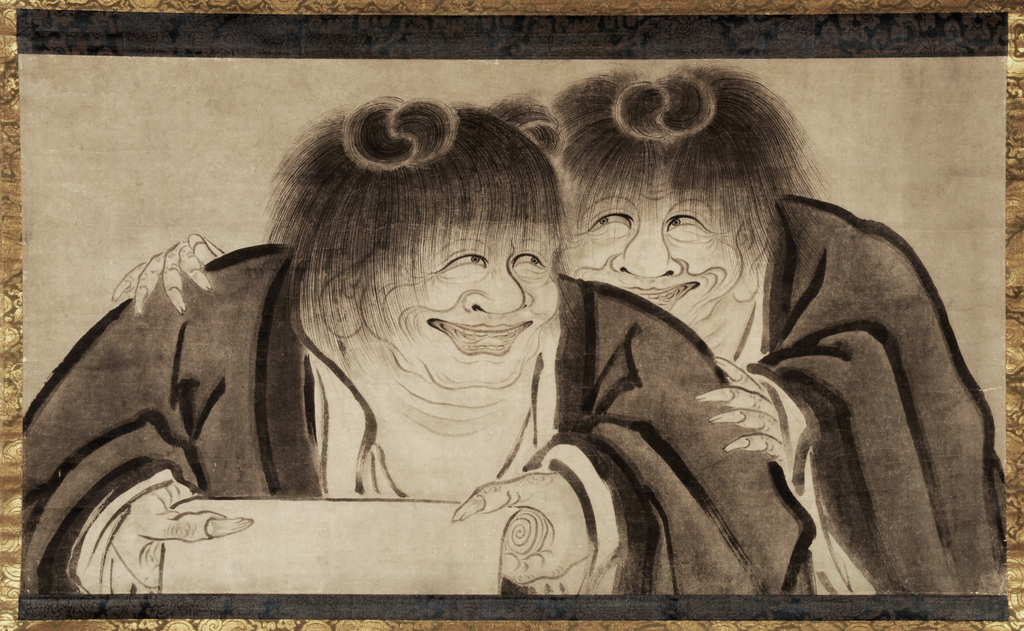
When Daoqiao called out, the bare-headed one turned his head and grinned, but did not reply. That appeared to be Shide. The one with a hat on didn’t even budge. That must be Hanshan.
Or so Lu guessed as he walked up to them. He formally held his sleeves inward, reverentially bowed, and introduced himself, “I am Lord Steward of the Imperial Council, Provincial Commander-in-Chief, Chief Censor of Taizhou, Army Chief of Staff, with Emperor-bestowed Scarlet Robe and Fish Tally, and I humbly call myself Lu Qiuyin.”
Shide and Hanshan simultaneously glanced at Lu. Then the two looked at each other, uttered laughter that could only have welled up from the pit of their stomachs, rose to their feet, and ran out of the kitchen. As they ran, Lu heard Hanshan say, “Fenggan prattled!”
The monks gathered around Lu, who was startled as he stared in the direction they had disappeared, to distribute rice, vegetables, and soup. Daoqiao stood where he was, deathly pale.
♦
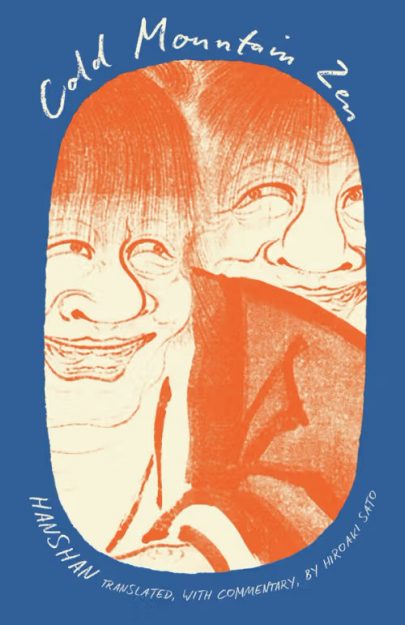
“Hanshan and Shide: A Story by Mori Ōgai,” translated by Hiroaki Sato from Cold Mountain Zen, copyright © 2026 by Hiroaki Sato. Reprinted by permission of New Directions Publishing Corp.