Lessons from a (Mostly) Good Dog: #10, Be Free
A writer and Zen practitioner offers some canine insight on how we might learn to be less inhibited. The post Lessons from a (Mostly) Good Dog: #10, Be Free appeared first on Tricycle: The Buddhist Review.
 Tekef
Tekef
“There is an expression in Japanese, ‘Without a rope, people bind themselves.’ You do not think you are completely free, so you practice trying to liberate yourself. But what is binding you? Look around you. Nothing is binding you, and yet you cannot see it. You feel as if you are bound by something. Buddha calls this delusion. Your mind is not in the right place.”
—Taizan Maezumi Roshi, Appreciate Your Life
I struggle sometimes with the idea that our dogs are not free—that we shackle them with collars and leashes and try to make them do what we want. (Of course, this does not always work out for us—some canines, my own mostly good dog Brooklyn very much included, are very willful little creatures, and do what they want to do when they want to do it. If that happens to line up with what you want them to do: fine. If not: good luck.)
Anyway, my wife, Lizzy, has reminded me not to feel too bad about the whole thing. After all, without any guidance or restriction from us, Brooklyn as a puppy, prowling the streets of Brooklyn, New York, would have snarfled up all sorts of nasty, potentially poisonous stuff from off the pavement, or bolted across the street after a squirrel and gotten hit by a car, or growled at a bigger dog and gotten mauled, or whatever. The point is, on one level, it’s for their own good we keep them on a short leash. Or at least that’s what we tell ourselves.
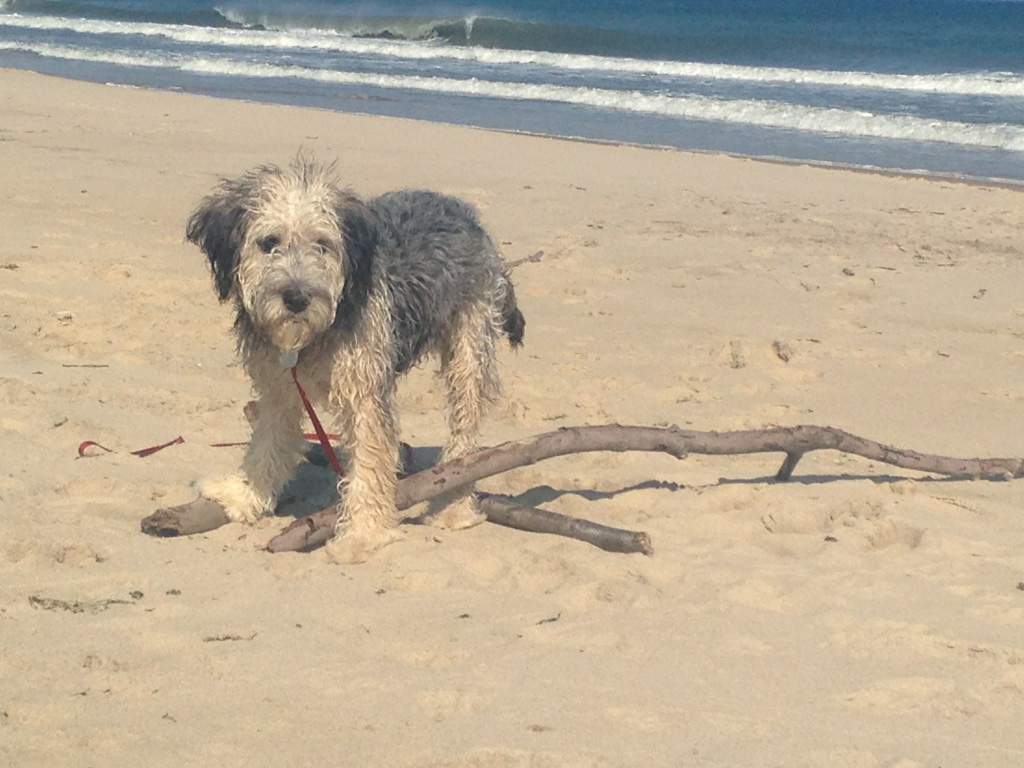
Actually, Brooklyn was born (and named Brooklyn) in South Carolina, where she started out as a little street urchin with a bunch of other ragamuffin sisters and brothers, and who knows what kind of life she would have had there without human interference—you know, if she’d just been left to be free. Maybe she simply would have withered away, unfed and unloved. But my guess is she would have survived, somehow. She has always been a bit of a scrapper, after all, and she would have likely more than held her own out there in the semiwilds—wandering the dusty streets with her little pack, nosing around in garbage, eating roadkill, catching the occasional squirrel, lapping up water from muddy puddles, wagging her tail at random kindhearted humans to get pet a bit and be gifted a morsel of chicken. No doubt she would not have presented as quite the same fluffy, well-groomed dog—I imagine her scarred and bloodied from her occasional battles with raccoons and bobcats, and her fur, uncut, uncombed, would have become thick and matted and dark with mud and muck. Oh, it may not have been the most glamorous life, but it would have been her life, nonetheless. She would have known no collar nor leash. She would have had her brothers and sisters. And eventually, she would have had puppies, a litter of little stinkers upon whom she could have poured her enormous love that I and my family are so lucky to have had bestowed upon us.
I do not mean to suggest that the whole dog rescue culture is a thing of cruelty—or that it is not necessary—for it isn’t, and it is. But I think it’s important to recognize what has been taken away from these dogs we love so much when we rescue them: in part, freedom, yes, but more than that, their mom, their brothers and sisters, family—and when we neuter them, the future of a family too. Is the life we end up giving them a “better” one? Yes, undoubtedly. But then also, in other ways, maybe not. Would she have preferred a free life, even if it came with none of the conveniences she enjoys now? These are difficult questions. And I am not, I don’t think, proposing we just let dogs roam free, that they not be neutered, that we just let them be. It would be a mess. It already is. But I do think these are questions worth asking.
Here’s the thing, though, that I’m really curious about: Even with all the leashes and collars and restrictions we place upon our dogs—eat this, don’t eat that, stop barking, get down from the couch, be nice to the mailman—dogs still somehow manage to be free in a way that’s truly enviable. I look at Brooklyn—happy, at ease, fully herself, her spirit vibrant and unhindered, and I cannot help but wonder: How does she do it?
And how might we?
*
As an American, I am, for all intents and purposes, free. (Apparently, we’ve been “free” for some 250 years now, though that figure is, of course, highly suspect for any American who’s not also a white male). Thankfully, I’m not here to pontificate on our scarred history but to ask a simpler yet more unanswerable question: If I am so free, why do I not always feel that way?
Too often, the way I really feel is constricted, somehow. My shoulders are tense, my jaw too. I’m all knotted up, inside and out—bound, as if some invisible rope has wound itself too tight around my heart, my spirit, my lungs. Sometimes it’s like I can’t even breathe.
What is this? Is this feeling of being bound, as Maezumi Roshi suggested, just a delusion? Are we actually free and just think we aren’t? Or is there something real binding me, imprisoning me, holding me back? And really, in the end, what’s the difference between that and thinking it, anyway? Or, to put it most plainly: How on earth do you free yourself when the deepest spiritual truth is that you are already free?
*
I don’t think my dog struggles with all this stuff, which may be part of the answer. Brooklyn may have a collar—peach and pink, with a little silver name tag with a paw print on it—but I don’t think she resents it. (She does, however, appreciate it when we remove it to give her a good scratch on that neglected part of her neck.) But there is not, I don’t think, this kind of yearning in her for something else—at least, not the way there is in me. I don’t think she feels bound, even though she literally sometimes is. This makes me wonder if freedom is less about the external than it is the internal–not so much a matter of the world around you but of the one within yourself. I think of the famous story of the Tibetan monk, Palden Gyatso, trapped in a Chinese prison for thirty-three years, who claimed his greatest fear was losing compassion for his torturers—which, in a sense, made him so much freer than his captors had ever been, even though he was the one imprisoned.
And so maybe true freedom isn’t about the circumstances that confine us—which, after all, we have so little control over—but about what we do within those confines. How we express ourselves within the space we are given. Brooklyn, for instance: Even with all those restrictions—collar, leash, admonishment, etc.—she finds a way to be herself. She finds a way to be at ease in her life. She finds a way to be free. She barks, shrilly, in the backyard, seeking out other neighborhood dogs who will bark back, until she makes such a racket that we have to bribe her back inside with offerings of chicken. (Sometimes not even the bribes work, and she’ll decide she’d rather be out there a little longer and howl some more: freedom.) When we go for walks, she leads the way, her tail high and with a wag—and if we try to go one way and she doesn’t want to, she resists, plants her paws in the ground and stays put, until we find a way to convince her to move or we relent and follow her lead. (Sometimes you’ll see this minidrama come to a head on city streets—a dog who refuses to go farther being dragged along the pavement on their belly—a classic vision of civil disobedience, and of what freedom, at least in part, really means: choice.)
Anyway, Brooklyn wags her tail when she feels like it, and she mopes when she feels like it too. She takes naps when she wants, and late at night, when I’m falling asleep on the couch in front of the TV, she’ll whine at me until I carry her upstairs to bed, where she’ll curl up at our feet and snore contentedly, making it difficult to stretch out. And when she gets the zoomies and tears around the backyard, she is like a great stallion, free as the sky, the thunder of her hooves, the wind in her fur. When she’s done running, she lies down in the grass, panting contentedly, nowhere else in the world she’d rather be.
This is, I think, the key difference between a dog like Brooklyn and a human like me. She feels free even though she is bound. I feel bound even though I am free. Helplessly, I long for more. There is this ache in me, this angst. Something else, something more. Then I will be free. That old, sick human whisper. Meanwhile, in Brooklyn, there is no whisper, no knots. Her ears hear only the wind in the trees, the distant bark of another dog. Her limbs are long and loose and at ease.
As Maezumi says, my mind is not in the right place. I think freedom is to be found in some other life. Brooklyn’s mind, on the other hand, is in exactly the right place—it inhabits, freely, the exact world in which it abides.
So this may be all good and true, but the question remains: What do we do about it? Is this yet another example of dogs being enlightened while we humans just stand there, stupidly suffering, at the gateless gate? Actually, yes, that’s exactly what it is. Unbound, we stand freely before an open door. All we have to do is walk on through. But how?
I don’t know. If I knew, I would have done it already. Instead, I’m still standing here. But there’s a koan about a goose that I’ve always loved—in fact, it was my father’s favorite—that I think might offer a solid hint.
Question: How do you get the live goose out of the bottle?
Answer: There! It’s out!