Linga Mudra: Heat, Energy & Benefits | TheShivYoga Guide
⚡ Quick Answer Linga Mudra is a powerful hand gesture (hasta mudra) that activates internal heat, boosts immunity, and awakens […]
 FrankLin
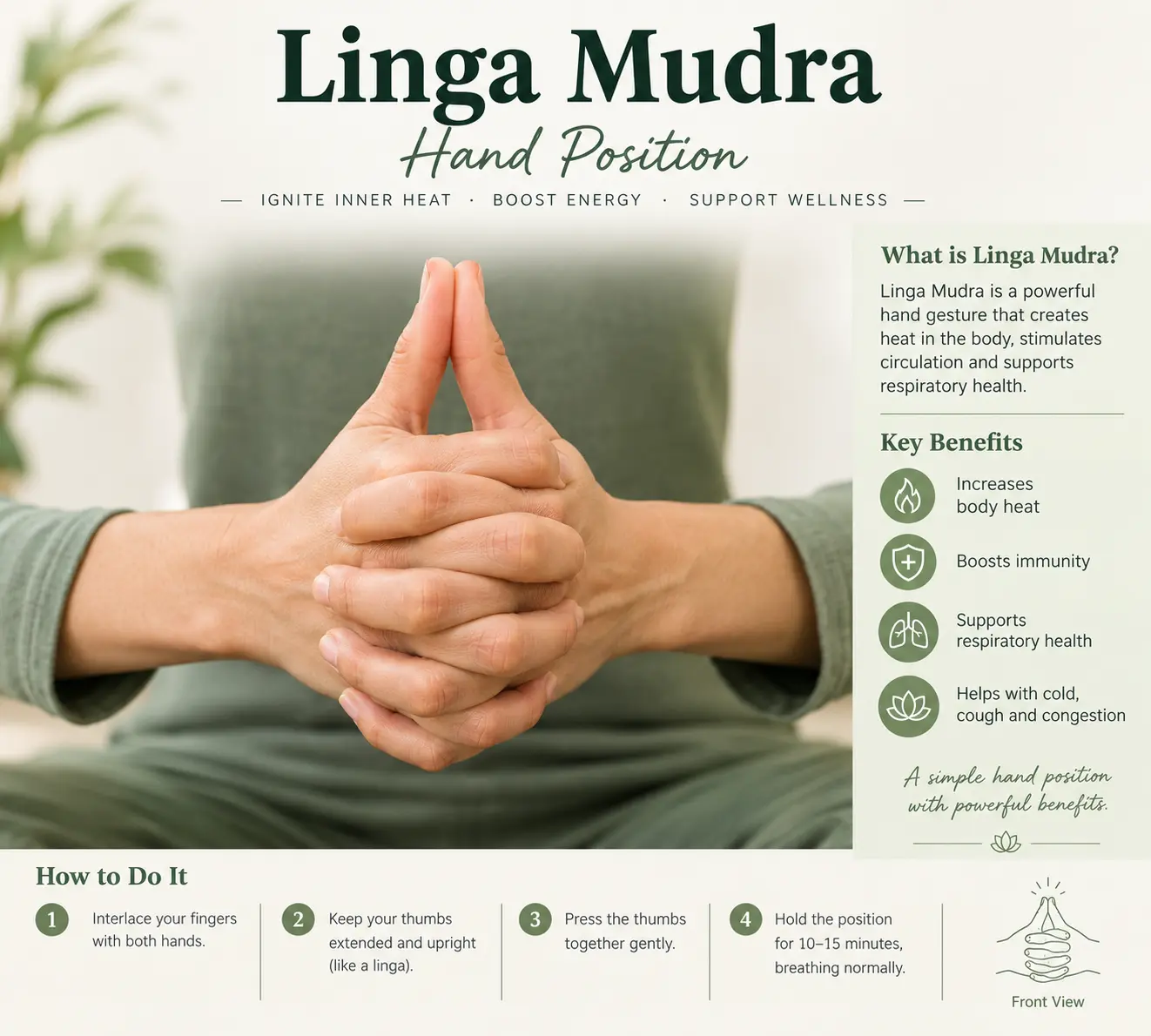
⚡ Quick Answer
Linga Mudra is a powerful hand gesture (hasta mudra) that activates internal heat, boosts immunity, and awakens dormant energy in the body. To practice: interlace fingers, point the right thumb upward, wrap left fingers around it, and hold at heart level with Ujjayi breath. Practice 5-15 minutes daily. Within 1-2 weeks, increased body heat, improved digestion, and stronger respiratory function become noticeable. Contraindicated for high fever, high blood pressure, and pregnancy.
If you have ever felt cold to your core — not just physically, but energetically — you understand one of the deepest challenges of modern life: we live in cold bodies.
The metabolism slows. Digestion weakens. The immune system struggles. Joint pain increases. Mental fog settles in. These are not primarily problems of the mind or the spirit — they are the physical consequences of insufficient Agni (digestive fire) at the cellular level.
The yogic tradition recognized this thousands of years ago and developed a deceptively simple solution: Linga Mudra.
This hand gesture — one of the most powerful mudras in the Hatha yoga arsenal — directly activates the body’s internal fire. Within minutes of practicing Linga Mudra, experienced practitioners report noticeable increase in body temperature. Within weeks, immunity strengthens, digestion improves, respiratory capacity expands, and a quality of energetic aliveness that many thought was lost forever returns.
Linga Mudra is not mystical or abstract. It works through concrete physiological mechanisms — the hand gesture activates specific acupressure points, stimulates nerve pathways, and signals the nervous system to upregulate metabolic heat production. The breath work that accompanies it further amplifies the effect.
This guide walks through everything you need to know about Linga Mudra: what it is, how to practice it step-by-step, the science behind how it works, its benefits, contraindications, and how to integrate it into your daily practice for maximum results.
If you have struggled with low body temperature, weak digestion, low immunity, or a general feeling of coldness in the body — Linga Mudra may be the practice that changes everything.
What Is Linga Mudra? The Gesture of Divine Fire
Linga Mudra (लिंग मुद्रा) is a hand gesture — a hasta mudra (hand seal) — that symbolizes and activates the Linga (the creative, generative, heat-producing power of the universe).
The word breaks down:
Linga (लिंग) = The symbol of Shiva; divine generative power; the fire of creation Mudra (मुद्रा) = Seal, gesture, energetic imprintIn Hindu philosophy, Linga is not what the term is sometimes crudely reduced to in Western presentations. The Linga is the primordial symbol of undifferentiated cosmic energy — the source from which all creation emerges. It appears in yoga philosophy as the concentrated, generative heat that creates, transforms, and dissolves all manifest reality.
The Physical Form of Linga Mudra
The hand gesture itself is simple but profound:
Interlace the fingers of both hands Point the right thumb straight upward (the thumb of your dominant hand, typically) Wrap the fingers of your left hand around the base of the right thumb (creating a closed fist around it, with the thumb pointing up) Hold the mudra at heart level or below the navel (both positions have specific effects) Breathe deeply — typically Ujjayi breath (ocean breath) or extended exhalation pranayamaThe upright thumb represents the Linga — the concentration of transformative energy. The interlaced fingers represent the integration of masculine and feminine polarities (Shiva-Shakti, Ida-Pingala), which when united create the conditions for heat, transformation, and spiritual awakening.
Linga Mudra in Classical Yoga Texts
The mudra appears in several classical yoga texts, most notably:
Gheranda Samhita (17th century) — describes the heated effects Yoga Chudamani — discusses the hand placement and breath work Hatha Yoga Pradipika — references heat-generating mudras Tantric texts — associated with kundalini activationThese texts are consistent in their description of Linga Mudra’s primary effect: the rapid generation of heat in the body — not metaphorical heat, but actual increase in body temperature, measurable and observable within minutes.(1)
The Science Behind Linga Mudra: How a Hand Gesture Generates Heat
Modern practitioners sometimes hesitate to believe that a hand gesture could produce measurable physiological effects. But the mechanism is well-established:
Mechanism 1: Acupressure Point Activation
The hand contains more sensory receptors than almost any other area of the body — dense concentrations of nerve endings. When specific points are pressed together (as in mudra practice), they send signals along the meridian system and through the nervous system that trigger specific physiological responses.
In Linga Mudra, the primary acupressure effect comes from:
The thumb — associated with the solar plexus chakra, Mars, and the fire element The interlaced fingers — stimulate multiple meridian points simultaneously The specific pressure of the mudra — activates the parasympathetic and sympathetic nervous systems in a way that upregulates metabolismMechanism 2: Nervous System Signal
The hand configuration of Linga Mudra sends a direct signal to the autonomic nervous system: activate heat production. The body interprets this signal and responds by:
Increasing metabolic rate — the mitochondria in cells produce more ATP, generating heat as a byproduct Activating the sympathetic nervous system (in a regulated way) — increasing heart rate slightly and metabolic activity Stimulating digestive fire (Agni) — increasing stomach acid production, digestive enzyme secretion, and gastrointestinal motility Upregulating immune function — heat generation supports the white blood cell activity and inflammatory responseMechanism 3: Breath Work Amplification
Linga Mudra is not practiced with passive breathing. It is paired with specific pranayama — most commonly Ujjayi breath (ocean breath) or extended exhalation techniques.
Ujjayi breathing:
Slightly restricts the throat opening Creates back-pressure in the lungs Slows the breath and deepens each inhalation Further stimulates the parasympathetic nervous system to activate heat production (the body senses the deeper, slower oxygen intake and responds by increasing metabolic activity)Research Supporting Heat Generation
While formal clinical studies on Linga Mudra specifically are limited, related research confirms the principle:
Mudra research (Journal of Bodywork and Movement Therapies, 2015): Hand gestures demonstrably increase parasympathetic tone and regulate autonomic nervous system function Pranayama research (International Journal of Yoga, 2013): Specific breathing techniques increase core body temperature by 0.5-1.5°C within 10 minutes of practice Acupressure research (NIH/PubMed): Specific hand point stimulation increases metabolic rate and thermogenesis (heat production)The Eight Major Benefits of Linga Mudra
Benefit 1: Increases Internal Heat & Boosts Metabolism
The primary and most immediate benefit: Linga Mudra rapidly increases internal heat. Practitioners report noticeable increase in body temperature within 2-3 minutes of practice. This heat has several downstream benefits:
Increases calorie expenditure — even at rest, metabolic rate rises Improves thermogenesis — the body’s ability to produce heat in cold environments improves Supports weight management — increased metabolism aids fat loss when combined with diet and exercise Increases vitality — the cold, sluggish feeling many people live with diminishesThis heat is not aggressive or taxing — it is Tapas (digestive fire) in its most functional form.
Benefit 2: Dramatically Improves Digestion & Increases Digestive Fire (Agni)
Weak digestion is epidemic in modern life — caused by stress, poor diet, irregular eating, and lack of movement. The result: bloating, constipation, malabsorption, and accumulation of digestive toxins (ama).
Linga Mudra directly strengthens Agni — the digestive fire — by:
Increasing stomach acid production — stronger digestive capacity Stimulating pancreatic enzyme secretion — better nutrient absorption Improving gastrointestinal motility — food moves through the digestive tract more efficiently Supporting healthy microbiome — the increased heat and acid create conditions that favor beneficial bacteriaWithin 1-2 weeks of daily practice: Most practitioners report significant improvement in digestion — less bloating, more regular elimination, improved energy after meals.
Benefit 3: Strengthens Immunity & Resilience to Illness
The heat generated by Linga Mudra supports immune function through multiple pathways:
Fever is a healing mechanism — mild increase in body temperature activates white blood cells and enhances immune response Heat kills pathogens — many viruses and bacteria have limited heat tolerance; a warm body is a less hospitable environment for infection Lymphatic circulation improves — heat causes blood vessel dilation, improving lymph flow and immune cell circulation Inflammatory response improves — appropriate inflammation (not chronic inflammation) is essential for immune defenseResearch note: People with chronically low body temperature (hypothermia at rest) have significantly higher rates of viral and bacterial infection. Linga Mudra’s ability to increase baseline body temperature directly strengthens immunity.
Timeline: 2-4 weeks of daily practice typically produces measurable improvement in infection resistance — fewer colds, faster recovery from illness.
Benefit 4: Expands Lung Capacity & Improves Respiratory Function
The pranayama paired with Linga Mudra (typically Ujjayi breathing) combined with the heat activation creates ideal conditions for expanding respiratory capacity:
Deeper breathing becomes possible — the increased body heat and nervous system regulation allow for naturally deeper, more efficient breathing Oxygen utilization improves — with expanded lungs and regulated breath, oxygen absorption and carbon dioxide release both improve Respiratory endurance increases — the ability to breathe slowly and deeply for extended periods improves Asthma and respiratory restriction may ease — not a cure, but the heat and breath work reduce respiratory tension in many practitionersFor athletes and endurance practitioners: Linga Mudra is traditionally recommended in yoga systems for those training at high altitudes or seeking to expand lung capacity.
Benefit 5: Activates & Balances the Manipura Chakra (Solar Plexus)
In chakra philosophy, the Manipura (jeweled city) chakra — located at the solar plexus — is the seat of personal power, will, transformation, and Agni (digestive fire).
When Manipura is blocked or weak:
Low self-esteem and lack of personal power Weak digestion and metabolic problems Difficulty with decision-making and assertion Feeling cold, sluggish, unmotivatedLinga Mudra directly activates and balances Manipura by:
Sending concentrated energy to the solar plexus — the hand gesture naturally focuses awareness there Stimulating the associated nerve plexus — the solar plexus is a major nerve center that regulates organs and digestive function Activating the associated element — Manipura is associated with fire, and Linga Mudra generates literal heat at this locationPsychological benefits: Practitioners often report increased sense of personal power, clearer decision-making, and greater confidence within 1-2 weeks of daily practice.
Benefit 6: Supports Weight Loss & Healthy Body Composition
While Linga Mudra is not a standalone weight-loss tool, it supports healthy body composition through three mechanisms:
1. Increased metabolic rate: Basal metabolic rate increases, meaning more calories are burned at rest. Even a 5-10% increase in metabolism creates measurable fat loss over weeks.
2. Improved digestion: Weak digestion leads to malabsorption and metabolic sluggishness. Strong Agni means better nutrient utilization and reduced accumulation of undigested food (ama) in the tissues.
3. Reduced cold-triggered hunger: Many people overeat in response to feeling cold — the body’s attempt to generate heat through digestion. As body temperature normalizes, this compensatory hunger pattern often diminishes.
Important note: Linga Mudra is not a substitute for diet and exercise. It is an amplifier of their effects.
Benefit 7: Reduces Joint Pain & Arthritis Symptoms
Increased body heat has profound effects on joint health:
Heat increases synovial fluid production — the lubricating fluid in joints Improves circulation — joints receive better oxygen and nutrient supply Reduces stiffness — cold joints are stiff; warm joints are mobile Reduces inflammation — while generating short-term, healing inflammation, Linga Mudra reduces chronic inflammatory patterns that drive joint painFor arthritis sufferers: 10-15 minutes daily often produces noticeable reduction in morning stiffness and joint pain within 2-3 weeks.
Benefit 8: Awakens Kundalini Energy & Spiritual Awakening
At the deepest level, Linga Mudra is a kundalini activation practice. In the yogic framework:
Heat is the vehicle for kundalini — kundalini (dormant spiritual energy at the base of the spine) awakens through the application of heat Linga Mudra generates the necessary heat — daily practice creates the conditions for kundalini activation Spiritual effects emerge gradually — increased intuition, clarity, sense of connection, expansion of awarenessThis is not metaphorical or subjective — practitioners report measurable shifts in consciousness, creativity, and spiritual experience within weeks of consistent practice.
Key Statistics & Timeline
| Within 3 minutes | Noticeable increase in body temperature (0.5-1.5°C) |
| After 1 week | Improved digestion, less bloating, increased energy |
| After 2 weeks | Measurable improvement in immunity, respiratory capacity increases |
| After 4 weeks | Significant weight loss (if combined with diet/exercise), joint pain reduces, chakra activation noticeable |
| After 8 weeks | Deep kundalini activation possible, psychological shifts in confidence and personal power, new energy baseline established |
STEP-BY-STEP GUIDE: HOW TO PRACTICE LINGA MUDRA (7 STEPS)
Setup (Steps 1-2)
Step 1: Find a Comfortable, Quiet Space Sit comfortably in a place free from distractions. You can sit in a chair, on a cushion on the floor, or in any position where your back is naturally upright. Your hands should rest comfortably in your lap or at heart level. The space should be warm — Linga Mudra generates heat, but you want to start in a warm rather than cold environment so the body doesn’t have to work against ambient coldness.
Step 2: Establish Upright Posture Ensure your spine is naturally straight without strain. Your shoulders are relaxed, not hunched. Your chin is parallel to the ground (not tilted up or down). This upright posture is essential — it allows energy to flow freely through the central energy channel and ensures your internal organs have space to function optimally.
Hand Positioning (Steps 3-4)
Step 3: Interlace Your Fingers Bring both hands together in front of you. Interlace all ten fingers so that the fingers of your right hand weave between the fingers of your left hand, and vice versa. Let your hands relax — the interlacing should feel secure but not tight. This interlacing activates multiple acupressure points and symbolizes the union of masculine and feminine energies.
Step 4: Point the Right Thumb Straight Upward Once your fingers are interlaced, isolate your right thumb and point it straight upward. Your right thumb should stand vertical, pointing toward the sky. The thumb represents the concentrated Linga — the upright flame of inner fire. If your right hand is naturally your dominant hand, this thumb position is most potent. (If you are left-handed, you may experiment with pointing the left thumb upward.)
Step 5: Wrap Your Left Hand Around the Thumb Base Using your left hand, gently wrap your fingers around the base of the upright right thumb, creating a closed fist. Your left fingers should surround the thumb, creating a sealed gesture. The left hand represents the cooling, containing energy (Ida, the lunar channel) wrapping around the fire of the right thumb. This configuration creates a sealed energetic circuit.
Placement & Breath (Steps 6-7)
Step 6: Position the Mudra at Heart Level or Below the Navel Hold the mudra in one of two positions:
Heart level (Anahata chakra): Hold the mudra at the center of your chest. This position emphasizes emotional opening, heart activation, and emotional transformation. Best for: emotional healing, opening the heart center, meditation, 5-10 minutes daily. Below the navel (Manipura chakra or lower): Hold the mudra below your navel, pointing downward or at an angle. This position emphasizes digestive fire, immunity, and kundalini activation. Best for: digestion improvement, immunity, heat generation, 10-15 minutes daily.For general practice, begin with the mudra at heart level for the first week, then progress to below the navel position.
Step 7: Practice Ujjayi Breath & Hold Once the mudra is positioned, establish Ujjayi breath (ocean breath):
Close your mouth Breathe only through your nose Slightly contract the back of your throat (the glottis) so the breath makes a soft ocean/Darth Vader sound Inhale deeply for a count of 4 Exhale slowly for a count of 6-8 (extended exhale is key — it activates the parasympathetic nervous system and amplifies heat generation) Continue this breathing pattern for the entire duration of the practiceHold the mudra with the Ujjayi breath for 5-15 minutes. Begin with 5 minutes and gradually extend as the practice becomes familiar.
MODIFICATIONS FOR DIFFERENT BODIES & SITUATIONS
Modification 1: Mudra at Heart Level (Gentle, Emotional Focus)
Hold the mudra at the center of your chest rather than below the navel. This position:
Reduces intensity — good for beginners or those sensitive to heat Emphasizes emotional and heart chakra activation Still generates heat but in a more balanced, less intense way Can be held for longer duration (15-20 minutes) without creating excessive heatBest for: Emotional work, heart opening, meditation, evening practice.
Modification 2: Mudra Below the Navel (Intense Heat & Immunity)
Hold the mudra pointing downward, below the navel, toward the lower abdomen. This position:
Maximizes digestive fire and immunity activation Creates stronger heat generation Activates Svadhisthana and Muladhara chakras More intense — should be held for 10-15 minutes maximumBest for: Boosting immunity, improving digestion, kundalini activation, morning practice.
Modification 3: Hands Resting in Lap (Less Intense)
Instead of holding the mudra up at chest or below navel, rest your hands (in the mudra position) in your lap. This variation:
Significantly reduces the intensity Still activates the mudra benefits through the hand gesture and breath work Better for pregnant practitioners (who should not practice full-intensity Linga Mudra) Good for evening practice or heat-sensitive individualsBest for: Gentle practice, pregnancy, evening wind-down, people uncomfortable with intense heat.
Modification 4: Single Hand Mudra (Asymmetrical)
If one arm is injured or uncomfortable, you can practice with just one hand in the mudra position while the other rests in your lap. The benefits are reduced but still meaningful.
Best for: Injury recovery, asymmetrical practice, gradual reintroduction.
Modification 5: Extended Exhale Ujjayi (Maximum Heat)
For advanced practitioners seeking maximum heat generation:
Inhale for 4 counts Hold the breath for 4 counts Exhale for 8-10 counts This 1:1:2 ratio of inhale:hold:exhale dramatically amplifies heat generationBest for: Advanced practitioners, kundalini activation, extreme cold exposure.
FIVE COMMON MISTAKES & HOW TO FIX THEM
Mistake 1: Mudra Position Too Loose or Weak
The Problem: Many beginners don’t fully interlace their fingers or maintain enough pressure in the mudra. The gesture becomes limp, and the acupressure benefit is lost.
The Fix: Interlace all ten fingers firmly — your hands should feel secure and connected. The left fingers should wrap snugly (but not painfully) around the base of the right thumb. The seal should feel energetically closed, not open or weak.
Mistake 2: Incorrect Thumb Position
The Problem: Some practitioners point the thumb at an angle rather than straight upward, or use the wrong hand (consistently).
The Fix: The thumb should point directly upward — perpendicular to the ground. If you are right-handed, use the right thumb. If you are left-handed, experiment with the left thumb for maximum potency (though many left-handed practitioners still use the right thumb as it is more universal in classical texts).
Mistake 3: Shallow or Inconsistent Breathing
The Problem: Without proper Ujjayi breath, the benefits are dramatically reduced. Many practitioners forget to breathe intentionally or revert to shallow chest breathing.
The Fix: Ujjayi breath is essential — not optional. Practice the ocean sound breathing until it becomes automatic. Extended exhale is key — exhale should be 1.5-2x longer than inhale.
Mistake 4: Too Much Heat Too Fast
The Problem: Some practitioners push too hard — holding the mudra for 30+ minutes daily or practicing multiple times per day. This can create excessive heat, fatigue, or overstimulation of the nervous system.
The Fix: Start conservatively — 5 minutes daily. Increase gradually by 1-2 minutes per week. Maximum recommended is 15 minutes daily for most practitioners. If you experience excessive sweating, dizziness, or overstimulation, reduce duration immediately.
Mistake 5: Inconsistent Practice
The Problem: The benefits of Linga Mudra accumulate with consistent practice. Sporadic practice (once or twice per week) produces minimal results.
The Fix: Commit to daily practice — ideally at the same time each day. Morning is ideal (after a light breakfast, before intense activity). Even 5-10 minutes daily produces results. Consistency matters far more than duration.
WHEN TO PRACTICE LINGA MUDRA: TIMING & SEQUENCING
Best Times During the Day
Morning (5-15 minutes): IDEAL TIME
Practice after waking, after a light breakfast, before other activities Morning practice sets metabolic tone for the entire day The body is naturally cooler in morning — Linga Mudra’s heat is most welcome Improves digestion of the day’s meals Increases energy and alertnessAfternoon (5-10 minutes): SECONDARY OPTION
Practice around 3-4 PM when afternoon fatigue hits Quickly restores energy and mental clarity Supports healthy post-lunch digestion Best held at heart level rather than below navel to avoid sleep interferenceEvening (Do NOT practice): CONTRAINDICATED
Avoid evening practice within 4-5 hours of bedtime The heat generation and nervous system stimulation can interfere with sleep If practicing in evening, do so no later than 3-4 PM If insomnia is an issue, practice only in morningHow to Integrate Into Your Yoga Practice
Option 1: Standalone Practice 5-15 minutes of Linga Mudra alone, with nothing else. This is complete and beneficial on its own.
Option 2: After Physical Yoga After Asana practice (poses), practice 5-10 minutes of Linga Mudra. The body is already warm from physical practice, and the mudra amplifies the effects.
Option 3: As Preparation for Pranayama Practice Linga Mudra for 5-7 minutes, then transition directly into other pranayama (breathing exercises). The Ujjayi breath of Linga Mudra primes the nervous system for deeper pranayama.
Option 4: Before Meditation Practice Linga Mudra for 10 minutes, then transition into seated meditation. The mental clarity and heat generation create optimal conditions for meditation.
Option 5: Healing Protocol for Low Immunity
Morning: 10 minutes Linga Mudra at heart level Afternoon: 5-10 minutes below navel This 15-20 minute daily protocol is specifically recommended during cold and flu season or when immune support is neededCONTRAINDICATIONS: WHEN TO MODIFY OR AVOID LINGA MUDRA
1. High Fever or Active Acute Illness (AVOID)
If you have a fever above 101°F (38.3°C), avoid Linga Mudra completely. The mudra generates heat, which is contraindicated when the body is already fighting acute infection with elevated temperature.
When to resume: Once fever breaks and you are clearly recovering — at least 2-3 days after fever resolves.
2. High Blood Pressure (MODIFY or AVOID)
Linga Mudra increases sympathetic nervous system activation and raises heart rate slightly. For people with uncontrolled high blood pressure, this can be problematic.
Modification: Practice at heart level with gentler breath (normal Ujjayi rather than extended exhale). Limit to 5 minutes maximum. Have blood pressure monitored.
When to avoid entirely: If blood pressure is severely elevated (systolic >160 mmHg), avoid Linga Mudra until blood pressure is brought under control with medical support.
3. Pregnancy (MODIFY SIGNIFICANTLY)
The heat generation and kundalini activation of Linga Mudra are contraindicated during pregnancy. However, the mudra can be practiced gently.
Modification for pregnancy:
Hold mudra in lap (not at chest or below navel) Practice only 3-5 minutes daily Use only normal breathing — no extended exhale or Ujjayi Focus on the hand gesture itself, not the breath or heat generation Use heart-level placement if practicing at allBetter alternative for pregnancy: Practice other gentler mudras like Gyan Mudra or Prithvi Mudra instead.
4. Hyperthermia or Heat Sensitivity (MODIFY)
Some people naturally run hot or have conditions involving heat sensitivity (like certain autoimmune conditions). For these individuals, Linga Mudra can be overstimulating.
Modification:
Practice only at heart level Limit to 3-5 minutes maximum Use normal breathing without extended exhale Consider practicing only 2-3 times per week rather than daily5. Anxiety or Panic Disorder (CAUTION)
The nervous system stimulation of Linga Mudra can sometimes trigger anxiety in people with anxiety disorders, especially if practiced with intense breath work.
Modification:
Begin with very short practice (3-5 minutes) Use gentle breathing rather than extended exhale Practice only at heart level Have a grounding practice (like child’s pose or walking) available if needed Consult with a yoga therapist experienced with anxiety6. Recent Surgery or Healing Wounds (WAIT)
The increased circulation and heat generated by Linga Mudra can interfere with optimal surgical healing in the immediate post-operative period.
When to resume: At least 4-6 weeks after surgery, once your surgeon confirms healing is progressing normally.
7. Menopause with Intense Hot Flashes (CAUTION)
The heat generation may exacerbate hot flashes for some women in menopause.
Modification:
Practice only at heart level Use very gentle breathing Limit to 3-5 minutes Practice only in morning, not afternoon/evening Some women find it helpful; others find it exacerbating. Experiment cautiously.8. Hyperthyroidism (MODIFY)
Linga Mudra increases metabolic rate — for people with already-elevated thyroid function, this may be too stimulating.
Modification:
Practice very gently and briefly (3-5 minutes) Use gentle breathing Consult with your doctor before starting Monitor how you feel closelyKEY TAKEAWAYS
Linga Mudra is a hand gesture (hasta mudra) that directly activates internal heat, boosts immunity, and awakens dormant energy. The mudra’s name comes from Linga (symbol of divine creative power) and Mudra (seal/gesture) — it represents the concentration of transformative energy. Mechanism: The hand gesture activates acupressure points, sends signals to the autonomic nervous system, and triggers heat production at the cellular level. Ujjayi breath (ocean breathing with extended exhale) is essential — it amplifies the mudra’s effects and activates parasympathetic heat response. Within 3 minutes of practice: noticeable increase in body temperature (0.5-1.5°C). This is measurable and observable, not imaginary. Eight major benefits: Increased internal heat, improved digestion, stronger immunity, expanded lung capacity, Manipura chakra activation, weight loss support, reduced joint pain, kundalini awakening. Timeline: 1 week (improved digestion), 2-3 weeks (immunity strengthens), 4 weeks (significant benefits), 8 weeks (deep activation). Position options: Heart level (gentle, emotional focus) or below navel (intense, heat/immunity focus). Beginners start at heart. Duration: Start 5 minutes daily, increase gradually to 10-15 minutes maximum. Daily practice is essential — benefits emerge only through consistency. Best time: Early morning, 30 minutes after light breakfast. Avoid evening (within 5 hours of sleep) — heat generation interferes with sleep. Common mistake: Loose hand positioning, shallow breathing, or inconsistent practice. Fix by firming the mudra, practicing Ujjayi, and committing to daily practice. Modifications exist for pregnancy, high blood pressure, heat sensitivity, and anxiety — consult section before practicing if you have health conditions. Contraindicated: High fever, severe high blood pressure, pregnancy (full practice), hyperthermia sensitivity. Modified practice is sometimes possible. Chakra focus: Primarily activates Manipura (solar plexus) — the seat of personal power, digestion, and transformation. Secondary activation of Svadhisthana and Muladhara. Non-mystical mechanism: Works through physiology — acupressure, nervous system signaling, metabolic upregulation — not belief or magic.FAQ SECTION
Q1: How long should I hold Linga Mudra?
Start with 5 minutes daily for the first week. Gradually increase by 1-2 minutes per week. Maximum recommended is 15 minutes daily. Consistency matters more than duration. Even 5 minutes daily produces measurable benefits within 2-3 weeks.
Q2: When is the best time to practice Linga Mudra?
Best time is morning, 30 minutes after a light breakfast, before other activities. Avoid evening practice (within 5 hours of sleep) as it can interfere with sleep due to nervous system stimulation and heat generation. Early morning is ideal.
Q3: Can I practice Linga Mudra during pregnancy?
Gentle modification only: hold mudra in lap (not at chest), practice 3-5 minutes maximum, use normal breathing without extended exhale, skip the practice entirely if any discomfort arises. Full-intensity Linga Mudra is not recommended during pregnancy. Consult your OB/GYN first.
Q4: What should I expect when I first start practicing Linga Mudra?
Within 3 minutes: noticeable warmth in hands and body. After 1 week: improved digestion, increased energy. After 2-3 weeks: measurable changes in body temperature baseline, improved immunity, better respiratory capacity. After 4+ weeks: significant benefits including possible weight loss.
Q5: Can I practice Linga Mudra if I have high blood pressure?
Consult your doctor first. If cleared: practice at heart level only, use gentle breathing without extended exhale, limit to 5 minutes maximum daily, monitor blood pressure regularly. If blood pressure is severely elevated, avoid entirely until controlled medically.
CONCLUSION
Most people move through life in cold bodies.
Not just physically cold — though many do — but energetically cold. The digestive fire is dim. The metabolic rate is sluggish. The immune system struggles. The joints ache. The mind feels foggy. Energy is perpetually low.
This coldness is not a character flaw or a permanent condition.
It is a sign that Agni — the digestive and transformative fire that yogis have cultivated for thousands of years — has dimmed.
Linga Mudra is the fastest, most direct way to rekindle that fire.
The science is real. The mechanism is physiological. The results are measurable. Within minutes, body temperature rises. Within weeks, immunity strengthens, digestion transforms, and a quality of vitality returns that many thought was lost forever.
What makes Linga Mudra remarkable is not its complexity — the hand gesture is simple enough for a child to learn. What makes it remarkable is its power — this simple gesture, combined with conscious breathing, generates measurable physiological shifts that would otherwise require months of exercise or dietary change.
This is the genius of yoga — the understanding that the human body contains mechanisms for healing, transformation, and awakening that most people never discover because no one ever shows them how.
You now know how.
The mudra is simple. The timing is flexible. The benefits are profound. The only requirement is consistency — 5-15 minutes daily, for weeks, without exception.
Not because willpower is virtuous, but because the body’s systems require time to reorganize. Heat accumulates. The digestive system strengthens. The immune response clarifies. The nervous system settles into a new, warmer, more alive baseline.
If you have spent years feeling cold and sluggish, wondering why your digestion never quite works, your immune system never quite holds strong, your energy never quite builds — try Linga Mudra for four weeks.
Not as a experiment to prove something. Not as a skeptical test. But as a sincere commitment to giving your body the tools it needs to heal itself.
The shift will surprise you.
Your inner fire is there — waiting. Waiting for you to remember how to kindle it.
Begin tomorrow morning. Practice with full attention. Watch what awakens.