Nothing Is More Joyless than Selfishness
An American Buddhist monk on kindness, mindfulness, and the suffering born of self-concern The post Nothing Is More Joyless than Selfishness appeared first on Tricycle: The Buddhist Review.
 BigThink
‘Mindfulness’ is an interesting word for most of us. We think it’s something that we have to try and get. Actually it’s just a very natural way of being receptive. When we drive a car we have to be mindful, unless we are drunk or in a really terrible state. We don’t think, ‘I’ve got to try to be mindful.’ If we are not a very disturbed, heedless, and foolish kind of person, we just are mindful, because it is quite apparent that when driving a car we have a dangerous machine under our control. If we are not mindful we may hit somebody, kill ourselves, or do some damage, so just that sense of self-preservation, respect for life, and not wanting to hurt others while driving a car makes us mindful. We don’t just practice mindfulness while driving—we are mindful.
In monastic life, if we think of mindfulness as something we must practice, we form an opinion about it as something we have to develop. If we are mindful we are aware of the whole way of thinking: ‘I’ve got to be more mindful—I must develop mindfulness in order to get out of the death-bound state and become an enlightened person.’ We are aware of the forces, intentions, and habits that affect us at that moment. If I am thinking, ‘I’ve got to be mindful’ while I am being mindful, I can see and be aware that I have this idea, ‘I’ve got to be mindful’. That’s mindfulness. But if I just follow the view that I must be mindful—I can be quite heedless! One example of this is when I was at Wat Pah Pong.
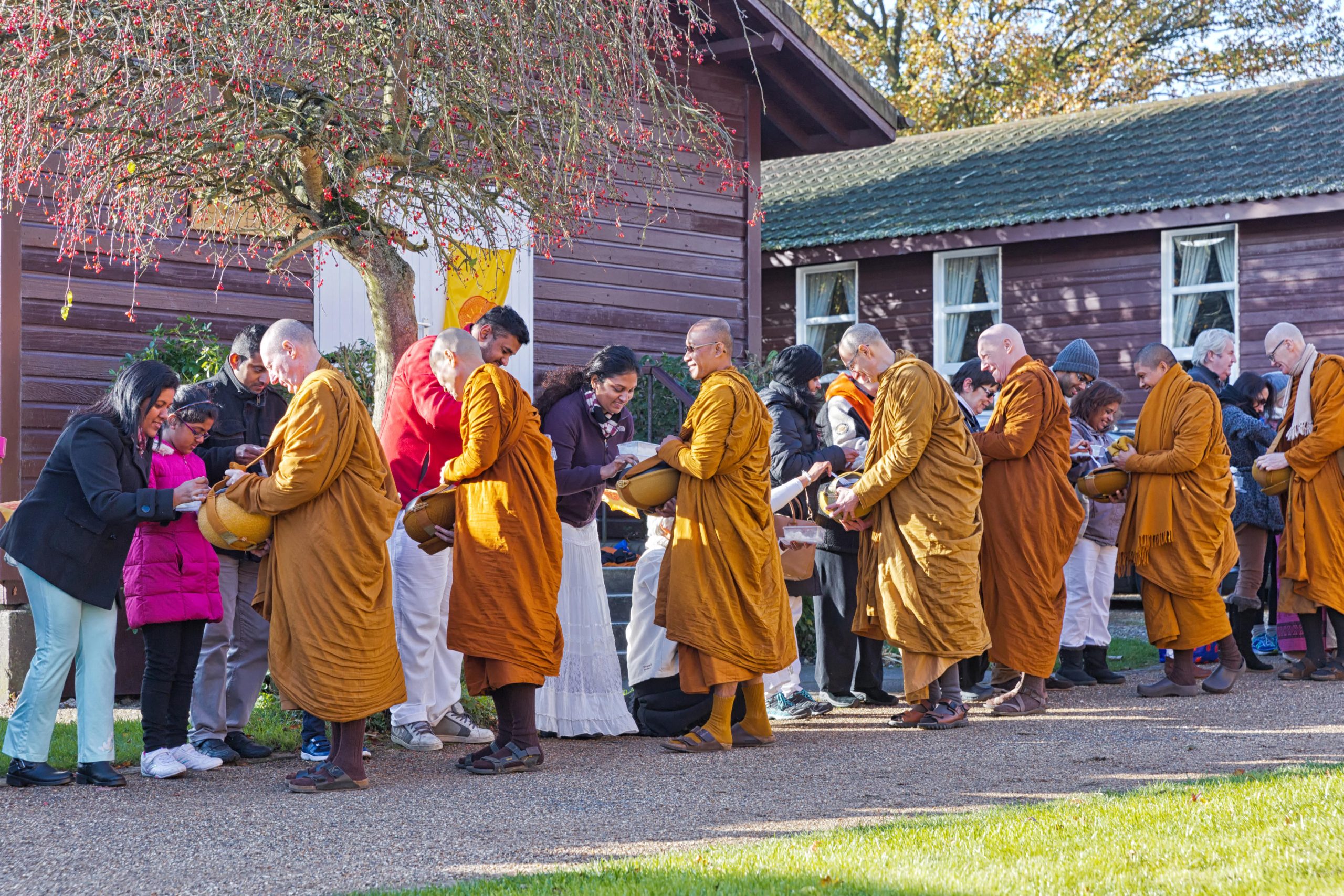
[At Wat Pah Pong,] I would go on almsround (Thai; pindapaht) to Bahn Gor, which is a three kilometer walk. One day it looked like it was going to rain and we thought it advisable to take our umbrellas. So I took my umbrella and started off. But it didn’t rain, so we left our umbrellas outside the village. I said to myself: ‘You must be mindful, Sumedho, and when you come back from your alms-round you must remember your umbrella. Remember where it is so that you can take it back to the monastery.’ So I went on pindapaht being very mindful of each step, got back to the monastery, and realized I’d forgotten my umbrella. I had concentrated and was maybe very composed while on my alms-round, but I was not terribly mindful about other things. In other words, when one just concentrates on walking in a certain way or doing something else, one is not necessarily mindful.
We need to take into our minds the way it is, what all that implies and what is involved. This does not mean just having the idea that one has to be mindful of each step while walking on an alms-round, as a kind of fixed view of mindfulness. That can be merely concentration. Mindfulness allows us really to notice the way it is, where we are, the time, and the place.
Another time I was walking on pindapaht at Tum Saeng Pet. I was trying to be very mindful, walking barefoot, and my right leg was very sensitive; I had to be most careful [with] it. It was very bumpy, rocky, and rooty up at Tum Saeng Pet, and I said to myself: ‘You must be mindful while walking, Sumedho!’ So I tried to be incredibly mindful, ever so careful—and I stubbed my toe. It was very painful and I said to myself: ‘You’re not being mindful, Sumedho!’ While I was saying that, I stubbed my toe again and it was absolutely excruciating. So I heard myself saying, ‘You’re not mindful at all! You’re just a hopeless case!’—and I stubbed my toe for the third time. I was about ready to faint. And there I was, thinking, ‘You’ve got to be mindful; be mindful; try to be more mindful; I wasn’t mindful.’ I was completely caught up with my ideas about being mindful, and my poor toe was suffering along with the rest of me.
People don’t wisely consider their limits and what mindfulness and wisdom really amount to. They develop fixed ideas about following certain meditation techniques or special practices, and do not take into account the nature of the human body with its limitations, or the time and the place. For example, one time I stayed at a meditation monastery where people develop mindfulness by doing everything incredibly slowly. But there was an occasion when we were asked to attend an important meeting.
Everyone was to congregate at two o’clock in the monastery meeting hall (Thai; sālā). I arrived on time, but then we had to wait for forty-five minutes—because some people were walking slowly and the rest of us had to wait for them. This didn’t strike me as being very wise or considerate; if one wants to walk slowly then maybe it’s best to set off well in advance. Or you can walk at a normal pace just for that occasion—in order to arrive [on] time. Whatever you decide, you should consider and contemplate time and place, what is appropriate, what is beautiful, what is kind. This takes wisdom rather than just mere willpower or blind grasping of conditions.
Here in Wat Pah Nanachat, contemplate this monastery as a place to practice, as a community where we share our lives together, being mindful of our vinaya, our customs, and traditions. What is the way things are done here? One doesn’t make up one’s own rules or go one’s own way in a community. In the sangha we determine to agree to live in a certain way. If we don’t want to live in that way, we shouldn’t be here. We should go where we can do what we want. The advantages of community life lie in our ability to be sensitive and caring, to be considerate and thoughtful of other human beings. A life without generosity, respect, and giving to others is a joyless life.
A life without generosity, respect, and giving to others is a joyless life. Nothing is more joyless than selfishness.
Nothing is more joyless than selfishness. If I think of myself first, what I want and what I can get out of this place, that means I might live here, but I will not have any joy living here. I might—because of my seniority—be able to intimidate, and—because of my size—be able to push my weight around and get my way, but I am not going to be joyful by doing that. Just asserting myself and getting my way is not the way to peacefulness, equanimity, and serenity of the heart. As we gain seniority in the sangha, we have to think more about other people. We need to consider how to train and look after the juniors and how to help the seniors. Nothing is more depressing than to be in a community of bhikkhus who don’t really bother and just want to do what they want. They are so blind or self-centered they don’t look and see, they don’t ask, they don’t notice—you have to tell them everything. It is very frustrating to have to live with people who are not willing to put forth the effort to try to notice and to take on responsibility.
In other words, we have to grow up…
For Buddhist monks here in Thailand it’s easy just to go off and find a nice cave and live there. The lay people are so generous in this country, they love to feed monks. They think monks are wonderful and will give them nice robes and build them lovely kutis. If a monk is a fairly decent and pleasant type of person, they will send him to the best doctors in Bangkok for any treatment he might need. So in Thailand a monk can be a very selfish kind of person, working on the basis of the idea: ‘I must get enlightened and nobody else matters but me.’ But this is a very joyless and dry way to live. Operating in this narrow-minded way becomes increasingly dreary.
I was pushed into a more responsible position by Ajahn Chah. I didn’t want it. I didn’t want to have to teach or be responsible for anything. I had all kinds of romantic ideas about being a monk: going off to an island, living in a cave in the Himalayan Mountains, developing magical powers, living in a state of bliss for months at a time. I had all kinds of hopes in that direction. Having to think about somebody else was not something I found very attractive. I had been married and I didn’t like that, it was a drag. As a monk in Thailand I was even praised for being totally selfish: ‘He’s really a good monk, very strict, doesn’t speak to anyone, likes to be alone, practices hard.’ One gets praised for that. But life sometimes forces us to look in different directions. That’s obviously what Ajahn Chah did for me. He put pressure on me, so I began to see and realize that if I just kept going the way I was, I would be a miserable, unhappy, selfish person. I began to think in terms of: ‘How can I help? What can I do?’
When I went to India in 1974 I had a strong experience of what is called kataññū katavedī: gratitude—to Gotama the Buddha, to Ajahn Chah, to Thailand, and to all the lay people who had been supporting and helping me. This sense of gratitude was very strong. At that time I had really wonderful opportunities. After five months in India I had a lot of adventures. I had gone [off engaging in ascetic practices] (Thai; tudong), just wandering and begging for food. I met some wealthy people who wanted me to spend the Rains Retreat (Thai; vassa) at a marvellous place in southern India. There was another invitation to go to Sri Lanka. All kinds of places in rather nice settings and idyllic environments were suddenly made available to me. But all I could think of was that I must go back to Thailand, I must find a way of serving Ajahn Chah.
So I thought: ‘What is the best way I can help and serve Ajahn Chah?’ I had left Thailand and gone to India to get away from all those Westerners who were piling up at Wat Pah Pong at that time. I was the only one who could speak Thai then, so they depended a lot on me for translating. Well, I thought the least I could do was go back and help translate for Ajahn Chah, so I left India, came back to Thailand, went to Wat Pah Pong, and offered my services. I decided to be a non-complaining monk, just do what Ajahn Chah wanted me to do, and no longer ask for anything for myself. I determined that if he wanted me to stay at Wat Pah Pong, I’d stay at Wat Pah Pong, or if he wanted to send me off to the worst, most horrible branch monastery, I’d go there. Wherever I could help I would do that, without asking for any special privileges.
I thought of Ajahn Chah’s worst branch monastery. At that time it was called Wat Suan Gluay. I remember going there once and I was taller than all the trees there. It is called ‘Banana Garden Monastery’, but I don’t think there’s a banana tree in the whole place. It was a hot, unattractive, and difficult place with rather coarse villagers and terrible food. So, hoping to do some kind of ascetic practice, I thought, ‘I know, I’ll help Ajahn Chah by volunteering to go to Wat Suan Gluay, because nobody wants to go there. He always has difficulty keeping monks there.’ I went to Ajahn Chah and said: ‘Luang Por, I volunteer to go to Wat Suan Gluay’, and he said: ‘No, you can’t go.’ I was quite disappointed. I was actually looking forward to it. But then a year or so later we started this monastery here. ‘Wat Pah America’ it was called as a joke, because most of the bhikkhus then were Americans. It was my responsibility to try and look after it.
A community is as good as its members. One person can’t make this community good by himself. The goodness of this community depends on all its members. This is for your consideration. If we want to have a really good monastery and a place that is worth living and practicing in, we all have to give something to it. We all have to give ourselves to it by opening our hearts and taking on responsibilities. Being sensitive to the needs and the type of people we are with, the time and the place, and the kind of culture we are in—all of this is part of our practice of being mindful.
To offer one’s services and be eager to help is really praiseworthy. It is something I appreciate very much. It is not always what one wants to do, but it is a very lovely gesture and very important. In a monastery we work together, each member reflecting wisely on how to support and help the whole community in the position where [they] find [themselves].
At Amaravati, for example, I am the abbot and the teacher, so I reflect on how to use this position for the welfare of the whole community, rather than saying, ‘I am the abbot, I am the teacher. I have many rights and privileges. I am senior to you; I can do this and you can’t. You’d better obey me because I’m the powerful figure here. Let’s see what I can get out of this for myself.’ That’s not a wise reflection, is it? A tyrant is like that, but not an abbot.
If we want to be a proper bhikkhu and we happen to be abbot, teacher, or senior monk, we reflect on how to use that position for the prosperity of the sangha. This also applies to the most junior member, the last anagarika, or the guests. Whoever is living here can reflect: ‘In my position, what can I do for the welfare and happiness of the community?’ As a new bhikkhu, a middling bhikkhu, or a senior bhikkhu, as a samanera, an anagarika, or a visitor, we consider: ‘How can I best serve this community with my talents and abilities, and the limitations I have?’ Then we have a very harmonious community, because everybody is reflecting in a way that supports it.
We are willing to give according to our abilities and our position within it. We are not trying to get something for ourselves anymore, or if we are, we can see that as an inferior attitude, not to be grasped or followed. We can always think in terms of our rights: ‘Now that I have ten vassas, what are my rights? What are the advantages? What perks do I get for having ten vassas?’ But if we cultivate a more mature attitude in the spirit of dhamma, we no longer demand rights and privileges, but offer our services. ‘How can I best help and serve this community?’ Ask yourselves that.
Here in Thailand, after five vassas one gets the inevitable five-vassa tudong-itch. One thinks: ‘I’ve got my five vassas, now I can go tudong. Whoopee!’ This can become a not very nice tradition if one is encouraged to think in that way.
We learn to do the best one can with the conditions around us. Here you have long periods of time to practice meditation, tudong experiences, and so on. There’s nothing wrong with all that, but to grasp those ideas and expect and demand it is really a hindrance to the understanding of dhamma. It’s not that one shouldn’t go on tudong after five vassas. I’m not saying that. But to hold on to that view without seeing it for what it is can be a great obstacle to one’s practice. To be dishonest with oneself, demand rights, and follow one’s own views and opinions is not the way to nibbāna.
If we really look at mental states of selfishness, self-concern, and grasping, we see that they are painful, dukkha. They don’t lead to peace and clarity, to letting go, cessation, ‘desirelessness’ or nibbāna; and that is what we are here for, isn’t it?—to realize nibbāna.
♦

© 2025 by Ajahn Sumedho, Teachings from the Forest. Reprinted in arrangement with Amaravati Publications.