
Spike in wrong-way driving as road designers urged to ‘up their game’
The RAC Foundation issued a stark warning
 Fransebas
Motorway designers are being urged to significantly improve safety measures following a 30 per cent surge in reported wrong-way driving incidents across England’s road network over the past four years.
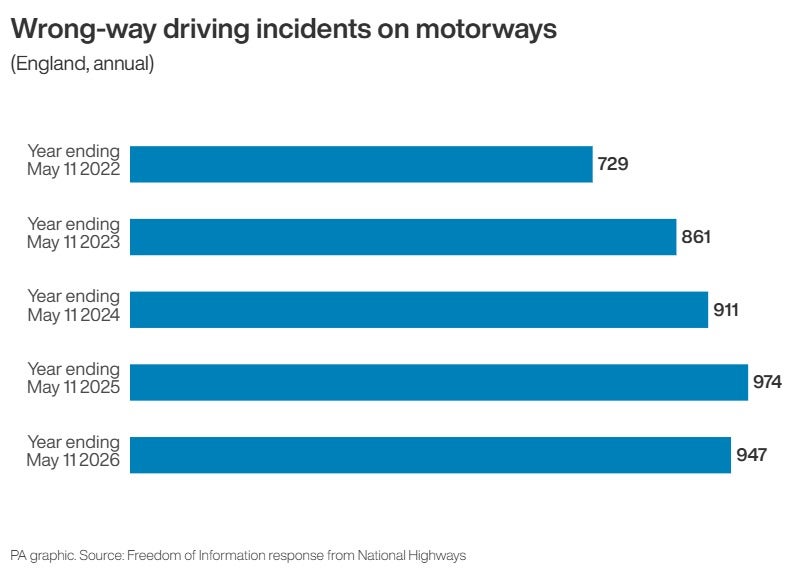
The RAC Foundation issued the stark warning after National Highways figures revealed 947 incidents involving "oncoming vehicles" were reported on motorways in the 12 months leading up to 11 May. This marks a substantial increase from the 729 incidents recorded during the same period four years prior, equating to an average of 18 such occurrences every week.
The data, released through a Freedom of Information request, compiles reports of wrong-way driving submitted to National Highways’ operations centres by various sources, including police, traffic officers, and the public. While the most recent annual total represents a slight decrease from the 974 incidents reported in the preceding 12 months, the overall trend remains a cause for concern.
The grave consequences of such incidents were tragically highlighted by recent fatalities. On 17 April, two male drivers died in a head-on collision on the M90 near Kinross, Perth and Kinross, involving a 44-year-old driving in the wrong direction and a 20-year-old in the other vehicle. Last October, a man in his 50s also died after driving the wrong way on the M6 near Charnock Richard services in Lancashire, with the driver and passenger of the car he struck, both men in their 40s, sustaining serious injuries.
Steve Gooding, director of motoring research charity the RAC Foundation, said: “To think anyone could drive the wrong way onto a motorway heading into fast-moving traffic is truly the stuff of nightmares.
“The fact that nearly 1,000 drivers did just that in the last twelve months both chills the blood and makes the case for demanding our highway engineers up their game to prevent drivers mistaking the off-ramp for a slip road.
“Whether the answer lies in re-configuring junctions or in technology – slip-road sensors that trigger roadside warnings or in-vehicle alerts – there’s clearly work to be done to establish what’s going wrong and to fix it.”
AA president Edmund King said incidents of vehicles travelling the wrong way on motorways are mainly caused by “driver impairment including by drink, drugs and fatigue”.
He explained that cases of drivers mistakenly turning onto an exit slip road instead of an entry slip road often happen at night, in poor weather, when they are confused or “blindly following their sat nav and take the instructions of ‘third on the right’ literally”.
He added: “Many people assume tourists from other countries who drive on the right are the main cause but more often the culprits are impaired local drivers.
“In rare, and sometimes fatal cases, drivers trying to avoid the police take a deliberate decision to go the wrong way.”
Mr King urged motorists to “always pay attention at motorway junctions” and called for more work to develop technology which could show alerts inside and outside vehicles when they are about to be driven the wrong way.
A National Highways spokesperson said: “Safety is our top priority, which is why every report of an oncoming vehicle triggers an immediate response to protect road users.
“This can include using roadside signals to warn drivers and reducing speed limits where necessary.
“These figures should be treated with caution as they may include unconfirmed reports received by our operations centres.
“Confirmed incidents of wrong‑way driving on motorways remain rare. Every report is treated seriously and acted on quickly.”

























.jpg&h=630&w=1200&q=100&v=1a56ad72fe&c=1)