Steppe Mother
Honoring Mother Earth through Mongolian folk songs The post Steppe Mother appeared first on Tricycle: The Buddhist Review.
 ValVades
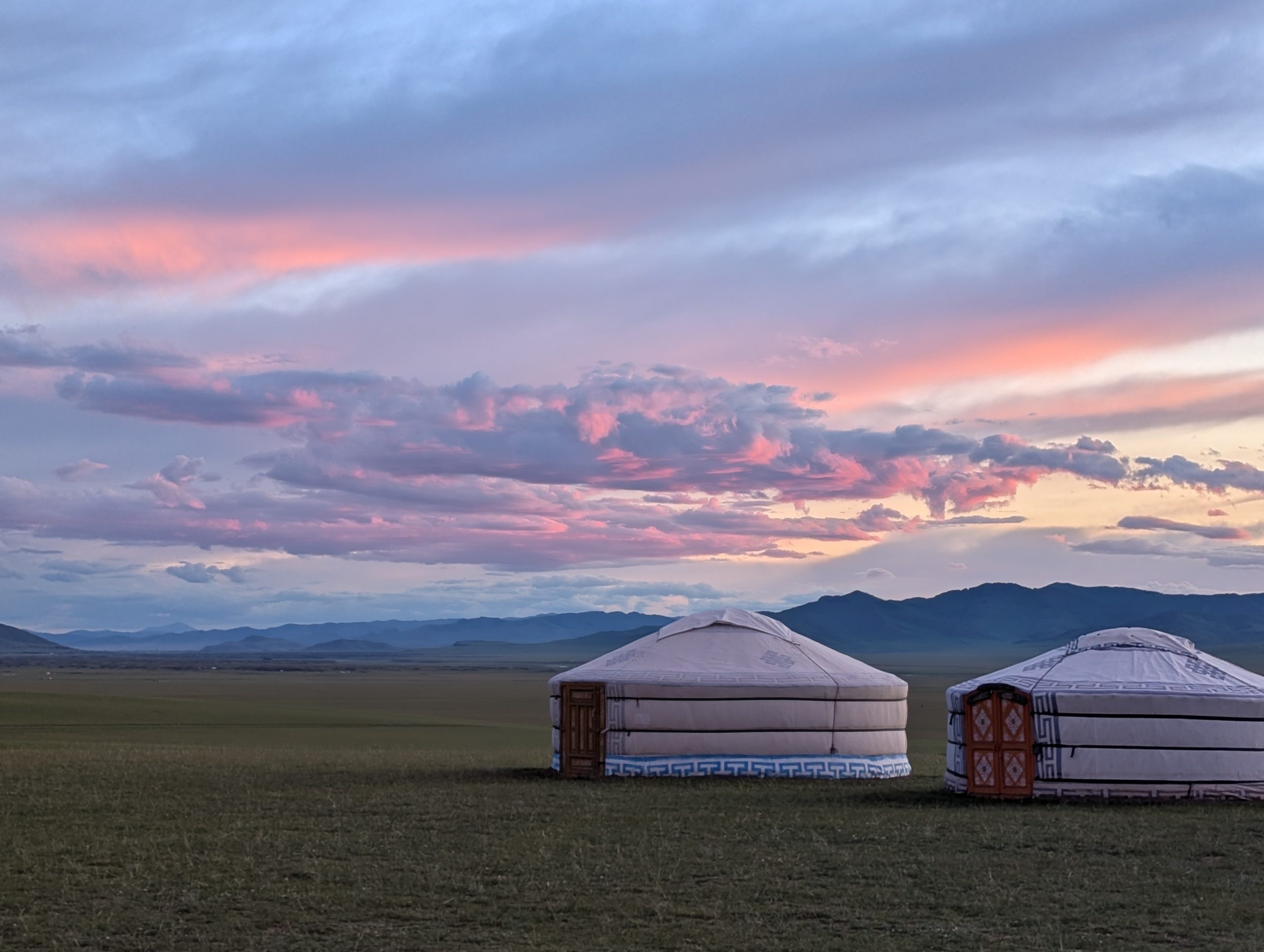
In the summer of 2025, I had the privilege of leading a group of Tricycle readers on a Buddhist pilgrimage to Mongolia. As a scholar and practitioner of Mongolian Buddhism, this journey offered a unique opportunity to share the Buddhist heritage of Mongolia with Buddhists of different traditions and cultures. As we traveled across the vast steppe, stretched out like endless sheets of green silk under the boundless blue sky, our conversations naturally turned toward Buddhism and the environment.
Mongols, like many other nomadic cultures of Inner Asia, have always had a special relationship with their ecosystem. For Mongols, nature was the embodiment of the sacred. Long before Buddhism permeated the culture of the Mongols, Möngke Tengri, the Eternal Blue Sky, was the cosmic father, the divine masculine principle. Less often discussed in the histories of the Mongols is the other half of this dual divine: the celestial mother Etügen, the Brown Earth, the Steppe Mother.
Despite popular culture’s fixation on the masculine Möngke Tenggri and men like Chinggis Khaan (also known as Genghis Khan) who claimed to have been born by the will of Möngke Tengri, Möngke Tenggri and Etügen were never separate; they were equal partners who gave birth to the cosmos. Even after the Mongols adopted Buddhism, their pre-Buddhist beliefs remained central to their worldview. The masculine Möngke Tenggri remained a pillar of power in government and legal circles as a Buddhist deity. In turn, the divine feminine principle of Etügen seeped into the very fabric of Mongolian society and culture: the realm of language.
 Tobken Keid monastery sits high on top of a mountain in Western Mongolia. It was the personal retreat center of the First Jebtsundampa Qutugtu, the leader of Mongolian Buddhism since the 17th century. Photo courtesy Sangseraima Ujeed.
One evening, after visiting Töbken Keid monastery, a 17th-century Buddhist mountain hermitage, our group of pilgrims returned to our camp and decided to have a bonfire. Soon, a song circle seemed to emerge from the fire. Our drivers were burly Mongolian men who had spent long hours in the car telling us stories about the masculine aspects of Mongolian culture: Chinggis Khaan, Möngke Tengri, lamas, wrestling, hunting, archery, and horsemanship. However, when it was their turn to sing, together, with tears in their eyes, they sang a folk song, Samsara of Love and Fate:
The wandering moon rabbit illumines the realm of samsara
The fallow deer leading its fawn feels like my own mother
There on the vast steppe decorated with saw-wort flowers
The resounding boundless peace is like my own mother
Heart melting melodies accompany my love for her.
Samsara’s coming and going is woven from prayers of karma and fate.
The verse overflows with Buddhist ideas and imagery, all bound together in the mother figure. The child’s love for their mother of this lifetime is seen in the wildlife and the medicinal flowers of the steppe. The steppe itself is the embodiment of the divine mother who looks upon all her children with boundless love, wishing them peace. The Steppe Mother is the mother of all beings, she is samsara, manifested through dependent origination and karma.
Folk songs have always held a special place in Mongolian culture. Unlike the writings of incarnate lamas and elite scholar-monks that serve as sources for monastic curriculum, debate, histories, and rituals, over the ages, folk songs have offered one of the few windows into the Buddhism of everyday nomadic Mongolians. Songs about the mother represent the largest genre of folk songs, many overflowing with imagery that brings together the universe, the environment, and the dharma, all embodied in the mother and Mother Earth: in the Steppe Mother. A lullaby that was passed down through generations of Mongolian families, including my own, recounts the Buddha’s disciple Maudgalyayana’s journey through the hells to find his mother to repay her kindness:
With the wood from the wild apple tree
My father hand-carved my cradle
Whether during the day or night
On her knees my mother breastfed me
Om Ma Ni Pad Me Hum (x 4)
When the night stars start to twinkle
My mother warmed me with her body
When night runs out and turns to day
My mother kept me on her knees
Om Ma Ni Pad Me Hum (x 4)
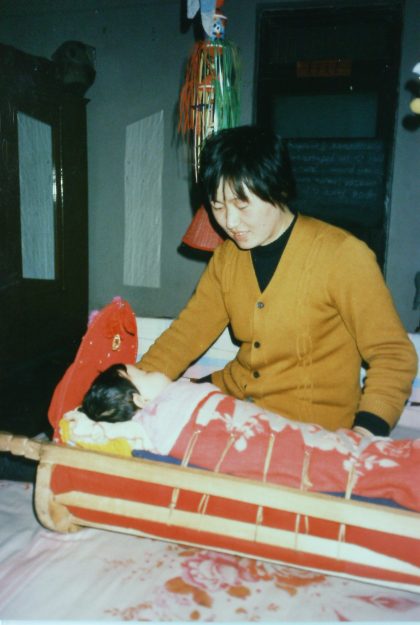 Author as a baby being rocked to sleep in a traditional handmade Mongolian cradle. Photo courtesy Sangseraima Ujeed.
For Mongolians, singing is an essential component of community, and no gathering is without song. No matter the occasion, no matter one’s age, gender, or the quality of their voice, Mongolians love to sing. When I was growing up, the first song I learned to sing was Silver Haired Mother:
Within the mist-covered aging Qorwa
With lullabies my mother raised me,
Taught me right from wrong.
Teaching with her wisdom, she nurtured me.
Within the dust-covered yellow Qorwa
With nourishment my mother nurtured me
Over the numbered years of her finite life
With freedoms and advantages, she raised me.
Looking at the song’s lyrics now, Buddhist teachings abound: the precious human life endowed with freedoms and advantages, impermanence, and the compassion of the mother as the source of all these good fortunes. However, when I first learned this song when I left home for college, the teachings and practices of Buddhist lojong (mind training) were unknown to me. Back then, this song stirred up images of my mother’s stories—of how she missed her mother and motherland when she left her country home at 12 to go study in the city. This, in turn, stirred feelings of longing and gratitude for my own mother and a connection to my ancestral motherland, now on the other side of the globe. As I grew up, I learned the lojong teachings. It was then that these songs became meaningful for my own practice.
One of the fundamental lojong practices for generating bodhicitta is the Mother Meditation. In brief, one starts this practice by understanding that all sentient beings have been their mother in some past lifetime. Then, focusing on one’s own mother, one recollects the mother’s kindness, the ways in which she nurtured, protected, and sacrificed for her child. From there, one generates the wish to repay the kindness, not only to this mother but to all their mothers from all lifetimes; in other words, of all sentient beings. Boundless love and compassion toward all mother sentient beings leads to bodhicitta: the promise to benefit all mother sentient beings by following the bodhisattva path to buddhahood. Many Mongolian songs capture the essence of these lojong teachings. There are numerous songs with the title My Mother, and among these, here are verses from two such songs that reflect the lojong teachings. In the first My Mother song, we sing:
She who endured life’s greatest trial with her own flesh and body
She who bestowed the gift of the precious human life to her child
She who forever set her mind, heart, and intention toward peace;
I will never forget my debt to my most compassionate and kind mother.
The second My Mother song has similar sentiments:
From the mysterious universe I came to samsara
I saw the turquoise blue sky together with the clouds
On the back and shoulders of my homeland and my mother
I grew up crying midst dreams and sleep.
From the hidden universe I came to this samsara
I saw mother environment together with the plants
On the chest and heart of my mother and homeland
I grew up smiling midst compassion and lullabies.
Songs like this remind us that the lay Buddhism of traditional Buddhists is not a simple faith. Profound Buddhist ideas and practices have been embedded in the culture, worldview, and psyche of ordinary Mongolians throughout history. In the realm of the song, we can see how indigenous appreciation for the motherland, the universe, and the ecosystem are woven together with teachings and practices of Buddhism. Resonating across the steppe in the form of songs sung across the generations, these are the prayers and meditations of the steppe nomads.
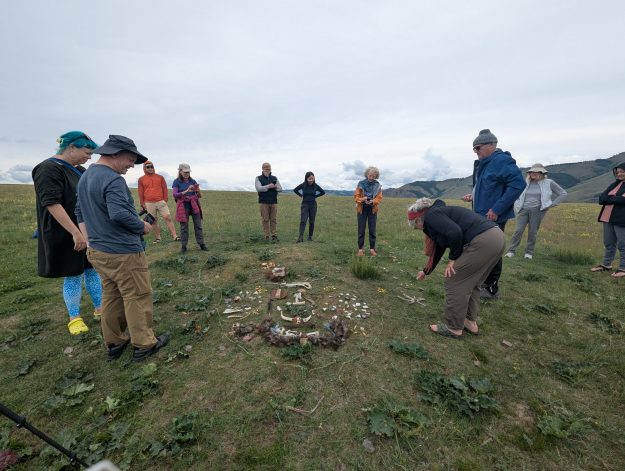 On one of the last days at the eco ger camp, the group of Tricycle pilgrims foraged objects from across the steppe and created a mandala. Photo courtesy BJ Graf.
During the last segment of the pilgrimage to Mongolia, the group spent three nights at an eco-ger (yurt) camp for a final retreat. Much of our discussion centered on the lojong teachings. On the last day, one of the travelers said to me, “I have always had an awful relationship with my mother, and it is very difficult for me to feel compassion when I meditate on her. She was a terrible mother. In fact, I feel quite the opposite—I feel a lot of resentment, anger, and pain. But I was very touched by some of the Mongolian mother songs. They made me feel so connected to Mother Earth. Could you share some more songs before the end of the retreat?” This was not the first time I had heard a comment like this during teachings and retreats. Today, for many people around the world, the mother is not the symbol of unconditional love and compassion but the source of deep pain, neglect, and trauma, making the practice of traditional lojong mother meditation very difficult, even triggering. In this context, the melodious images that Mongolian folk songs evoke about the Steppe Mother might be the ingredients needed for a healing lojong tonic.
Mongolians use the terms Sansar, Qorwa, Orčilang, Delekei, and Yirtinču for the Buddhist universe, the endless cycle of birth, death, and rebirth that is the Buddhist cosmos. Many of these terms appear together with eke or ma, both meaning mother. Sansarma (mother samsara) is a common Mongolian name for girls. Eke Qorwa, Eke Orčilang, Eke Delekei, and Eke Yirtinču are common themes in folk songs and tales. Often appearing in conjunction with the mother universe is the concept of the eke nutug (motherland). For Mongolians, the mother is the embodiment of this interconnected ecosystem, the motherland, the mother universe. Here are but a few examples of verses from folk songs that capture this sentiment:
Flower Scented Homeland
Within samsara’s vast void
Winds carry the soft melodies
Of my silver-haired mother
Worthy of offerings of milk from our hearts.
My Eternal Mother
The nights when I woke up crying, she would always be awake
The nights she slept sitting up are numerous beyond the stars in the sky
Oh mother, you are the Buddha sitting in prayer on my crown
Oh mother, you are samsara that fulfills my karma and merit.
Milk Ocean Mother
Endowed with the warmth of the sun
My beautiful moon mother
Her boundless compassionate gaze
Causes the whole universe to smile.
With the melodies of her lullabies
She softens the hearts of the world
With the purest and kindest heart
My mother, the Ocean of Milk.
A Child’s Heart
From a faraway land across wide waters
I long for my beloved motherland
Among the myriads of worlds within samsara
My precious mother. How I miss you.
For Mongolian Buddhists, the Steppe Mother embodies their own mother as well as Etügen, the Brown Earth who gives life to and nurtures all the beings that inhabit her depths and her surfaces. The Steppe Mother is the ocean of milk that nourishes all beings without distinction, her equanimity like the warmth of the sun and the light of the moon. She is the motherland, but she is also the universe. As a Mongolian who has migrated across the globe, when I think of the Steppe Mother today, she is so much more than just the Inner Asian Steppe, she is Etügen the Brown Earth, she is planet earth, the mother that we all share, regardless of our race, ethnicity, religion, gender, language, or even species. If we take the Steppe Mother beyond the steppe and into our global ecosystem, is it possible to meditate on the single mother that we all share to cultivate more compassion, empathy, and connection?
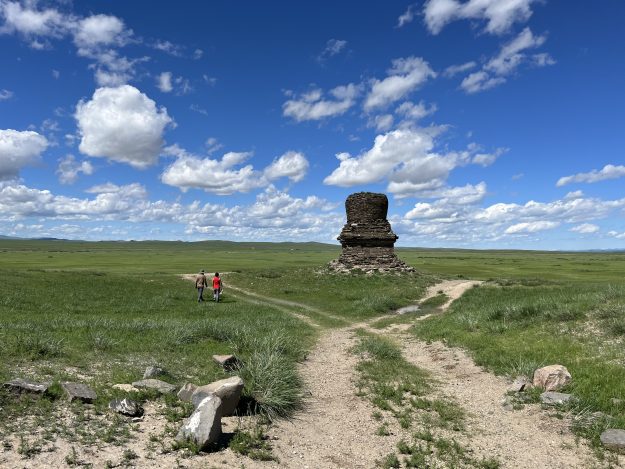 The ruins of a stupa on the steppe. Photo courtesy Sangseraima Ujeed.
In the last fifty years, our understanding of the Earth’s ecosystem has expanded exponentially; life on planet earth is more entangled than ever before. Not only do we now know more about how the entire ecosystem of our planet is interconnected, we also know more about how our actions impact this ecosystem and its inhabitants. Our group of travelers eating avocados grown in Mexico for breakfast at a remote eco ger camp in Mongolia would have been impossible even ten years ago. Today, wherever we are on the planet, our actions affect Mother Earth and all the beings who she has given life to, has nurtured, and continues to nourish. She is the single mother, mother to all sentient beings, the compassionate Mother Earth who cares for all her children.
Humor me, a modern Mongolian nomad migrating across the oceans and continents of our globe for a moment in a lojong meditation on the universal Steppe Mother, our Mother Earth:
“The great Steppe Mother Etügen, Mother Earth, our shared mother, made possible my birth as a human, with its freedoms and advantages. Because of her, the Buddha, teacher of the dharma was born. Because she nourished the sangha over generations, his dharma has survived. Because of her, my human mother was born, I was born, and so, I was able to hear the Buddha’s teachings. Whether in Asia, Europe, America, or Africa, we benefit from her generosity. She does not discriminate as we harvest her fruit, mine her for precious materials and drain her lakes and rivers. She bestows her kindness on us even when we kill and eat her children, our siblings, or when we slaughter each other in wars over her resources. She has bestowed our most precious belongings. She endures our cruelty, greed, and self-grasping, watching over all her children, with complete equanimity, compassion, and generosity. She is the source of true kindness, of all the protection, nourishment, happiness, and peace we have and will ever have in this life. So, to repay her kindness and nurturance, we must protect her from harm and lead our sibling sentient beings from suffering to happiness. I will do everything I can to repay her kindness by protecting her for future generations of my sibling sentient beings, all my mothers, so that she can sustain the three jewels for the future generations, so that they too can have the opportunity for a life endowed with the freedoms and advantages, the opportunity to practice to one day achieve true peace.”