The Buddha’s Enduring Audience
A pilgrimage to the sacred Buddhist sites of India reveals a world of devotion. The post The Buddha’s Enduring Audience appeared first on Tricycle: The Buddhist Review.
 Fransebas
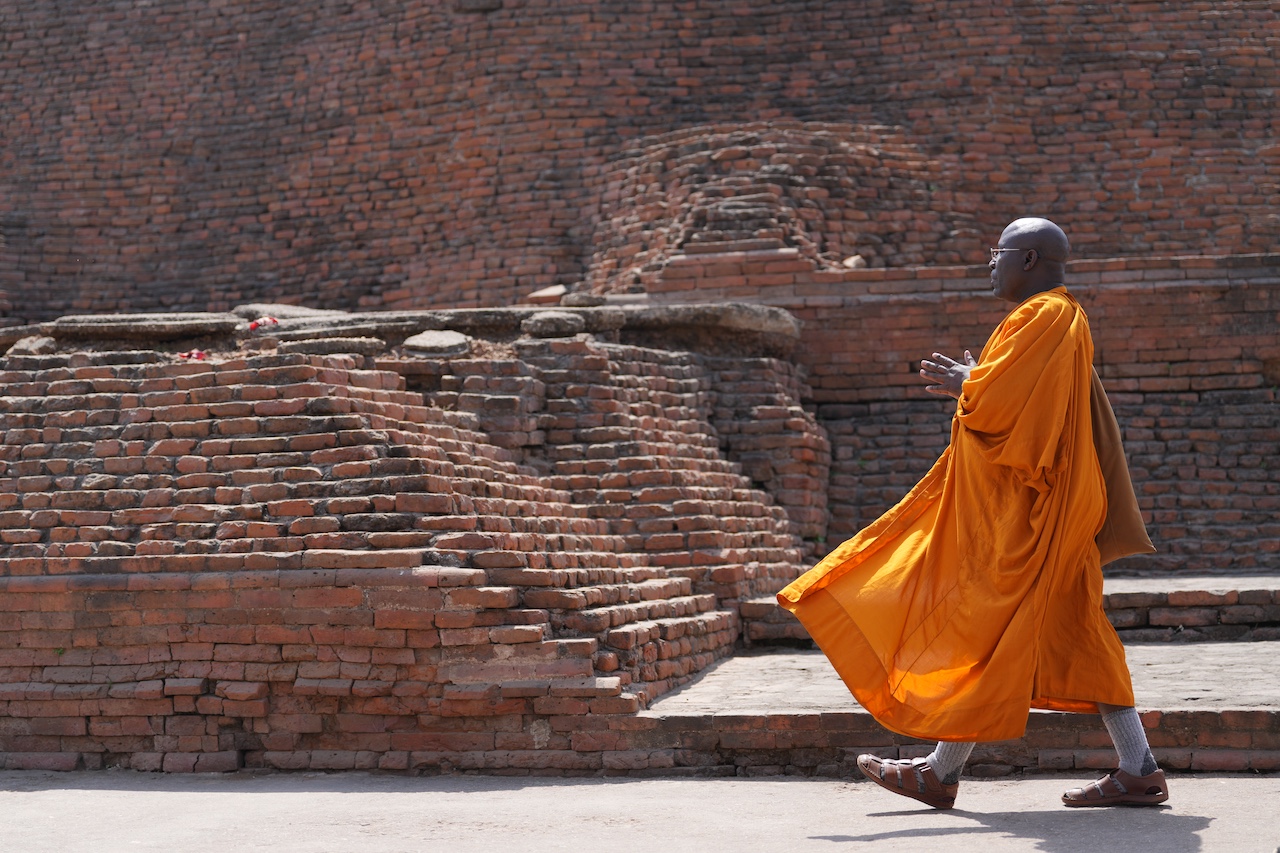
The path to Vulture’s Peak is broad and the slope is gentle, but the way is not easy. It winds along the hill of Gijjhakuta, one of a series of ridges that enclosed the ancient city of Rajagriha (now Rajgir) like the ramparts of a fortress. Fringed by dry brush and broken rocks, the path is paved and even, but is largely unshaded and heats up rapidly as the sun rises.
The pilgrims from the Walking with the Buddha tour climb the path amid many other pilgrims, including an enormous group of Sri Lankans, their white clothes blinding in the sunlight. Vendors sell flowers, souvenirs, and cookies to toss to the dogs and monkeys, who wisely shelter in the few shaded areas. Beside the vendors’ stalls, sometimes on mats, more often on the bare stone, sit alms-seeking supplicants. Mala-sellers walk among the pilgrims, their cajoling conversation forming the soundtrack to the journey. It is an arduous profession. In the course of a day, which starts early and ends late, they will climb up and down the sacred mountain dozens of times, ignoring the lone shaded rest area named for King Bimbisara, the ruler of Rajagriha and one of the Buddha’s greatest patrons.
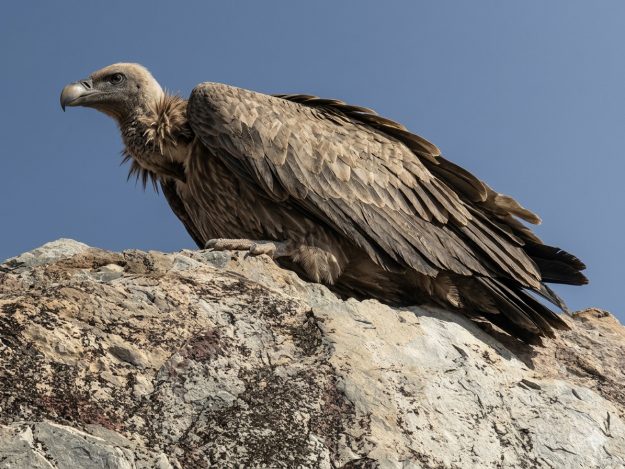 Vulture’s Peak, Bihar, India. Photo by BJ Graf.
The Buddha delivered many teachings on this peak. It is here that the Mahaparinibbana Sutta, which describes the end of the Buddha’s life, begins. Just below the summit are caves, named for Sariputta (said to have attained enlightenment here) and Ananda. In Ananda’s cave the pilgrims chant the Heart Sutra, led by two Zen monks from SokukoJi Monastery in Michigan. Another group visiting the caves is an ebulliently cheerful crowd of Vietnamese vajrayana practitioners, dressed in the Tibetan style, with maroon and yellow running shoes to match. They are delighted to be here, joyfully following, as we are, in the footsteps of the Buddha.
The peak itself is small. It might hold a hundred bhikkhus (the literal translation is beggar or alms-seeker), far fewer than the 12,000 mentioned in the Lotus Sutra, let alone the 80,000 bodhisattvas and 20,000 devas also said to be in attendance. But a broad hillside overlooks Vulture’s Peak like the seats in an amphitheater, and one can easily envision an audience of many thousands crowded there. And as the pilgrims walk back down the slow road, sweating in the growing heat, wading through thickets of dangling malas, it becomes apparent that they are the bodhisattvas described in the text, and the vendors and alms-seekers are the devas. The Lotus Sutra deals in huge numbers, but the reality is even more fantastic. Every day the peak swarms with devotees from across the globe, and every day vendors and alms-seekers, many sick and missing limbs, and mothers carrying small children, climb the path and, beneath the pitiless sun, perform the sacred duty of providing for themselves and their families. The Buddha’s audience on Vulture’s Peak is enormous, and always growing.
This pilgrimage began a week earlier in Varanasi on the Ganges, city of fire and water, sacred to Siva. Varanasi was a bustling hub of scholarly and religious activity in the Buddha’s time, and remains so today. This pilgrimage will visit the four main sites the Buddha encouraged pilgrims to visit—Sarnath, where he gave his first teaching; Bodhgaya, where he was enlightened; Kushinigar, where he passed into parinirvana; and Lumbini, where he was born—plus several other sites of interest along the route. The scholar Malcolm David Eckel writes, speaking of medieval India, “To see the evidence of the Buddha and hear his teaching did not require an elaborate study of texts. All it took was the stamina to travel in the steps of the Buddha, see the remnants of his presence, and hear the stories that placed each site in the sacred narrative of the Buddha’s life.” Would it still be so today?
In Varanasi we cruised the mist-shrouded Ganges on a large party boat, eventually disembarking by a crematory ghat where families gathered around burning pyres. The scene was solemnly chaotic, bodies jostling through the dust and smoke, and it was 98 degrees though still early morning. Cremations have been performed beside this river for 5,000 years. Here, I turned aside and performed a private puja, depositing a few tablespoons of my mother’s ashes, smuggled in-country in a Ziploc bag, into the Ganges. She and I visited this spot in 2001, and she died in 2004, two weeks after her 63rd birthday.
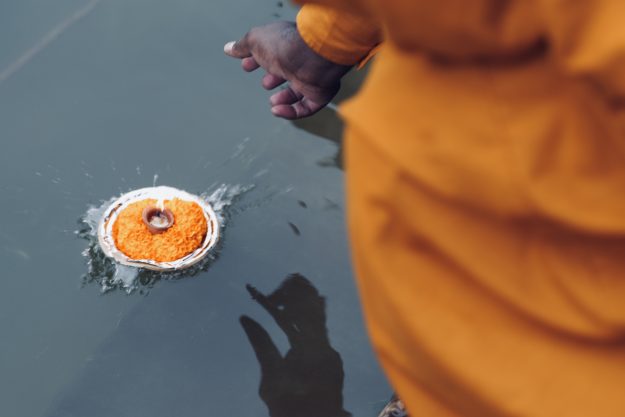 The bank of the Ganges River in Varanasi, Uttar Pradesh, India. Photo by BJ Graf.
Close by Varanasi is Sarnath (called Isipatana in the Pali suttas), the deer park where the Buddha gave his first teaching to his five former companions in asceticism. Here, Bhante Buddharakkhita, the spiritual leader of our pilgrimage, delivered a teaching echoing the Buddha’s discourse on the middle way, the four noble truths, and the eightfold path. It is peaceful in Sarnath. Ruins abound, and a stupa that was cut down to the ground provided bricks that were used for local construction projects. (The flattened stupa’s relics, a mystery to their discoverers, were removed and respectfully deposited in the Ganges.) Some monasteries, of which we could see only stone foundations, are said to have stood six stories high. The site’s museum houses Buddhas in both the Gandharan and equally ancient Mathuran style, as well as the four lions atop the fallen Ashokan pillar, which were chosen as the symbol of India shortly after independence.
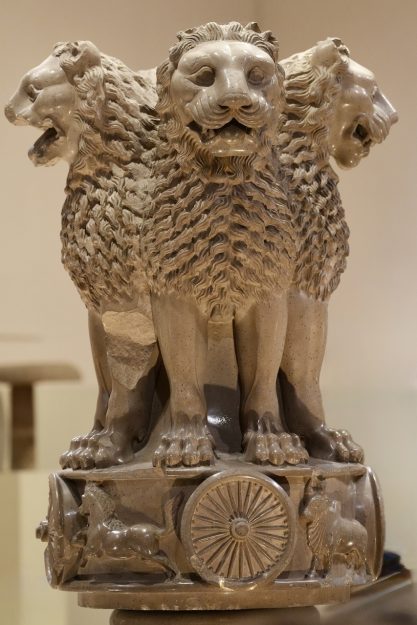 Four lions atop a fallen Ashokan pillar. Sarnath, Uttar Pradesh, India. Photo by BJ Graf.
The pilgrimage then moved into the state of Bihar, its name derived from vihara, the Buddhist term for monastery. Despite its flood of generous Buddhist tourists, Bihar is India’s poorest state, with a GDP per capita of around $800 annually. Bodhgaya is here, a busy town studded with monasteries and temples, some functional and busy, others near-deserted showpieces. Richard H. Davis, author of the magisterial Religions of Early India, counted monasteries from thirteen nations on his visit, and had this to say about Bodhgaya:
Many modern world religions have sacred centers, places that are considered particularly holy for the faithful. One thinks of Mecca, Jerusalem, the Vatican in Rome. For Buddhists around the world, Bodh Gaya has become that kind of center. It is the place that pilgrims seek above all to visit, and it has become a place where we can see on display—in its diversity of nationalities, dress, language, and custom—the full transnational character of the modern Buddhist world.
Bodhgaya was a major pilgrimage spot from the time of Ashoka (3rd century BCE) through at least the 13th century. By the 16th century, the temple had become the domain of Shaivite Hindus, but locals (the city of Gaya is nearby) remembered its Buddhist associations. Pilgrimage resumed when the site was refurbished in the mid-19th century. Academics argue that the Protestant, or secular, Buddha is an invention of this time. This seems to follow naturally from the identification of the major sites, which compel the visitor to imagine what went on there.
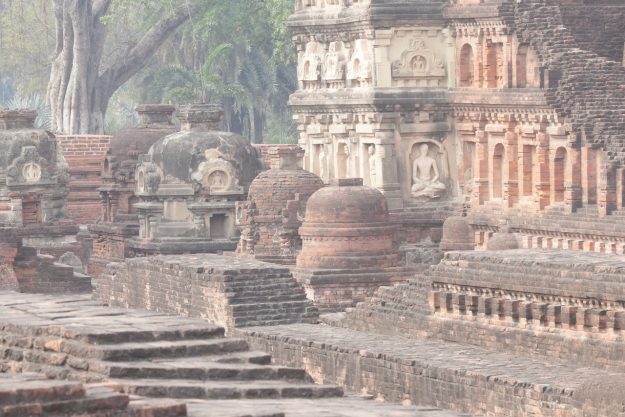 Bodhgaya, Bihar, India. Photo by BJ Graf.
Today, the site is jointly administered by Hindus and Buddhists, and that the Buddhists have a place at the table at all is thanks to the efforts of the Sri Lankan Buddhist reformer Anagarika Dharmapala. Hindus operate the two security gates. One effect of this, Bhante Buddharakkhita pointed out, is that monks and nuns are not treated with the respect they would be accorded by Buddhists, and are frisked, poked, prodded just like the laypeople. This is accepted at airports, but, particularly for Theravada monks, it is an indignity at the site of the Buddha’s awakening.
The Mahabodhi temple, constructed in the flat-sided shikhara, or mountain, style, dates from the Gupta era, the 5th or 6th century. The towering structure was completely enclosed by bamboo scaffolding during our visit, giving it the feel of the Centre Pompidou. Men and boys climbed throughout the massive bamboo latticework, and water sprayed down at random from their work cleaning the temple exterior. The bamboo footings interrupted the plazas surrounding the temple, making circumambulation difficult.
Beneath the Bodhi tree devotees gathered from across the world. It was a place of prayers and prostrations, meditations and mantras. Visitors offered flowers, candles, and oil lamps. Devotees in white swept the marble floors on which rained the petals of a thousand offerings. Small noisy engines powering the cleaning process around the complex coughed and spat angry black smoke but failed to quiet the chanting.
Near Rajgir, the city once ruled by King Bimbisara, the group visited Vulture’s Peak and the bamboo grove where the Buddha often taught. We then proceeded to the vast ruins of Nalanda, an ancient university that was sacked repeatedly and finally destroyed in the late 12th century. At its peak it may have hosted 10,000 students and 2,000 faculty. Most visible to the modern pilgrim is its massive library, Dharmaganja (ganja means storehouse), which is said to have burned for three months due to the density of manuscripts within. The scale of the ruins and the magnitude of the loss and devastation were keenly felt here. Burn marks are still visible on the bricks.
Traveling north through the city of Patna, once Ashoka’s capital—and here let us bow to the great distances the Buddha and his sangha walked that we traverse in an air-conditioned bus— the pilgrims visited Vesali, or Vaishali, recognized as the oldest republic on earth and the place where the Buddha was convinced to ordain women. Vaishali was run by the Licchavi clan, and the town was a favorite resting spot of the Buddha. A famous Licchavi is the legendary Vimalakirti of the eponymous sutra. “I am sick because the whole world is sick,” Vimalakirti tells Manjushri in a notable exposition of the bodhisattva vow. The pilgrims’ visit coincided with the wheat harvest in Vesali. In every yard families beat long stalks of wheat against wooden tables, freeing the kernels to spill down onto waiting sheets of canvas.
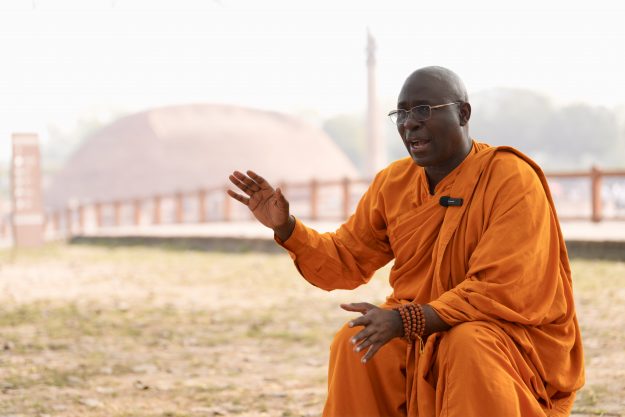 Bhante Buddharakkhita giving a dharma talk in Vaishali, Bihar, India. Photo by BJ Graf.
Next was Kesariya, formerly Kesaputta, city of the Kalamas, home to a gargantuan stupa originally built in Ashokan times, and expanded in later centuries. (Stupas turn out to be expandible when you find you have more bricks.) Bhante Buddharakkhita gave a teaching here on the theme of the Kalama Sutta—that one should not accept doctrines based on tradition or reports but rather on which teachings lead to less suffering.
The journey continued to Kushinagar (Kusinara), the site of the Buddha’s passing into parinirvana. The pilgrims participated in a ritual at the Mahaparinibbana Temple, an Art Deco monument tended by Burmese monks, laying a large yellow robe atop the twenty-foot reclining Buddha statue. The four major locations in the life of Gotama Buddha are said to be common to all Buddhas throughout time, so all past Buddhas died in Kushinagar, and all future Buddhas will die there too. This extraordinary idea, which is more about real estate than theology, essentially collapses time so that every Buddha will relive the same life. What are the implications of this?
 Kushinagar, Uttar Pradesh, India. Photo by BJ Graf.
Crossing into Nepal, the pilgrims visited Lumbini, the Buddha-to-be’s birthplace. The actual supposed birth spot (Queen Maya clutched a tree while Baby Buddha exited her right side) is marked by a stone underneath a glass plate in the floor, all inside an exceedingly modest warehouse-like edifice. Outside, the restored garden and planned monastic zone is massive, giving the area the feel of an unfinished capital city.
Close by Lumbini is Kapilavastu, the city in which the Buddha-to-be grew up and, at that time, the capital of the Sakyan republic. (The brief flourishing of republics, known as gana-sanghas, between the Ganges and Himalayas in the Buddha’s lifetime was swiftly extinguished around the date of his death.) The Buddha’s father, Suddhodana, whose role in the story is to attempt to protect his son from life’s harsh realities, has suffered a series of downgrades over the years, from a king to a ruler to a powerful (elected?) oligarch, but the point remains the same: Gotama, who would be the Buddha, had a sheltered, privileged upbringing.
Many questions surround the city, which is not mentioned outside of Buddhist sources. Two regions claim the title to Kapilavastu, or rather two countries: Piprahwa in Uttar Pradesh, India, and Tilaurakot in Nepal. The Indian site is much smaller but contains Ashoka’s imprimatur—pillar and stupa and so on. But the Nepal site, which we were visiting, is vastly larger, and was certainly a city with a substantial population in ancient times.
Kapilavastu today is simply a stretch of nature surrounded by walls. It contains the barest traces of the palace, to which so many stories are attached, and the gates, which the young prince exited, and which still open onto farmland. A small temple, named for the Buddha’s mother, remains active inside the walls, and a procession of brightly dressed women from the nearby town processed through the empty ancient city, circumambulating the temple and offering flowers.
The Buddha is not in the ruins but in the continuous devotion of the people who visit.
And so we stood in Kapilavastu, looking for the young Siddhartha, long hair flowing behind him, riding down the street in his chariot, or on horseback. The scholar Donald S. Lopez Jr. writes in his book The Buddha: Biography of a Myth:
One might ponder whether we can distinguish between the Buddha and what might be called the Buddha function. We might describe the Buddha function as the necessity felt by the Buddhist tradition over the past two millennia to derive all authority from the Buddha himself. . . . The question is: How far back in time must one go to find not the Buddha function but the Buddha himself? Is it possible that there is no Buddha, that there is only the Buddha function?
No Buddha? There is some silliness to imagining the Buddha and his bhikkhus wandering the now-vanished forests of northern India, when the modern environment brutally crushes such romanticism. Trash fills every square meter of open ground except for fields under cultivation, and the air is thick with diesel fumes and burning garbage, much of it plastic—literally everything, oh bhikkhus, is burning. And yet Buddhanussati, recollection of the Buddha, is fundamental to Buddhist practice, and the sites themselves crackle with sacred energy from the devotion and joy of visiting pilgrims from across Asia and beyond. The Buddha is not in the ruins but in the continuous devotion of the people who visit, and our very presence is the fulfillment of the sutras, bringing us nearer to the Blessed One.