The Spirits Shape-Shift
A new exhibition at the Pao Arts Center honors Boston’s Chinatown as a site of ancestral histories and dreams. The post The Spirits Shape-Shift appeared first on Tricycle: The Buddhist Review.
 KickT
KickT

When Dr. Peter Kiang first brought UMass Boston students to Mount Hope Cemetery in the fall of 1993, they found the Chinese immigrant burial area—New England’s oldest and densest—in utter disrepair. Broken glass stippled the leaf litter. Hundreds of gravestones lay damaged, displaced, and eroded. If the tomb markers were the teeth of a vanquished boxer, a full-mouth dental implant would be in order. But stones, like teeth, hold ancestral history, so Dr. Kiang and his Asian American Studies students walked the grounds with reverence as they paid respect to Boston’s earliest Chinese immigrants: born as early as the 1860s, with death years from the 1930s to 1960s.
Though she couldn’t read the Chinese characters on the markers, one of the students moved from grave to grave long after her classmates had stopped, offering incense and three bows before each stone. Sophia Nun’s mother had been killed by the Khmer Rouge. There had been no chance to say goodbye; she didn’t even know where her mom was buried. Sophia felt an unexpected sense of connection at Mount Hope, and she urged Dr. Kiang not to let this field trip be the last.
The relationship between the Chinese burial grounds of Mount Hope Cemetery and UMass Boston’s Asian American Studies Program is now into its fourth decade. AsAmSt students have returned again and again to pay respect, clean up, and document. Their research efforts gave shape and story to the neglected mass of 1,500-plus gravesites. In an analysis of 351 names, nearly all were male; most were born in Toishan and lived in Boston’s Chinatown; a great many worked in laundries; a significant portion died of tuberculosis. These facts hint at hardscrabble, hard-won lives in the face of the anti-Chinese exclusion acts that barred immigration and denied citizenship rights from 1882 through WWII.
The students weren’t the only ones galvanized into action by the neglected burial grounds. Concurrent with their efforts, community members founded the Chinese Historical Society of New England (CHSNE) to repair the site and construct a memorial altar. These restoration efforts are captured in the short documentary Mt. Hope Cemetery by filmmaker and Boston native Kenneth Eng.
 Mt. Hope Cemetery, on view at the Pao Arts Center. Photo by Mel Taing.
Eng’s documentary is on view now at the Pao Arts Center in Boston Chinatown as part of the “Temple of Our Ancestral Dreams” exhibition, which opened April 8 and runs through June 19, with public programming on April 11, May 16, and June 13. Cocurated by Wenxuan Xue and Sung-min Kim and supported by the New England Foundation for the Arts, the multidisciplinary exhibition features contemporary work by community-engaged artists Lani Asunción, Feda Eid, Kenneth Eng, Zhonghe (Elena) Li, Joanna Tam, Yolanda He Yang, Ying Ye, and Mimi Zhang. Bilingual English-Chinese wall labels accompany the artworks.
The myth of the solitary artist (or gallery-goer, for that matter) finds no purchase in “Temple of Our Ancestral Dreams.” Eng’s documentary, for instance, was made in and for community. Mt. Hope Cemetery weaves together interviews and archival footage and plays on a flat-screen TV in front of a wide padded bench with not one but two sets of headphones. At the exhibition’s opening event on April 11, we were invited to write down our dreams for Mount Hope. Pinned up, our index cards dangled from a zigzagging red thread like shirts on a clothesline.
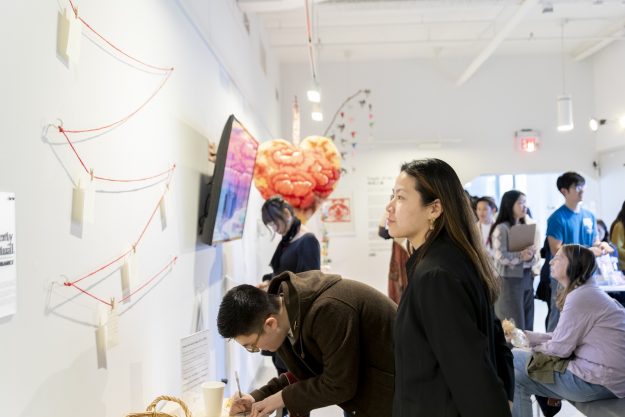 Participants at the opening event for “Temple of Our Ancestral Dreams” write down their dreams for Mount Hope Cemetery. Photo by Mel Taing.
Our wishes hung to the left of the TV. To the right, another set of prayers for the dead took the form of Feda Eid’s For Habibi’s Eyes (2024, fabric blanket, wire, thread, photo transfer on fabric; “With the current colonial assault of Lebanon and in solidarity with murdered and oppressed people around the world, we continue to grieve the children returning to the earth”). Suspended from the ceiling, an enormous heart-shaped pillow cast its slowly rotating shadow against the wall.
Expanding the scope of our care may give us greater cause for grief, but distributing the burden across many hearts lightens the load.
Though sixteen years had passed since my paternal grandmother’s death, I suddenly recalled a queen-size fabric blanket draped over a wheelchair-bound abuelita at the nursing home. A tiger was printed on the blanket, its massive size and fierce expression a herald for my emotions (Nainai would die a few weeks later). They shared no common language, but the abuelita always let my Nainai prop up her feet against the fuzzy orange paws of that regal tiger. Expanding the scope of our care may give us greater cause for grief, but distributing the burden across many hearts lightens the load.
 Participants at the opening event for “Temple of Our Ancestral Dreams.” Photo by Mel Taing.
The April 11 public event was held, by design, shortly after Qingming. Literally “clear bright,” this tomb-sweeping festival day is traditionally a family affair—a springtime occasion to honor one’s ancestors by making offerings at their freshly cleaned gravesites. Most of the hundred-plus people who attended the opening weren’t related by blood, but the Pao Arts Center buzzed with familial warmth that Saturday afternoon.
We wrenched ourselves away from the gravitational pull of artwork and conversation for the second part of the afternoon program, a screening of Mt. Hope Cemetery followed by a storytelling panel with Deborah Dong, Kenneth Eng, Terry Guen, Peter Kiang, and moderator Nancy Lo. Multigenerational Bostonians Dong and Guen shared photos and memories of relatives buried at Mount Hope Cemetery. Eng credited the late photographer Corky Lee for spurring him on to apply his art practice for the benefit of his community. Dr. Kiang told us about the students—Sophia Nun among them—whose connection to the Chinese gravestones at Mount Hope had transformed people and place alike.
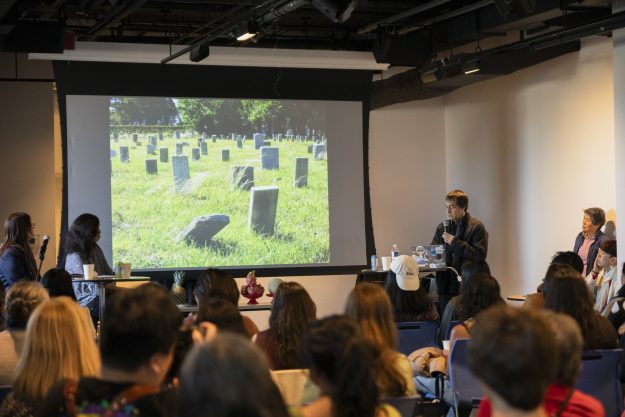 Deborah Dong, Nancy Lo, Peter Kiang, and Terry Guen (from left) at the storytelling panel. Photo by Mel Taing.
Dr. Kiang’s presentation included a black-and-white photo of a 1903 funeral procession from Boston Chinatown to Mount Hope Cemetery, where local laundry owner Wong Yak Chong was to be buried. Three thousand community members gathered to bear witness. Local, state, and federal authorities showed up with meaner motives. They turned the memorial into an immigration raid, arresting over 200 people and deporting more than fifty.
Who among us wasn’t thinking of ICE in that moment? The afternoon program could have ended here, with the past echoing painfully into the present, but a final segment remained: an ancestral ceremony organized by Harvard Divinity School student Jiamin Li and led by monastics from Thousand Buddha Temple in Quincy, Massachusetts. This unconventional ritual embodied the exhibition’s aspiration to “activate Chinatown as a memory archive, a diasporic temple, and a space for spiritual, ancestral, and communal refuge.”
A row of fruit lined the bottom of the projection screen on which we’d viewed Mt. Hope Cemetery and the panelists’ slideshows, as if in offering to dilapidated gravestones and deceased relatives. Five trays bore quartets of Asian pears and apples and dragon fruit and oranges in stacked pyramids along with a solo cantaloupe; the pineapple rested on a paper plate so as not to tower over the others. The pineapple’s crown found its analog in the leafy twig that sprouted from a clear cup of water between the apples and oranges. The projector screen retracted to reveal a black lacquer Guanyin statue three cantaloupes tall. Garlanded in pearls and standing on a rhinestone-studded lotus platform, Guanyin rocked the costume jewelry as the abuelita did her tiger blanket. You wouldn’t be blamed for seeking out the bilingual wall label for this display, though the bodhisattva of compassion may need no introduction.
 A Guanyin statue stands behind trays of ritual offerings. Photo by Mel Taing.
Ritual presents us with paradox. It unifies participants, each of whom has their own unique experience. It renders words sacred, even as words are inadequate to render its sacredness. It is heavily scripted yet never predictable.
The plan had been to conduct the ceremony indoors. Ven. Kuan Yen, the 95-year-old founder and abbot of Thousand Buddha Temple, looked at the standing-room-only crowd and ushered us out the back entrance onto a large deck. The West MassPike Worcester freeway sign rose above us like a green sun. Cars sped past, so loud they seemed within touching distance. The Pao Arts Center stands where the row houses of Chinese and Syrian immigrants once did—before they were destroyed to make way for the I-93 highway on-ramp (Boston Chinatown remains in the 90th percentile for traffic exposure, worst air quality, and highest childhood asthma rate in Massachusetts). We watched as the monastics and laypeople from TBT orbited the outdoor altar they had set up. The ceremony was about to begin.
 Ven. Kuan Yen (right) leads a ritual blessing as part of the exhibition opening. Photo by Mel Taing.
What does it mean to bring spiritual practice into an art center? Or, more precisely, onto the deck of a luxury high-rise apartment building that also houses Boston Chinatown’s first art center? In a mix of Cantonese and Mandarin, Ven. Kuan Yen sternly informed us that our ritual setting was highly unorthodox. She proceeded nonetheless. The air filled with Buddhist chant and incense smoke and water droplets from the leafy twig, a shower of blessings for the living and the dead.
Ven. Kuan Yen had advocated for moving the ritual outdoors so that more people in the neighborhood could receive the merit we were generating. Participant Khanh Nguyen loved “the fact that in the middle of downtown Boston, we were a whole crowd of people lighting a bunch of incense and getting people to stop and wonder.” Ga Tsung Chan appreciated the monastics for lending spiritual weight to the opening. Born in Toishan and raised in Boston, Chan had considered visiting Thousand Buddha Temple but hesitated due to her transgender identity as well as the language barrier. The nontraditional choice to bring Buddhist liturgy into an art space thus became an act of chaplaincy: spiritual care beyond the temple walls, for people of any faith background.
 Participants light incense as part of the ceremony. Photo by Mel Taing.
I interviewed cocurator Wenxuan Xue and ceremony organizer Jiamin Li—both young adult Buddhists and first-generation immigrants to the US—after the exhibition opening. “Everything came together quite magically,” said Xue. Curating the exhibition had taught them “to understand that the spirits can shape-shift in multiple forms.”
Li agreed. It took “a team effort . . . a big relational effort.” Collaboration was essential to the process, and such partnerships are never seamless. Xue and Li put a great deal of care into translation, from the name of the exhibition (尋根之夢 xúngēn zhī mèng carries a root-seeking valence instead of translating “temple” or “ancestors” directly) to the wall labels to the conversations with artists, social service providers, city officials, monastics, and descendants.
Working with so many different community partners had demonstrated to Li “how we come to innovate in diasporic communities—to create and to form, to shape-shift things.” In diaspora, an ethnic enclave can broaden into a pan-Asian refuge. In diaspora, grief might metamorphose from a private, familial matter into a public, everyone-could-be-kin affair.
In the wake of kindred projects like May We Gather, the Angel Island pilgrimage, and the Irei National Monument, “Temple of Our Ancestral Dreams” transmutes private grief into public art, civic engagement, spiritual care, and coalition-building. Rooted in history, drawing on ritual, and unafraid to confront violences past and present, these projects evaporate the binaries between public and private, secular and sacred, tradition and innovation, ritual and art, performance and practice, living and dead.
Rooted in history, drawing on ritual, and unafraid to confront violences past and present, these projects evaporate the binaries between public and private, secular and sacred, tradition and innovation, ritual and art, performance and practice, living and dead.
“We’re not doing anything new,” Xue noted. “The history and the memories and the ancestral spirits are all present. But to activate means to pay attention, to remember.” New England’s only surviving historic Chinese enclave, the layered histories of Boston Chinatown, the Massachusett tribe, Middle Eastern and European and Asian immigrants, garment factories and laundries, highway construction and row house destruction: “It’s all present, but how do we learn to pay attention and to care for these histories that might have been buried or erased?”
 Exhibition installer Diya Ghosh and artists Ying Ye, Lani Asunción, Yolanda He Yang, Zhonghe (Elena) Li, Kenneth Eng, Feda Eid, and Joanna Tam at the opening reception. Photo by Mel Taing.
Among the many things that baffled me when I immigrated to America as a child was the instruction to place the teeth that had fallen from my mouth underneath my pillow. Only in this country, I marveled, could molars become money.
Coin buys power, but I’d like to think that the ancestors honored in Pao Arts Center’s current exhibition—ancestors unbound by nation-states and other earthly illusions—are dreaming of an even more powerful currency. Collectively speaking, care is an inexhaustible resource (though on the individual level, burnout is real).
I like to think the ancestors would want to hear about care’s shape-shifting ways. I would tell them how a wide range of spiritual traditions—Buddhist, Daoist, Muslim, Catholic, Filipino Indigenous animist—influence the artworks at the current Pao Arts exhibition. How the room where Chinatown residents sing karaoke and play ping-pong turned into a Saturday matinee theater for a documentary about a no-longer-forgotten burial ground. How the room hosted Guanyin and a panel of history-unearthing activists. How two of the panelists (Lo and Guen) contributed to the successful campaign to list the Josiah Quincy School on the National Register of Historic Places. How at least one of the audience members (Chan) attended that very school. How the elementary is a short walk from Chinatown Gate, where a monastic named Sik Kuan Yen performed Buddhist rituals before the temple she established had found a physical home. How Yolanda Yang’s Itchy Grief: Sweeping the Ground in Front of the Chinatown Gate (13 minutes, Jan 7 to 30, 2025, daily labor and care) echoed Ven. Kuan Yen’s refuge-making efforts.
I would tell these ancestors: Everyone who’s enjoyed a meal and gotten groceries in Boston Chinatown is indebted to you—not in a monetary or Confucian sense but in an interconnected, I-couldn’t-be-here-without-you sense (an insight from Xue). After visiting “Temple of Our Ancestral Dreams,” I imagine that broken gravestones dream of 結緣 jiéyuán: the foundational spiritual practice of weaving karmic affinities, of identifying the threads that connect us without glossing over the painful links, like the 1956 Interstate Highway Act that devastated Black, Latino, and Asian neighborhoods across the country.
I would tell them how Chan learned about Mount Hope Cemetery for the first time at “Temple of Our Ancestral Dreams” and realized it was situated right next to Forest Hill Cemetery, where her maternal grandmother is buried. Hearing Chan’s story, Nguyen remembered a cemetery near Washington, D.C., where she unexpectedly encountered Vietnamese names on the tombstones. She felt, in that moment, a sense of belonging. “I identify with this idea of a cemetery as a community space,” said Nguyen. Đám giỗ, the death day anniversary of a relative, honors the deceased while uniting the family over a celebratory feast. “Death is sad, and death is about grief,” Nguyen reflected, “but death is also peaceful and happy and joyful and life-giving.”
Nguyen has been reading a lot on Asian American history. “It always makes me sad how badly we were treated,” she laments. After seeing “Temple of Our Ancestral Dreams,” she refuses to capitulate to the sense that there’s nothing we can do, because the past is past.
“But there is something you can do about it. You can respect and clean up the graves in the present, right?”
“Temple of Our Ancestral Dreams” is on view at the Pao Arts Center through June 19, 2026.
















.jpg&h=630&w=1200&q=100&v=c0f97a310e&c=1)