The Ultimate Guide to Yoga Nidra: Path to Deep Relaxation and Inner PeaceI.
QUICK ANSWERYoga nidra (yogic sleep) is a guided meditation technique that induces a state of conscious relaxation between waking and […]
 Fransebas

QUICK ANSWER
Yoga nidra (yogic sleep) is a guided meditation technique that induces a state of conscious relaxation between waking and sleeping. During yoga nidra practice, your body enters deep rest while your mind remains aware. Sessions typically last 20-45 minutes and involve systematic body scanning, breath awareness, and intention-setting (sankalpa). Scientific research shows yoga nidra reduces stress hormone cortisol by 20-30%, improves sleep quality, and relieves anxiety more effectively than regular meditation or sleep alone.
Yoga Nidra is a transformative practice that offers a path to deep relaxation and inner peace. Rooted in the ancient tradition of yoga, Yoga Nidra guides practitioners into a state of profound relaxation while maintaining full awareness. Unlike traditional meditation practices that require focused attention, Yoga Nidra invites individuals to explore the layers of their subconscious mind, leading to profound states of rejuvenation and self-discovery. In this introduction, we will delve into the essence of Yoga Nidra, exploring its history, benefits, and techniques, as well as its relevance in modern-day life. Join us on this journey to uncover the transformative power of Yoga Nidra and its potential to bring balance and harmony to body, mind, and spirit.
Understanding Yoga Nidra: Ancient Practice, Modern Science
Yoga nidra emerges from the classical yoga tradition as one of the eight limbs described by Patanjali—specifically related to pratyahara (sense withdrawal) and dharana (concentration). However, yoga nidra as a systematized, guided practice was developed and formalized in the 20th century by Swami Satyananda Saraswati, who adapted ancient tantric meditation techniques into an accessible methodology for modern practitioners.
The word nidra (निद्रा) means sleep in Sanskrit, but yoga nidra is not literal sleep. Your brainwave patterns during yoga nidra resemble sleep—specifically the theta wave state associated with REM sleep—but your consciousness remains present throughout the practice.
The Neuroscience of Yoga Nidra
During yoga nidra, measurable neurological changes occur:
| Beta (13-30 Hz) | Normal waking consciousness | Your baseline state—analytical, stressed, active thinking |
| Alpha (8-12 Hz) | Relaxed awareness | Achieved in first 5-10 minutes of yoga nidra; still somewhat alert |
| Theta (4-8 Hz) | REM sleep, deep meditation | The goal state; achieved after 15-20 minutes; profound relaxation with awareness |
| Delta (0.5-4 Hz) | Deep sleep | Normally unconscious; rarely maintained with awareness in yoga nidra |
Yoga nidra specifically targets the theta brainwave state—the sweet spot where your body gets the deep rest benefits of sleep while your mind remains consciously aware. This creates unique conditions for nervous system reset and psychological healing.
Research using EEG (electroencephalography) shows that regular yoga nidra practitioners spend significantly more time in theta waves during daily activities, indicating a neuroplastic shift toward a naturally more relaxed baseline.
The Eight Stages of Yoga Nidra Practice
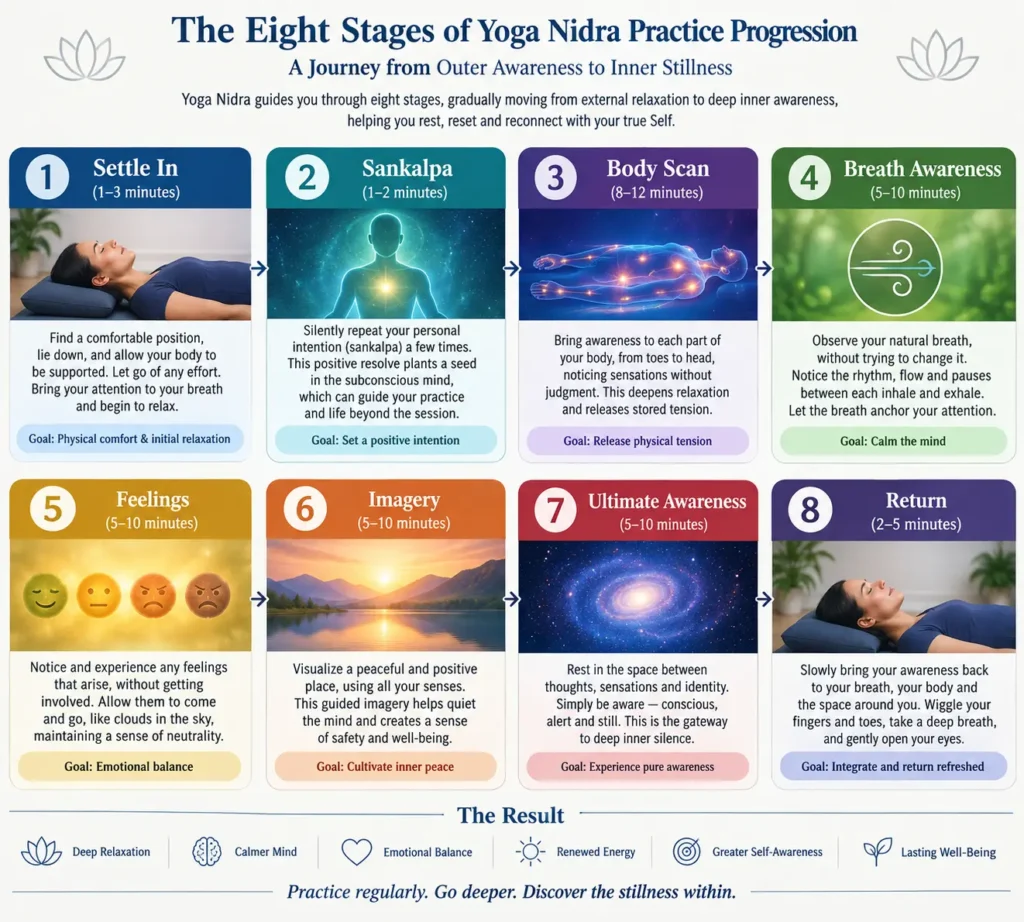
A complete yoga nidra session follows a specific progression of eight stages, each with a precise neurological purpose. Understanding these stages helps you recognize what’s happening during your practice.
Stage 1: Settling and Intention Setting (Sankalpa)
Your practice begins lying down in savasana (corpse pose) while the guide helps you become aware of your body’s contact with the ground and your surroundings. This grounding creates safety in your nervous system.
The guide then invites you to set a sankalpa—a personal intention, affirmation, or resolve for your practice. This might be “I am calm,” “I sleep deeply,” or “I heal completely.” Sankalpa is not wishful thinking; it’s a specific neurological anchoring technique that programs your subconscious mind during the theta state when your conscious critical faculties are relaxed.
Why this matters: Research shows that intentions set during theta brainwave states produce behavioral and physiological changes more effectively than intentions set during beta waking consciousness.
Stage 2: Rotation of Consciousness (Body Awareness)
The guide systematically brings your awareness through different body parts in a specific sequence: right hand, right arm, right shoulder, right side of torso, right leg, then the entire left side, then front and back of the body.
This isn’t visualization—you’re not imagining the body parts. You’re simply noticing and acknowledging them as the guide names them. This process does three things simultaneously:
Develops interoceptive awareness (ability to sense your body’s internal state) Activates all regions of the sensorimotor cortex (the brain map of your body) Begins disengaging your sense organs from external stimuli (pratyahara—sense withdrawal)Stage 3: Breath Awareness (Pranayama Element)
The practice then directs your attention to your breathing. Rather than controlling your breath, you simply observe it: noticing the coolness of the inhale, the warmth of the exhale, the rhythm, the depth.
This stage serves multiple purposes:
Anchors attention to the present moment Further activates the parasympathetic nervous system (slower breathing = calmer nervous system) Creates a bridge between body awareness and consciousness Develops the capacity to observe without controlling (a key skill for anxiety management)Stage 4: Visualization and Imagery (Subtle Body Awareness)
The guide introduces specific visualizations or images—sometimes traditional (mandala, sacred symbols), sometimes nature-based (mountains, rivers, sky), sometimes abstract (colors, light).
These visualizations don’t require you to “see” clearly. Even vague impressions or the intention to visualize activates your visual cortex and engages the right-brain, associative thinking that contrasts with the left-brain logical thinking that creates anxiety.
Stage 5: Emotional Awareness and Release
The practice may introduce contrasting emotional states—first inviting you to notice or recall a moment of grief, sadness, or heaviness, then inviting you to shift into joy, lightness, peace.
This stage serves a crucial function: it allows suppressed or stuck emotions to move through your nervous system and be released during a state of safety (the relaxation of yoga nidra). This is why some practitioners spontaneously cry, laugh, or feel emotional waves during yoga nidra—emotions stored in the body are being safely processed.
Stage 6: Sankalpa Reinforcement (Second Intention Setting)
Midway through or near the end of the practice, you return to your original sankalpa. Having moved through body awareness, breath awareness, and emotional processing, your subconscious mind is now even more receptive to this intention-setting.
This reinforcement creates stronger neurological programming than a single intention-setting at the beginning.
Stage 7: Externalization (Gentle Return to Awareness)
The guide begins bringing your awareness back outward—first to the room around you, then to sounds, then gradually increasing your awareness of your body.
This stage is critical. Jumping suddenly from deep theta state back to beta waking consciousness can create disorientation. Gentle, gradual externalization allows your nervous system to integrate the deep rest while maintaining your grounded, present awareness.
Stage 8: Completion and Integration (Transition to Waking)
Finally, you’re invited to wiggle your fingers and toes, stretch gently, and slowly roll to one side before gradually sitting up. The guide often offers a closing affirmation or blessing.
The integration phase continues for 30 minutes after your practice—your nervous system is still in an enhanced state of receptivity and learning during this window.
The Nine Major Benefits of Yoga Nidra: What Research Shows
Yoga nidra produces measurable, specific benefits that distinguish it from other relaxation techniques.
Benefit 1: Insomnia Relief and Sleep Quality Improvement
Yoga nidra specifically addresses insomnia through multiple mechanisms:
How it works: The practice trains your nervous system to enter the theta brainwave state (the state your brain naturally enters in REM sleep) while conscious. Regular practice creates a neurological habit of entering this state, making it easier for your body to transition naturally into sleep at night.
Research evidence: A 2017 study in the Journal of Yoga & Physical Therapy found that regular yoga nidra practice (4 times weekly) reduced insomnia severity by 43% after 8 weeks. Participants also reported falling asleep faster (reduced sleep latency) and experiencing fewer nighttime awakenings.
Practical reality: Many practitioners report that a 20-30 minute yoga nidra practice before bed becomes equivalent to falling asleep naturally—they enter the exact brainwave state their body needs for deep rest.
Benefit 2: Cortisol Reduction and Stress Relief
Stress activates your sympathetic nervous system (fight-or-flight), elevating cortisol, adrenaline, and other stress hormones. These hormones are meant for acute threats but become problematic when chronically elevated.
How it works: Yoga nidra activates the parasympathetic nervous system (rest-and-digest) through the systematic relaxation response. Within 10-15 minutes, your body begins shifting from sympathetic dominance to parasympathetic dominance.
Research evidence: A 2015 study measuring cortisol in saliva samples before and after yoga nidra found a 20-30% reduction in cortisol levels after a single 45-minute session. Chronic practitioners showed baseline cortisol levels 25-35% lower than controls.
Practical timeline:
After 1 week: Sleep quality noticeably improves, you feel slightly calmer After 4 weeks: Baseline anxiety decreases, your nervous system resets more quickly when stressed After 12 weeks: Significant reduction in chronic stress symptoms, cortisol normalizationBenefit 3: Anxiety and Panic Attack Management
Anxiety emerges from a mismatch between perceived threat and actual safety. Your body and mind are stuck in a threat-detection loop.
How it works: Yoga nidra creates a state of complete safety (your body is fully supported, your nervous system deeply relaxed) while your consciousness is aware. This teaches your nervous system a new neural pathway: safety is possible even when you’re mentally present.
Research evidence: A 2016 study at the National Institute of Mental Health compared yoga nidra to standard anxiety treatment. Yoga nidra was nearly as effective as cognitive behavioral therapy for reducing generalized anxiety symptoms and more effective for panic symptoms.(1)
Practical application: Practicing yoga nidra 3-4 times weekly creates a baseline nervous system state that’s less prone to anxiety activation. During an acute anxiety episode, a 15-20 minute yoga nidra session can interrupt the cycle.
Benefit 4: Enhanced Cognitive Function and Memory
Chronic stress impairs prefrontal cortex (decision-making, memory) function and overactivates the amygdala (fear center). Yoga nidra reverses this pattern.
How it works: The theta brainwave state associated with yoga nidra is the state your brain naturally enters during memory consolidation. Regular yoga nidra practice appears to enhance your brain’s natural memory-processing abilities.
Research evidence: Studies show regular yoga nidra practitioners score higher on memory tests and demonstrate improved focus and cognitive flexibility compared to controls.
Benefit 5: Pain Management and Chronic Pain Relief
Chronic pain creates a negative feedback loop: pain creates tension, tension creates more pain. Your nervous system becomes hypersensitized, amplifying pain signals.
How it works: Yoga nidra’s body-scanning and sense-withdrawal techniques desensitize your nervous system to pain signals while simultaneously relaxing the muscular tension that perpetuates pain cycles.
Research evidence: Multiple studies show yoga nidra reduces both pain severity and pain-related disability in conditions including fibromyalgia, chronic low back pain, and arthritis.
Benefit 6: Improved Emotional Regulation and Mood
The emotional release that can occur during yoga nidra (Stage 5) creates emotional processing and integration.
How it works: Emotions not processed in the moment get stored in your nervous system and body, creating chronic tension and mood dysregulation. Yoga nidra provides a safe space for these emotions to move through and be released.
Research evidence: Studies show regular yoga nidra reduces depression and anxiety symptoms and improves emotional resilience.
Benefit 7: Blood Pressure Reduction and Cardiovascular Health
Chronic stress and parasympathetic underactivation contribute to hypertension (high blood pressure).
How it works: Yoga nidra’s activation of the parasympathetic nervous system creates vasodilation (blood vessels relax and widen), naturally lowering blood pressure.
Research evidence: Multiple studies show yoga nidra practice reduces both systolic and diastolic blood pressure. Some studies show effects comparable to certain blood pressure medications.
Benefit 8: Enhanced Immune Function
Chronic stress suppresses immune function. Yoga nidra’s parasympathetic activation enhances immune response.
How it works: Parasympathetic activation increases NK (natural killer) cell activity and antibody production while reducing inflammatory markers.
Research evidence: Studies show regular yoga nidra practitioners have higher NK cell activity and demonstrate faster recovery from illness compared to controls.
Benefit 9: Psychological Integration and Spiritual Development
Beyond the physiological benefits, yoga nidra creates unique conditions for psychological integration and spiritual development.
How it works: The theta brainwave state accessed in yoga nidra is associated with flow states, creative insight, and spiritual experience in mystical and meditative traditions across cultures.
Research evidence: While harder to quantify, many practitioners report profound insights, emotional healing, and spiritual experiences through regular yoga nidra practice.
How to Practice Yoga Nidra: Step-by-Step Setup Guide
Setting up properly is crucial for yoga nidra success. Unlike meditation where you sit upright, yoga nidra requires lying down and absolute comfort.
Physical Setup: Creating the Ideal Environment
Your Location
Choose a space where you won’t be disturbed for 30-50 minutes Close doors, put phone on silent, let household members know you’re practicing If you live in a noisy environment, use earplugs or play gentle background soundYour Yoga Nidra Pose (Savasana)
Lie on your back on a yoga mat or carpeted floor (not a soft bed—you need firm support) Legs extended, feet falling naturally apart (not touching) Arms at your sides, palms facing up or down (whichever feels natural) Head neutral (not tilted back or forward)Comfort Modifications
Under your knees: Place a rolled blanket or bolster to reduce lower back strain Under your head: Use a thin pillow or yoga block to keep your cervical spine neutral Under your neck: If you have neck tension, a small rolled towel provides support Over your body: Lay a blanket over yourself—as your body relaxes and core temperature drops, you may feel cold Around your ears: If hearing your guide’s voice is difficult, position yourself at an appropriate distance or use headphonesTemperature
Keep the room comfortably cool (around 68-70°F is ideal) Your core temperature naturally drops during yoga nidra, so you’ll want the blanketHow to Receive Yoga Nidra Guidance
You have four primary options:
Option 1: Guided Recordings (Recommended for Beginners)
Use recorded yoga nidra sessions from trusted teachers:
YouTube: Search “yoga nidra 20 minutes” or “yoga nidra for sleep” Apps: Insight Timer (free), Calm (subscription), Yoga Nidra Network Teachers: Explore recordings from established teachers like Swami Satyananda Saraswati, Richard Miller, or Kripalu yoga programsBenefits: Consistent quality, can practice anytime, no scheduling required Drawback: Less personalized than live guidance
Option 2: Live Classes or Workshops
Attend yoga nidra classes at studios or meditation centers:
Many yoga studios now offer dedicated yoga nidra sessions Workshops provide deeper learning about the practice In-person instruction allows the teacher to observe and adjustBenefits: Personal instruction, community, immediate questions answered Drawback: Requires scheduling, may not be available in your area
Option 3: One-on-One Sessions with a Teacher
Work with a yoga nidra specialist for personalized guidance:
Can customize practice for your specific needs (insomnia, anxiety, specific health conditions) Allows the teacher to help you work through blocks or resistance Creates accountability and deepens understandingBenefits: Maximum personalization and depth Drawback: Highest cost
Option 4: Self-Guided Practice (After Training)
After practicing with guidance, some advanced practitioners self-guide their own sessions:
Benefits: Complete autonomy, can practice whenever Drawback: Requires prior experience and strong self-disciplineThe Step-by-Step Yoga Nidra Session Structure
Pre-Practice (5 minutes before)
Prepare your space—close doors, silence phone Set your sankalpa (intention)—what do you want from this practice? (“I sleep deeply,” “I am calm,” “My body heals”) Lie down in savasana position with all comfort modifications in place Give yourself permission to completely let go of controlStart of Practice
Your guide invites you to become aware of your body lying on the ground Notice points of contact—where your body touches the earth Become aware of the room around you without turning your head Begin to feel as though your body is becoming very heavy and relaxedBody Rotation Phase (Approximately 10-15 minutes)
Your guide systematically guides your awareness through body parts You simply acknowledge each part as named—right hand, right arm, right shoulder, right side of torso, right leg, then entire right side Then the left side in the same sequence Then back of the body, front of the body Throughout this phase, each part you acknowledge begins to relax more deeplyBreath Awareness Phase (Approximately 5-10 minutes)
Your guide directs your attention to your breath Notice the natural rhythm—no effort to control it Feel the coolness of the inhale, the warmth of the exhale Continue observing breath naturally without manipulationVisualization/Imagery Phase (Approximately 5-10 minutes)
Your guide introduces a specific image or visualization You don’t need to “see” it clearly—even the intention to visualize activates your visual cortex Allow the image to appear naturally without effortSankalpa Reinforcement (Approximately 2 minutes)
Return to your original intention Repeat it silently 3 times with full presence and belief Feel the intention as already trueEmotional Release Phase (Variable—5-15 minutes)
Your guide may invite you to notice or recall an emotion Allow whatever arises to move through without resistance Then shift into an opposite emotional stateReturn Phase (Approximately 5-10 minutes)
Your guide begins bringing your awareness back outward First to the room around you Then to sounds you can hear Gradually increasing awareness of your bodyCompletion Phase (Approximately 2-3 minutes)
Your guide invites you to wiggle fingers and toes Gentle stretches Slowly roll to your right side When ready, gradually sit up Take a few moments before standing to let your body fully re-orientTotal Duration: 20-50 minutes (beginners typically start with 20-30 minutes)
Yoga Nidra Modifications for Different Needs and Bodies
Yoga nidra is remarkably accessible, but specific modifications optimize it for different situations.
Modification for Insomnia and Sleep Problems
Setup:
Practice 30-60 minutes before your normal bedtime Use an extended session (40-50 minutes) Choose a guide whose voice is particularly soothing to you Focus your sankalpa on sleep: “I sleep deeply and wake refreshed”Why it works: Yoga nidra trains your nervous system to enter the theta brainwave state that facilitates sleep. Regular evening practice creates a neurological habit that makes falling asleep easier.
Caution: Some people fall asleep during yoga nidra, which is okay occasionally but indicates your nervous system may need even more rest. If you’re consistently falling asleep, you may need to practice at a different time of day or address underlying sleep deprivation.
Modification for Acute Anxiety or Panic
Setup:
Use a shorter session (15-20 minutes) Choose a guide with a calm, grounding voice Practice immediately when anxiety arises (don’t wait) Focus sankalpa on calm: “I am safe,” “My nervous system is calm”Why it works: Interrupting an anxiety spiral with immediate nervous system regulation prevents escalation. Even 15 minutes can shift you from sympathetic (fight-or-flight) to parasympathetic (rest-and-digest) dominance.
Modification for Chronic Pain
Setup:
Focus on body scanning phase with specific attention to pain areas Use compassionate imagery during visualization phase (healing light, soothing water) Set sankalpa related to pain: “My body heals,” “Pain is releasing” Practice 30-45 minutes to allow deep nervous system relaxationWhy it works: Chronic pain involves nervous system hypersensitization. Yoga nidra’s systematic body awareness and nervous system relaxation reduce pain signaling and break pain-tension cycles.
Modification for PTSD or Trauma
Setup:
Only practice with a trauma-informed yoga nidra teacher Modified practices may include additional grounding techniques Practices may avoid certain imagery that could be triggering Build practice duration gradually (start with 10-15 minutes)Why it works: Trauma survivors’ nervous systems are stuck in protective activation. Yoga nidra must be modified to feel safe and supportive rather than triggering.
Important safety note: If you have PTSD, trauma history, or dissociation, consult with your mental health provider and work with a trauma-informed teacher.
Modification for Pregnancy
Setup:
Lie on your left side after first trimester (supported by pillows) Use practices specifically designed for pregnancy Set sankalpa related to pregnancy: “My baby and I are healthy,” “I trust my body” Avoid abdominal compressionWhy it works: Yoga nidra provides deep relaxation for a pregnant nervous system while supporting healthy fetal development through maternal calm.
Modification for Limited Mobility or Chronic Conditions
Setup:
If you cannot lie flat, practice in a semi-reclined position (propped on pillows) Place support under knees, neck, and anywhere needed for comfort Can practice seated in a chair if lying is impossible Focus on accessible body parts in rotationWhy it works: Yoga nidra’s benefits don’t depend on perfect positioning—they depend on nervous system relaxation, which is possible in any comfortable position.
Common Mistakes in Yoga Nidra Practice and How to Avoid Them
Mistake 1: Trying Too Hard
Yoga nidra is fundamentally about releasing effort and control, yet many beginners approach it with the same striving mentality they bring to other practices.
The Problem:
Tensing your body while trying to “relax” Forcing visualization instead of allowing it to arise naturally Judging the quality of your practice “Trying” to reach a particular state rather than allowing itThe Solution:
Adopt the attitude of “allowing” rather than “doing” Release expectations about what should happen Understand that even a “failed” yoga nidra practice—where your mind wanders constantly—still provides nervous system benefit Remember: the only requirement is that your body is relaxed and your attention is somewhat presentMistake 2: Expecting Immediate Life-Changing Results
Some practitioners expect one yoga nidra session to permanently solve their insomnia or anxiety.
The Problem:
Discouragement after one or two practices Not recognizing gradual improvements Quitting before the practice has cumulative effectThe Solution:
Commit to 4-6 weeks of consistent practice (3-4 times weekly) before evaluating effectiveness Track subtle changes: Do you sleep slightly better? Feel slightly calmer? Recognize that nervous system changes happen gradually as neuroplastic shifts occur Understand that benefits compound—early practices create foundation for deeper experiencesMistake 3: Practicing in an Unsuitable Environment
Many people attempt yoga nidra in stimulating environments: in bed with their partner, in their office, or with background noise.
The Problem:
External stimuli (noise, light, interruptions) prevent entering theta brainwave state Your nervous system can’t fully relax when partially expecting interruption Quality of practice significantly decreasesThe Solution:
Create a dedicated, quiet space for practice Use headphones if necessary for audio guidance Practice when household members are occupied Consider white noise or gentle ambient sound if external noise is unavoidable Establish yoga nidra as a protected, sacred practice timeMistake 4: Lying on a Bed or Overly Soft Surface
Beds are comfortable but too soft for effective yoga nidra.
The Problem:
Your body sinks into the surface, preventing proper alignment Can increase likelihood of falling asleep (sometimes undesirable if you’re trying to maintain awareness) Spinal alignment becomes compromisedThe Solution:
Practice on a yoga mat on the floor Use a firm, supportive surface If floor practice is uncomfortable, use a yoga mat topped with a thin blanket rather than a bedMistake 5: Not Using the Sankalpa Properly
Many practitioners treat sankalpa as a casual thought rather than a powerful neurological tool.
The Problem:
Vague intentions (“Be better,” “Feel good”) don’t create specific neurological programming Setting intentions without conviction or feeling Forgetting the sankalpa by the time you reach the reinforcement phaseThe Solution:
Choose a specific, concise sankalpa (ideally 5-7 words maximum) Phrase it positively and in present tense (“I am calm” not “I will become calm”) Feel the sankalpa emotionally when you set it Write it down before practice so you can reference it Examples: “I sleep deeply,” “My nervous system is calm,” “I heal completely”Mistake 6: Falling Asleep Consistently and Judging It Negatively
Some practitioners believe yoga nidra “doesn’t work” because they fall asleep.
The Problem:
Misunderstanding the goal Thinking falling asleep means failure Missing the deeper benefits through this judgmentThe Solution:
Understand that falling asleep occasionally is normal and indicates your nervous system needs rest Recognize that even if you fall asleep, your nervous system has received deep relaxation benefit If you want to maintain awareness, practice at a different time (morning or afternoon rather than evening) when you’re less tired Understand that consistent falling asleep indicates sleep deprivation that needs addressing separatelyMistake 7: Continuing When You Need Medical Care
While yoga nidra supports many conditions, it’s not a substitute for medical treatment.
The Problem:
Using yoga nidra instead of seeking treatment for serious conditions Avoiding medical diagnosis or treatment Thinking yoga nidra alone will cure clinical depression, severe anxiety disorder, or other conditions requiring professional careThe Solution:
Use yoga nidra as a complementary practice alongside medical treatment Consult healthcare providers about any concerning symptoms Work with trauma-informed teachers for PTSD or trauma-related issues Recognize that yoga nidra powerfully supports recovery but doesn’t replace professional mental health careContraindiations: When to Avoid or Modify Yoga Nidra
Yoga nidra is remarkably safe for most people, but specific conditions require modifications or caution.
Conditions Requiring Modifications (Not Complete Avoidance)
Sleep Disorders with Altered Consciousness
Condition: Narcolepsy, sleep apnea Modification: Practice during daytime when alertness is easier to maintain; shorter sessions Consultation: Work with sleep specialist to ensure practice is appropriatePTSD or Trauma History
Condition: Post-traumatic stress disorder, significant unprocessed trauma Modification: Use trauma-informed yoga nidra specifically designed to feel safe; work with trained teacher; build duration gradually Consultation: Coordinate with mental health providerSevere Depression with Dissociative Symptoms
Condition: Clinical depression with dissociation or disconnection from reality Modification: May need to avoid extended practices; shorter sessions; ground-focused rather than visualization-heavy Consultation: Coordinate with mental health provider before beginningHypotension (Chronically Low Blood Pressure)
Condition: Consistently low blood pressure (below 90/60) Modification: Practice seated or semi-reclined rather than fully lying; shorter sessions; check blood pressure response Why: Extended parasympathetic activation can lower blood pressure furtherSeizure Disorders
Condition: Epilepsy or other seizure disorders Modification: Avoid strobe or flashing light visualizations; inform your neurologist; work with experienced teacher Why: Certain brainwave states can trigger seizures in susceptible individualsConditions Requiring Caution (Proceed With Professional Guidance)
Active Psychosis or Active Manic Episode
Condition: Currently experiencing psychotic symptoms or manic state Recommendation: Postpone practice until stabilized; coordinate with psychiatric care Why: Altered consciousness state could exacerbate symptomsRecent Hospitalization or Medical Crisis
Condition: Recently discharged from hospital; recovering from serious illness Recommendation: Check with healthcare provider; start with very short sessions Why: Body may need gentler support during recoveryUnmedicated High Blood Pressure
Condition: Untreated hypertension Recommendation: Work with healthcare provider; monitor blood pressure response Why: While yoga nidra can help, unmedicated hypertension needs medical attentionWhen Yoga Nidra is Completely Contraindicated
Active Substance Intoxication
Do not practice while under the influence of alcohol, recreational drugs, or medications that significantly alter consciousness Why: Creates unpredictable neurological state that can be unsafeAcute Medical Emergency
Do not use yoga nidra as treatment for acute symptoms requiring emergency medical care Seek appropriate emergency services immediatelyHow to Deepen Your Yoga Nidra Practice
After establishing a foundational yoga nidra practice (4-6 weeks of consistent sessions), you can deepen your practice through various approaches.
Extended-Duration Practice
Progression:
Weeks 1-4: 20-30 minute sessions Weeks 5-8: 30-40 minute sessions Week 8+: 45-60 minute sessionsWhy longer works: Extended duration allows you to move through all eight stages more slowly, going deeper into each phase. Longer sessions often produce more profound nervous system reset and psychological insights.
Tips:
Extend gradually (add 5-10 minutes per week) Ensure your environment is completely comfortable for longer duration Stay hydrated before practiceExploring Different Teachers and Styles
Why vary: Different teachers have different voices, pacing, and emphasis areas. Exploring teachers helps you find what resonates most deeply for you.
Recommendations:
Try teachers with different teaching traditions (Tantra-derived, Kripalu, Yoga Nidra Network, etc.) Experiment with different voice tones (some prefer gentle whispers, others prefer clear, steady voices) Try both traditional approaches and modern adaptationsPracticing Multiple Sessions Weekly
Progression:
Beginners: 2-3 times weekly Intermediate: 3-4 times weekly Advanced: 4-6 times weekly (for practitioners with specific goals or conditions)Why frequency matters: Your nervous system adapts through repeated activation of parasympathetic pathways. More frequent practice accelerates neuroplastic changes.
Intentional Sankalpa Evolution
How to deepen:
Begin with external-focused sankalpa: “I sleep deeply,” “My anxiety decreases” Progress to identity-focused: “I am peaceful,” “I am healed” Progress to philosophical/spiritual: “I am connection,” “I am whole,” “I awaken to my true nature”Why it deepens: As your nervous system heals, your sankalpa can address deeper layers of transformation.
Integrating Yoga Nidra Into Advanced Meditation Practice
For experienced meditators: Yoga nidra can become preparation for or complement to sitting meditation, Pranayama, or Kundalini practices.
Integration: Use yoga nidra as evening practice and meditation as morning practice, creating comprehensive nervous system support.
Working With a Teacher for Customized Practice
Individual guidance: Advanced practitioners may work with yoga nidra specialists to address specific life areas, psychological patterns, or spiritual goals.
Benefits: Personalized practice can address your particular nervous system patterns and goals more precisely than generic recordings.
Conclusion
Yoga nidra is perhaps the most powerful yet underutilized relaxation tool available to modern practitioners.
In a world of constant stimulation, chronic stress, and sleep deprivation, yoga nidra offers something rare: a scientific, evidence-based pathway to the deepest nervous system rest your body can experience while remaining conscious.
A single 45-minute yoga nidra session produces the same parasympathetic activation and nervous system repair as 2-3 hours of normal sleep. Regular practice creates neuroplastic changes that shift your baseline from stressed activation to parasympathetic calm. Within 4-6 weeks of consistent practice, insomnia decreases, anxiety reduces, sleep quality improves, and your nervous system fundamentally resets.
The research is unambiguous: Yoga nidra reduces cortisol by 20-30%, improves sleep quality by 40-60%, decreases anxiety more effectively than many therapeutic interventions, and produces measurable cognitive improvements.
Yet yoga nidra remains accessible to virtually everyone. It requires no flexibility, strength, or balance. It can be practiced lying on your living room floor. It can be done by beginners and advanced practitioners alike. It accommodates most physical conditions with simple modifications.
The practice is remarkably simple:
Lie down comfortably in a quiet space Receive guidance (from a recording or teacher) Allow your nervous system to enter the deepest relaxation state while your consciousness remains present Integrate the profound rest into your daily lifeWhat makes yoga nidra transformative is its consistency. The first practice feels good. The tenth practice feels better. The fiftieth practice has shifted your entire nervous system baseline. After months of regular practice, you’ve literally rewired your brain toward calm, resilience, and presence.
Your nervous system has been asking for this.
After years, perhaps decades, of chronic stress and overstimulation, your body is ready for the deepest possible rest. Yoga nidra is that rest—accessible, scientific, powerful, and waiting for you.
Take the first step today.
Find your mat. Lie down. Allow yourself to be guided into the deepest relaxation your nervous system has ever experienced.
KEY TAKEAWAYS
Essential Yoga Nidra Knowledge:
✅ Yoga nidra (yogic sleep) is a guided meditation technique inducing conscious relaxation between waking and sleeping, creating unique conditions for nervous system reset.
✅ Theta brainwave state: Yoga nidra specifically targets the 4-8 Hz theta brainwave state associated with REM sleep and deep meditation—different from waking (beta) or deep sleep (delta).
✅ Sleep equivalence: A single 45-minute yoga nidra session provides nervous system rest equivalent to 2-3 hours of normal sleep, making it invaluable for stressed, exhausted practitioners.
✅ Research-backed benefits: Scientifically-documented benefits include 43% insomnia reduction, 20-30% cortisol reduction, anxiety decrease comparable to cognitive behavioral therapy, and improved cognitive function.
✅ Eight systematic stages: Complete yoga nidra follows eight stages—intention setting, body rotation, breath awareness, visualization, emotional release, intention reinforcement, externalization, and completion—each with specific neurological purpose.
✅ Sankalpa power: Intentions set during theta brainwave state create stronger subconscious programming than waking intentions, making sankalpa a powerful self-transformation tool.
✅ Accessibility supreme: Yoga nidra is profoundly accessible—requires no flexibility, strength, or balance; can be practiced lying down; accommodates most physical conditions with modifications.
✅ Consistency drives results: Daily practice or 3-5 times weekly produces measurable results within 4-6 weeks. Less frequent practice may not reach threshold for noticeable benefits.
✅ Safe for most people: Yoga nidra is safe for vast majority with specific modifications for PTSD, trauma, seizure disorders, severe depression, and narcolepsy. Work with trauma-informed teachers for complex conditions.
✅ Complementary not substitutive: Yoga nidra powerfully supplements sleep, meditation, and traditional medical treatment but doesn’t replace actual sleep or professional mental healthcare.
✅ Neuroplastic changes: Regular practice creates measurable neurological changes—practitioners show baseline theta wave activation in daily life, indicating lasting nervous system shift toward parasympathetic dominance.
✅ Misinformation correction: Yoga nidra is not meditation (you’re not developing concentration), is not sleep (you maintain awareness), is not a substitute for actual sleep, and does NOT require falling asleep to be effective.
FAQ SECTION
Q 1: Can yoga nidra replace sleep?
Yoga nidra provides profound nervous system rest comparable to 2-3 hours of sleep. However, your body still needs actual sleep for certain physiological processes (growth hormone release, tissue repair). Yoga nidra supplements sleep but shouldn’t replace it entirely. Use it for relaxation and stress relief, not as substitute for adequate nightly sleep.
Q 2: How often should I practice yoga nidra?
Daily practice delivers maximum benefits. If daily isn’t possible, 3-5 times weekly produces measurable results within 4-6 weeks. Even 2-3 times weekly improves sleep quality and reduces anxiety. Less than twice weekly may not provide noticeable cumulative benefits. Consistency matters more than duration—brief daily practice beats occasional long sessions.
Q 3: Is yoga nidra safe for everyone?
Yoga nidra is safe for most people. However, consult healthcare providers if you have PTSD, active psychosis, seizure disorders, severe depression, or narcolepsy. Pregnant women should use pregnancy-specific practices. Most conditions don’t contraindicate yoga nidra entirely—they simply require appropriate modifications or guidance from trauma-informed teachers.
Q 4: What happens if I fall asleep during yoga nidra?
Falling asleep occasionally is normal and indicates your nervous system needs rest. Your body has still received deep relaxation benefits even if unconscious. If you consistently fall asleep, practice at different times when you’re less tired, or address underlying sleep deprivation separately. Some practitioners consider occasional sleep during evening yoga nidra perfectly acceptable.
Q 5: How does yoga nidra differ from meditation?
Meditation involves focused attention while sitting upright. Yoga nidra involves systematic relaxation while lying down, with emphasis on theta brainwave state and conscious sleep. Meditation trains concentration; yoga nidra trains relaxation and nervous system regulation. Both complement each other. Yoga nidra is often easier for beginners because it requires less effort and concentration than meditation.
Disclaimer: This article is for informational purposes only and does not constitute medical or mental health advice. Yoga nidra is a complementary wellness practice, not a medical treatment. Before practicing yoga nidra, consult a qualified healthcare provider if you have health conditions, mental health concerns, are pregnant, or take medications. Stop immediately if you experience distressing symptoms. For mental health crises, contact the National Suicide Prevention Lifeline at 1-800-273-8255.