Turning Back to Place
Environmentalist, Zen, and Indigenous teachings for overcoming rootlessness The post Turning Back to Place appeared first on Tricycle: The Buddhist Review.
 ValVades
Reinhabitory refers to the tiny number of persons who have come out of the industrial societies . . . and then start to turn back to the land, back to place. This comes for some with the rational and scientific realization of interconnectedness and planetary limits.
—Gary Snyder
Unfortunately, few of us feel like we live in a “nature-culture” nexus. Most of us spend our days indoors. We get entranced by the black screen in front of us. We’re largely ignorant of the natural systems enveloping us. We have little sense of place. In the United States, people tend to move around—in search of education, employment, and love—and end up dis-located and dis-placed. Gary Snyder writes:
One of the key problems in American society now, it seems to me, is people’s lack of commitment to any given place—which . . . is totally unnatural and outside of history. Neighborhoods are allowed to deteriorate, landscapes are allowed to be strip-mined, because there is nobody who will live there and take responsibility; they’ll just move on.
In some respects, however, our disconnection from a specific place is inside of history, at least recent history. Daniel Wildcat writes:
In the increasingly geographically mobile world humans inhabit at the beginning of what Western civilization calls the twenty-first century, fewer and fewer people have tangible lifeway relationships to the places in which they live. Humankind’s diets, clothing, dwellings, and everyday lives are increasingly shaped by social forces such as corporations and marketers that attempt to transcend the unique features of the peoples and places of the planet.
This recent historical development has left us with “one monolithic global consumer culture that makes a sense of place—or more properly, natural landscapes—irrelevant in its homogenizing logic. And being dis-placed, we may not pay close attention to what is happening around us, whether pollinators disappearing, songbirds becoming scarcer, or insect-borne diseases spreading. In this way, our awareness of climate disruption gets stunted.
Reinhabitation
In response to our dis-placement, Snyder has drawn from his youth on a farm, extensive time in wilderness areas, monastic practice of Zen in Kyoto, commitment to his region in the foothills of the Sierra, understanding of Indigenous traditions, scientific knowledge, and a range of other sources to offer a vision of how we might live more fully in our place and take care of it in community with others. He advocates that we discern “the web of the wild world” and “make intimate contact with the real world, the real self.” Here, he seems to be drawing from the Zen idea that we do not exist apart from the world and that, in the depths of practice, we can realize our non-dual relationship with it. Unfortunately, however, our moving around and mental disconnection from nature has made us, in Snyder’s view, “an unsettled and disenfranchised people.”
This pattern of unsettledness and disconnection certainly pertains to me. On the one hand, I grew up in one house and spent much of my youth down at the river across the street. I came to love the pools where I fished, the hemlocks and ferns on the banks, and the tall grasses and wildflowers in the abandoned cow pastures through which my brothers and I walked on our way down to the river and back. My body was intimately engaged with that place, as evidenced by the mosquito bites I sported on my legs each summer. I felt wonder as I watched the trout in that river and the fireflies above those fields at night. My love of that place is in my bones, as is the grief I feel over recent changes that have been wrought by our disrupted climate: the dwindling trout population as the river warms, the disappearance of those fireflies, the inability of kids to scamper through those grassy fields without getting deer ticks on their legs, and the stark fact that the delicate mosquitoes that used to leave me with those familiar bumps on my legs can now hammer me with West Nile virus and eastern equine encephalitis.
Though I fully inhabited that place with my youthful body and spirit, across the thirty years between leaving there for college and moving to Massachusetts my residence changed every year or two. For much of that time, I knew little about the watersheds in which I lived, and I rarely got involved with the local community. Granted, in certain moments I felt connected to the nature around me, but my knowledge of it was limited.
To be in nature more fully than just experiencing rare moments of intimacy with our surroundings, we need to “turn back to the land, back to place.” And do so for the long haul. Snyder once said, “First, don’t move, and second, find out what that teaches you.” As we stay put, “we must honor this land’s great antiquity—its wildness—learn it—defend it—and work to hand it on to the children (of all beings) of the future with its biodiversity and health intact.” Settling down in my current semi-urban place has been hard for me at times, for there is a part of me that wants to move out into the country, with some land, and maybe some forested acres to cut wood for a fireplace. But I stay here in our condo on the edge of Boston, at times frustrated but cognizant of the carbon emissions caused by heating with wood and enjoying a fire, not to mention the effect that the wood smoke would have on my wife’s asthma.
In our turning back to the land, we have to reinhabit our local place. We have to grasp how our homes are nestled in a specific ecosystem, in a watershed, and, more broadly, in a bioregion. This necessitates a detailed understanding: “Bioregional awareness teaches us in specific ways. It is not enough just to ‘love nature’ or to want to ‘be in harmony with Gaia.’ Our relation to the natural world takes place in a place, and it must be grounded in information and experience.” Through this information and experience, we acquire knowledge of our place as a particular locus of interconnection. As Snyder puts it, “You should really know what the complete natural world of your region is and know what all its interactions are and how you are interacting with it yourself.” Charles Strain argues that Snyder is in this way emphasizing “the practice of mindful concentration, samadhi, refocused as the kind of attention to the detailed variations of climate and soil, to what will flourish and what will not in this place. . . .”
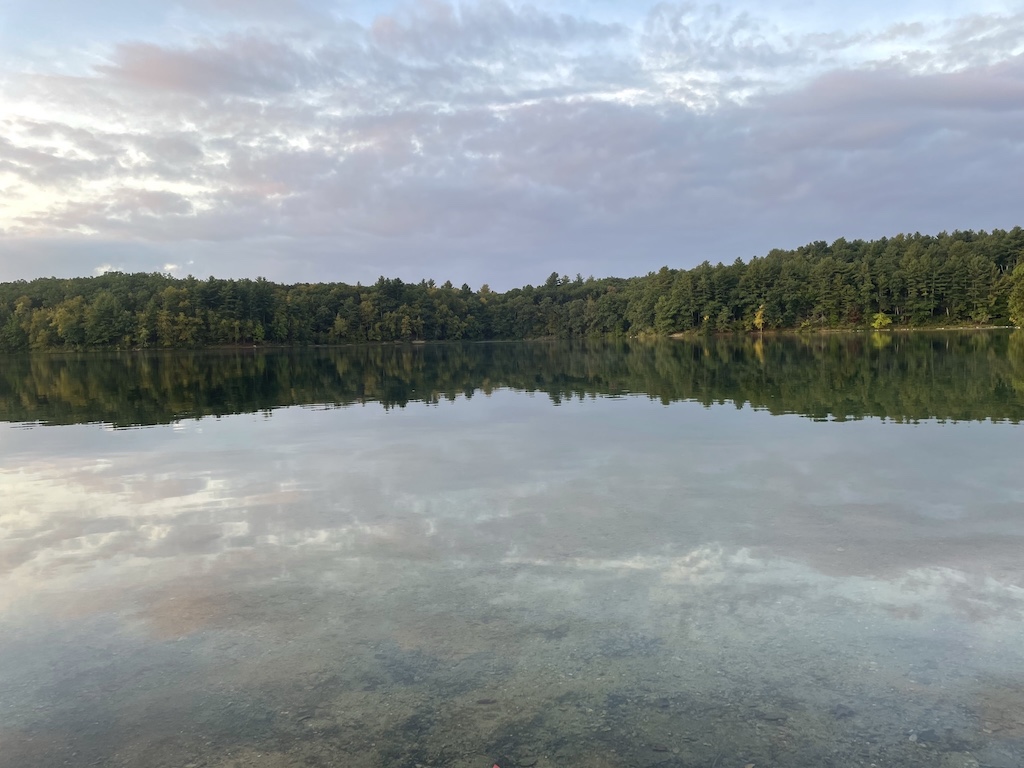
To this end, we need to study the geological history underneath and around our dwelling. We need to get a handle on the constitution of the bedrock and the composition of the soil. My geological knowledge of the area where I live is limited, but I do know that it was under a mile-thick layer of ice during the last ice age, and that nearby Walden Pond is a kettle pond, similar to those on Cape Cod, which formed when the ice melted back from south to north.
Those of us who are non-Native can learn from the Original peoples who have complex knowledge systems derived in part from their enduring connection to land, waterways, animals, and all forms of life, and who have their own ways of being in these places.
It is important to know what has happened here since that melting, including the lifeways of the different peoples who have lived here, whether Indigenous or invasive. We also need to identify bugs and other animals living on our block or in our backyard, as well as the plants growing around the buildings. We need to learn how water moves through this place in a hydrological cycle. Scott Russell Sanders writes, “When we figure our addresses, we might do better to forget zip codes and consider where rain goes after it falls outside our windows.” In the place where I live, known by its original inhabitants as Pigsgussett—present-day Watertown, Massachusetts—much of the rain flows into Quinobequin (the Charles River), as it does in other nearby towns, at times pulling sewage into the river and resulting in the cancellation of one of my favorite activities in the early summer: participating in a one-mile swim race in the Boston section of the river before it flows through a dam by the Museum of Science and into the harbor. We also need to learn how our local ecosystem changes with the seasons. We need to come up to speed with how land is being used and perhaps damaged in our town or city, and how local government is—or is not—regulating what is being done.
As part of this inquiry into the places where we live, those of us who are non-Native can learn from the Original peoples who have complex knowledge systems derived in part from their enduring connection to land, waterways, animals, and all forms of life, and who have their own ways of being in these places. Snyder writes that Original peoples can be “a great instructor in certain ways of tuning into what the climatic cycles, plant and animal communities, can tell us of where we are.” At the very least, as pointed out by Daniel Wildcat (Yuchi, Muscogee), “Tribal lifeways can remind us of the imperative to reconstitute a life-enhancing nature-culture nexus in the places where we live.” I might add that white Americans like me who descend from colonial settlers must also acknowledge the genocidal history that has “taken place,” taken land, in the places where we live.
♦

© 2025 by Christopher Ives, Zen Ecology: Green and Engaged Living in Response to the Climate Crisis. Reprinted by arrangement with Wisdom Publications.