Ugly to Iconic: How Crocs Marketing Strategy & Advertising Won the World
Crocs’ marketing strategy, in a sentence, is what makes you judge someone first when you see them wearing a pair of those shoes, but then you try one of them. But here’s what’s even more fascinating than the shoes...
 JimMin

Crocs’ marketing strategy, in a sentence, is what makes you judge someone first when you see them wearing a pair of those shoes, but then you try one of them.
But here’s what’s even more fascinating than the shoes themselves: the Crocs marketing strategy that took a brand widely mocked as an eyesore and turned it into a global cultural phenomenon worth over $4 billion in annual revenue just in a year (2022).
That journey is one of the most instructive marketing stories of the past two decades, and I’m going to talk about it throughout that blog.
Inside Crocs Advertising
Crocs Marketing History in a Nutshell Crocs SWOT Analysis: Knowing What You’re Working With The 4P Marketing Mix of Crocs Crocs Target Market Crocs Digital Marketing Management: How It Owns the Feed Social Media Strategy of Crocs Crocs Influencer Marketing Approach Real-World Crocs Marketing Campaigns How Does Crocs Marketing Strategy Support DIY & Sustainability? FAQ About Crocs Marketing StrategyCrocs Marketing History in a Nutshell
Crocs, Inc. was founded in 2002, launching its iconic foam clog shoes to the world.
The founders, Lyndon “Duke” Hanson and George Boedecker Jr., originally designed the shoes for boaters: practical, grippy, and easy to clean.
Nobody expected the world to go crazy for them. But then they did.
By 2007, Crocs was riding one of the wildest waves in footwear history. Annual revenue hit nearly $850 million, Hollywood celebrities were spotted wearing them, and the company’s stock had a 48% premium over its issue price. They had sold over 600 million pairs worldwide by the early 2020s.
Then came the crash.
In 2008–2009, the brand practically fell off a cliff. Revenue dropped to under $650 million. The 2007–2008 financial crisis didn’t help, as you can predict. People weren’t spending money on colorful foam clogs when they were worried about their mortgages. But the bigger problem was internal: Crocs lost its identity.
It started redesigning products in response to being called “ugly” (not in the same way as Balenciaga shoes) and expanding into completely unrelated product categories like sunglasses and golf shoes. They went from being one iconic thing to being nothing in particular.
Time magazine even put Crocs on its list of the “50 Worst Inventions” in 2010.

But then, Crocs found itself again. By 2020, despite a global pandemic, the company hit an all-time revenue high of $1.4 billion. And in 2021, their Q2 revenue alone reached $640 million, a 93.3% increase compared to the same quarter the previous year.
How?
Let’s dig into the full Crocs marketing strategy, from the ground up.
Crocs SWOT Analysis: Knowing What You’re Working With
Before we get into campaigns and channels, let’s do what any good marketer would do: understand the brand’s position. Here’s an honest SWOT analysis of Crocs.
| Strengths Instant Recognition: The Crocs clog is one of the most distinctive, multi-million dollar silhouettes in footwear. Material Advantage: Made from proprietary, odor-resistant, and durable Croslite™ foam resin. Extreme Comfort: Highly favored by medical workers, chefs, and retail employees; molds to the foot with body warmth. E-commerce Presence: Deep investments and fast growth on platforms like Amazon, eBay, Tmall, and JD.com. Customization Culture: Jibbitz™ charms (acquired in 2006) serve as a built-in personalization and engagement tool. | Opportunities Professional B2B Markets: Huge potential to dominate hospital and professional sectors where laceless, easy-to-clean footwear is required. Global Reach: Significant headroom for expansion in emerging markets beyond the current 90+ countries. High-Fashion Collaborations: Leveraging partnerships (like Balenciaga) to capture new and luxury customer segments. Sustainability: Leaning into biodegradable EVA materials and rubber recycling programs for eco-conscious buyers. |
| Weaknesses Polarizing Aesthetic: The “ugly shoe” reputation limits market reach as a highly divisive design. Safety Liabilities: Over 140 accidental injury claims (escalators, wet slips) totaling nearly NZD $180,000 over five years. Counterfeiting: Flood of knockoffs (especially in Indonesia) leading to bad brand experiences blamed on the original. Seasonality: Google Trends shows sharp cyclical revenue peaks in summer and drops in winter. | Threats Trend Cycles: Vulnerability to fast-fashion shifts where consumer clog preferences can quickly cool down. Intense Competition: A crowded space with Birkenstock, Hoka, and fast-fashion copycats releasing chunky clogs. IP Infringement: Ongoing struggles with widespread global counterfeiting despite design patents. Economic Downturns: Although accessible pricing helps, historical recessions show the brand is not entirely immune to downturns. |
The 4P Marketing Mix of Crocs
If you’ve ever taken a marketing class, you know the 4Ps: Product, Price, Place, and Promotion. Crocs is a textbook example of how getting all four right (and keeping them aligned) can transform a brand.
🌟Product
The biggest product lesson Crocs ever learned was: stop trying to fix what isn’t broken.
When they started redesigning the clog to make it more “normal-looking” in 2008, sales tanked.
When CEO Andrew Rees came on board in 2017 and steered the company back to its roots, the classic clog, the bright colors, the ventilation holes, revenue started climbing again.
After 2020, Crocs slashed 40% of their product line and reduced SKUs to around 200. Instead of trying to sell you everything, they focused on doing one thing exceptionally well.
The classic clog, the Jibbitz charm system, and the sandal line became the core.
What makes the product uniquely powerful is its customizability.
Jibbitz charms are a genius retention mechanic. Consumers collect charms, swap them out, and show them off. It’s basically wearable merchandise. This drives repeat purchases.
🌟Price
Crocs walks an interesting pricing tightrope. Standard classic clogs retail for around $50–$60, which puts them squarely in the “accessible” category. So, you don’t need to save up for them, but they’re not bargain-bin shoes either.
Then come the collaborations. The Balenciaga x Crocs platform clog? That launched at $850 and sold out within hours. Justin Bieber and Post Malone collaborate on Crocs? Limited quantities, premium pricing. KFC-themed Crocs? Also sold out in a flash.
This pricing strategy is brilliant because it creates a two-tier brand perception: Crocs is both the affordable everyday shoe AND the exclusive fashion piece you can’t get your hands on. It widens the addressable market enormously.
🌟Place
Before their turnaround, Crocs made a critical mistake: they opened too many stores, oversaturating the market and creating inventory nightmares, according to Hakala’s research. Their 2014 restructuring, which involved investing $24.5 million into revamping their marketing strategy, also included reducing physical store count.
Today, Crocs sells through a carefully managed mix of channels:
Direct-to-consumer (DTC) online through crocs.com Ecommerce marketplaces including Amazon, eBay, Tmall, and JD.com Wholesale retail through department stores and specialty footwear retailers Brand outlet stores in select locations🌟Promotion
This is where Crocs’ advertising strategy really shines, and we’ll spend a lot more time on this throughout the rest of this post. In short: Crocs leans into controversy, embraces collaborations, dominates social media, and uses scarcity to drive demand. Their promotional strategy is equal parts bold and self-aware.
Crocs Target Market
Understanding the Crocs target market is more complex than you might think.
The Original Core: Practical Comfort-SeekersThe original Crocs target audience was people who needed comfortable, waterproof, easy-to-maintain footwear. Boaters. Healthcare workers. Restaurant staff. Teachers. Parents chasing kids around.
These people didn’t care if Crocs were fashionable; they cared that their feet didn’t hurt after a 12-hour shift.
This segment never went away. In fact, during the COVID-19 pandemic, Crocs launched their “A Free Pair for Healthcare” campaign, donating over 900,000 pairs to frontline medical workers. It was a genuine act of generosity but also a part of Crocs marketing strategy. Those healthcare workers became walking brand ambassadors.
The New Core: Gen Z and Younger MillennialsAccording to survey research by Hakala, 57% of Crocs buyers surveyed were Generation Z or younger, with the largest group being 19–25 year olds at 40% of respondents.
Gen Z is the social media generation. They grew up on Instagram, TikTok, and YouTube. They discovered Crocs through feeds and reels and “get ready with me” videos. And critically, they don’t experience the same fashion shame around “ugly” shoes that older generations do. For them, wearing something deliberately weird is a flex.
The Luxury Fashion ConsumerThe Balenciaga collaboration introduced Crocs to an entirely new audience: people who shop at luxury boutiques and follow runway trends. This consumer doesn’t overlap much with the hospital nurse, but both are important to the brand’s positioning.
From a customer’s perspective, Crocs and Birkenstock occupy the same headspace: they are the go-to choice for anyone who prioritizes “ugly-cool” comfort and effortless utility over traditional fashion.
Crocs Digital Marketing Management: How It Owns the Feed
Crocs’ digital marketing approach is built around a few core principles:
be everywhere, be authentic, be a little weird.Crocs operates accounts across Instagram, TikTok, YouTube, Facebook, and Pinterest. Their content strategy is notably different from most footwear brands:
They don’t take themselves seriously. Posts are playful, often self-deprecating, and lean into the “ugly shoe” narrative instead of fighting it. They celebrate their community. User-generated content (UGC) is a huge part of their social presence. Real people wearing Crocs in real, sometimes absurd situations. They use hashtags strategically. Campaigns like #ComeAsYouAre and #ThousandsOfWays generated massive organic reach.On TikTok especially, Crocs has found a natural home. The platform’s algorithm rewards authentic, entertaining content over polished advertising, and Crocs’ personality fits that environment perfectly.
Crocs Influencer Marketing Approach
The brand’s president, Michelle Poole, described Crocs influencer strategy as follows:
Influencer strategy is a really critical part of our marketing playbook. And it has evolved. Several years ago, when Crocs was really trying to get back on the radar be perceived as a more aspirational brand, we leveraged some big name celebrities to really be ambassadors for our brand — people like Drew Barrymore. We continue to do some partnerships and have some partnerships with some broader well known names like Priyanka Chopra, for example. But I would say, we’ve also now evolved to really focus on a tapestry of micro-influencers. Some of these influences have such dedicated followers; they might have a smaller number of followers, but they have a really devoted — almost obsessed — group of followers. So we think about our influencer strategy as a rich tapestry of interests and affinities and geographies — and we stitch it together like a quilt.
This means everything from:
Mega-celebrities like Justin Bieber, Post Malone, and SZA Mid-tier influencers in lifestyle, fashion, and comedy niches Micro-influencers with highly engaged niche audiences Healthcare and professional communities where Crocs have genuine utilityOn the performance marketing side, Crocs invests heavily in search advertising, retargeting, and product listing ads across marketplaces. Their ChannelAdvisor partnership allowed them to syndicate product data across global e-commerce platforms efficiently meaning their products show up where people are already shopping.
What’s more, Crocs uses its DTC channel to build a first-party data advantage. Email marketing (particularly for new collection launches, limited-edition collaborations, and seasonal sales) drives significant repeat purchase behavior among their loyal base.
Real-World Crocs Marketing Campaigns
Now let’s talk about the actual Crocs marketing campaigns that have made headlines, driven sales, and kept the brand culturally relevant.
#1 MSCHF x Crocs
The Big Yellow Boot ($450) was designed to break the internet, not necessarily to be walked in. It worked because it transformed Crocs from a “utility clog” into a “conceptual art piece.”
By piggybacking on MSCHF’s existing “Big Red Boot” hype, Crocs didn’t have to build momentum from scratch. Launching at a Rick Owens show during Paris Fashion Week signaled to the world that Crocs belongs in the luxury conversation, even if ironically.
Crocs has historically been the punchline of fashion. By collaborating with a “troll” collective like MSCHF, they prove they have the self-awareness to mock themselves. This builds immense brand loyalty among Gen Z and Alpha, who value authenticity and humor over traditional prestige.
#2 Crocs x Shrek — The “Shrocs”
If the MSCHF collab was about clout, the Shrocs ($60) were about community. This campaign succeeded because it felt like a direct response to a decade of internet culture.
There is a cosmic alignment between Shrek and Crocs. Both are “ogres” in their respective fields: green and mocked. This “Ugly-Cool” aesthetic taps into a massive cultural trend where perfection is boring and “weird” is relatable.
By fulfilling a 2018 Change.org petition, Crocs showed they are actually listening to their fans. This turns customers into stakeholders; people felt they helped create it.
Restocking in 2025 alongside the Shrek 5 announcement is a textbook example of real-time marketing. They didn’t need a multi-million dollar ad spend because the movie studio’s PR machine did the heavy lifting for them.
#3 The Balenciaga Collaboration
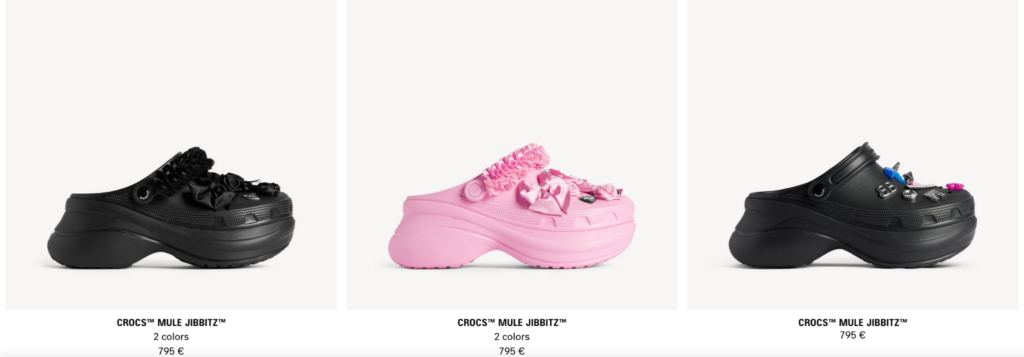
If there’s one moment that marks the true beginning of Crocs’ modern era, it’s the Balenciaga collaboration of October 2017.
This was a $850 platform clog, 10 centimeters of sole, Crocs holes, Jibbitz charms, and the Balenciaga logo. It walked down the Paris Fashion Week runway. Fashion critics lost their minds. And it sold out within hours of public release.
By aligning with one of the most prestigious houses in luxury fashion, Crocs effectively said: we exist in high culture now. Deal with it. After this, no one could credibly dismiss Crocs as a low-status brand anymore.
Still, the collaboration continues with the next lines:
#4 A Free Pair for Healthcare
When COVID-19 hit in 2020, Crocs launched a campaign to donate free pairs to healthcare workers. By November 2021, they’d donated over 900,000 pairs. The campaign generated enormous goodwill and media coverage and the cost.
The act reminded people that Crocs aren’t a fashion statement; they’re genuinely useful shoes. And wearing them became associated with people doing important, difficult work.
#5 Wonderfully Unordinary | A Crocs Story
This campaign is one of the most emotionally resonant pieces of Crocs marketing the brand has ever produced.
It basically tells human stories; people who refuse to conform, who show up as themselves, who are confident in their weirdness.
The tagline “Come As You Are” is embedded throughout. It’s a philosophy. And for Gen Z especially, that philosophy hits differently. This is the generation that grew up watching influencers commodify authenticity, so when a brand actually commits to it visually and narratively, it stands out.
From a production standpoint, this is high-quality, emotionally sophisticated Crocs advertising.
#6 Bretman Rock | These Are the Crocs
Bretman Rock is one of the most-followed beauty influencers on the internet, known for his unapologetic, vibrant personality and his enormous Filipino-American following. The decision to collaborate with him for a Crocs campaign was brilliantly targeted.
Bretman’s audience skews young, diverse, and deeply engaged. They follow him for his authenticity and his humor. And Crocs, as a brand, fits perfectly into his aesthetic: bold colors, zero apologies, and maximum personality. This campaign makes them look fun, which is arguably cooler.
How Does Crocs Marketing Strategy Support DIY & Sustainability?
The Crocs marketing strategy, no doubt, has encouraged the DIY culture; fans design custom Jibbitz charms and trade or sell them. That has created a micro-economy of handmade accessories.
Because official Crocs charms are expensive, consumers increasingly turned to handmade workshops and Etsy sellers for custom designs. This community-driven economy generated significant income for small creators and further cemented Crocs’ cultural presence.
According to the research titled “Market Fluctuations and the Crocs’ Resurgence,” on the supply chain side, high Crocs sales volumes translated into increased orders for suppliers of shoe materials, soles, and insoles, stimulating production across the footwear supply chain.
And then there’s the job creation at Crocs itself. From their headquarters in Broomfield, Colorado, to their manufacturing partners and retail operations across 90+ countries, Crocs directly and indirectly supports thousands of jobs.
What about sustainability? As consumers (especially younger ones) increasingly factor environmental values into purchasing decisions, Crocs has begun investing more seriously in sustainability messaging.
They are not just greenwashing; their use of biodegradable EVA materials alongside traditional Croslite, their rubber recycling programs in Asian factories, and their commitment to “reduce the number of types of materials in shoes, use waste or create products in products” are all real initiatives.
For future Crocs marketing strategy development, sustainability could become a much more prominent pillar. The brand already has the authenticity credentials, they just need to tell that story more loudly.
FAQ About Crocs Marketing Strategy
What is Crocs Inc.’s marketing strategy?
Crocs marketing strategy is one of the most interesting in modern business. The short version is: they stopped fighting what they were and started celebrating it. After a painful fall in 2008–2009, Crocs rebuilt around a few core pillars. First, they refocused entirely on their original product (the classic clog). Then they invested heavily in collaborations with celebrities (like Justin Bieber) and luxury brands (Balenciaga being the game-changer), leaned into social media especially among younger Gen Z consumers, embraced ecommerce as their primary growth channel, and adopted an influencer marketing strategy that spans everyone from global megastars to niche micro-influencers. The whole thing is held together by a brand philosophy — “Come As You Are.”
How does Crocs Inc. approach its advertising?
Crocs approaches advertising the same way they approach their product. Their advertising doesn’t try to make Crocs look “normal” or conventionally beautiful. Opposite, it leans into the brand’s weirdness, comfort-first philosophy, and community. They run big hero campaigns — like the emotionally driven “Wonderfully Unordinary | A Crocs Story” and the fun, personality-forward Bretman Rock collaboration — alongside a constant stream of social content that engages their community daily. Collaborations are treated as advertising events in themselves: a limited-edition celebrity Croc launch generates news coverage, social buzz, and resale market activity that no paid media budget could replicate. They also think globally, with China-specific campaigns including live-stream commerce, while running culturally tailored messaging in other markets.
What makes Crocs Inc. advertisements so effective?
A few things make Crocs advertisement so effective. First, they’re authentic in a way that a lot of brand advertising isn’t. When Bretman Rock stars in a Crocs ad, you believe it because Bretman Rock actually vibes with the Crocs brand personality. When they donated nearly a million pairs of Crocs to healthcare workers during COVID-19, it was meaningful, and people felt that. Second, Crocs ads tend to be emotionally resonant rather than feature-focused. They’re talking about freedom, self-acceptance, and comfort. Third, they’re smart about scarcity; limited editions create urgency and free media coverage. And fourth, they don’t fear controversy. The tension between “Crocs are ugly” and “Crocs are everywhere” generates cultural conversation that keeps the brand endlessly relevant.
Who is the target market of Crocs Inc.?
The Crocs target market is genuinely broad. At its core, Crocs targets comfort-seekers across all ages and backgrounds: healthcare workers, people who stand all day, parents, travelers, anyone who prioritizes how their feet feel. But in recent years, the brand has made a very deliberate push into Gen Z. This younger audience discovered Crocs through social media, celebrity culture, and the “ugly-cool” aesthetic trend. On top of that, Crocs has successfully penetrated the luxury fashion market through collaborations, attracting high-fashion consumers who might pay $850 for a Balenciaga x Crocs platform clog.
What are some notable Crocs Inc. advertising campaigns?
The Balenciaga collaboration (2017) was the moment that changed the brand’s cultural status; a $850 platform clog that walked Paris Fashion Week and sold out in hours. The “A Free Pair for Healthcare” campaign (2020) donated 900,000+ pairs to frontline workers during COVID-19 and earned enormous goodwill. The “Wonderfully Unordinary | A Crocs Story” brand film told deeply human stories around the “Come As You Are” philosophy. The Bretman Rock collaboration hit hard with diverse, younger audiences. Snowglobe made a strong case for Crocs as a winter shoe. And the Back to School “Summer Inside” campaign cleverly captured both the kids-and-parents market during peak back-to-school shopping season. The 2026 EXP Lineup is their most recent push into performance-adjacent territory, expanding the brand’s footwear identity without abandoning what makes it special.
How has Crocs Inc.’s advertising strategy evolved over time?
It’s quite a journey. In the early 2000s, Crocs basically let word-of-mouth do the work, the product was so unusual that it spread organically. When they hit peak fame around 2007, they doubled down on expansion (too many products, too many stores, celebrity placements everywhere) and then ironically started listening to the “ugly” criticism and tried to redesign their way out of it. That’s when things went wrong. The advertising message became muddled because the product identity was muddled. The real evolution began around 2014 when they invested $24.5 million in restructuring their marketing strategy, refocusing on the original clog concept. Then from 2017 onward under CEO Andrew Rees, the strategy became fully modern: embrace controversy, invest in meaningful collaborations, own social media, build a global influencer network, and make e-commerce the center of gravity. The tone shifted from defensive to confident.
Why is Crocs Inc.’s marketing strategy considered successful?
Crocs marketing strategy works because it successfully turned being “ugly” into a badge of honor. Not by trying to fit in with traditional fashion, the brand leaned into its polarizing design with a self-aware, “in-on-the-joke” attitude that feels refreshingly honest. They’ve stayed at the center of the cultural conversation by treating their clogs like a blank canvas, using unexpected collaborations, ranging from the high-fashion irony of MSCHF to the nostalgic charm of Shrek, to bridge the gap between internet memes and genuine style. By focusing on digital-first shopping and giving fans the power to personalize their shoes with Jibbitz, Crocs moved beyond being just a functional tool for comfort. They transformed from a brand once mocked for its look into a global staple that proves being authentic and a little weird is actually the ultimate competitive advantage.










![How Much Does an Explainer Video Actually Cost? [New Data]](https://www.hubspot.com/hubfs/explainer-video-cost-1-20250113-3811736.webp)