What Do Buddhists Think of Fort Worth’s “Walk for Peace” Monks?
Three months into the historic journey, Tricycle talks with teachers and authors about the significance of Walk for Peace 2026. The post What Do Buddhists Think of Fort Worth’s “Walk for Peace” Monks? appeared first on Tricycle: The Buddhist...
 JimMin
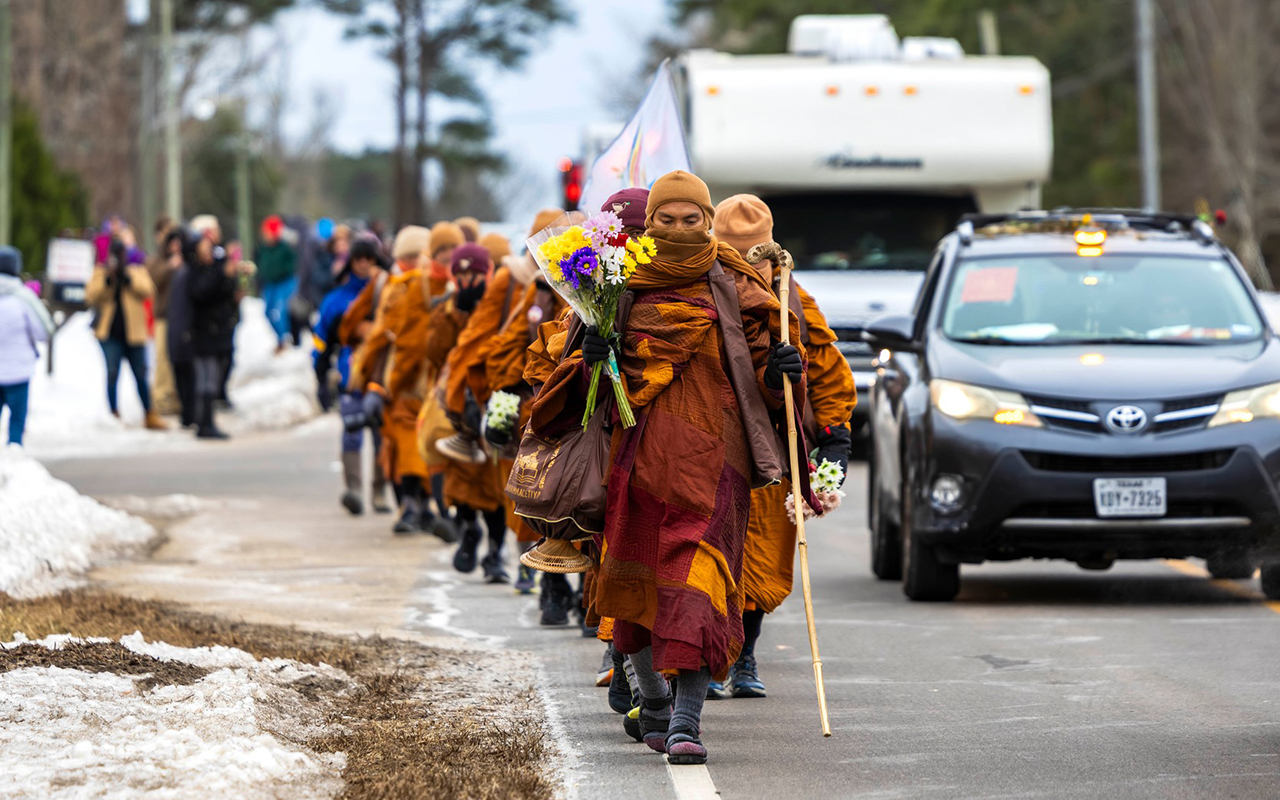
On October 26, 2025, a group of nineteen monks from the Vietnamese Theravada Buddhist tradition, affiliated with the Huong Dao Vipassana Bhavana Center, began a historic pilgrimage from the temple’s center in Fort Worth, Texas, to Washington, D.C., in an effort to promote peace, compassion, and nonviolence. From its humble beginnings and in spite of some serious injuries endured along the way, this story has reverberated in the public’s hearts and imaginations, turning these monks—along with their companion, a rescue dog named Aloka—into viral celebrities, with fans and supporters gathering by the thousands to meet them at stops along their journey.
Three months in, and the troupe is nearly in reach of their destination. With so much violence and cruelty currently engulfing the United States and the world at large, it makes sense that the public would want to focus on the noble efforts of those promoting peace and restoring harmony in a world that sorely needs it. But what is it, exactly, about these specific monks right now that places them at the top of the zeitgeist?
To put these noble monks and their historic journey into context, Tricycle asked a selection of Buddhist teachers and authors: What is it about Fort Worth’s “Walk for Peace” monks that so captures the public’s imagination?
***
When it feels like everything’s sliding into authoritarianism and nothing we do makes the slightest difference, the worst part isn’t fear—it’s the feeling of being totally powerless. That’s where nonviolent action, protest, marches, and showing up in public changes everything for us. It turns doomscrolling and spiraling into actually doing something real; it provides a sense that we can push back. Instead of obsessing over these massive forces we can’t touch, we’re focused on connecting. We’re giving a voice to the sentiment “not on my watch!” [Seeing that example,] others, who are paying less attention to the world gone mad, realize something’s going on that demands attention and involvement. So any form of demonstration is not a pie-in-the-sky idea.
So I support the group of Buddhist monks walking 2,300 miles to Washington, D.C., on a Walk for Peace. It’s not some naive feel-good thing or empty symbolism. Nor is it only compassion. It’s saying “no” with legs—even when stuff goes sideways, like an accident that injured some of the monks along the way. The whole point is taking all that vulnerability and fear and grief about the state of the world and turning it into one foot in front of the other, together, just keeping going.
–JOSH KORDA, Buddhist teacher and counselor, Dharma Punx NYC
They are walking for all of us.
–JACK KORNFIELD, American Vipassana teacher, psychologist, and author
 Image via Walk for Peace/Facebook.
With each step, abiding fully in this present moment, the pure path of awakening unfolds beneath my feet.
With each step, serenity and calm blossom in my body and mind, my heart opens like a flower to the morning sun.
With each step, I become one with the Buddha, one with the sangha, one with the dharma, and find refuge in this warm embrace.
With each step, I vow to nourish a heart overflowing with love, tranquility, and compassionate action in service of all beings.
As a dharma teacher in the Plum Village community of socially engaged Buddhism founded by Venerable Thich Nhat Hanh, I am reminded of the practice and power of walking as an act of individual and collective healing, walking as social witness, a statement of peace and solidarity with the human and more than human world. Thay taught the practice of walking meditation as a spiritual discipline, a practice of healing and transformation. To walk in a relaxed way, calming and releasing tension in the body, generating a mindset of happiness and gratitude in this moment, is akin to prayer. Every path, whether city streets or forested trails, is the path of awakening.
Thay and Rev. Dr. Martin Luther King, Jr., shared a special friendship that Thay recalled in a poignant moment. “Martin, you know something?” Thay said, “In Vietnam, they call you a bodhisattva, an enlightened being trying to awaken other living beings and help them go in the direction of compassion and understanding.” Thay spoke these words to King at one of their last meetings. A few years earlier, in a letter nominating Thay for the Nobel Peace Prize, King said, “I know Thich Nhat Hanh, and am privileged to call him my friend.”
Both King and Thay engaged in walking as a form of nonviolent social witness and the visible practice of peacemaking. They shared a vision of peace, compassion, and love galvanized by nonviolent social engagement that included walking meditation as a form of social action. This was particularly important during the historic Birmingham Campaign of 1963, which was a pivotal event in the struggle for racial and social justice in the United States. Organized by the Southern Christian Leadership Conference and others, this action led to the passage of the Civil Rights Act of 1964 and the Voting Rights Act of 1965. The Birmingham Campaign was fueled by the resolve and commitment of volunteers, ordinary people committed to nonviolent resistance. Each volunteer was required to sign a pledge, a written affirmation to nonviolence that included a vow to meditate daily, to walk and talk in the manner of “God is love,” to pray daily, and to perform acts of service for others. This historic campaign underscores the importance of spiritual determination and principled, nonviolent action in promoting social justice through peaceful practice.
Today, as our society faces the firestorm of racial and social injustice, systemic and structural oppression and discrimination, the dismantling of the civil rights enforcement mechanisms of the federal government, threats to the rule of law, and ongoing violence, this pilgrimage for peace and compassion brings into our awareness the intersection of social justice and spiritual engagement. This walking pilgrimage of peace by these twenty-four monks from Vietnamese Theravada Buddhism points us to a new order of justice grounded in compassionate action, peace, and love that challenges us to transform suffering into compassion, understanding, and love.
This peace pilgrimage is an act of love and liberation that reminds us, as it did in 1964, to rediscover what we love, what matters, and to offer this love for the good of the world.
–VALERIE BROWN, dharma teacher, Plum Village
Soto Zen’s founder, Dogen Zenji, once said, “Do not ask me where I am going, as I travel in this limitless world, where every step I take is my home.”
I am deeply grateful to the nineteen courageous monks of the Huong Dao Vipassana Bhavana Center, and, of course, Aloka the Peace Dog, for their heroic practice, which is surely touching the hearts of people the world over. In one sense, they have undertaken an enormous journey, meeting new people and spreading the dharma with word and action. And in another, deeper sense, they have never left their true home—the home that stretches from each patch of earth they tread upon to the very ends of the universe.
The magic of our practice is that the smallest gestures, offered with all of our heart, have the same strength as heroic undertakings.
Walking as an expression of a deep hope for political and social transformation has a long history in Buddhism, dating back to the time of Shakyamuni Buddha. I often think of the first women’s march, undertaken by our earliest women ancestors. When the Buddha initially refused to ordain women, his stepmother Mahaprajapti and her followers shaved their heads, donned monastic robes, and set out on a 200-mile barefoot journey to Vesali. Their nonviolent challenge and offering of committed practice gave rise to the first known women monastics in the history of any religious tradition. Through our walking, through our practice, we can bring about miracles.
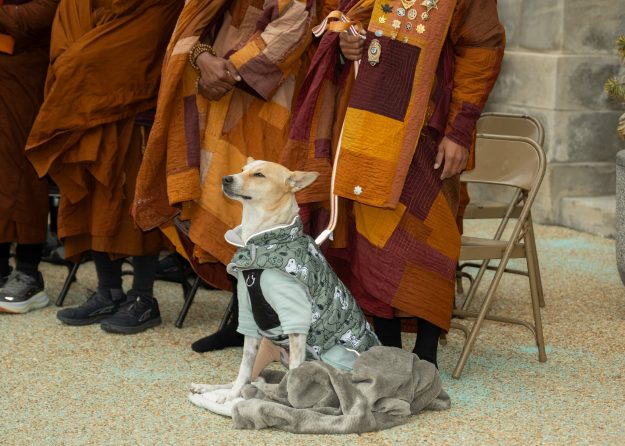 Aloka. Image via Walk for Peace/Facebook.
We may be inspired by the Walk for Peace, particularly in the midst of increasing violence, but find ourselves unable to set aside our lives to undertake great acts of generous commitment. But the magic of our practice is that the smallest gestures, offered with all of our heart, have the same strength as [these] heroic undertakings. A peace walk can bring us across a continent, but it can also bring us next door to tell a neighbor or friend that they are loved, welcome, and that they are not alone. Let us follow the example of the nineteen monks, and Aloka, and may our every step in this limitless world, our true home, be an expression of peace with and for all beings.
–RIVER SHANNON, public interest lawyer, educator, and Zen priest at Mountain Rain Zen Community
What the world needs now is an influx of peace to impede the three poisons that MLK once named as militarism, poverty, and racism. These monks, by their mere presence, answer the bodhisattva’s call to liberate all beings from suffering.
–VIMALASARA, author and senior teacher in the Triratna Buddhist Community
I’ve been following the Hung Dao monks on their Walk for Peace with interest and inspiration. The photos open my heart. How rare it is to see this kind of pilgrimage in the West. In Thailand, where I grew up, monks do an alms walk every day. They leave their temples at dawn and walk out holding their black alms bowl in front of them. What they are doing is more than a pretty picture. It is a trust fall: that their begging will give rise to our dana, our generosity, and that they will consequently eat. The idea of not eating in a day strikes at our most elemental safety. I speak of this alms walk a lot because it moves me, every time, to ponder a devotion to the dharma so deep and wide that I would put myself in a position to risk not eating.
We can admit that Buddhism, practiced with sincerity and diligence, is an uncomfortable commitment. It kind of sucks. It asks us to trust that the inner work we’re doing will help us grow into beings of love and wisdom, bodhisattvas. This sounds exalted, and it feels exalted at times, but the work on the path is also messy and hard. Over time it has moments of being disheartening, if not downright painful. We become bored of meditation; tired of hearing the same dharma stories; and convinced that our kleshas, the inner defilements, are the most stubborn black stains of anyone in the dharma hall. One thing that the monks may be showing us is that we need a lot of determination to keep going on the path of dharma. They set the example.
There are 2.6 million people following the Walk for Peace’s Facebook page. Two of the monks were injured in a road accident. One had his leg amputated, and has returned to some of the pilgrimage in a wheelchair. The monks are accompanied by a dog, Aloka, which means light, who has his own dedicated following. The roads where the monks are to come are lined with people waiting. It looks like the Fourth of July, except people are wearing beanies and puffer coats and the parade is silent. There are so many offerings in parts of the walk that the monks can’t accept all the offerings that people hold out for them.
When I see these humble monks in their burnt orange robes walking for peace, greeted by everyday Americans on the roadside giving drinks, flowers, falling to their knees to pray, it makes me cry.
The Walk for Peace is happening now. In the season of winter. As the government kidnaps and kills its own citizens. These simple monks are walking a long way to ask our president to designate a national holiday for peace.
I hope this gets our attention. I hope it gets through the noise. American democracy is not in crisis; it is breaking in real time. Our government is kidnapping children off the street and killing people who are filming them on their phones. What should we do? March—fight—protect—flee—hide—pray—cry. I’m hearing all of it.
This walk is just a symbol, but we’re learning how much power a symbol holds. America was never a perfect democracy. The light (aloka) shone by how much we tried, by the way we renewed our imperfect commitment to shelter the tired and take in the weak (also known as refugees), inspired an example across the world of what we could be. By “we,” I mean humanity; everyone alive in this tremendous human body who gets the chance to choose what they will do each day. Animals cannot choose. Humans alone think and have an observing ego that can decide on different intentions and act in new, more conscious ways. Our decisions matter. They can come from a symbol and an ideal. We humans decided after tremendous war that we should make pacts of peace, and worked to negotiate nonproliferation treaties; that we should promise to aid our neighbors, and in so doing, deter armed conflict. All of that is in danger of being smashed now.
Has anyone reread “The New Colossus” lately? It was penned by Emma Lazarus in the 19th century, not a banner year for women’s rights. Lazarus helped settle refugees fleeing pogroms in the US. Her words are carved at the base of the Statue of Liberty:
Not like the brazen giant of Greek fame,
With conquering limbs astride from land to land;
Here at our sea-washed, sunset gates shall stand
A mighty woman with a torch, whose flame
Is the imprisoned lightning, and her name
Mother of Exiles. From her beacon-hand
Glows world-wide welcome; her mild eyes command
The air-bridged harbor that twin cities frame.
“Keep, ancient lands, your storied pomp!” cries she
With silent lips. “Give me your tired, your poor,
Your huddled masses yearning to breathe free,
The wretched refuse of your teeming shore.
Send these, the homeless, tempest-tost to me,
I lift my lamp beside the golden door!”
Much of the poem resonates now. Despite the opening negation, America seems to have reverted to the Colossus of Rhodes, the brazen giant dipped in gold (“Greek fame”) whose limbs come to dominate. It’s jarring to see “twin cities” name-checked in a poem penned so long ago. Lazarus meant different twins, but our hearts go to Minneapolis–St. Paul. Lightning imprisoned in a flame recalls the vajra, the diamond thunderbolt that is the symbol of the Vajrayana, the dharma made for this time. I notice that Lady Liberty grimaces. She’s not smiling as she welcomes “the homeless,” “the huddled masses yearning to breathe.” This work is not easy. It is deeply uncomfortable.
A lot of the poem sounds in fact like the bodhisattva vow, where we promise to be a bridge, a boat, a beacon (aloka) in the night. I believe that is the choice in front of us: if we will take the examples before us of conquering and domination, or if we will see the quiet dignity; the deep resolve; the fortitude of this group of monks, who are practitioners just like us—and let it ignite a fire for us to turn toward wisdom and compassion.
It is going to take a lot of determination for us to decide to put our commitment to the dharma over TV, social media, vacation, shopping. We live longer and mostly in better health than ever before, but samsara’s dance these days seems to be the most beguiling mental addiction that we have ever seen. We’re holding a casino in our pockets, a gumball machine in our phones.
If you are watching what’s happening in this beloved country and wonder what you can do—please. Let the monks inspire you. Let their walk put you into kshanti, tolerance of samsara, and virya, joyful effort, to walk the path like you have never walked it before.
–SUNISA MANNING, dharma teacher, Heart Sangha
Although I have only been able to watch their journey from afar, I know that their embodiment of beautiful qualities such as compassion, mindfulness, and peace deeply touches people who have had the opportunity to meet them. Here are two vignettes.
A student who participates in my sutta study group was moved to tears by the kindness exuded by these monks. She noted that everyone in their presence was spontaneously placing their hands in anjali, including the police officers decked out in guns and bulletproof vests. She noted the stark contrast between their effect on people and the effect of ICE agents who have been active recently.
The sutta we were studying that day was about a meditator learning to “abandon the hindrances”—to release certain mind-states that weaken wisdom. The discourse talked in terms of what qualities are naturally revealed when a certain harmful mind-state falls away. For instance, when ill will is let go, the meditator “abides compassionate for the welfare of all living beings.” Perhaps when ICE is not present, compassionate monks become visible.
A second vignette was a news clip shared from a fellow dharma teacher. The story was broadcast on a local TV station, where one reporter, along with his partner and toddler, had gone to see the monks. He was telling his colleagues about his experience. Due to the crowds, they had to walk for a mile to reach the monks. One was giving a dharma talk, and although the reporter could not see him, he had clearly absorbed the main message: We can stay grounded fully in the present moment, not allowing the mind to be distracted or to wander on long thought trails. Being simply present in this way is one means to a more peaceful life.
Watching this ordinary person describe his (first?) experience of a dharma talk, I was struck by how it had brought his mind into clarity. Life with a full-time job, a partner, and a toddler is surely busy, and yet he immediately saw the benefit of mindfulness and waxed quite eloquent while conveying the monk’s message to his TV station colleagues.
What benefits might come while people are temporarily aligned with what is beautiful, compassionate, wise, and peaceful?
In both these cases, we see how the demeanor and straightforward words from the monks can touch the heart of anyone open to them, whether Buddhist or not, practitioner or not. I imagine their walk as like a magnet being dragged from Texas to Washington, D.C., aligning the random iron filings of people’s lives along the way. Although that alignment will eventually relax after the magnet passes through, it will not do so immediately. What benefits might come while people are temporarily aligned with what is beautiful, compassionate, wise, and peaceful?
It is inspiring to know that we have a practice through which these qualities are strengthened in our own heart and can affect others too.
–KIM ALLEN, Western Insight teacher
It has been an incredible experience witnessing the public reaction to the Buddhist monks walking for peace through the southern United States. At a time when we have been made to bear witness to livestreamed carnage first abroad and now at home, this peace pilgrimage is resonating with the American public, whether or not they be Buddhist, bringing the nation together across political, religious, and ethnic barriers in a joy and levity that has been deeply and sorely needed. Over and over again in news coverage of the monks, both gathered onlookers and reporters alike have said that their sense of hope in the future has been renewed, that the mere sight of the monks had led some of them to tears. For Buddhists especially, this has been an incredible opportunity for us to abide in sympathetic joy for those moved by the pilgrims and to rejoice in the incredible merit made by the monks and the temples hosting them along their path, who share the blissful medicine of the buddhadharma at each location in which the venerable ones stop to rest.
Amidst all this, I want to take a moment to reflect on the history and lineage of how this tradition of walking for peace arrived here in America, to ground ourselves in the richness of a modern tradition that took an eccentric transnational path.
Bhikkhu Pannakara and the eighteen other monks are transmitting a transnational Theravadin tradition that first originates in 1992 when a revered monk in the Khmer tradition of Theravada known as Venerable Maha Ghosananda led the first dhammayietra, or “pilgrimage for peace.” Hundreds of monks, nuns, and lay Buddhists gathered to escort on foot a number of refugees from the camps in Thailand back to their home villages in Cambodia, trekking through 125 miles of land that was still invisibly pockmarked with land mines from the Khmer Rouge’s regime. As news of the pilgrimage spread, the number of pilgrims—Buddhist and otherwise—joining the group grew exponentially, and caught the attention of the international news media. In the following years, the dhammayietra became an annual tradition for Theravadin Buddhists in Cambodia, walking a new path that began again in Thailand and this time crossed through all of Cambodia into Vietnam. Like the early sangha of the Buddha’s direct disciples, the pilgrims paused at various villages and cities, temples and monasteries, to share dhamma teachings on nonviolence, freedom from suffering, and the preciousness of human life to the communities they passed through.
The temples and monasteries in Vietnam receiving these pilgrims at the end of their long journeys were, especially in the first few years, mostly Theravadin temples in the Cambodian tradition as well. Khmer territory had been slowly annexed into modern-day southern Vietnam beginning in the 15th century, with the modern borders mostly taking form by the 18th century. For much of this time, Buddhist culture in the south of Vietnam was bifurcated: The Kinh people, Vietnam’s largest ethnic population, continued to practice the Mahayana tradition; meanwhile, Theravada remained mostly confined to the Khmer minority.
This changed in 1940 when a monk named Venerable Ho-Tong arrived in Saigon from Phnom Penh, opening Buu-Quang Temple in the Go Dua district, a Theravada temple teaching in the Vietnamese language for an ethnically Vietnamese audience. Ven. Ho-Tong was ethnically Kinh himself, born in the south of Vietnam with the name Le Van Giang, and trained as a veterinarian. He went to Phnom Penh under assignment for the French colonial government, where a near-obsessive interest in Buddhism took hold of him. He first explored the Mahayana tradition in Vietnamese, but this did not satisfy his spiritual yearning. Curiosity led him to French books on Theravada Buddhism, which astounded him with the simplicity and directness of how the Buddha’s teachings were presented—a stark contrast to the complex Mahayana philosophy he was reading in his native language. And so he began to study and practice with Cambodian monks at Unalom Temple, eventually ordaining with them. When Ven. Ho-Tong returned to Vietnam, he returned with a small cadre of other Vietnamese monks that had been trained in Cambodian Theravada, and they began teaching the Theravada tradition in the Vietnamese language, as well as translating the Pali canon into it. Ven. Ho-Tong would go on to be recognized as the first Sangharaja of the Vietnamese Theravada Buddhist Sangha, responsible for establishing the first ethnically Vietnamese Theravadin community in the country. And so, when the dhammayietra processions arrived at temples on the Vietnamese border at the end of their marches, many of these Khmer temples were populated and run by Vietnamese monastics and belonged to the network of Vietnamese Theravada monasteries and temples established by Ven. Ho-Tong and his disciples. Now, over thirty years on from the first dhammayietra, even Vietnamese temples affiliated with the Mahayana participate in the tradition.
The nineteen monks from Huong Dao Pagoda trekking across the southern United States belong to the school of Viet-Khmer Theravada tradition transmitted by Ven. Ho-Tong—the abbot of their temple, Ven. Bhikkhu Ratanaguna, is the last direct disciple of Ven. Ho-Tong. As our hearts resonate in sympathetic joy with all who have been moved by this historic first dhammayietra in the US, we should remain reverently mindful of the noble history we are inheriting. I think the very reason this is so resonant with Americans is that there is some inexplicable knowing that the story of the Walk for Peace reflects the story of America itself—that it is a story of migration, of multicultural union, and of traditions coming into new lands, being adapted and practiced in translation. And this is the story of America we have all needed reminding of in this moment.
–AN TRAN, author
 Image via Walk for Peace/Facebook.
The practice of pilgrimage, an integral form of Buddhist practice, has yet to develop here in the US, so I have been following the Walk for Peace with deep interest and gratitude. I grew up in the South. When I recall Southern country roads, I think of long stretches of quiet, of rural drivers unused to walkers, and of territorial outside dogs. I wonder how the monks meet these dogs, how they negotiate close calls with pickup trucks, and what they eat. Most of all, though, I’m curious about the people waiting along the road to greet them. What brings them out into the cold? What are they looking for? Who do they expect to find?
I asked a Southern friend why she thinks people in the South are so taken with the monks. She replied, in a series of texts:
We need more of their energy.
We need healing
And forgiveness
And our children to know love.
We are looking for Christ and they are the closest example.
Everything is happening so fast that it’s hard to know where to start other than to follow the monks.
This is the power of pilgrimage. Whatever intention we have when we set out on pilgrimage shifts and opens into a deeper meaning as we walk. Pilgrimage is an alchemy forged by each encounter along the way—each hardship, each act of kindness, each meeting of hearts. The meaning of pilgrimage is in the doing of it.
Though I’ve undertaken many Buddhist pilgrimages, the one closest to my heart took place in Japan in 2012. The 88-Temple Pilgrimage in Shikoku, or the Henro, takes forty-five days of continuous walking, through villages, cities, and forests, over steep mountains, and along the seaside. When I look back now, I remember little about how much my feet hurt, my concerns about where I would sleep, and the typhoon I slogged through. What I remember is the people.
Why did I go? The 2011 earthquake and tsunami left around 20,000 people dead in the area near my home temple. The woman who donated the large Kannon Bodhisattva (the bodhisattva of compassion) statue in our main hall was washed away in the tsunami. As soon as I could, I went to the coast of Iwate Prefecture to help. I envisioned myself wrapped in a hazmat suit cleaning debris, but that was not what the people needed from me. They asked me to offer incense, to listen to their stories over tea, and to chant for lost family members. They needed witness to their grief.
The next year, I walked the Shikoku pilgrimage in honor of the people who died in the tsunami, as well as the people who had died on the hospital oncology ward where I worked as a professional chaplain. I walked for the immeasurable grief I had witnessed and experienced in just one short year.
On my first day, I met a man watching his family disintegrate. Later, I met an elderly couple whose son couldn’t leave his room. I walked with a young monk dying of brain cancer, a fearful woman married to an abusive man, and a young Chinese man trying to find an alternative to a materialistic future. Just as we see in the Walk for Peace, people made offerings along the way—food, tea, small items, foot tape, a hot bowl of noodles, lodging. People cried. People thanked me. People took photos. Some made their offerings quickly, then rushed off to their busy day. One mother kept pace with me for hours, telling her story as we walked through rice fields in the rain.
This is the alchemy I see happening between the Walk for Peace monks and those of us following them. We see children practicing generosity and we feel more generous. Adults cry and our hearts open. Seeing people travel for hours to meet the monks gives us renewed purpose. Pilgrimage transmutes our broken hearts. Loving-kindness grows and spreads in the world around us. In this way, we have all joined the monks in making each day our peaceful day.
–TENKU RUFF, Osho, Beacon Zen Temple
When I learned of the Walk for Peace, the first thought that crossed my mind was sadhu, sadhu, sadhu—Well done! Well done! Well done! The kinds of headlines that dominate the news are rarely cheerful, and these days conflict seems never-ending. So it was refreshing and heartwarming to learn of these monks’ efforts to spread a message of peace.
The Walk for Peace project is rooted in the sort of walks Buddhist monastics have been doing since the beginning of the religion. In the very early texts, we hear of Buddhist alms-mendicants going to and from villages on foot, engaging with royalty and commoners alike, to share teachings and their way of life. The Walk for Peace aims to raise awareness of mindfulness, and there’s no doubt the monks—with their patchwork ochre robes and metal bowls—embody the ancient archetype of the wandering monastic.
Of course, the pilgrimage has not been entirely glamorous. Now, as it was back then, hikes are arduous and unpredictable. The clothing and supplies the men carry weigh dozens of pounds, and they cover twenty to eighty miles per day, all while exposed to the elements. A number of them have required medical attention along the way, and in November, one monk was even struck by a vehicle, causing doctors to amputate one of his legs to save his life. Still, the group perseveres.
In part because of their dedication, the Walk for Peace has struck a chord with a public starved for joy. Some online are calling the event the biggest thing to happen to Buddhism in North America for some time, and it has even reached people across the globe. In fact, while I was on a personal hike in Rio de Janeiro, Brazil, our tour guide very excitedly asked my friends and me our impressions of the monastics’ mission.
Sometimes, Buddhists—especially Western ones—feel guilty supporting social causes. This makes sense if we consider both the US’s claustrophobic political climate and Buddhism’s world-renouncing tenets. And yet there has always been a tension between the transcendent and immanent aims of Buddhist practice.
To me, the Walk for Peace fits perfectly within the broader sociohistorical context of Southeast Asian Buddhism and the Engaged Buddhism movement. Since the 1950s, prominent leaders such as the late Thich Nhat Hanh and B. R. Ambedkar applied Buddhist ethics and practice to modern-day causes—even if just to spread the message that the world needs peace.
The magnitude of such activism is one evolution of Buddhist practice over the centuries but is not without foundation in the multifaceted tradition. These days, almost every Buddhist tradition has confronted the social realities of the day in one fashion or another. Monastics like the American Bhikkhu Bodhi have long called for religion to play a greater role in positive change, Sri Lankan monks have protested nationwide violence, and Thai monks have ordained trees in an effort to preserve fragile ecosystems. The relationship between monasticism and activism is not new or unheard of.
If anything, the Walk for Peace reminds me of an encouragement of the Buddha in the Anguttara Nikaya: “After examining and scrutinizing, praise those deserving of praise” (AN 5.236). And what is worthy of praise? Renunciation, love, and compassion—especially when those values seem to be in such short supply.
–BRADLEY DONALDSON, teacher and former monastic
I wept.
I first learned about the monks walking while on retreat at Upaya in Santa Fe. There was a panel of teachers speaking on the bodhisattva way, but it was Roshi Joan Halifax’s words that stayed with me. She spoke of how, historically, monks walking is a symbol of a terrifying reality where we have reached a point when we can no longer afford the luxury of doing nothing. Yet, when faced with the magnitude of the crisis, sometimes the only thing left to do is to put one foot in front of the other.
Sometimes, I find myself dismissing the whole thing, retreating into a state of manufactured optimism just to keep moving and, mostly, to be able to parent my kids without scaring the hell out of them. Other moments, I feel anger and tension welling up, sparking a desperate desire to do something, only to look around my living room and realize there is nothing I can fundamentally change about what is happening from here. And then, in the stillness, I feel a real unknowing. From that space, a wise hope emerges. There is a sincerity in my longing for the world to have access to peace and stability. Accepting that I don’t know how that arises gives me permission to stop trying to single-handedly change the world. Instead, it reinforces my deep wisdom to keep the focus on my sila (morality) and cultivating what is skillful in my own life.
This focus and direction is important for my well-being, it is a significant contribution to the well-being of my children, and ultimately it has a positive effect on those I’m in contact with throughout the day.
Steve Armstrong, who recently passed, emphasized to me and my husband the importance of moving toward wholesomeness. This walk is a literal movement toward the wholesome wish for us to have peace. This peace takes many forms, and it is unnecessary to wait for resolve on the global level to have peace within.
I’m reminded again and again, our practice is not to defeat unpleasantness and unsatisfactoriness with the “weapon” of Buddhist practices. It is to use these practices to be with the uncertainty, the confusion, the anger, the hurt, and the wise hope.
Hearing of the monks moved me to weep with comfort, a recognition that, yes, this is confusing. Watching clips of them on social media, I feel a sense of unity and strength. Seeing children and neighbors meeting them with flowers on the roadside restores my faith in humanity. Even the injury of the monk who was struck by a car reminds me that some risks are worthwhile.
I wish safety to the monks on their journey. May each step gather the wholesome intentions of our humanity and move us forward together toward peace.
–SHANNON SMITH, teacher, Secular Dharma Foundation
⬥
This article will be updated with more responses as we receive them.






















.jpg&h=630&w=1200&q=100&v=c0f97a310e&c=1)