What is a Good Organic CTR? Real Website Benchmarks (June 2026)
In a nutshell: for a whole website, a good organic CTR usually falls between 1% and 2%. But that figure varies a lot by industry, authority, and website size. Below, we break down median organic CTR by industry, by...
 ValVades
We pulled anonymized Google Search Console data from over 400,000 websites and measured the real organic CTR for each. In a nutshell: for a whole website, a good organic CTR usually falls between 1% and 2%. But that figure varies a lot by industry, authority, and website size. Below, we break down median organic CTR by industry, by Domain Rating (DR), and by website size—then look at why CTR is falling across the board, thanks to AI Overviews and AI search. Methodology This article is updated with fresh data every month by Agent A. Here’s the median organic CTR for all 26 industry categories, ranked highest to lowest, for May 2026. A few things stand out, and most of them come back to one thing: how often Google answers the query for you. Recognition earns clicks, and the stronger your site (measured here by Domain Rating), the more likely searchers are to click your result over a competitor’s. Across 422,421 websites, median CTR climbs steadily as DR rises, from 0.43% at the bottom to 2.56% at the top—roughly a 6x difference. And the climb is remarkably consistent: every single DR tier has a higher median CTR than the one below it, with no exceptions — a clean, near-linear rise all the way up the scale. To be clear about cause and effect: chasing more backlinks to push up your DR won’t make people click. DR doesn’t show up in the SERP, and nobody clicks a result because of its referring-domain count. What’s probably happening is that the same brands recognizable enough to earn a high DR are also the brands searchers recognize and trust in the results—so they get the click. DR is a proxy for that recognition, not the cause of it. The takeaway for newer sites: a sub-1% CTR isn’t a failure, it’s the norm when you’re under DR 40. CTR improves as you build authority, but it’s a slow climb, not a switch you can flip. Bigger sites tend to earn higher CTR too—partly because size correlates with authority, and partly because large sites rank for more branded and navigational queries (where people are specifically looking for them). Organic CTRs are falling for one primary reason: Google has a clear incentive to keep people on Google rather than send them off to your site. Our research shows this happening: What this means for your benchmark Don’t compare yourself to a position-one ideal. Compare against your industry’s median (the tables above), and watch the relationship between impressions and clicks. If impressions hold steady but CTR slips, an AI Overview is probably intercepting your query. To confirm, head to the Organic positions report in Site Explorer and filter to keywords that show an AI Overview: If you’re below your industry’s median, here are the levers that can actually help improve your CTR: One honest caveat: even if you nail every one of these, you can’t guarantee a big jump in clicks. That’s the nature of SEO today. Google is increasingly siphoning clicks away and keeping people inside its own properties, so the ceiling on organic CTR is lower than it used to be, and largely outside your control. These levers help you win the clicks that are still up for grabs, but the bigger opportunity now is to influence the sale in other ways: getting cited in AI answers, building brand recognition so people seek you out, and capturing the high-intent visitors who do click. Optimize for CTR, but measure success by more than the click. So, what’s a good organic CTR? For a whole website, 1–2% is the honest, typical benchmark—but the real answer is “better than your industry’s median, and trending up.” Use the tables above to find your realistic target by niche, authority, and size, then focus on the levers that move the needle. And remember: as AI Overviews and answer engines reshape the SERP, CTR is becoming a less complete measure of SEO success on its own. The sites that win from here still earn clicks, but they also get cited as the source the answer is built from. Track both.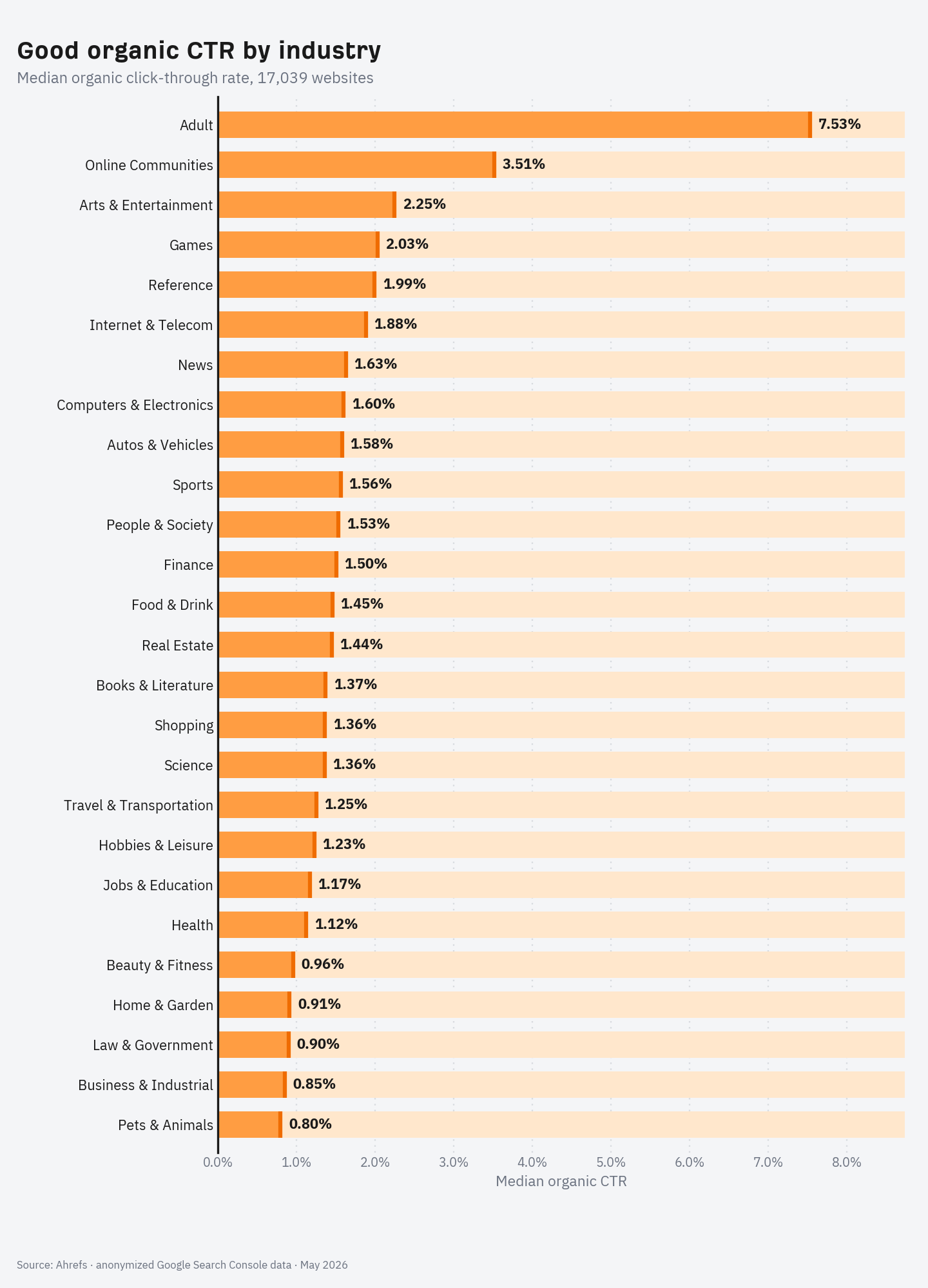
IndustryMedian CTRMean CTRSites Adult 7.53% 11.66% 182 Online Communities 3.51% 6.28% 21 Arts & Entertainment 2.25% 4.26% 557 Games 2.03% 4.77% 684 Reference 1.99% 6.54% 18 Internet & Telecom 1.88% 4.36% 397 News 1.63% 2.62% 515 Computers & Electronics 1.60% 3.74% 535 Autos & Vehicles 1.58% 2.51% 808 Sports 1.56% 2.92% 717 People & Society 1.53% 3.22% 293 Finance 1.50% 2.60% 1,236 Food & Drink 1.45% 2.99% 717 Real Estate 1.44% 2.30% 313 Books & Literature 1.37% 2.91% 86 Science 1.36% 2.98% 142 Shopping 1.36% 2.50% 2,363 Travel & Transportation 1.25% 2.40% 1,314 Hobbies & Leisure 1.23% 1.94% 28 Jobs & Education 1.17% 2.07% 1,356 Health 1.12% 2.02% 1,730 Beauty & Fitness 0.96% 1.88% 201 Home & Garden 0.91% 1.65% 1,419 Law & Government 0.90% 1.73% 276 Business & Industrial 0.85% 1.74% 865 Pets & Animals 0.80% 1.36% 266 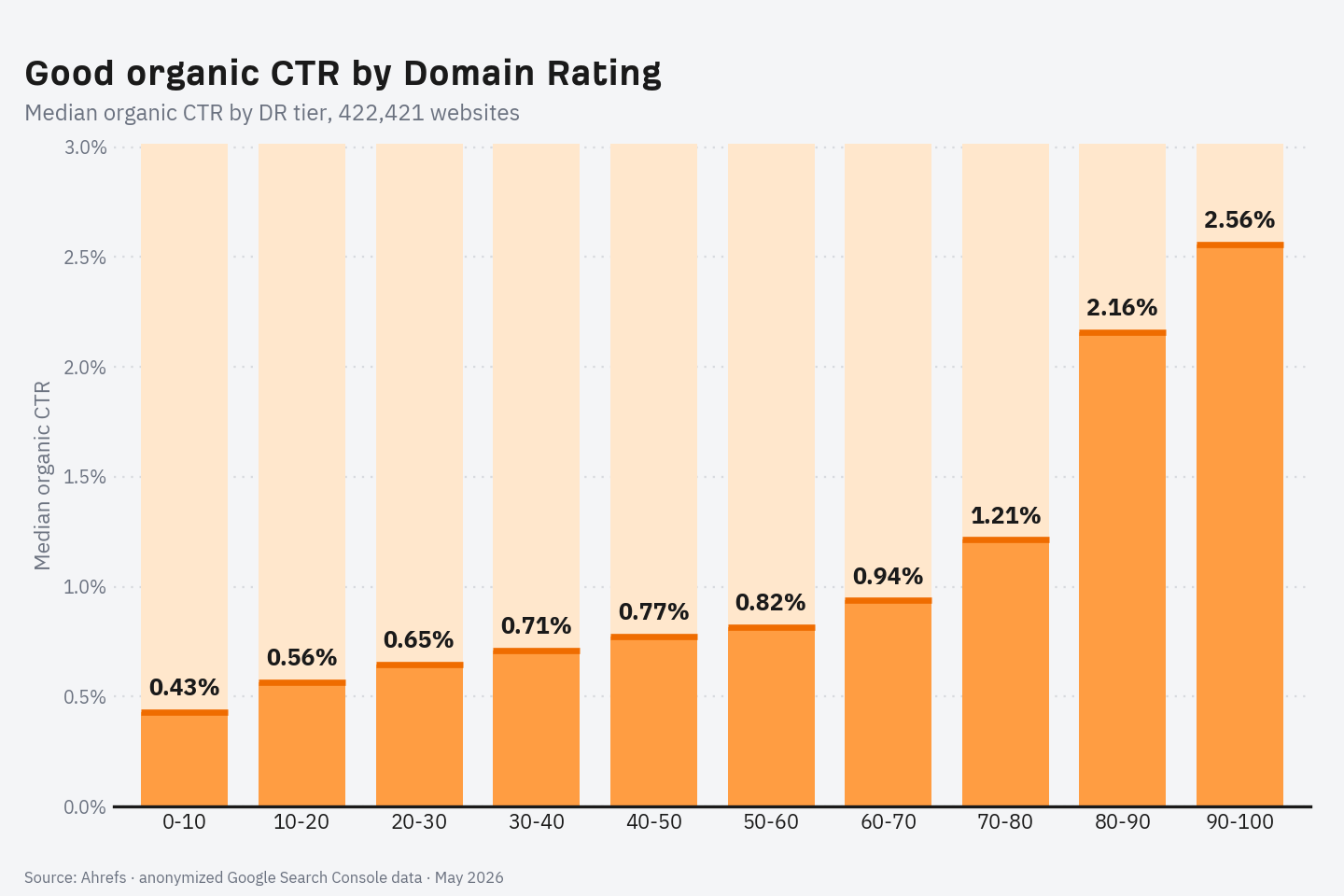
Domain RatingMedian CTRMean CTRSites 0–10 0.43% 1.99% 217,565 10–20 0.56% 1.72% 59,960 20–30 0.65% 1.70% 51,139 30–40 0.71% 1.72% 38,447 40–50 0.77% 1.68% 21,499 50–60 0.82% 1.74% 15,575 60–70 0.94% 1.81% 8,344 70–80 1.21% 2.52% 7,858 80–90 2.16% 4.75% 1,614 90–100 2.56% 7.03% 420 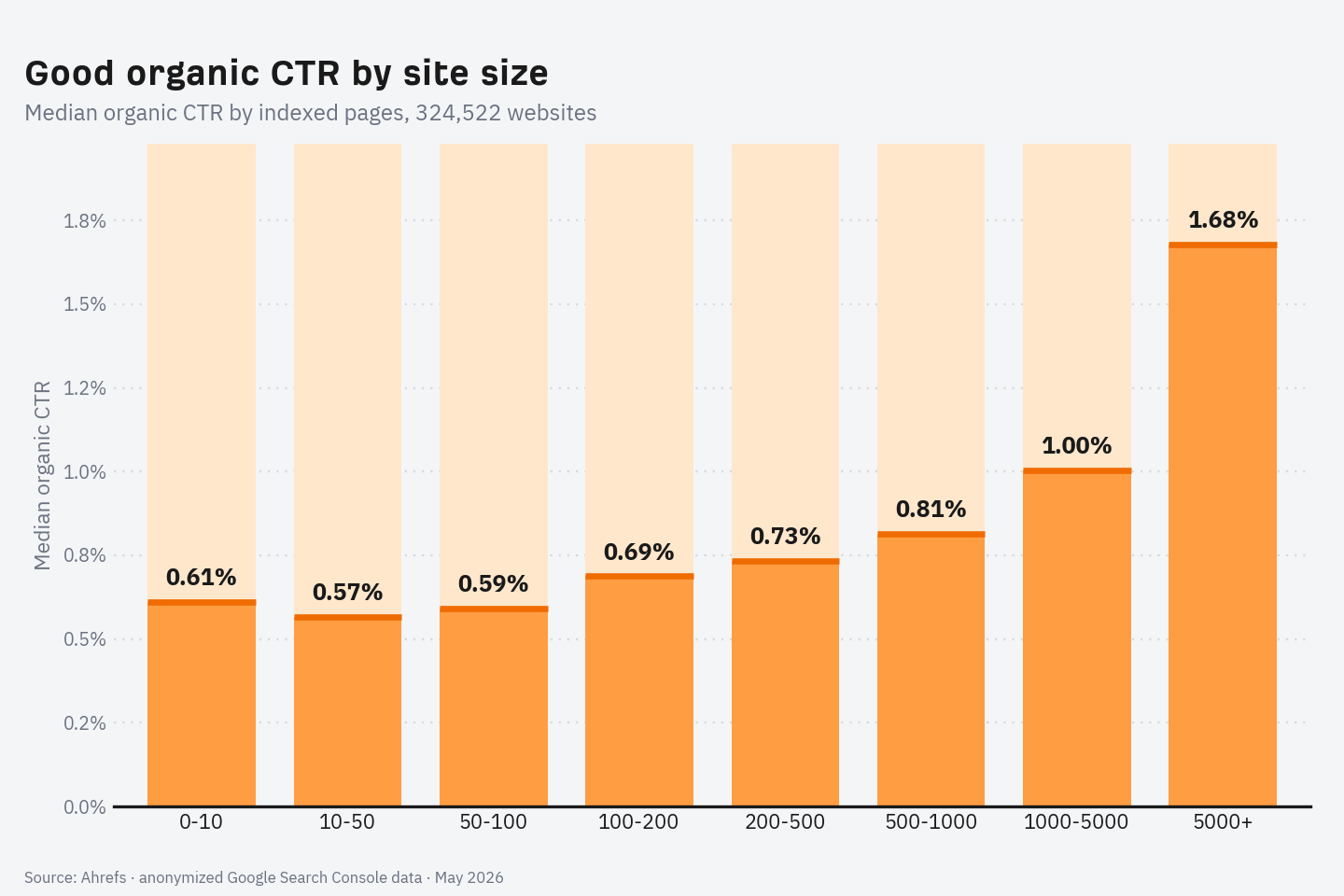
Indexed pagesMedian CTRMean CTRSites 0–10 0.61% 2.21% 135,931 10–50 0.57% 1.31% 98,839 50–100 0.59% 1.18% 29,701 100–200 0.69% 1.20% 21,192 200–500 0.73% 1.30% 17,968 500–1,000 0.81% 1.40% 8,217 1,000–5,000 1.00% 1.66% 8,910 5,000+ 1.68% 2.75% 3,764 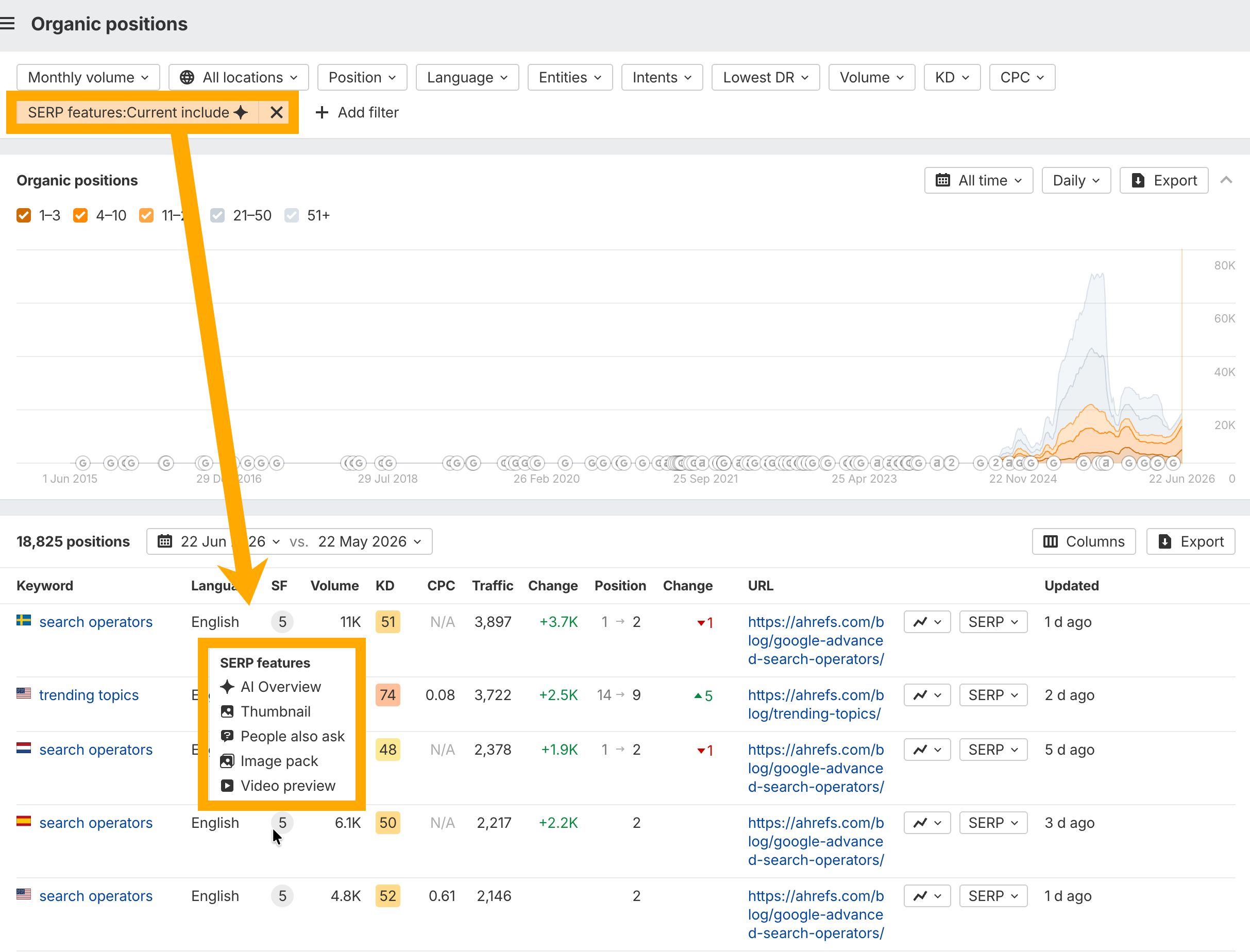










![How to Analyze a Sudden Drop in Website Traffic [With Template]](https://ahrefs.com/blog/wp-content/uploads/2025/02/how-to-analyze-a-sudden-drop-by-despina-gavoyannis-general-seo.jpg)