Your ChatGPT history is a personality test you didn’t know you were taking
ETH Zurich researchers collected 62,090 real ChatGPT conversations from 668 users and trained an AI to predict personality traits from them. The results are a privacy wake-up call.
 UsenB
UsenB

Scientists trained AI to guess your personality from your ChatGPT history, and it worked.
 Growtika / Unsplash
Every time you ask ChatGPT to help draft an email, vent about a relationship problem, or look up symptoms, you might be handing over more than just a query. As reported by TechXplore, Researchers at ETH Zurich trained an AI model to predict personality traits directly from real ChatGPT conversation logs, and it was scarily good at recognizing personality traits.
The study collected 62,090 real conversations from 668 ChatGPT users. Participants also completed a standard personality test, giving the researchers a baseline to measure against. The AI was then trained to classify each user as low, medium, or high across the five traits: openness, conscientiousness, extraversion, agreeableness, and neuroticism.
The fine-tuned model beat random chance across all five traits, with extraversion being the easiest to predict, achieving up to 44% higher accuracy than guessing.
Does it matter what you talk about?
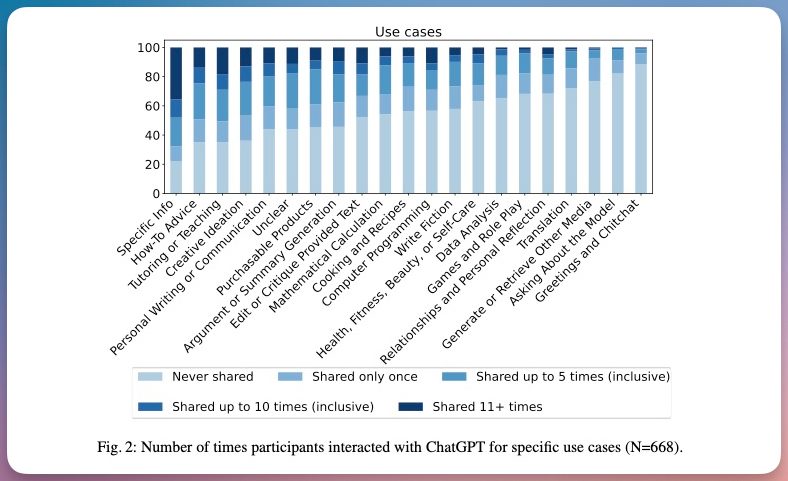
The study found that chats involving mental health topics made extraversion particularly easy to infer. Discussions about religion were strongly linked to conscientiousness inference, and conversations about mental state and mood made openness more predictable.
 Derya Cögendez, Verena Zimmermann, Noé Zufferey / arXiv
Even seemingly casual conversations contained enough signal to be useful. The researchers also found that the more you use ChatGPT, the easier you become to profile. Given how much data we share with ChatGPT, it matters a lot whether it can easily discern our personality traits.
 Derya Cögendez, Verena Zimmermann, Noé Zufferey / arXiv
Recently, ChatGPT has started integrating ads. With the data it has on hands for us, think how easily it can format the ads to manipulate our thinking.
Why does this matter beyond the research lab?
The researchers are clear about the implications. Service providers already have access to all of this data, and with over 800 million monthly ChatGPT users as of January 2026, the scale of potential profiling is enormous.
A personality profile built from your chat history could be used for targeted advertising, personalized persuasion, or in worst-case scenarios, large-scale influence campaigns.
For now, it is worth remembering that your AI chatbot is not a diary. At least not a private one. You can also take a proactive approach and delete your ChatGPT history regularly to remove your personal chats from its memory.

Rachit is a seasoned tech journalist with over seven years of experience covering the consumer technology landscape.
ChatGPT’s new default model is half as likely to mislead you on medical and financial questions
GPT-5.5 Instant is now ChatGPT's default model, and it promises significantly fewer hallucinations in medicine, law, and finance, shorter responses, and smarter personalization.

OpenAI has swapped out GPT-5.3 Instant for GPT-5.5 Instant as the default ChatGPT model, rolling the update out to all users starting today. The new model focuses on improving three things: accuracy, conciseness, and personalization.
Less hallucination, less fluff
iOS 27 could let users pick an AI model of their choice for text and image tasks
Apple isn't racing to build the smartest AI; it's building the best stage for others to perform on, and iOS 27 might just be opening night for a very crowded cast.

There’s going to be a significant shift in how AI works across Apple’s devices, and you’re going to be at its center. According to Bloomberg’s Mark Gurman, iOS 27 and its major siblings (iPadOS 27 and macOS 27) will allow users to select from competing third-party AI models to handle tasks across core Apple Intelligence features.
I’d like you to think of it as using your TV’s remote to set the desired channel and watch it, except the remote is iOS 27 and the channels are some of the most popular AI models that you’ve been using elsewhere.
32GB RAM for Windows 11? Hey Microsoft, that sounds like a you problem!
If your OS needs more memory, maybe the issue isn’t the user’s PC.

There was a time when buying a PC felt… rational. 8GB of RAM got the job done, 16GB felt like a power move, and anything beyond that was reserved for people doing genuinely heavy work. That balance existed because software respected hardware. Today, that balance has quietly collapsed, and Microsoft seems perfectly okay with it.
The company’s since-pulled guidance, casually positioning 16GB as the baseline and 32GB as the “no worries” zone, wasn’t just a recommendation. It’s a shift in responsibility. Because nothing about modern hardware suggests we suddenly need double the memory for the same everyday tasks. DDR5 memory is faster, more efficient, and more capable than anything we’ve had in the past. On paper, systems should feel smoother, more responsive, and more efficient. Instead, users are being nudged into upgrading just to maintain the same level of comfort they had years ago.