494 agencies say the SEO playbook is broken. 88% are confident anyway. Here’s why.
By Francois Marchand, Content Strategist at AgencyAnalytics Ask an agency owner how the year is going, and you’ll often get two answers in the same breath: The work got harder, and they wouldn’t bet against themselves. Both these answers...
 UsenB
UsenB

By Francois Marchand, Content Strategist at AgencyAnalytics
Ask an agency owner how the year is going, and you’ll often get two answers in the same breath: The work got harder, and they wouldn’t bet against themselves.
Both these answers showed up in the 2026 AgencyAnalytics Marketing Agency Benchmarks Report. 88% of the 494 agencies surveyed say they’re confident about the next 12 months, in a year that broke more of the SEO playbook than any since Google’s first big algorithm shifts.
The year gave agencies plenty of reasons not to feel that way.
Here’s what they’re doing about it.
They’re rebuilding SEO for a page that keeps the click
64% of agencies name Google’s AI Overviews as their top industry concern, and 59% say LLMs and AI search are disrupting traditional SEO.
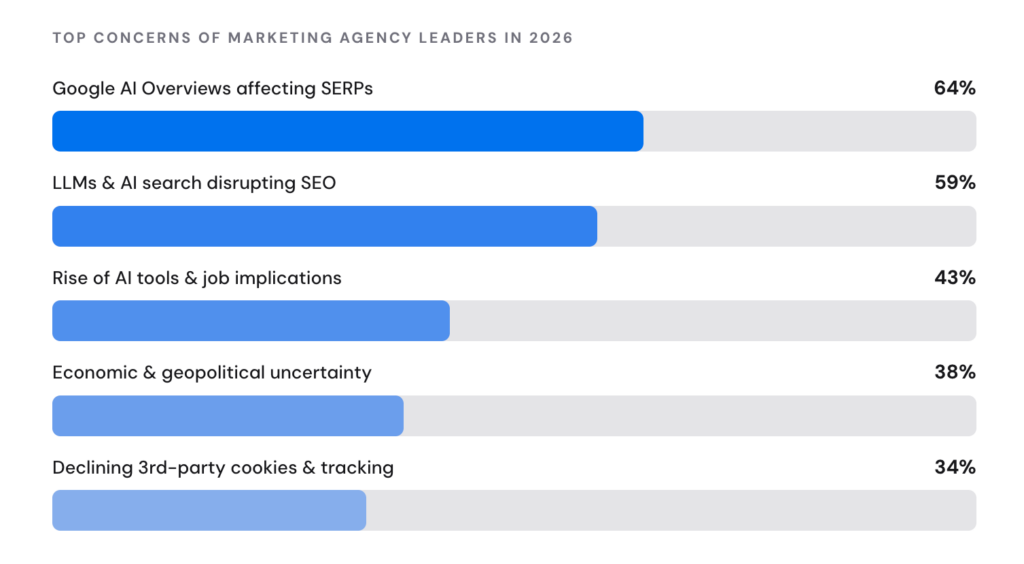
AI Overviews answer the query at the top of the page, so the user never clicks through, and the visit that used to land on your client’s site stays on Google’s, next to Google’s ads. That’s not a glitch in the algorithm. It’s the product working as designed, and the design moves value from the open web onto a page Google owns.
The response is already underway. 51% of agencies are optimizing for AI-driven search experiences beyond Google, and 40% are developing content specifically to surface inside AI answers. The SEO playbook, built on a ranked blue link and a click, is quietly being rewritten to assume the answer is read on someone else’s page.
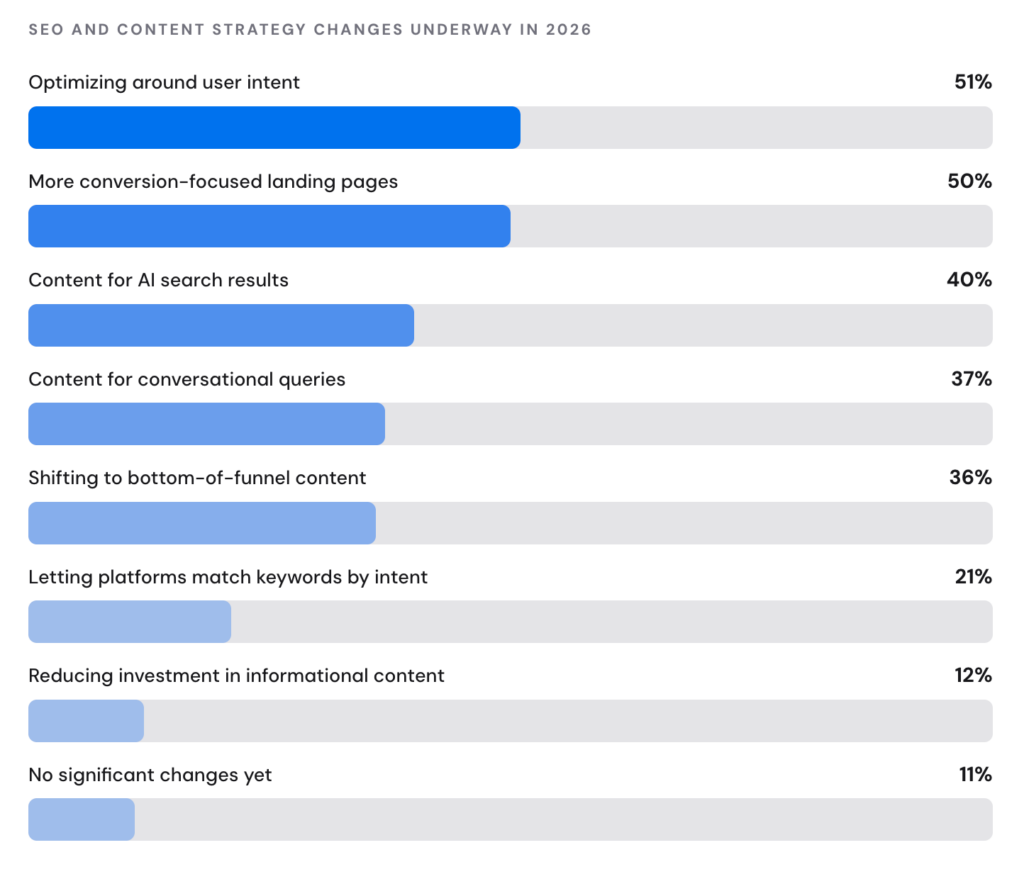
And the demand supports that new playbook.
AEO and SEO for AI-driven search is now the single fastest-growing service clients ask for, ahead of paid ads and short-form video, a service category that didn’t exist in last year’s survey.
The agencies pulling ahead started building capability before they had a perfect playbook, because the demand arrived before the playbook could be written.
They name the measurement gap before the client does
48% of agencies say they struggle to track users who discover brands through AI.
A prospect asks ChatGPT for a recommendation, clicks nothing, and buys a week later. In your report, that sale shows up as a mystery because the discovery happened inside a system that returns an answer and keeps the data. The middle of the funnel moved to a place agencies aren’t allowed to look.
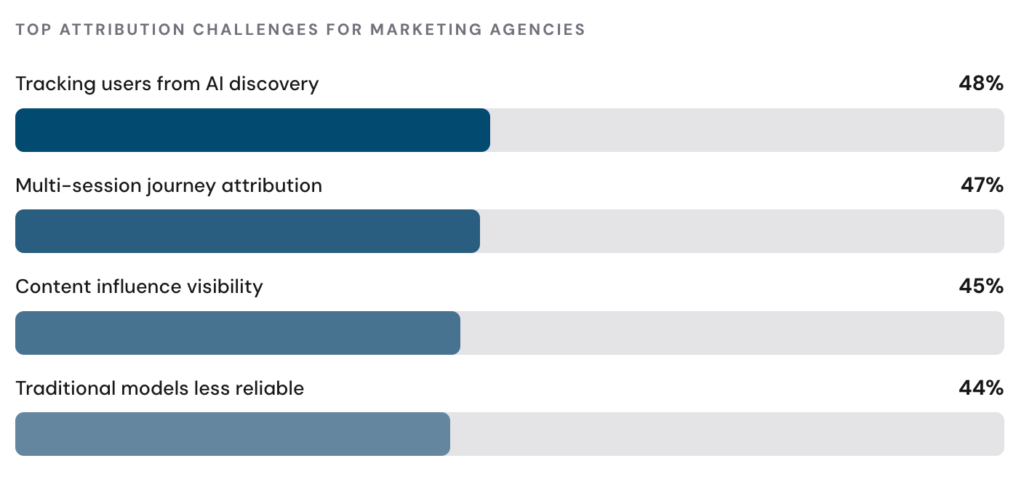
55% of agencies say the question they hear most from clients is some version of “can you clearly connect marketing performance to revenue?” Clients want a straight line from spend to outcome, while AI search platforms have obscured part of that line.
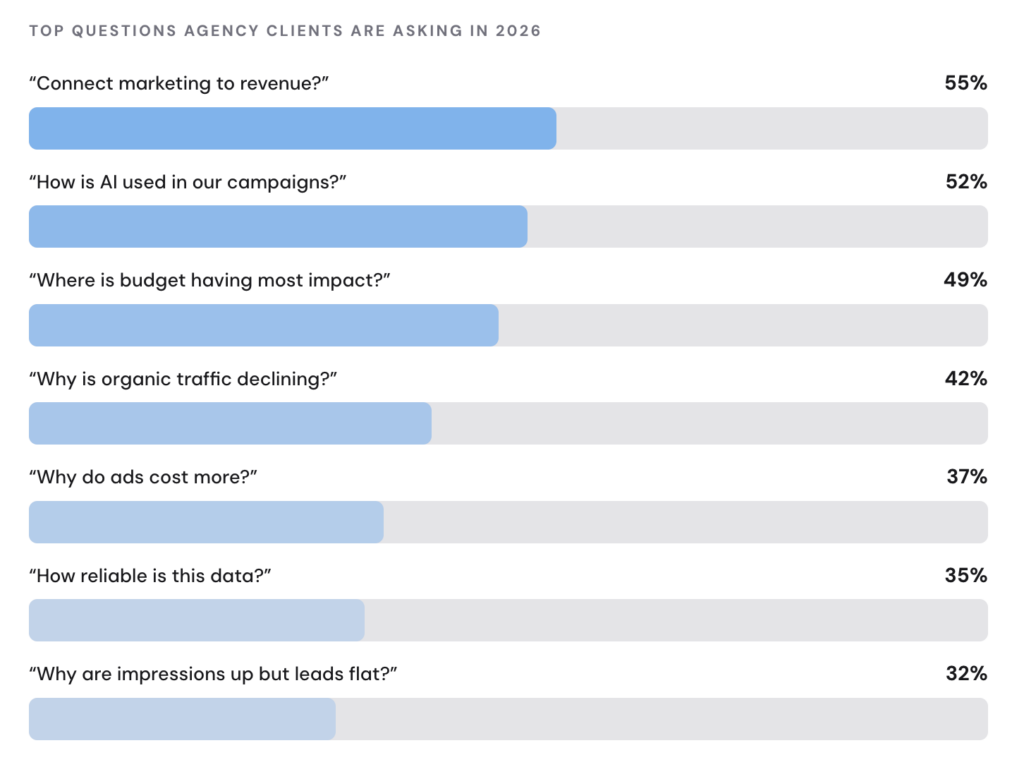
The agencies handling it are responding to client concerns with greater transparency. 45% report being more open with clients about how AI is used in their work, and the same instinct carries into how they handle attribution: name what can’t be tracked yet, then show the revenue story everywhere it can be drawn.
A client who hears “here’s what we can prove, here’s what we’re watching, here’s how we’ll know” trusts the agency more than one who gives a confident answer that collapses under a single follow-up.
The gap is real for everyone. The agencies keeping clients are the ones who say so first.
They make the value impossible to miss
Set against all that, 88% confidence sounds like bravado. The financials say otherwise.
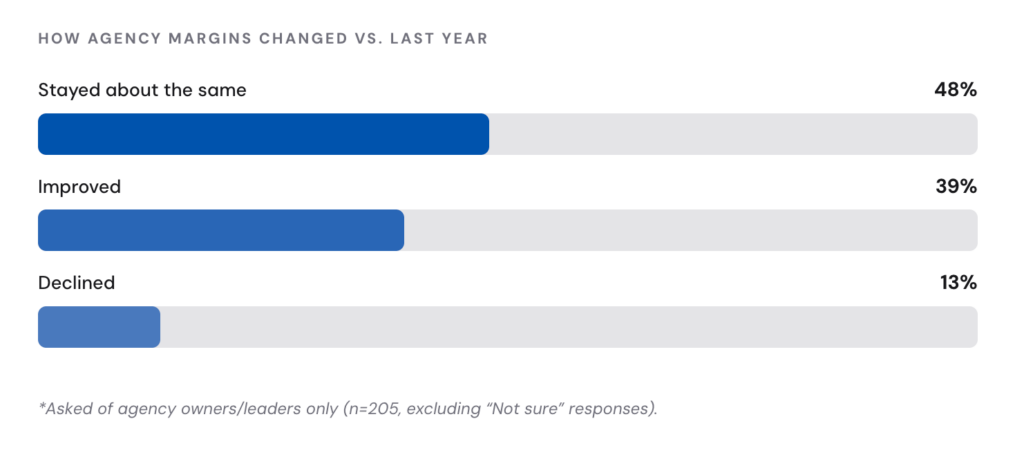
87% of agencies held or improved their operating margins year over year, and 68% are running margins above 20%. Those are the numbers of an industry that absorbed a genuinely disruptive year and kept its profitability intact.
Budget cuts and economic pressure are now the top reason clients leave, named by 42% of agencies, ahead of performance problems. You can do excellent work and still lose the account when the client’s own budget tightens, which makes a retainer depend on how clearly the client sees the value month to month.
So the agencies holding their accounts treat the report as the place where the decision is made.
When channels are unpredictable, and attribution is contested, the monthly report is where a client decides whether your line item survives the next budget review. The agencies losing accounts are often doing fine work that nobody outside the agency can see.
They point AI at the work clients never see
The loudest AI conversation is about content, which is the part that vendors like to demo. The more useful one, for margins, is everything around it.
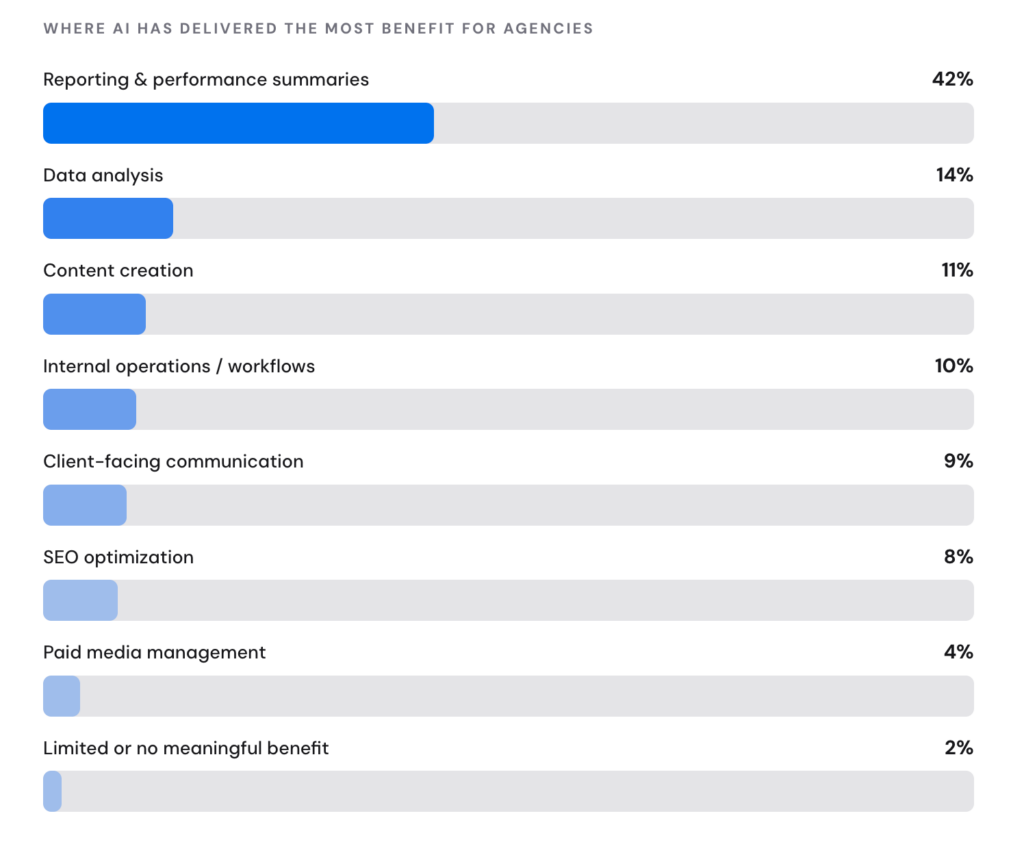
79% of agencies now save five or more hours a week using AI, and the biggest gains have shifted.
Last year, content creation led at 58%. This year, the top answer is reporting and performance summaries at 42%, the unglamorous, time-eating work that sits between the actual marketing and the client conversation.
They’re also putting guardrails on AI rather than letting it run.
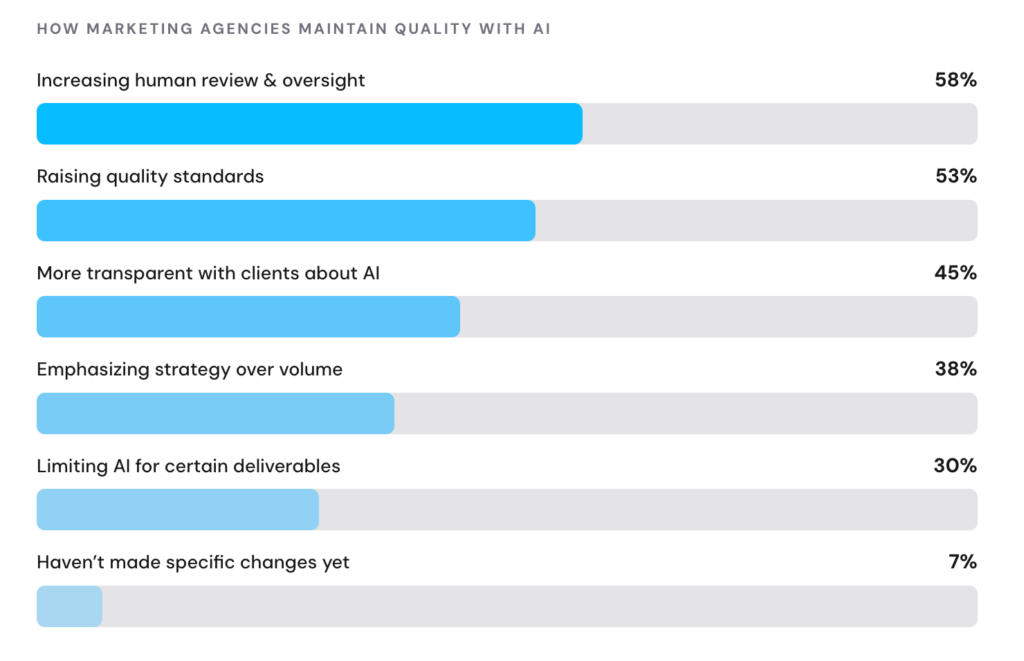
58% have increased human review and oversight of AI-generated work, and 53% are raising their quality bar to cut generic output. That combination, more AI on the back office and more human judgment on the output, is how a smaller team holds a bigger book of business without grinding itself down.
The hours that used to vanish into assembling reports go back into the strategy and relationships that defend a retainer.
What this adds up to
The agencies feeling good about 2026 share a pattern, and it has nothing to do with team size or tech budget. They’re rebuilding their search work for AI answers, naming the measurement gap before clients force it, making their value legible in every report, and pointing AI at the work that is quietly eating their margins.
The 2026 Marketing Agency Benchmarks Report covers all of it in depth, across six sections: the search shakeup, AI in agency operations, the attribution and measurement gap, client relationships and retention, growth and financial health, and reporting as a trust-builder.
It’s the fifth edition and the largest yet, built on more than double last year’s sample, with the year-over-year swings and the verbatim takes from agency leaders living through it.
Read the 2026 Marketing Agency Benchmarks Report here.




















.jpg&h=630&w=1200&q=100&v=c0f97a310e&c=1)
![AEO checker tools that measure answer engine visibility [2026]](https://53.fs1.hubspotusercontent-na1.net/hubfs/53/aeo-checker-1-20260903-3858273.webp)