8 Limbs of Yoga: The Complete Guide to Patanjali’s Ashtanga Path
⚡ Quick Answer BoxThe 8 limbs of yoga are a systematic path to self-realization described by the sage Patanjali in […]
 ShanonG
⚡ Quick Answer Box
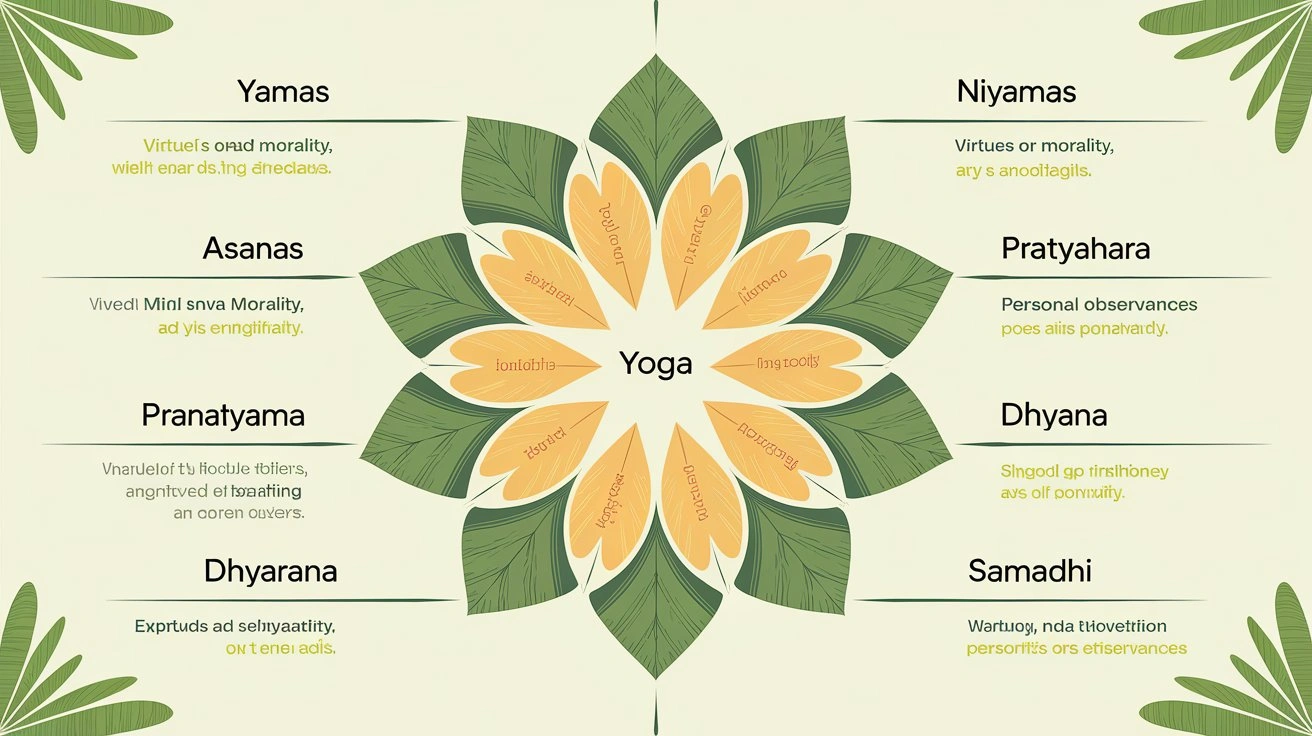
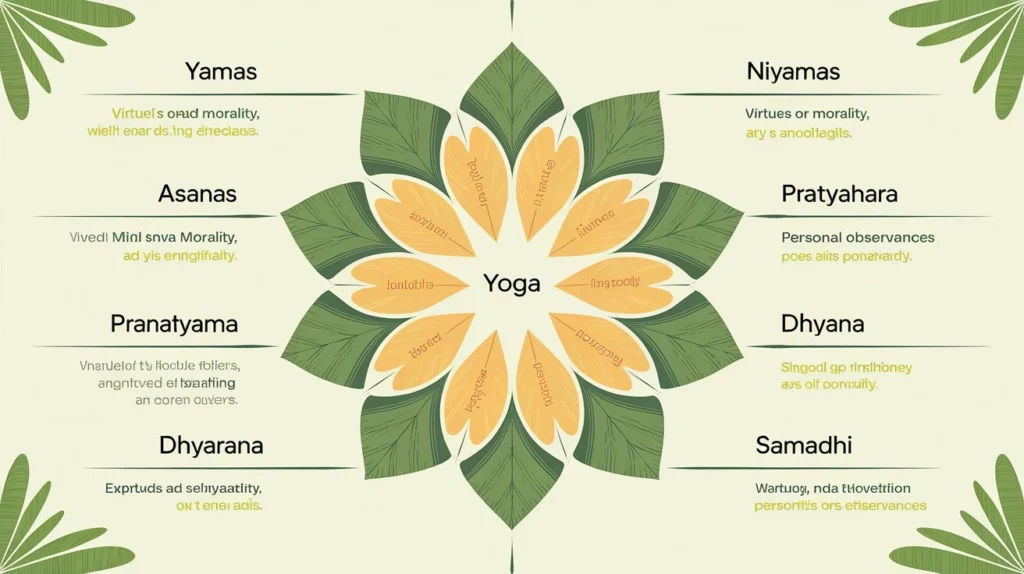
The 8 limbs of yoga are a systematic path to self-realization described by the sage Patanjali in the Yoga Sutras (approximately 400 CE). They are: Yama (ethical restraints), Niyama (personal observances), Asana (physical posture), Pranayama (breath control), Pratyahara (withdrawal of senses), Dharana (concentration), Dhyana (meditation), and Samadhi (absorption/enlightenment). Together they form Ashtanga yoga — “Ashta” meaning eight and “Anga” meaning limb — a complete inner and outer path from ethical living to spiritual liberation.
Most people who practice yoga know one of its eight limbs very well — the physical postures, called Asana.
What far fewer people know is that Asana is only the third limb. It was never intended to be the entire practice. In the classical yoga tradition, the physical poses are a preparation — a single step on a much larger, richer, and more transformative path.
The 8 limbs of yoga — described by the sage Patanjali in his foundational text, the Yoga Sutras — form one of the most complete and practically applicable frameworks for human living ever written. They address how to treat others, how to treat yourself, how to use your body, how to breathe, how to withdraw from distraction, how to concentrate, how to meditate, and ultimately — how to experience the deepest possible state of stillness and clarity available to a human being.
This guide walks through all eight limbs in complete detail — their Sanskrit names, their meanings, their practical applications in modern life, and how they relate to each other as a unified path rather than a disconnected list of practices.
Whether you are new to yoga philosophy or have been practicing for years, understanding the 8 limbs will permanently change how you see your practice — and how you live your life.
Who Was Patanjali? The Source of the 8 Limbs
The 8 limbs of yoga come from a single foundational text: the Yoga Sutras of Patanjali — a collection of 196 concise aphorisms (sutras) organized into four chapters (padas).
Patanjali is believed to have compiled and systematized existing yoga philosophy around 400 CE, though some scholars place the text earlier. He did not invent yoga — the practice is far older. What Patanjali did was organize a vast body of yogic knowledge into a single coherent, systematic framework that could be taught, studied, and practiced methodically.
The Yoga Sutras define yoga in its most essential form in just four Sanskrit words:
“Yogas chitta vritti nirodhah” (Yoga Sutras 1.2)
Translation: “Yoga is the cessation of the fluctuations of the mind.”
This single definition reveals what the entire 8-limbed path is ultimately building toward: a state of mental stillness so complete that the practitioner can perceive reality clearly — without the distortions of desire, fear, memory, or imagination.(1)
The 8 limbs are the systematic, step-by-step methodology for achieving this state.
The Structure of the 8 Limbs: Inner and Outer
Before exploring each limb individually, it helps to understand their structural relationship.
The 8 limbs are divided into two broad categories:
Bahiranga (Outer Limbs) — Limbs 1–5
These are the external, preparatory practices — the foundation that makes the inner practices possible.
| 1 | Yama | Outer | How we relate to the world |
| 2 | Niyama | Outer | How we relate to ourselves |
| 3 | Asana | Outer | Relationship with the body |
| 4 | Pranayama | Outer | Relationship with breath |
| 5 | Pratyahara | Bridge | Turning inward |
Antaranga (Inner Limbs) — Limbs 6–8
These are the internal, meditative practices — possible only when the outer limbs have prepared the ground.
| 6 | Dharana | Inner | Concentration |
| 7 | Dhyana | Inner | Meditation |
| 8 | Samadhi | Inner | Absorption / Liberation |
The Samyama — Limbs 6, 7, and 8 Combined
Patanjali refers to the final three limbs (Dharana, Dhyana, Samadhi) collectively as Samyama — a unified inner practice that cannot truly be separated into distinct stages. The meditator moves from concentration to meditation to absorption in a single continuous deepening of awareness, not as three separate sequential steps.
The 8 Limbs of Yoga: Complete Explanation
Limb 1: Yama — Ethical Restraints (How We Relate to the World)
Yama (यम) means “restraint” or “moral discipline.” The Yamas are the ethical foundation of the entire 8-limbed path — the principles governing how a yoga practitioner relates to other living beings, to society, and to the world.
Patanjali describes five Yamas:
1. Ahimsa — Non-Violence
Ahimsa (अहिंसा) is the first and most foundational Yama — the principle of non-harm in thought, word, and action toward all living beings.
Ahimsa is not simply about avoiding physical violence. It encompasses:
The violence of harsh words — toward others and toward yourself The violence of judgment and contempt The violence of overworking or harming your own body The violence of environmental destruction The violence of consuming in ways that cause harm to animals and ecosystemsIn modern yoga practice, Ahimsa is the principle that prevents you from forcing your body into a pose it is not ready for, from criticizing yourself when practice is difficult, and from judging other practitioners’ progress or choices.
Practical application: Before speaking or acting, pause and ask: “Does this cause harm — to another, to myself, or to the living world?”
2. Satya — Truthfulness
Satya (सत्य) is the commitment to truth — in speech, thought, and action. It means speaking what is true, living in alignment with your genuine values, and refusing to deceive yourself or others.
Satya operates in relationship to Ahimsa — when the full truth would cause unnecessary harm, Ahimsa takes precedence. Truth without compassion is not the fullest expression of Satya.
Practical application: Notice where in your life you are performing a version of yourself that is not authentic — in your relationships, your work, your social media presence. Satya invites a gradual return to genuine expression.
3. Asteya — Non-Stealing
Asteya (अस्तेय) extends far beyond not stealing physical objects. It encompasses stealing time (lateness, wasting others’ time), stealing energy (taking more than you give in relationships), stealing credit (claiming others’ ideas as your own), and stealing from the future (consuming resources that belong to future generations).
Practical application: Practice Asteya by arriving on time, giving credit generously, taking only what you genuinely need, and leaving spaces — physical, energetic, and environmental — better than you found them.
4. Brahmacharya — Wise Use of Energy
Brahmacharya (ब्रह्मचर्य) is traditionally translated as “celibacy” — but its deeper meaning is the wise, intentional use of vital energy (prana). In the classical monastic context, this meant sexual abstinence. In the context of modern householder yoga practice, it means conscious stewardship of your energy in all its forms.
This includes: the energy spent on social media, on gossip, on excessive consumption, on draining relationships, on compulsive habits. Brahmacharya asks: Where is your life force going — and is it going toward what truly matters?
Practical application: Identify three activities or habits that consistently drain your energy without genuine return. Reduce them by 50% for one week and observe the effect on your clarity and vitality.
5. Aparigraha — Non-Possessiveness
Aparigraha (अपरिग्रह) is the principle of non-grasping — releasing the compulsive need to acquire, accumulate, and possess. It applies to physical possessions, to relationships (holding people as if they are property), to outcomes (grasping for results from your efforts), and to self-identity (clinging to fixed ideas of who you are).
Aparigraha is one of the most psychologically sophisticated of the Yamas — it asks practitioners to hold life lightly, to receive what comes and release what goes, without the anxiety of ownership.
Practical application: The next time you feel the impulse to acquire something new, pause for 24 hours before acting. Ask: “Am I grasping here — or is this a genuine need?”
Limb 2: Niyama — Personal Observances (How We Relate to Ourselves)
Niyama (नियम) means “observance” or “positive duty.” Where the Yamas govern external relationships, the Niyamas govern the practitioner’s internal relationship with themselves — the personal disciplines and attitudes that support sustained spiritual practice.
Patanjali describes five Niyamas:
1. Saucha — Purity
Saucha (शौच) means cleanliness and purity — of body, mind, and environment. It encompasses physical hygiene, the cleanliness of one’s living and practice space, purity of diet, and the mental cleanliness of releasing thoughts, grudges, and mental patterns that contaminate the inner environment.
Saucha is not about perfectionism or obsessive cleanliness — it is about creating and maintaining an internal and external environment that supports clarity, focus, and spiritual practice.
Practical application: Practice Saucha by dedicating your yoga space to practice only — keeping it clean, uncluttered, and free from the intrusions of work and digital life. Apply the same principle to your mental space: notice which relationships, content, and habits leave your mind feeling murky rather than clear.
2. Santosha — Contentment
Santosha (संतोष) is the practice of contentment — finding genuine satisfaction in what is present, rather than perpetually reaching for what is next. It is not resignation or passivity. It is the radical act of being genuinely at peace with the current moment while continuing to grow.
Santosha is perhaps the most countercultural of the Niyamas in the modern world — which is built almost entirely on the premise that contentment is something achieved in the future when you have more, achieve more, or become more.
Practical application: At the end of each day, identify three things that are already enough — not impressive, not aspirational, simply genuinely sufficient. Practice receiving them without immediately qualifying them with what is still missing.
3. Tapas — Disciplined Effort
Tapas (तपस्) literally means “heat” — the transformative heat of disciplined spiritual practice. Tapas is the willingness to engage with difficulty, discomfort, and resistance in service of growth. It is the commitment to practice on the days when you don’t feel like it, to hold the pose when the mind wants to give up, to return to meditation when the thoughts pull you away.
Tapas is not self-punishment or asceticism for its own sake — the heat it generates is the heat of purification, the burning away of what is unnecessary to reveal what is essential.
Practical application: Choose one yoga or meditation practice and commit to it daily for 30 days — without modification, without skipping, without negotiating with the resistance. This is Tapas in its simplest and most directly applicable form.
4. Svadhyaya — Self-Study
Svadhyaya (स्वाध्याय) means self-study — the practice of honest, ongoing inquiry into one’s own nature, patterns, motivations, and conditioning. It encompasses the study of sacred texts (the Yoga Sutras, Bhagavad Gita, Upanishads) and the study of the self through meditation, journaling, and reflective practice.
Svadhyaya recognizes that genuine knowledge begins with self-knowledge. Without understanding the lens through which you perceive the world — your conditioning, your beliefs, your unconscious patterns — all other knowledge is filtered through distortions you cannot see.
Practical application: Keep a practice journal. After each yoga or meditation session, write one honest observation about what arose — in the body, in the mind, in the emotions. Over months, patterns emerge that reveal the deeper structures of your own conditioning.
5. Ishvara Pranidhana — Surrender to the Divine
Ishvara Pranidhana (ईश्वर प्रणिधान) is the practice of dedicating all actions to a higher principle — whether that is understood as God, universal consciousness, truth, love, or the deepest intelligence of life itself. It is the release of ego-driven control and the cultivation of trust in something larger than the individual self.
Ishvara Pranidhana does not require a specific religious belief. At its essence, it is the practice of acting with complete effort and then releasing attachment to the outcome — doing the work and trusting the process without insisting that reality conform to your preferences.
Practical application: At the beginning of each yoga practice, set a dedication — “I offer this practice to…” (whatever holds meaning for you). At the end of each session, consciously release the practice — let go of whether it was “good enough,” and trust that the effort itself has value.
Limb 3: Asana — Physical Posture (Relationship with the Body)
Asana (आसन) is the limb most familiar to modern yoga practitioners — the physical poses that constitute the majority of most yoga classes worldwide.
The word Asana comes from the Sanskrit root “as” meaning “to sit” — and in Patanjali’s original description, Asana referred primarily to a stable, comfortable seated position for meditation. Patanjali devotes only three sutras to Asana — far fewer than the Yamas, Niyamas, or meditative limbs.
Patanjali’s definition of Asana:
“Sthira sukham asanam” (Yoga Sutras 2.46)
Translation: “Asana is a posture that is steady and comfortable.”
This single definition contains everything essential about how Asana should be practiced: sthira (steadiness, stability, effort) and sukha (ease, comfort, softness). Neither extreme alone is correct — not maximum effort without ease, and not maximum comfort without steadiness. The practice of Asana is the ongoing negotiation between these two qualities.
The True Purpose of Asana in the 8-Limbed Path
In the context of the complete 8-limbed path, Asana serves four specific functions:
1. Physical health and longevity — A body free from pain, illness, and physical limitation is better able to sustain long meditation practice.
2. Energy regulation — The physical practice activates and balances prana (life force energy) throughout the body’s energy channels (nadis), creating the energetic conditions for deeper meditative states.
3. Mental preparation — The focus, discipline, and present-moment awareness cultivated in Asana practice directly trains the mind for the concentration required in the inner limbs.
4. Embodied self-awareness — Asana practice develops the capacity to observe sensation, thought, and breath simultaneously — the same multi-layered awareness required for meditation.
Asana in Modern Practice
The explosion of Asana-based yoga in the 20th century — through teachers like Krishnamacharya, B.K.S. Iyengar, and Pattabhi Jois — expanded the Asana vocabulary dramatically beyond Patanjali’s original seated postures. Modern Hatha and Vinyasa yoga contain hundreds of standing, balancing, backbending, and inversional postures that were not part of the original classical system.
This expansion is not a corruption of yoga philosophy — but understanding that Asana is the third limb, not the whole, restores the practice to its proper proportion within the full path.
Limb 4: Pranayama — Breath Control (Relationship with Breath and Prana)
Pranayama (प्राणायाम) is the fourth limb — the systematic practice of breath regulation and the conscious direction of prana (life force energy) through the body.
The word combines prana (life force, breath) and ayama (extension, expansion, regulation). Pranayama is not simply “breathing exercises” — it is the science of working with the subtle life force that animates the body through its most accessible vehicle: the breath.
Patanjali describes Pranayama as arising naturally from the establishment of Asana:
“Tasmin sati svasa prasvasayoh gativicchedah pranayamah” (Yoga Sutras 2.49)
Translation: “Pranayama is the regulation of the incoming and outgoing breath, which follows when one is established in Asana.”
The Three Dimensions of Pranayama
Patanjali describes breath as having three aspects, and Pranayama as working with all three:
| Inhale | Puraka | Drawing in prana |
| Exhale | Rechaka | Releasing and purifying |
| Retention | Kumbhaka | Holding — external or internal |
Why Pranayama Comes Before Meditation
The connection between breath and mental state is direct and immediate — anyone who has ever taken a deep breath to calm anxiety has experienced this. Pranayama systematizes this relationship, using breath as the primary tool for regulating the nervous system and preparing the mind for the stillness required in the inner limbs.
In modern neuroscience terms: slow, controlled breathing activates the parasympathetic nervous system, reduces cortisol and cortical arousal, and shifts the brain toward the alpha and theta wave states associated with meditation. Patanjali understood this connection 1,600 years before neuroscience had the tools to measure it.
Key Pranayama Techniques Rooted in the 8-Limbed Tradition
Nadi Shodhana (Alternate Nostril Breathing) — balances the solar and lunar energy channels Ujjayi (Victorious Breath) — builds internal heat, focuses the mind Kapalabhati (Skull-Shining Breath) — purifies the respiratory system and energizes Bhramari (Humming Bee Breath) — calms the nervous system, withdraws awareness inward Kumbhaka (Breath Retention) — the advanced practice most directly described by PatanjaliLimb 5: Pratyahara — Withdrawal of the Senses (The Bridge Inward)
Pratyahara (प्रत्याहार) is the fifth limb — often called “the forgotten limb” because it sits between the outer practices and the inner practices, belonging fully to neither category.
The word means “withdrawal” or “drawing back” — specifically, the withdrawal of the senses (the five Indriyas: sight, hearing, smell, taste, touch) from their objects in the external world.
Patanjali describes Pratyahara as:
“Svavisaya asamprayoge chittasya svarupanukarah iva indriyanam pratyaharah” (Yoga Sutras 2.54)
Translation: “When the senses withdraw from their objects and imitate, as it were, the nature of the mind, that is Pratyahara.”
What Pratyahara Actually Means in Practice
Pratyahara does not mean forcing the senses to shut down — it means that through sustained practice of the first four limbs, the practitioner has developed sufficient inner stability that the attention naturally stops being pulled outward by sense objects.
The difference is crucial:
Forced sense withdrawal — blocking out the world through willpower. This creates tension and is not sustainable.
Natural Pratyahara — the attention, having found something more interesting inside (the stillness cultivated through Asana, Pranayama, and ethical living), simply loses its compulsive attraction to external stimulation.
Pratyahara in the Modern World
Pratyahara is perhaps the most urgently relevant limb for modern practitioners — in an environment of infinite sensory stimulation (smartphones, social media, streaming, constant notifications), the ability to withdraw attention from external objects and find genuine inner quiet is both extremely difficult and extremely valuable.
Every time you close your eyes in meditation and your attention stays with the breath rather than spinning toward thoughts of the outside world — that is Pratyahara developing.
Practical application: Practice Pratyahara daily by designating 20–30 minutes with zero sensory input from technology — no phone, no music, no podcast. Sit quietly. Notice how strongly the senses reach for stimulation. Simply observe without acting on the impulse.
Limb 6: Dharana — Concentration (Single-Pointed Focus)
Dharana (धारणा) is the sixth limb and the first of the three inner practices — the deliberate, effortful focusing of attention on a single object without wavering.
The word comes from the Sanskrit root “dhri” meaning “to hold” — Dharana is the practice of holding the mind on one point.
Patanjali defines it as:
“Desabandhas chittasya dharana” (Yoga Sutras 3.1)
Translation: “Dharana is the binding of the mind to one place.”
Objects of Dharana
The object of concentration in Dharana can be:
A physical point — the flame of a candle, the tip of the nose, a fixed point on the wall A bodily sensation — the breath at the nostrils, the rise and fall of the belly, the heartbeat A mental image — a yantra (geometric symbol), a deity form, a natural image like the sun or moon A mantra — a sound or phrase repeated silently and used as the anchor for attention A concept — the quality of compassion, the feeling of spaciousness, the idea of stillnessThe specific object matters less than the quality of attention brought to it — single-pointed, sustained, and repeatedly returned when it wanders.
The Difference Between Dharana and Dhyana
Dharana involves effort — the mind wanders, and the practitioner returns it. Repeatedly. This returning is the practice of Dharana. In Dhyana, the effort begins to dissolve — the attention holds itself on the object without the constant need for redirection.
Practical application: Sit comfortably and focus your attention on the sensation of breath at the nostrils — the feeling of air entering, the brief pause, the feeling of air leaving. When your attention wanders (it will), bring it back without self-criticism. One session of Dharana practice is 15–20 minutes of this returning. This is the foundational meditation practice of the 8-limbed path.
Limb 7: Dhyana — Meditation (Uninterrupted Awareness)
Dhyana (ध्यान) is the seventh limb — a state of meditation in which the flow of attention toward the object of concentration becomes continuous and uninterrupted. Where Dharana is the effort to concentrate, Dhyana is what happens when that effort matures into effortless, sustained awareness.
Patanjali defines Dhyana as:
“Tatra pratyaya ekatanata dhyanam” (Yoga Sutras 3.2)
Translation: “Dhyana is the continuous flow of cognition toward that object.”
The Key Distinction: Dharana vs Dhyana
| Effort | Effortful — mind wanders, practitioner returns | Effortless — flow is sustained naturally |
| Continuity | Interrupted — gaps between moments of focus | Continuous — unbroken stream of awareness |
| Quality | Practice | State |
| How it arises | Through consistent Dharana | From the maturation of Dharana |
| Duration | Can be practiced intentionally | Arises spontaneously when conditions are right |
Dhyana Is Not Something You Do — It Is Something That Happens
This is one of the most important and frequently misunderstood aspects of the 8 limbs. You cannot force yourself into Dhyana through willpower. You can only practice Dharana consistently and create the conditions in which Dhyana arises naturally.
This is why the metaphor of gardening is often used in yoga philosophy: you can prepare the soil (Yama, Niyama), plant the seed (Asana, Pranayama), water it consistently (Pratyahara, Dharana) — but the flowering (Dhyana) happens in its own time, on its own terms.
Practical application: The pathway to Dhyana is simply the consistent, patient practice of Dharana — returning to the breath, the mantra, or the object of focus, again and again, without expectation of result. Dhyana cannot be manufactured but it cannot fail to arise when Dharana is practiced with sufficient consistency and non-attachment.
Limb 8: Samadhi — Absorption (The Goal of the 8-Limbed Path)
Samadhi (समाधि) is the eighth and final limb — the state of complete meditative absorption in which the distinction between the meditator, the act of meditation, and the object of meditation dissolves. It is the culmination of the entire 8-limbed path.
Patanjali defines Samadhi as:
“Tad evartha matra nirbhasam svarupa sunyam iva samadhih” (Yoga Sutras 3.3)
Translation: “When only the object shines forth as if devoid of the form of the meditator, that is Samadhi.”
In Samadhi, the sense of a separate self observing an object collapses. There is only the object — or more precisely, there is only awareness itself, without the intermediary of a self that is “doing” the experiencing.
The Levels of Samadhi
Patanjali describes Samadhi not as a single state but as a spectrum of deepening absorption:
Samprajnata Samadhi (Conscious Absorption) — The lower levels of Samadhi in which some object of awareness remains. These include:
| 1 | Savitarka | Absorption with gross thought |
| 2 | Nirvitarka | Absorption beyond gross thought |
| 3 | Savichara | Absorption with subtle reflection |
| 4 | Nirvichara | Absorption beyond subtle reflection |
| 5 | Sananda | Absorption with bliss |
| 6 | Sasmita | Absorption with sense of “I am” |
Asamprajnata Samadhi (Seedless Absorption) — The highest state in which even the subtlest object of awareness dissolves. This is also called Nirbija Samadhi (seedless absorption) — the state in which all latent impressions (samskaras) that fuel the cycle of suffering and rebirth are dissolved. This is the state Patanjali identifies with Kaivalya — liberation, freedom, the final goal of yoga.
Samadhi in Practical Terms
For the vast majority of practitioners, the deepest states of Samadhi described by Patanjali are not the goal of their daily practice. And this is completely appropriate — the 8-limbed path is a lifetime journey, not a weekend workshop.
What most practitioners can realistically experience are the entry-level states of Samadhi — moments in deep meditation when the sense of effort dissolves, when the boundary between the meditator and the object of awareness becomes temporarily permeable, when time seems to disappear and awareness rests in a quality of quiet clarity that is unmistakably different from ordinary waking consciousness.
These glimpses are meaningful. They are valid. And they motivate the sustained practice that gradually deepens the capacity for the fuller states Patanjali describes.
How the 8 Limbs Work Together: The Integrated Path
The 8 limbs are not a menu from which you select what appeals to you. They are an integrated, sequential, mutually supporting system — each limb preparing the ground for the next.
The Progression
Yama and Niyama create the ethical and psychological stability that makes sustained practice possible. Without an honest, non-harming, disciplined life as the foundation, the mental fluctuations that meditation is attempting to still will be constantly regenerated by how we are living.
Asana prepares the body — releasing the physical tension, pain, and restlessness that prevent the practitioner from sitting still for extended periods.
Pranayama regulates the nervous system and prana — creating the calm, energized physiological state in which deeper awareness becomes accessible.
Pratyahara turns the attention inward — withdrawing the energy that has been flowing outward through the senses and redirecting it toward inner experience.
Dharana focuses the now-inward attention on a single point — gathering the scattered mind into a coherent, stable beam of awareness.
Dhyana emerges when Dharana matures — the beam of awareness steadies itself without continued effort and flows continuously toward its object.
Samadhi arises when even the beam dissolves — when awareness merges completely with its object and the sense of a separate observer disappears.
The Limbs Are Not Strictly Sequential
While the progression above describes the logical development of the path, Patanjali does not insist that a practitioner must master one limb completely before touching the next. In practice, all eight limbs are developed simultaneously — each supporting the others in a web of mutual reinforcement.
A practitioner working on Asana develops Dharana (concentration) as a natural byproduct. A practitioner working on Svadhyaya (self-study) develops Pratyahara (turning inward). A practitioner committed to Ahimsa (non-harm) finds Santosha (contentment) arising naturally from the reduction of self-generated conflict.
How to Practice the 8 Limbs of Yoga in Daily Life
Understanding the 8 limbs philosophically is valuable. Applying them to daily life is transformative. Here is a practical framework for integrating all eight limbs into a modern life:
Morning Practice (Limbs 3, 4, 6, 7)
Begin each morning with a consistent sequence:
Asana: 20–40 minutes of physical practice Pranayama: 5–10 minutes of breath work (Nadi Shodhana or Ujjayi) Dharana/Dhyana: 10–20 minutes of seated meditationThroughout the Day (Limbs 1, 2)
The Yamas and Niyamas are lived — not practiced on the mat.
Before speaking, pause and ask: Is this true? Is this kind? Is this necessary? (Satya + Ahimsa) Notice moments of grasping — in shopping, in scrolling, in relationships. Pause. (Aparigraha) Find one moment of genuine contentment in what is already present. (Santosha) Notice where your vital energy is going. (Brahmacharya)Evening Practice (Limbs 5, 7, 4)
Pratyahara: 30 minutes technology-free before bed Pranayama: 5 minutes of extended exhale breathing (4:8 ratio) Dhyana/Yoga Nidra: 15–20 minutes of guided or self-directed body scan meditationWeekly Reflection (Limb 2 — Svadhyaya)
Once per week, review your practice journal:
Where did you express Ahimsa? Where did you fail to? Where did Tapas (discipline) serve you? Where did you avoid it? What patterns are you beginning to see in your own mind and behavior?The 8 Limbs and Modern Yoga: An Honest Perspective
The modern yoga world has, in many ways, become predominantly an Asana culture — the third limb has come to represent the whole in mainstream practice and marketing.
This is not a catastrophe. Asana is a genuinely powerful practice that brings real benefit to millions of people worldwide. And for many practitioners, a sustained Asana practice naturally creates curiosity about the deeper dimensions of the path — about what yoga is for, beyond physical fitness and flexibility.
The 8 limbs offer that deeper dimension — not as a criticism of physical yoga, but as an invitation to a more complete and ultimately more satisfying relationship with the practice.
B.K.S. Iyengar, one of the most influential yoga teachers of the 20th century, spent decades teaching that Asana practiced with the right quality of attention — with Sthira (steadiness) and Sukha (ease), with breath-awareness, with ethical intention — is itself a doorway into all eight limbs simultaneously.
The limbs are not a hierarchy of spiritual achievement. They are dimensions of a single integrated life — a life in which how you move, how you breathe, how you think, how you speak, how you eat, how you relate, and how you rest are all understood as aspects of a single coherent practice.
Conclusion
Most people who practice yoga have touched only one of its eight limbs.
And that one limb — Asana — has genuinely changed their lives. It has made them stronger, more flexible, less stressed, and more present. This is real. This is meaningful. This is yoga working exactly as it should at the level where they have met it.
The 8 limbs of yoga are an invitation to go further — not because Asana is insufficient, but because the human capacity for depth is greater than one limb can fully address.
When you begin to practice Ahimsa — non-harm — in the way you speak to yourself during a difficult pose, you have moved into the first limb. When you sit quietly for twenty minutes without reaching for your phone, you are practicing Pratyahara. When you return your attention to the breath for the hundredth time without self-judgment, that is Dharana — the sixth limb — happening in the most ordinary, unglamorous, and completely sufficient way.
The path does not begin somewhere in the future when you are advanced enough, disciplined enough, or spiritual enough.
It begins exactly where you are — with the next breath, the next choice, the next honest moment of turning inward.
The 8 limbs are not a destination. They are a direction. Begin in any limb — and let the path unfold. Visit TheShivYoga.com and practice with us.
Note: This article draws on the classical teachings of Patanjali’s Yoga Sutras and traditional yoga philosophy. Sanskrit translations represent one interpretation among several valid scholarly traditions. For in-depth study of the original text, we recommend exploring translations by B.K.S. Iyengar, Georg Feuerstein, or Edwin Bryant alongside your personal practice.
Key Takeaways
The 8 limbs of yoga come from Patanjali’s Yoga Sutras — a systematic path from ethical living to spiritual liberation compiled around 400 CE. The Sanskrit name is Ashtanga — “Ashta” (eight) + “Anga” (limb) — not to be confused with the modern Ashtanga Vinyasa yoga style of Pattabhi Jois. The limbs divide into Bahiranga (outer — Yamas, Niyamas, Asana, Pranayama) and Antaranga (inner — Dharana, Dhyana, Samadhi), with Pratyahara as the bridge between them. Asana — the physical poses — is the third limb, not the whole. Patanjali defined it simply as “a posture that is steady and comfortable,” and devoted only three sutras to it. The Yamas (five ethical restraints) and Niyamas (five personal observances) form the foundation of the entire path — without them, deeper meditative states remain unstable. Dharana (concentration) and Dhyana (meditation) are not different practices — Dhyana is what Dharana becomes when effort matures into effortless, continuous awareness. Samadhi is not a single state but a spectrum of deepening absorption, culminating in Nirbija Samadhi — the seedless absorption that Patanjali identifies with liberation (Kaivalya). The 8 limbs are not strictly sequential — all eight develop simultaneously and mutually reinforce each other across a lifetime of integrated practice.FAQ Section
Q1: What are the 8 limbs of yoga in order?
The 8 limbs of yoga in order are: 1. Yama (ethical restraints), 2. Niyama (personal observances), 3. Asana (physical posture), 4. Pranayama (breath control), 5. Pratyahara (sense withdrawal), 6. Dharana (concentration), 7. Dhyana (meditation), and 8. Samadhi (absorption). They progress from outer ethical living to increasingly deep inner meditative states.
Q2: Do you have to practice all 8 limbs of yoga?
You do not need to master each limb sequentially before beginning the next. In practice, all eight limbs develop simultaneously and support each other. Most modern practitioners naturally begin with Asana, then explore Pranayama and meditation, while gradually integrating the ethical principles of Yama and Niyama into daily life. The path is holistic, not linear.
Q3: What is the difference between Dharana and Dhyana?
Dharana (concentration) is effortful — the mind wanders and the practitioner repeatedly returns attention to the chosen object. Dhyana (meditation) is what Dharana becomes when effort matures into effortless, continuous, uninterrupted awareness of the object. Dharana is the practice; Dhyana is the state that arises from consistent Dharana practice.
Q4: Where does Asana fit in the 8 limbs of yoga?
Asana is the third limb — not the whole of yoga as often presented in modern Western practice. In Patanjali’s Yoga Sutras, Asana is defined simply as “a posture that is steady and comfortable” — originally referring to seated meditation postures. Its purpose in the 8-limbed path is to prepare the body for extended meditation, not as an end in itself.
Q5: What is Samadhi and can modern practitioners achieve it?
Samadhi is the eighth limb — a state of complete meditative absorption in which the distinction between the meditator and the object of meditation dissolves. Most practitioners experience entry-level Samadhi as moments of deep quiet in meditation where effort dissolves and awareness rests in clear, spacious stillness. The deepest states Patanjali describes (Nirbija Samadhi / Kaivalya) are the culmination of a lifetime of sustained practice.